

On the map and in the mirror: 1 Million Cups contrasts international eship visitors with KC startup scene
July 16, 2025 | Haines Eason
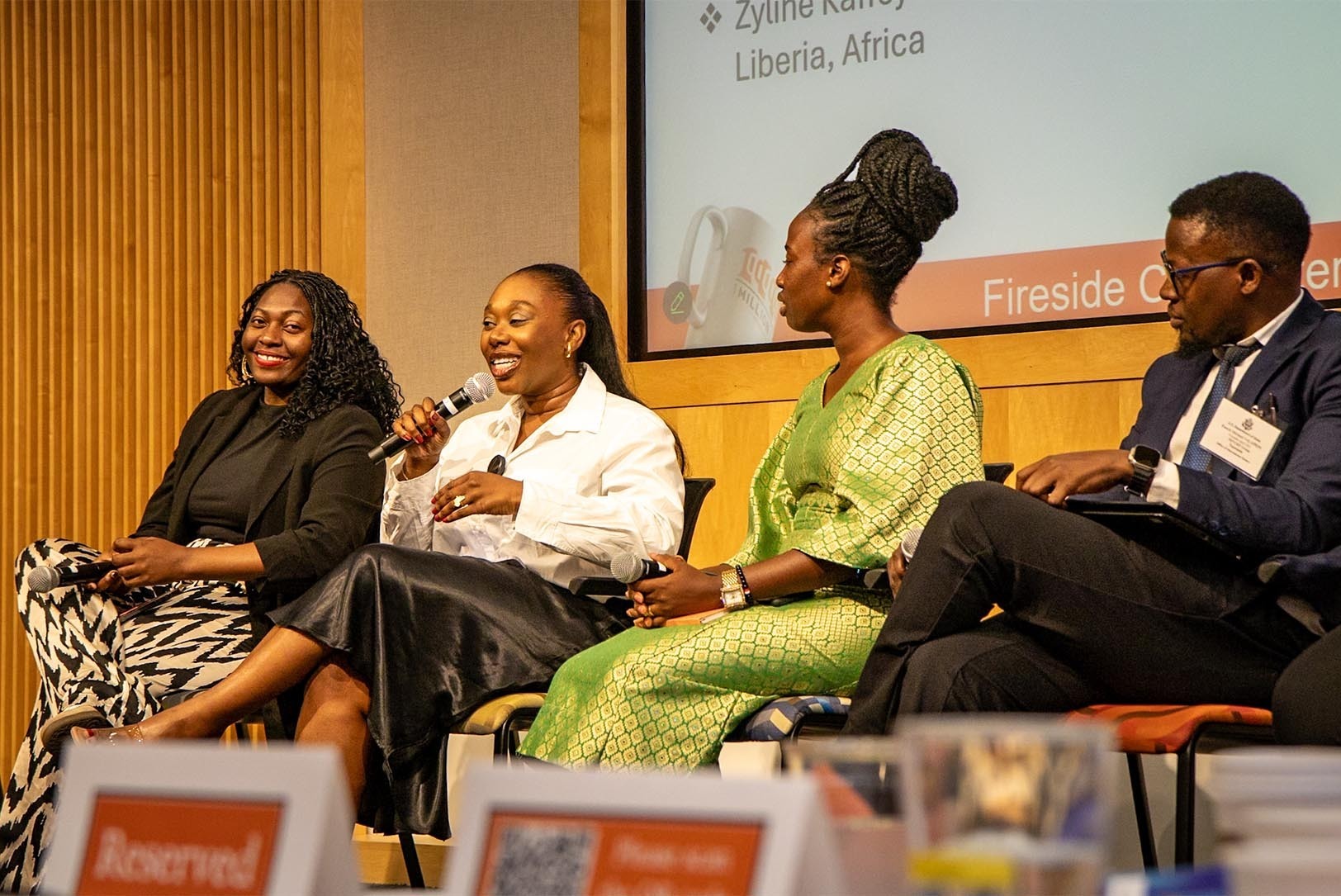
The fail-fast mindset and high risk tolerance many American entrepreneurs employ in their quests to build unicorn startups are arguably foreign concepts to business builders on the other side of the globe, said Lucy-Llonna Larbi.
Her experiences in Germany reflect a slower, security-first focus, she said, expressing admiration for the American approach.
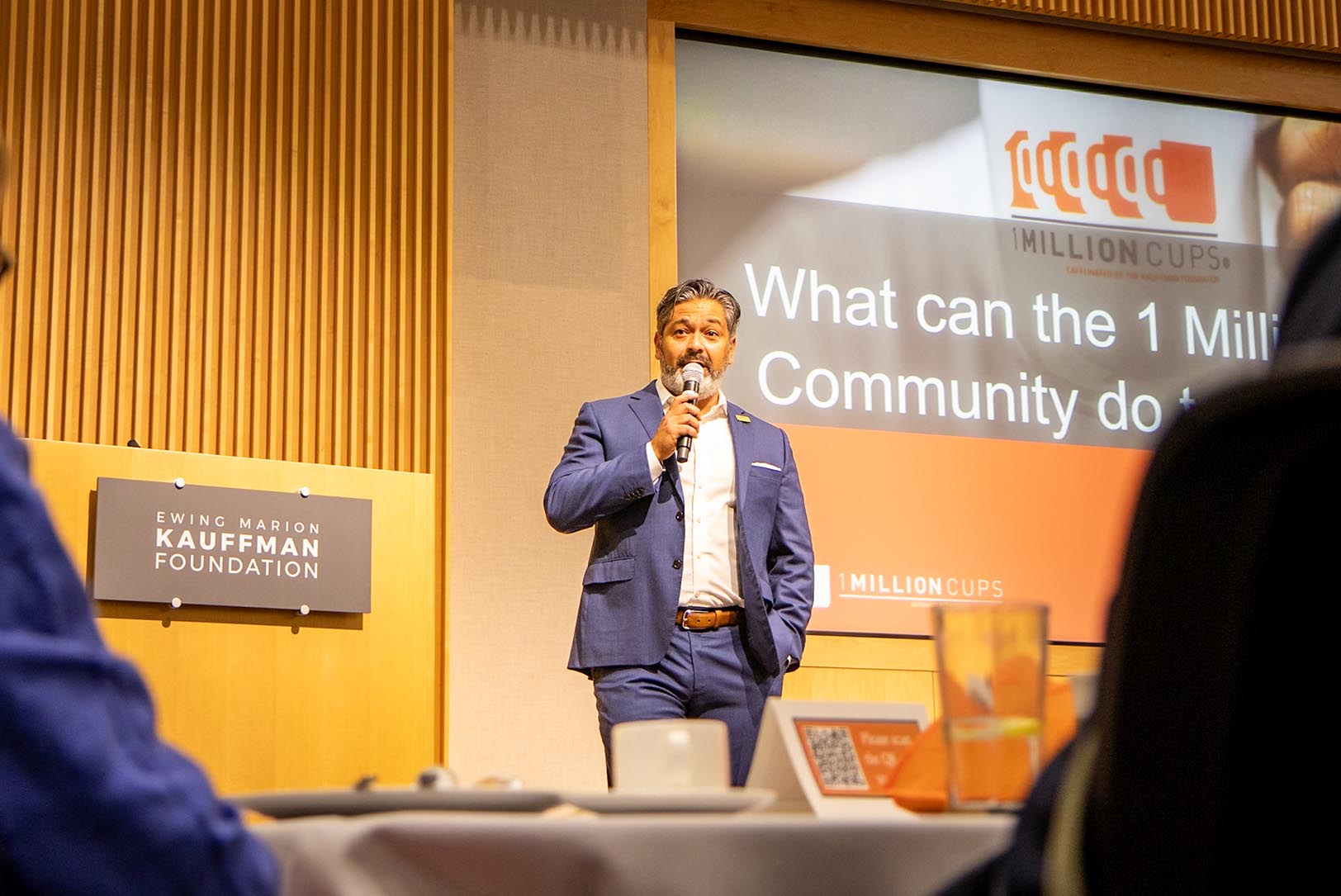
Kansas City entrepreneur Liderman Duin pitches his company, Toucan Talent, during 1 Million Cups Kansas City at the Ewing Marion Kauffman Foundation; photo by Haines Eason
“We think that Americans are very risky; they take risks. There’s a lot of high-risk capital,” said Larbi, a German entrepreneur and leadership expert selected for an international panel Wednesday during 1 Million Cups Kansas City — a supplement to the typical pitch event format — at the Ewing Marion Kauffman Foundation.
“If you haven’t failed at a company [in America], you’re not a real entrepreneur,” she continued. “In Germany, if you want high-risk capital, you need to go through 770 steps to get it.”
Across borders and time zones, entrepreneurs and ecosystem builders face many of the same challenges and questions, Larbi and her fellow panelists told the crowd for the special 1 Million Cups gathering.
How do we make entrepreneurship more inclusive? How do we move from ideas to products? And what does real support look like — not just at launch, but at scale?
How those far-flung change-makers respond to such obstacles and unknowns, however, can mean a world of difference from place to place, they said.
Bureaucratic boosts and bottlenecks
The panel of founders — participants in the U.S. State Department’s International Visitor Leadership Program hailing from Germany, Tunisia, Tanzania, Liberia, and Malawi — sat shoulder-to-shoulder at the Kauffman Foundation to compare notes on what it takes to build a business back home.
Each had been hand-selected by U.S. embassies in their respective countries for their leadership in economic development and brought to Kansas City through a partnership between Global Ties KC and the Kauffman Foundation; each eager to understand why U.S. entrepreneurs scale — or fail — faster.
From legal frameworks to mentorship funding, the panelists shared examples of how their home countries support startups — or, in some cases, how red tape slows progress before it begins.
In Tunisia, a grassroots push after the Jasmine Revolution helped create one of Africa’s first pieces of startup legislation, a government-supported legal framework to foster entrepreneurship.
“We were one of the first African countries that started bottom-up,” said Khaoula Behi, managing director of Tunisia’s Future Islands, an innovation lab.
“We put up this legal framework, the Startup Act, for entrepreneurs.”
Germany, meanwhile, has leaned into public funding initiatives.
“We have three things to highlight in Germany,” said Larbi. “We have our German Entrepreneurship Factory, which is now the new entrepreneurship system. We have the D-Hub Initiative, which is 25 locations with 25 focal points in Germany. One’s logistic, one is fintech, one is digital health — all provided by the government.
“And then on the international level, we have the GTAI, Germany Trade & Invest, where Germans go outside, abroad, and want to foster international trade and entrepreneurship.”
But bureaucracy remains the system’s Achilles’ heel, she said.
“Our biggest strength is also our weakness: We are very good at systems, but they make us very slow for entrepreneurship.”
That slow pace stands in stark contrast to the American model, panelists said.
“In the U.S., things move fast. You need something, you go for it and you get it,” said Enock Michael Salapion, founder of InnoPocket in Tanzania.
“Back home, to get a license might take a month,” he said. “In some countries, it might take a year.”
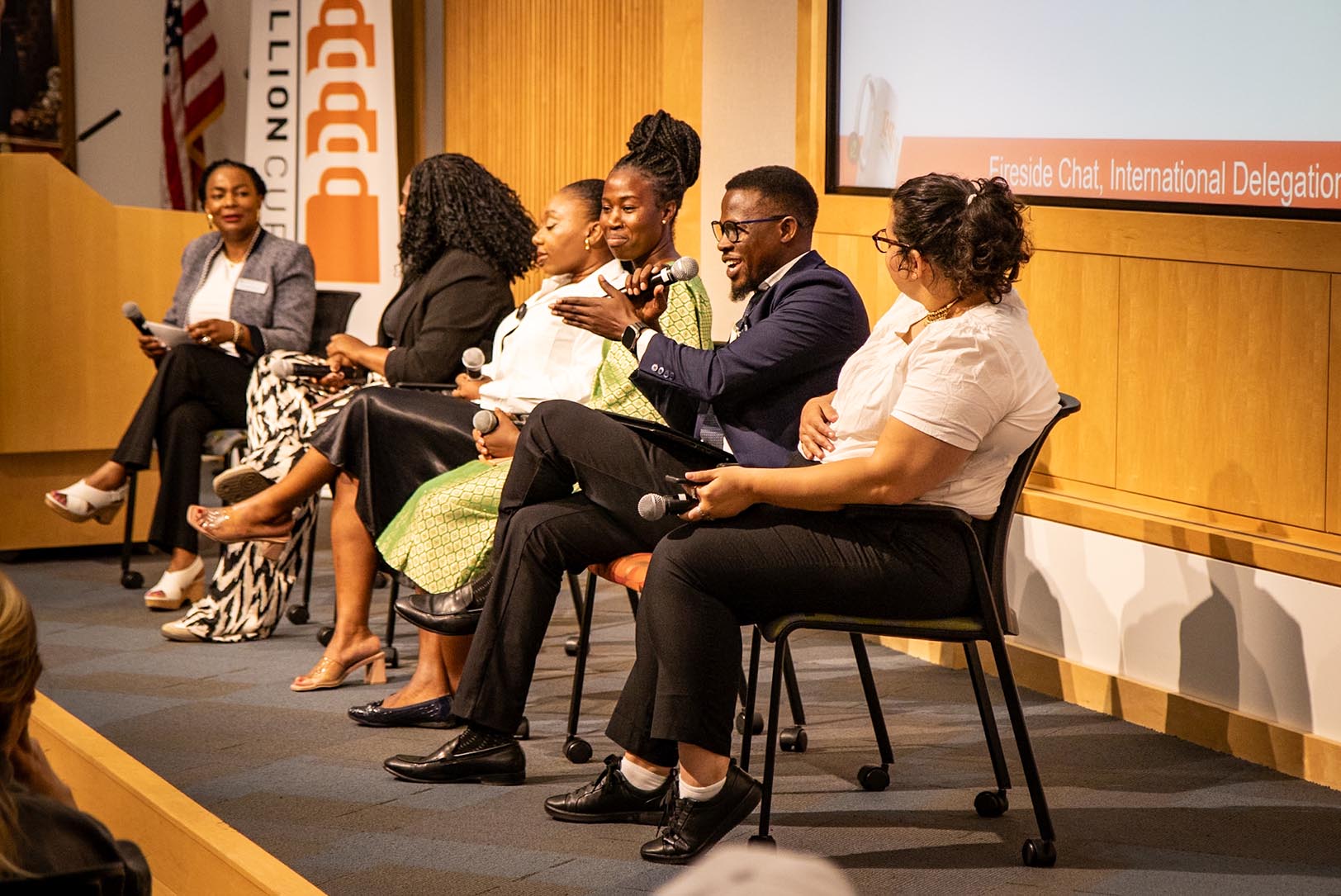
Enock Michael Salapion, founder of InnoPocket in Tanzania, speaks during a panel at 1 Million Cups Kansas City at the Ewing Marion Kauffman Foundation; photo by Haines Eason
Aligning priorities for scale
Several panelists emphasized that early-stage support — from pitch competitions to training — is abundant. But the gap between pitching an idea and launching a product remains a challenge to bridge.
“We have incubators and coaching,” said Behi. “But it gets ugly when you need to prototype. We stick to PowerPoint. We don’t go further than that.”
In Germany, Larbi said, students and even unemployed individuals can access grants just by filling out simple forms. But scaling those startups is another matter.
“But for us, the next step from the idea stage to the scaling stages, this is where it becomes more difficult, and this is where we have to model the U.S. a little bit more,” she said. “This is where entrepreneurship is a numbers game, it’s a connection and networking game, and this is where in Germany, our bureaucracy slows us down again.”
Liberia’s Zyline Kaffey Smith, founder of ZeeWash detergent company, said that the business ecosystem there “has not matured, so Liberians are still struggling.”
Challenges like limited access to markets and a lack of marketing skills or entrepreneurship education persist, she said.
But she and peers there are pushing back with “hands-on workshops, brand awareness (training) and mentorship.”
“We have been working with entrepreneurs to build a strong market where they can find trust and loyalty,” Smith said.
In Tanzania, Salapion described, a generational divide lingers wherein older adults still see tech as a threat to tradition.
“The biggest challenge that we have experienced is that there is a narrative, because technology came in later, so there is a narrative that there is a separation between this generation and people (in their) 80s, 70s, 60s, 50s — they still think that technology has come to destroy their culture,” he said. “So, embracing entrepreneurship through technology has been a challenge.”
On the flip side, seeing how technology is more freely adopted in the U.S., Salapion marveled at the concentration of high-growth startups even in secondary hubs.
“This morning I learned that all of Africa has fewer than 10 unicorns,” he said. “But a city like Charlotte, [North Carolina]? Charlotte alone has multiple unicorns. That is shocking.”
He said the difference also lies in policy alignment — particularly how U.S. government and private sector leaders seem to speak the same language.
“In some places, the people making policy have never started a business,” he said. “So they don’t understand what they’re trying to promote.”
Reflecting back the startup founder image
Building a startup-friendly culture for everyone — across gender, age, and class lines — proves to be a global challenge.
In Tunisia, Behi’s lab deliberately recruits women 35 and older, especially those with B2B experience, for tech and green economy roles.
In Germany, entrepreneurship has an image problem.
“The average entrepreneur is 36, white and male,” said Larbi. “At 45, people are thinking about retirement. Why start a business? We’re trying to change that.”
Government-funded youth events like the Young Makers Festival are helping — but so are grassroots efforts from the country’s older population.
“We need to build a brand for entrepreneurship,” Larbi said.
“We need to build a brand for entrepreneurship regardless of age, and the brand has the power to speak for yourself without you opening your mouth,” she said. “We need an entrepreneurship system that says, ‘Regardless of whatever you look like, your age, this is about innovation. This is about future-oriented scaling.’”
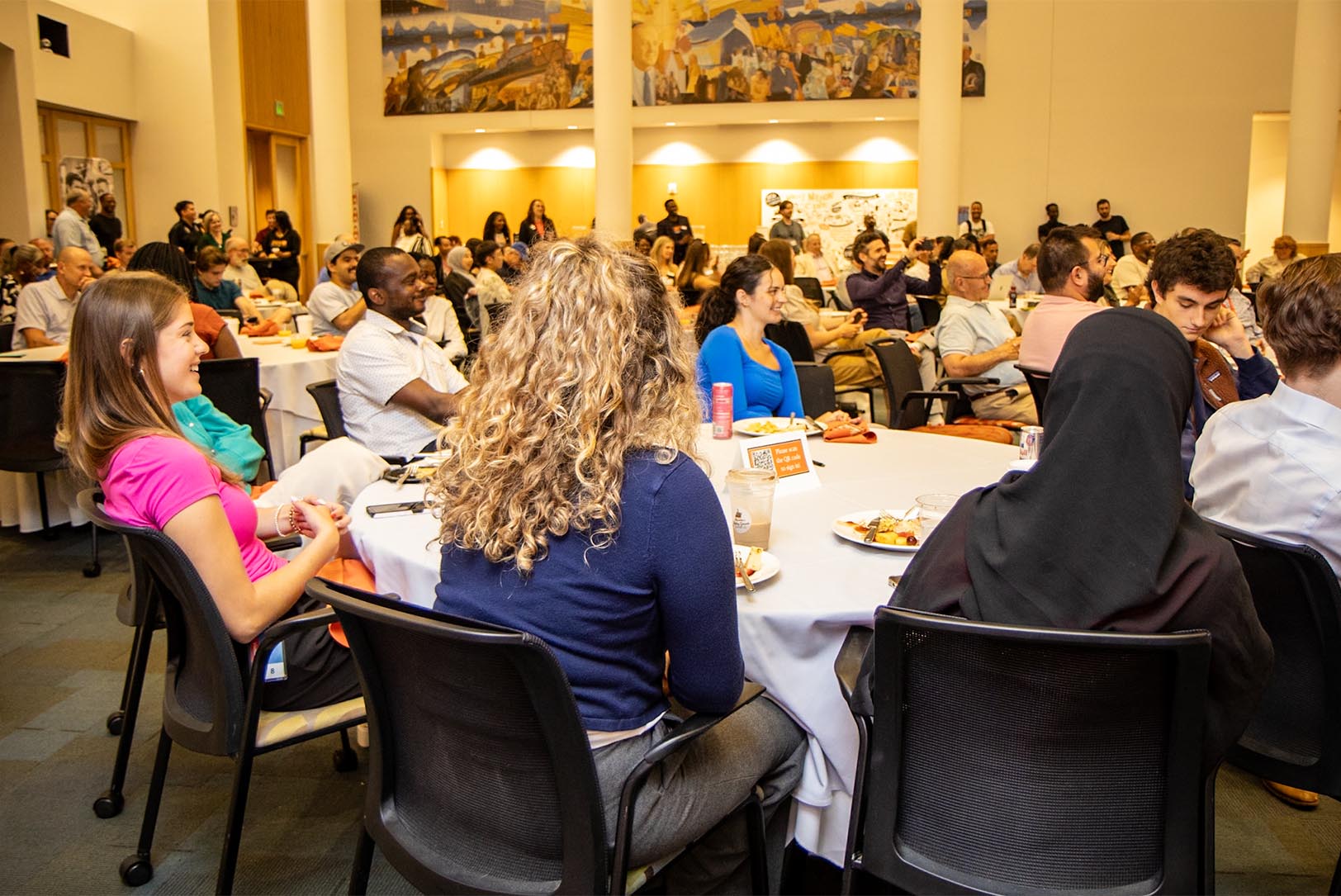
A crowd gathered for 1 Million Cups Kansas City listens during a panel conversation at the Ewing Marion Kauffman Foundation; photo by Haines Eason
Is 1 Million Cups due for a global breakout?
Several panelists said they were inspired by the 1 Million Cups model itself — and expressed interest in adapting it for their home countries.
“This concept — the format, the branding — it’s powerful,” said Malawi’s Wangiwe Joanna Kambuzi, founder of the nonprofit Emerge Livelihoods. “We’d love to see if this could be franchised in Malawi.”
Her country is already experimenting with similar formats, like the Zantchito Entrepreneurship Voices program, supported by the EU and the United Nations Development Programme. But she said continuity — keeping programs alive after initial funding ends — remains the greatest challenge.
“It can’t just be a five-year project,” she said. “We need collaboration across private, public, and development sectors to make it sustainable.”
Haines Eason is the owner of startup content marketing agency Freelance Kansas. Previously he worked as a managing editor for a corporate content marketing team and as a communications professional at KU. His work has appeared in publications like The Guardian, Eater and KANSAS! Magazine among others. Learn about him and Freelance Kansas on LinkedIn.

Featured Business

2025 Startups to Watch
stats here
Related Posts on Startland News

Novel Capital teams with Crux KC to offer growth-focused marketing to early-stage tech companies
An exclusive partnership between two Kansas City-based innovators is expected to help remove a traditional financial hurdle to business growth, said Ethan Whitehill, president and chief strategy officer for the KC Chamber-lauded marketing firm Crux KC. The collaboration between Crux and Overland Park-headquartered capital provider Novel Capital is expected to offer B2B SaaS and tech…
Neighborhood smart cans help Kansas Citians save the planet from their kitchens
Newly introduced composting technology is already turning new ground in Kansas City, Kristan Chamberlain said, with more solar-powered compost cans arriving later this spring across the metro’s urban landscape. Her social venture, KC Can Compost, installed three of the devices in October — free to use for KCMO residents wanting to deposit their soil-making food…

Voodoo Volleyball bounces back in OP: Father-daughter duo doubles as new venture’s setters
Quinn Austin put several sports to the test as a preteen — racing from basketball practice to softball to volleyball. But she latched on to just one. “Volleyball. It was my sport. Everyone was having a good time,” she said. “We just loved the cheers — a cheer when we got a hit, a cheer…

Black farmers are losing ground in the fight to feed their communities, advocates say
More than a century of systemic land dispossession and discriminatory practices has left Black farmers with less than 0.6 percent of U.S. farmland — less than a third of the 16 million acres they operated in 1910, according to local urban farming advocates. They gathered Tuesday at Independence Boulevard Christian Church to confront this history…