

Landlord’s solution to Kansas housing crisis: 3D print his own home inventory
June 3, 2025 | Haines Eason
TOPEKA — Regularly confronted with a lack of supply in the housing market — and the subsequent higher prices — landlord and general capital investor Chris Stemler faced a multi-dimensional challenge.

Chris Stemler, Trident Homes
“I thought to myself, ‘How do I help solve an inventory problem?’ the Topeka-based Trident Homes founder said.
“I know I’ve got renters who need more availability and affordability,” he continued. “There’s not enough housing and I know there’s a need for it, so what do I do?”
That problem — and Stemler’s search for a scalable solution — led him to concrete 3D printing.
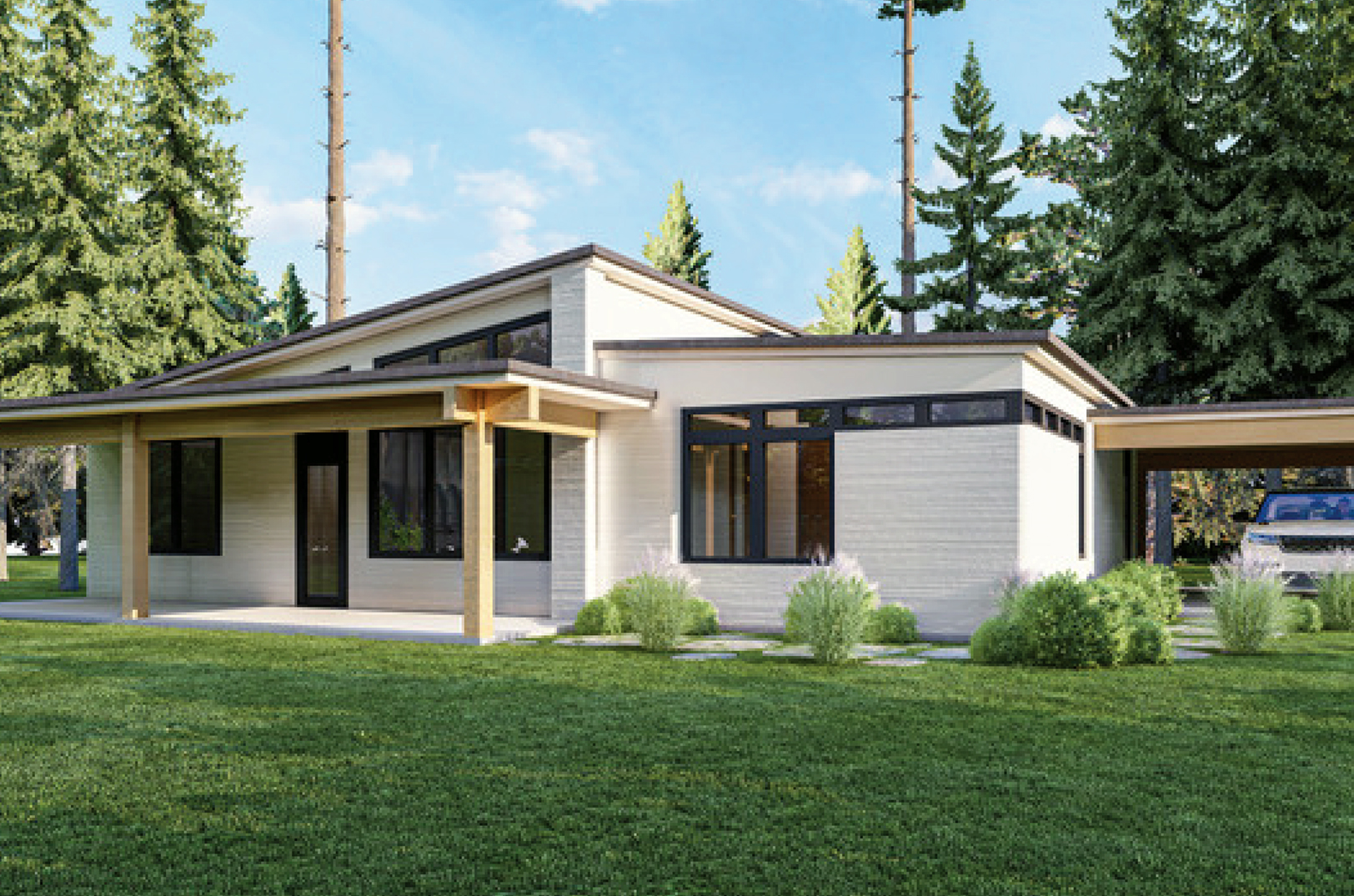
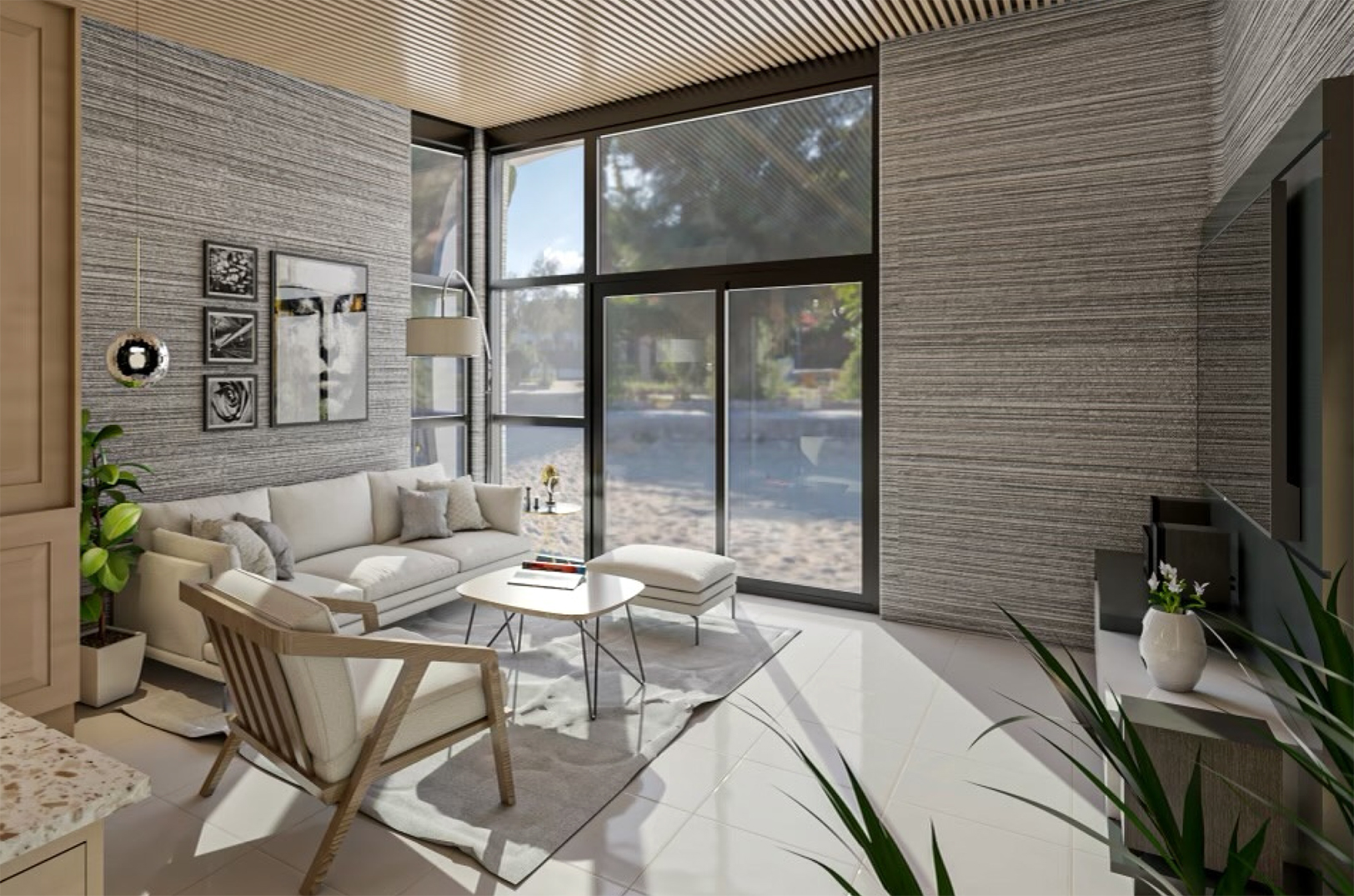
By late summer or early fall, Trident plans to be printing full-scale homes directly on lots and larger land parcels across eastern Kansas — bringing to market an option that’s faster to build and significantly more affordable than traditional homes.
They’re also more fire resilient and durable enough to withstand winds from an F4 tornado.
Trident’s first full-scale machine is waiting for Stemler in Utah.
“Our next step: Our crew needs to go up to Utah between now and July 3 and train on our equipment,” he explained. “Then, we’ll come back with that printer and, after Independence Day, we’re going to start working on some infrastructure projects — some for the company, some contractual for other parties — because we have to print some structures in order to comply with our training and contract with our print manufacturer.
The goal: deliver affordable, durable, customizable housing erected fast enough to help alleviate a persistent inventory crisis.

Darin Stephens, Stone & Story Real Estate Group
“To give you some specifics, Shawnee County, where Topeka is, is 175,000 people. Normally we should see 300 to 400 houses on the market at any given time,” said Darin Stephens, CEO of Stone & Story Real Estate Group, which houses the headquarters of Trident Homes.
Stone & Story has partnered with Trident Homes to bring its 3D-printed homes to market.
Illustrating just how dire the housing crisis has gotten, Stephens said, “This week, we’ve got 168 houses on the market that are active at any given time, and that’s every price range for the county for 175,000 people.”
When a person targets homes in the $150,000 to $250,000 range, only about 35 of those 168 are available, he added.
And, the need isn’t just in Topeka.
“It crosses over to Lawrence, Kansas City, Eastern Kansas,” Stephens said. “We’ve got this need across the board.”
Faster, tougher, but still home
By using concrete instead of lumber, Stemler said, Trident gains several advantages: end product resilience, efficiency and cost savings.

3D concrete wall printing from Trident Homes; courtesy photo
The homes are printed under a climate-controlled tent on-site, a process that can reduce wall construction time from weeks to days. Once cured, those walls are far more durable than drywall — an attractive prospect for landlords and long-term homeowners alike.
“You can have a rental, you go through a year lease, and you’re going back in and you’re putting Humpty Dumpty back together again,” Stephens said. “With this structure, with this type of technology, that’s going to minimize that because it’s a little hard to destroy a concrete wall versus sheetrock or whatever.”
Stemler anticipated consumer skepticism of the product, especially from within a market not known for rapid adoption, he said. But feedback from Trident’s first open house challenged that assumption.
“I expected some of our open house to be just people curious about the process and that’s really not who showed up,” Stemler said. “It was a lot of individuals who were actively considering something like this as an option.
“I also think that Topeka — and this happens not because people mean to — but just generally Topeka gets compared to Lawrence or Kansas City almost as if it’s a backwater, and that’s not really the case,” Stemler added. “Fifteen percent of any population would generally be considered early adopters… and that’s true whether you’re in Kansas City, you’re in Topeka, you’re in Wichita, you’re in Lawrence.”
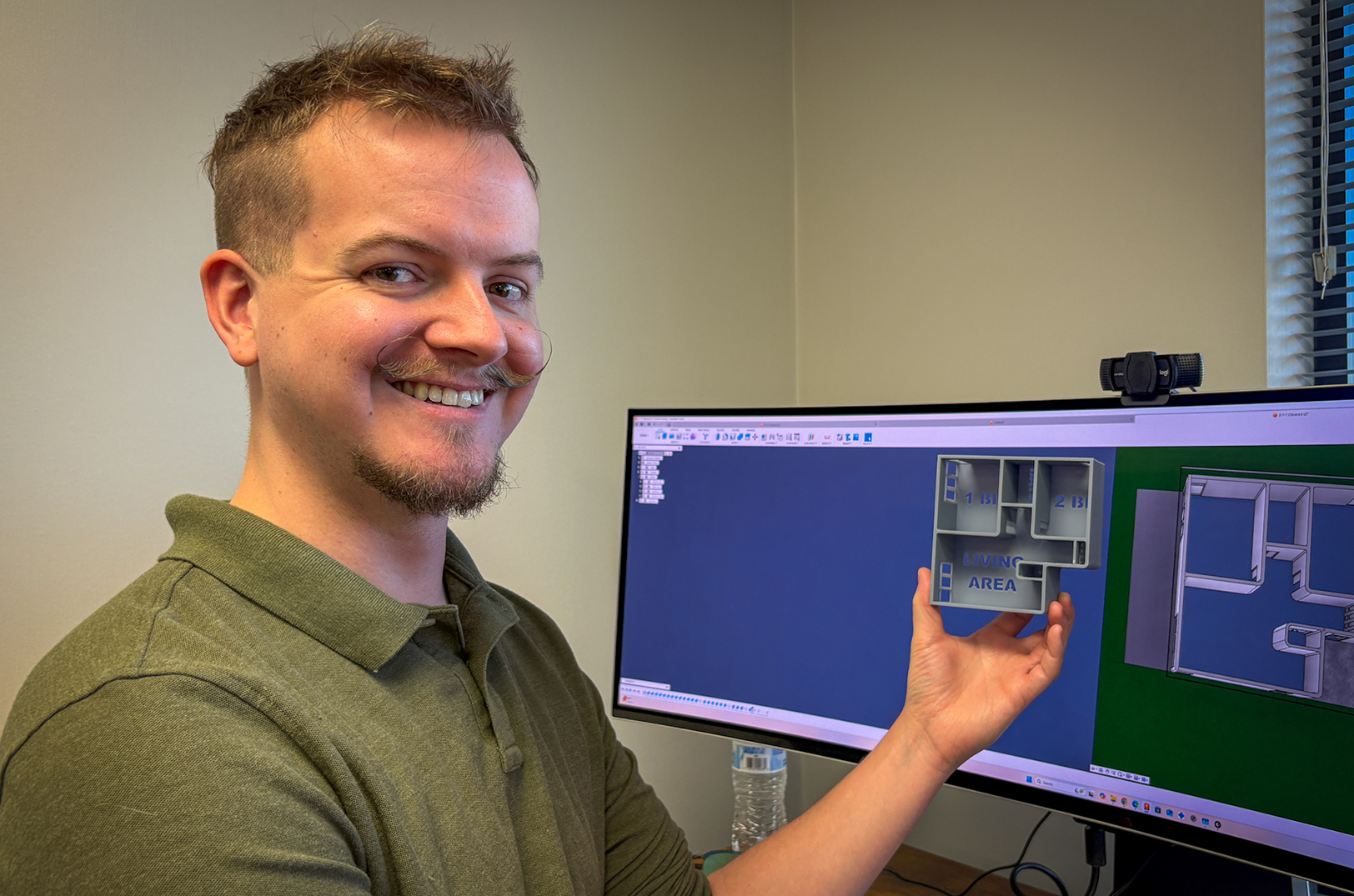
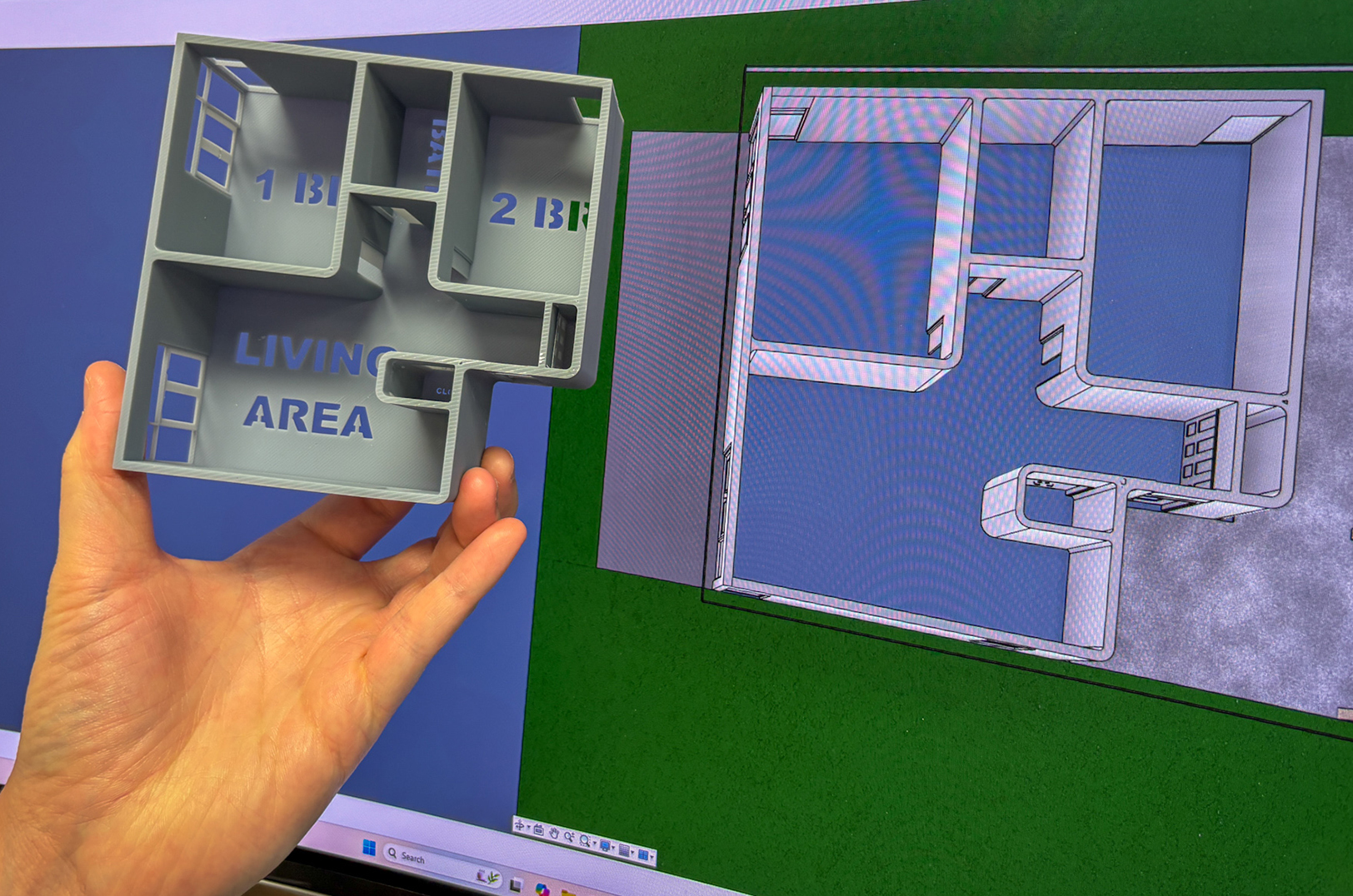
Scott Smith, 3D design technician for Trident Homes, illustrates the company’s technology with a model and diagrams of the structure; photo by Haines Eason
Stick-built, concrete-printed
If Stemler is the visionary and Stephens the strategist, Scott Smith serves as the bridge between idea and implementation.
“There’s this association with 3D printing — that it makes these cheap little plastic toys, and that’s definitely not what we’re doing,” said Smith, 3D design technician for Trident Homes.
“As you know, the printer that we’re going to end up running actually prints with concrete… (And the result) is a real home,” he continued. “It’s just made in a slightly different way and in a way that allows us to really control a lot more of the process.”
Much of the cost savings come from speed and materials used, Smith said.
“What a framing crew might be able to do in one to two weeks, we can do in one to two days. So that is a huge time and labor savings right there,” he said. “But also the materials are just cheaper.”
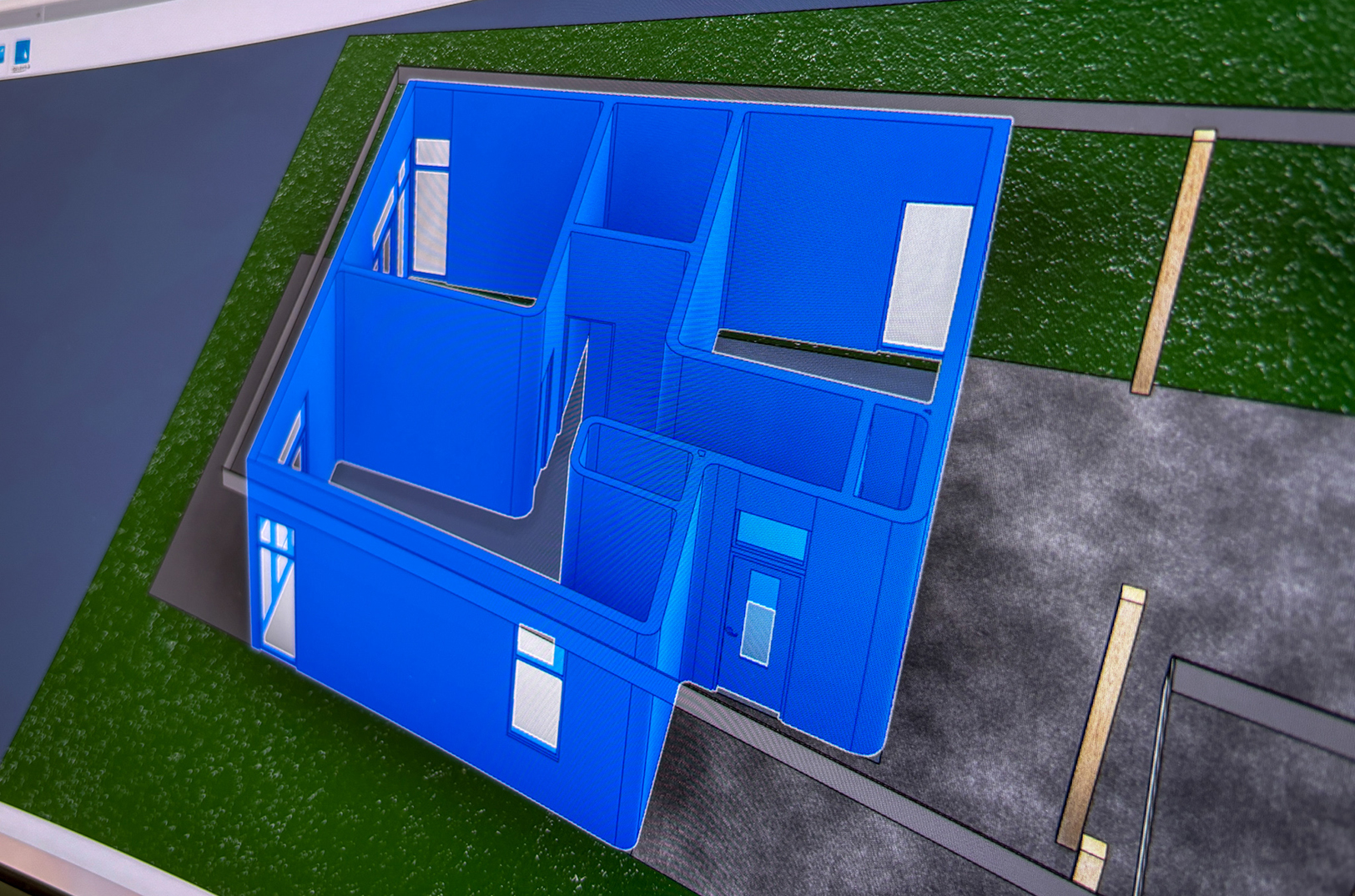
A digital rendering of the Trident Homes 3D printed home design; photo by Haines Eason
In contrast to misconceptions based on large-scale, commercial projects, walls within Trident Homes aren’t solid slabs, Smith added.
“The 3D printer actually will print primarily two walls,” he said. “There’s an exterior and an interior. … But you do end up with a wall cavity, and so there are spaces for your utilities and for your insulation.”
That space makes rough-ins easier during construction and also allows for maintenance later on, Smith said, acknowledging he’s seen such avoidable pain points firsthand.
“I did quite a bit of handyman work down in Florida where all the houses are poured concrete and/or cinderblock construction,” he said. “It was just frustrating trying to do anything there — as someone who’s had to tell homeowners they needed to rip up a slab to fix a leak, that matters to me.”
He also sees long-term potential in the design flexibility offered by 3D printing.
“Traditional concrete construction is limited by formwork,” Smith said. “We’re not. That opens up new geometry, new possibilities. Right now, we’re focused on affordability. But once we’re established, who knows? We can get weird with it.”
Stone & Story Real Estate Group in Topeka; photo by Haines Eason
Bringing a concierge experience
Even with new materials and methods, Trident’s founders are focused on delivering something that might be the most novel thing of all, the said: a home-buying experience that’s grounded in service.
“When we sit down with the buyer and the design team,” Stephens said, “some of our first conversations are going to be, ‘Tell us how you like to live. Tell us about you. Tell us what’s important to you.’”
“We’re not ‘Here, just take the number.’ It’s not all about the numbers; it’s not all about the transaction,” he continued. “We’re here for them.”
It has to be a win-win for everybody, Stephens emphasized.
“And part of that win-win is bringing the journey to full fruition with the buyer so that they feel like, ‘I’ve enjoyed this process, I like it. And at the end, I’m getting an amazing beautiful home,’” he said.
Haines Eason is the owner of startup content marketing agency Freelance Kansas. Previously he worked as a managing editor for a corporate content marketing team and as a communications professional at KU. His work has appeared in publications like The Guardian, Eater and KANSAS! Magazine among others. Learn about him and Freelance Kansas on LinkedIn.

This story is made possible by eGrowth Ventures.
eGrowth Ventures (EGV) is a business unit of NetWork Kansas supporting innovative, high-growth entrepreneurs in the State of Kansas. NetWork Kansas promotes an entrepreneurial environment by connecting entrepreneurs and small business owners with the expertise, education and economic resources they need to succeed.


2025 Startups to Watch
stats here
Related Posts on Startland News
Downtown food hall hits closing time; Strang’s chef-driven concept leaving lightwell
Strang Chef Collective is serving its final customers within the food hall’s downtown space, said CEO Shawn Craft, announcing the lightwell location would close Tuesday “despite the company’s best efforts over the past year to keep it open.” The chef-driven concept — through which diners experience a mix of global and elevated comfort flavors —…

KC Daiquiri Shop closing Dec. 1; iconic duo behind the party vibes plans to ‘regroup, reflect, and rebuild’
The good times roll through the weekend at KC Daiquiri Shop as the well-known Mardi Gras-themed getaway on Grand Boulevard shuts down its years-long revelry. “This decision has not come lightly,” Kinley Strickland and Calvin Vick, owners of KC Daiquiri Shop, said Monday in a social media post announcing the business’ plans to close Dec.…

Side hustle to help autistic adults belong in the workplace earns young founder Student Entrepreneur of the Year honor
Grace Kertz is redefining what workplace inclusivity can look like with Sensory Sync, an AI-powered platform designed to support neurodivergent employees. Her work on the innovative venture on Thursday earned her the title of UMKC Student Entrepreneur of the Year. “Sensory sync is an enterprise grade DEI and wellness platform sold to companies. It utilizes…

UMKC Entrepreneur of the Year: How Populous designed a legacy, built to go global
Kansas City-built design firm Populous brought to reality more than just great venues, Tom Bloch shared; it developed great experiences for a worldwide audience. “From its start here in Kansas City as HOK Sport in 1983 until now, Populous has set an unmatched standard for stadiums, convention centers, and event spaces,” Bloch told the crowd…