

Why this ‘monstrous Midwesterner’ started the presses for a sacred space in KC’s West Bottoms
June 20, 2025 | Nikki Overfelt Chifalu

Editor’s note: The following story was produced through a paid partnership with MOSourceLink, which boasts a mission to help entrepreneurs and small businesses across the state of Missouri grow and succeed by providing free, easy access to the help they need — when they need it.
Thayer Bray loves printmaking, but he gets just as much energy by helping others with their own art, he said.
“Printing is labor,” Bray continued. “I’m a monstrous Midwesterner, so labor is tantamount to prayer. But the thing that really catches me is the excitement I felt when I was working with artists.”
The University of Kansas and University of Missouri-Kansas City graduate started Greenhouse Print Space, a place where he can hone his printing skills, as well as create the artistic community he craves.
“There’s that intense pleasure, excitement and discovery when I make my own work,” he explained, “and it was almost the same as when I was helping other people make their own work. This is great. This is amazing. I want to do this.
“I want people to come in and grow their technical skills. I want them to grow their business. I want them to grow as people. I want them to grow their art. Maybe I’m small-minded: I don’t see a way you can do that if you’re not sharing and if you’re not competing and collaborating.”
Bray, who also still sells his own work, launched the West Bottoms print space — the former home of the Kansas City Center for the Ink and Paper Arts in the Hobbs Building — a year ago. It offers studio space, memberships, classes like copper etching, block printing and book binding, plus an upcoming artist in residency program.
“Something that is important and intrinsic to printmaking is the communal aspect of it,” he said. “It’s just natural. Things are expensive.”

Equipment rests inside Greenhouse Print Space in the West Bottoms; photo by Nikki Overfelt Chifalu, Startland News
Building blocks
Greenhouse Print Space has been more than five years in the making, Bray noted. Although his love of printmaking started in childhood with exposure to Linoleum printing T-shirts.
“That just really blew my hair back,” he added. “I was just obsessed with it.”
After graduating from KU with a degree in printmaking, he worked for The Lawrence Lithography Workshop in downtown Kansas City, Missouri, for nearly a decade as an edition printer.
When his boss was winding his time down in the printing business — leaving Bray with less work with which to help — he started to contemplate his next move, Bray said. He knew he didn’t want to be a master printer, but he also hoped to continue collaborating with fellow artists.
“I was like, ‘Mike, what if, when you retire, I’ll just buy the business, buy the presses, buy everything?’” he recalled. “He’s like, ‘I won’t sell the business, but you can certainly buy all the equipment.’ I was like: ‘OK, I could buy the equipment. I know how to use it, and I’ll just open up a public access shop.”
For this, he would need money. So Bray talked to a few potential investors who were interested in the arts, he said. They liked the concept, but ultimately passed on the idea. That led Bray to do some soul searching.
“What could have been insufficient to them?” he asked himself. “Well, it’s me. Even though I know how to run a print shop, do they know that I know how to handle people? Do I know how to handle finances?”

Letters from an older press sit at Greenhouse Print Space; photo by Nikki Overfelt Chifalu, Startland News
Class is in session
To develop such business skills, Bray earning his master’s degree in business administration — specifically at UMKC — was his next move, he notes. He chose UMKC because — although classes were still online during the pandemic — the school prioritized breakout groups and networking.

Thayer Bray, Greenhouse Print Space; photo by Nikki Overfelt Chifalu, Startland News
“They’re like, ‘We want you to succeed, so we’re gonna get you in front of people’s faces,” he explained. “So that was something that I was really excited by. I need to be able to talk to people, interact with people. I’m a natural introvert.”
During his first class — a corporate entrepreneurship course — his professor mentioned the Entrepreneurship Scholars (E-Scholars) program, but Bray didn’t think much of it at the time, he said; he was still acclimating to taking classes again.
It wasn’t until his last year at UMKC when talking to a counselor about what he wanted to do after graduating — be an entrepreneur — that they spoke again about E-Scholars: an early stage student entrepreneurial ideation and acceleration program designed to support students and community members in building sustainable and scalable ventures. After encouragement from the counselor, he joined the program during his last semester.
“It was really exciting and engaging,” Bray continued. “And it was really sobering because at this point, it was five or six years that I had the idea and was trying to cogitate it out.”
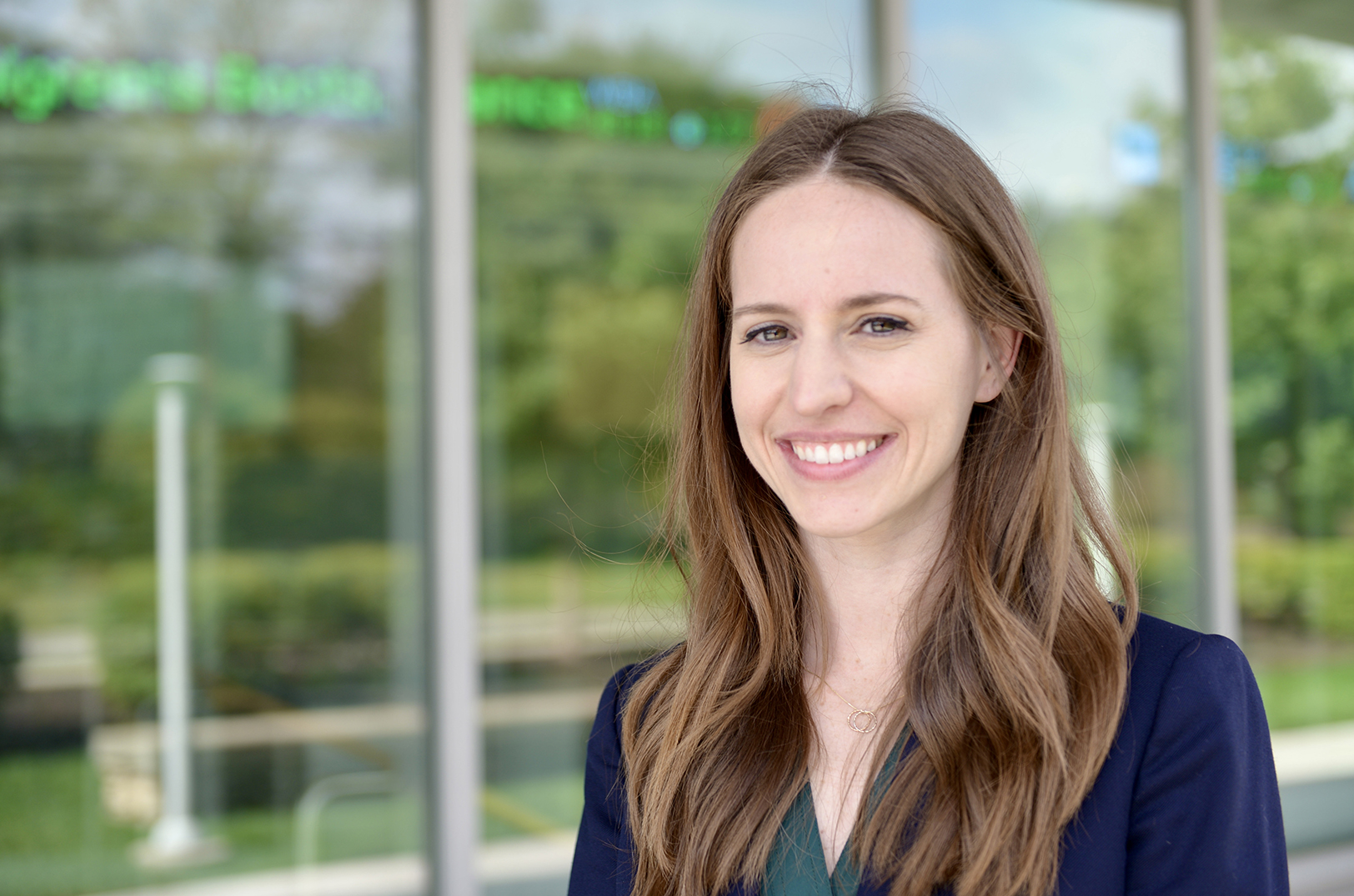
Alex Matlack, director of E-Scholars, UMKC
E-Scholars helps aspiring entrepreneurs, many of them students, realize their early-stage ideas, said Alex Matlack, director of E-Scholars.
“We help businesses from the idea stage get their business off the ground,” Matlack added. “Primarily we work with student founders, although we’ll work with community founders, as well. I think a lot about the program is just meeting entrepreneurs where they are with their individual goals.”
During the program, Bray was able to test his idea for a print space for failure, he shared.
“It was just really amazing to look at it soberly, look at it without emotion,” he explained. “That phrase, ‘Let’s mitigate this.’ I think that’s one of the biggest things that you learn in the E-Scholars: Let’s reduce risk. There’s always going to be risk. Even not doing anything, even not building a business, is some kind of risk.”
“I think what we’re good at is helping turn creative ventures into something that is more of a business,” Matlack added.
The program prioritizes a support network for the students through fellow founders in their cohort and mentors, she emphasized.
“(Bray) was really great in terms of his ability to really dig into that peer-based model, which is really about supporting and having community around you,” Matlack continued. “He was really a great community member in terms of working with the other founders in the group. And we’re still seeing that today.”
Bray gained valuable insights from his mentors, he said. One was excellent at networking and pointed him in the right direction for events to go to and people to talk to when it came to finding a place to house the print space. Another helped him reframe the challenges he ran into.
“[My mentor] had this eagle-eye view of problems and ways to look at them and hold them in your hands and turn them into manageable things,” Bray explained. “It was like sky-view problem solving and on-the ground problem solving. It was just really amazing.”
He even joined a second cohort of the program after he graduated to continue to bring his idea to life, he noted.
“My first semester, I was given all these building blocks and like, ‘Let’s run this through the gauntlet and see what survives,’” he explained. “Then my second semester, it was like, ‘Well, I have all these pieces of survived parts.’
“This idea was 7 years old at this point. That’s even slow for my pace. I need to get this done. So Alex helped guide me to figure out how to utilize the class in a way that would finalize the execution.”
Matlack said having a distinct idea for the business was a big plus for him.
“Thayer had a clear vision for what he wanted to do, and so it was wonderful to be along that journey with him,” she said. “But that’s just an example of how it doesn’t always have to be a software company that sells to enterprise companies. It can be whatever your dream is. And I think he was someone that had a clear dream for a very long time and was able to build it. So it was really cool.”

Greenhouse Print Space in the West Bottoms, which features a full complement of traditional and contemporary presses; photo by Nikki Overfelt Chifalu, Startland News
‘Sacred space’
Between spring and June 2024, Bray had found the space in the Hobbs Building and opened Greenhouse, taking over the home of the Kansas City Center for the Ink and Paper Arts. The space launched about 20 years ago by Calvert Gutherie — a former Hallmark master letterer with presses Hallmark was no longer using, Bray said. But after the pandemic stopped the presses, they were slow to be used again and started to gather dust.
“I was talking with him,” Bray recalled, “and just off the cuff, I was like, ‘Oh, I’m starting a print shop and trying to find some space.’ And he was like, ‘Well, I’m literally not doing anything down here. So if you want to have your own business, we can talk about transfer of ownership.”
Greenhouse has a full complement of traditional and contemporary presses, including a Fuchs and Lang Lithography press, Conrad intaglio press, French Tool Co. intaglio press, Reliant Washington press, Vandercook Letterpress, two tabletop platen card presses, screen printing octopus and several banks of cast and wooden type.
The space already has six studio members and three access pass members, Bray noted.
“We need that sacred space and we need that special space,” he added. “It’s just a different beast to come and be in this space, this openness. There’s liveliness. There’s people around.”
Looking to start your own business? Need help clearing a pesky hurdle? MOSourceLink can connect you with more than 600 resources across Missouri that can help your business flourish. Tell the team what you need online or give them a call at (866) 870-6500 and get your free plan of next steps and the experts who can help.

Featured Business

2025 Startups to Watch
stats here
Related Posts on Startland News
Advocates push Latino entrepreneurs to urgent action in the face of ‘innovation churn,’ civil rights challenges
Latino entrepreneurs are a powerful force in America’s economy, leaders emphasized Thursday from the UnidosUS stage, but systemic barriers continue to keep many from achieving financial freedom, they lamented. “Our superpower is an entrepreneurial spirit,” said Ruby Azurdia-Lee, president and CEO of Comunidades Latinas Unidas en Servicio (CLUES), speaking during the UnidosUS Annual Conference’s closing…

River Market’s iconic ‘Trolley Tom’ reopening with grab-and-go deli menu, specialty cocktails
A new grab-and-go eatery is rolling into River Market, filling a hole left when Donutology shuttered operations inside “Trolley Tom” — the circa 1947 Kansas City streetcar permanently parked at 426 Delaware in the popular retail and entertainment district. Car No. 551 is scheduled to open by mid-September with deli offerings and and drinks by…
KC on top: Hat maker’s best-seller spotted on ‘GMA,’ ‘Ted Lasso’ as brand shapes its national profile
Sandlot Goods wears the spotlight well, said Thomas McIntyre, noting each high-profile media close up of its signature dad hat is another step toward establishing Kansas City’s only hat manufacturer as a national brand. After being featured on the “Made In America Christmas” segment of ABC World News Tonight with David Muir, Sandlot was again…
Rooftop Cinema Club premieres its open-air movie theater experience in KC’s Crossroads
Pink dusk views of the Kansas horizon and a cityscape bathed in sunset only added to the silver screen experience for midweek movie-goers trying out the newly opened Rooftop Cinema Club in Kansas City’s Crossroads Arts District. “Just the ambiance and what they did with the design is really cute,” said Emily Hendricks of Kansas…