

Power moves: Electric vehicle infrastructure stalled in Kansas where liquid fuels still dominate
May 13, 2025 | Harry Whited
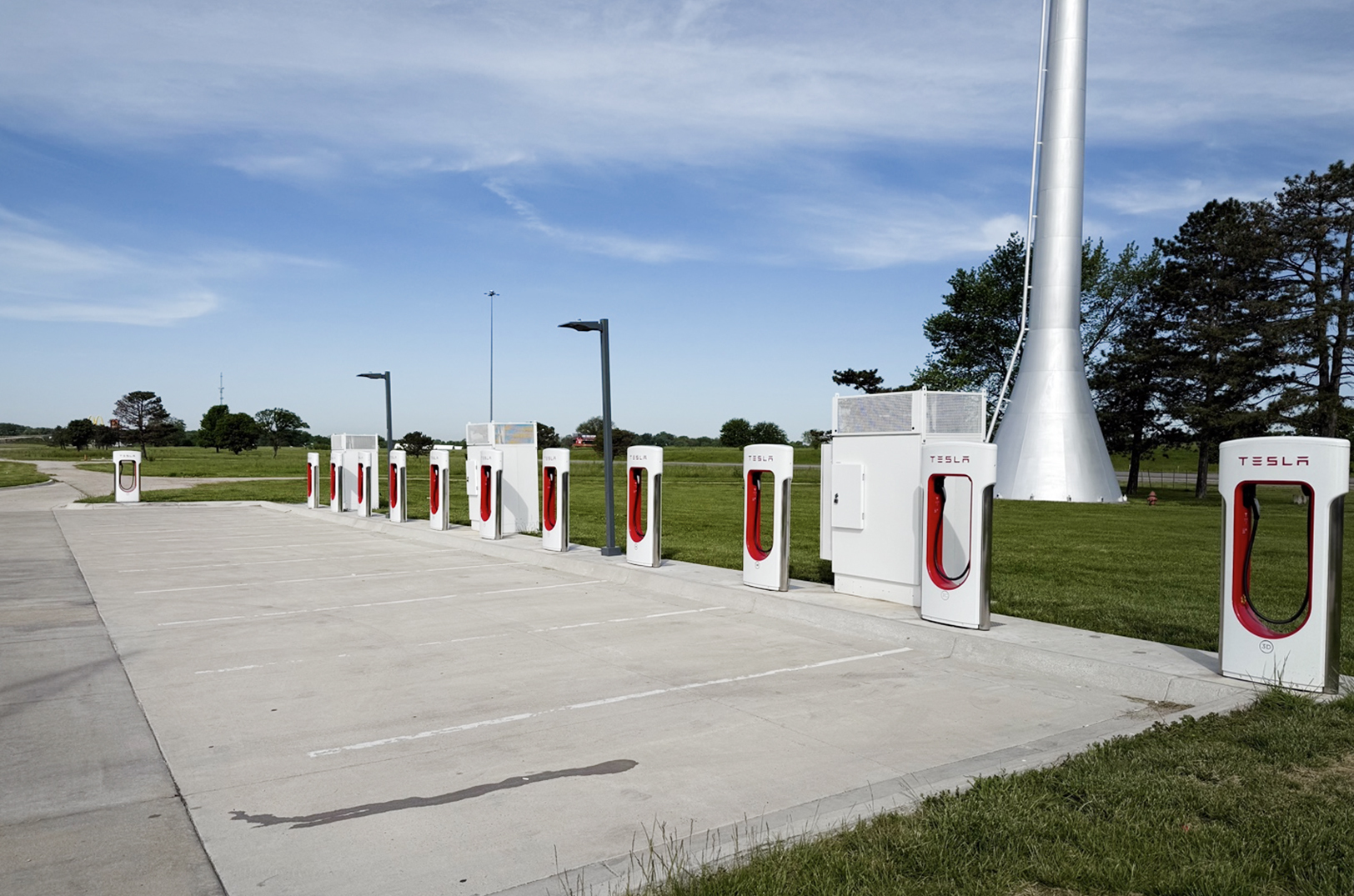
Editor’s note: This article was written for a class at the University of Kansas’ William Allen White School of Journalism and Mass Communications and distributed through the Kansas Press Association.
The number of people buying electric vehicles in Kansas is steadily growing, and as the number increases, the need for accommodation will be balanced with what works for Sunflower State drivers, state officials said.
Kansas has 1,297 charging ports and more than 11,000 registered electric vehicles on the road.
Phillip Harris, chief public information officer for the Kansas Department of Transportation, said that as electric and alternate fuel vehicle usage increases, they have begun to develop the best possible plans to accommodate these vehicles.
“Our goal is to work with industry partners and communities to develop infrastructure that supports the active vehicle fleet and keeps Kansans moving forward,” Harris said by email.
One of these goals was to implement a program called Charge Up Kansas. This is an initiative that would establish charging stations along the state’s major highways. However, a majority of these stations have not been installed yet, even though KDOT approved the program in September 2022.
Harris said that the program, also known as the Kansas National Electric Vehicle Infrastructure Formula Program (or NEVI), relies on federal funds to establish these charging stations.
When a new program like NEVI is initiated, Harris said that it takes time to develop and fund the projects. He said Kansas was still only one of 15 states with a NEVI-funded station for the public, which is located in Emporia along I-35 and opened March 31.
Gasoline and traditional fuels are also another challenge. Though the state is seeing an increase in the number of people buying electric vehicles, gas-powered vehicles still dominate the current vehicle market, with over 2.16 million registered gas-powered vehicles.
However, Harris said that KDOT does not anticipate pushback from fuel distributors as the number of electric vehicles rises. He said that gas operators have been the primary applicants for NEVI funding, as well as other opportunities to provide charging stations in Kansas.
“They are in the business of meeting the evolving needs of the traveling public, which includes multiple fuel types and other amenities,” Harris said.
According to a June 2024 article from the University of Chicago, 66 percent of adults have begun to buy electric vehicles to reduce their effect on the environment. As of 2023, there were more than four million electric vehicles on the road in the United States and experts predict 78 million on the road by 2035.
Legislators in states like Colorado and California have begun implementing electric vehicle initiatives to raise awareness and emphasize climate change and the impact that motor vehicles are having on it.
Kansas responds
During this most recent legislative session, the House Committee on Agriculture and Natural Resources introduced House Bill 2012. The bill would establish an ethanol grant program fund that would incentivize fuel distributors in Kansas to distribute ethanol. The bill was withdrawn from the calendar March 21, and legislators may try to get to it again during the next session.
Kansas Rep. Ken Rahjes, R-Agra, chair of the House Committee on Agriculture and Natural Resources, said in an April phone interview that although his panel is encouraging people to use this higher blend ethanol, the two forms of energy should have their separate segments of the market where people can readily have access to them without interference.
“We as a Legislature should not hamper commerce any way whatsoever,” Rahjes said.
He said that the consumer should make the decisions about what they buy and that introducing incentives is good as long as they do not directly interfere with the consumer’s choice to purchase.
“I think it’s a matter of choice,” Rahjes said. “I don’t want a mandate from the federal government that says you must purchase an electric vehicle.”
What do the consumers say?
Michael Storm, a Tesla owner who was driving up from South Carolina to pick up his daughter at the University of Kansas, said in an interview at the Tesla Supercharger Station in Tonganoxie, Kansas, that he prefers traveling in an electric vehicle.
He said that his Tesla only cost $24,000 and that traveling through Kansas was a pleasant experience with little difficulty during the commute regarding constant recharging.
“It’s not as bad as you think it is,” Storm said. “You don’t have to stop and fill up as much as you think.”
He said the only negative aspect of driving through Kansas was finding available charging stations.
Ron Seeber, president and CEO of Renew Kansas Biofuels Association, said in a recent phone interview that his association has an “all of the above philosophy” when it comes to providing energy to Kansans.
Even though electric vehicle sales are on the rise, Seeber said that liquid fuels are still the best option for drivers in Kansas since it has longer periods of use and are more affordable.
“It’s a fuel that has so many positive attributes that we think it should certainly be the top choice for consumers,” Seeber said.
He said electric vehicles are not the best-suited for driving in Kansas. Since the state is so rural, relying on liquid fuels that will last longer in the tank, and are environmentally conscious, would be the best choice for the Kansas consumer.
“In the Midwest, we need to drive long distances, and it’s just not practical to have to go for a limited time period, then wait an hour to recharge your car,” Seeber said.
California currently leads the country in the number of electric vehicles it has in its state, with a majority of the vehicles being registered in Los Angeles, where there are more than 7,000 charging stations in that city alone.
Currently, the Kansas Legislature does not have any bills on the docket that deal with accommodating more electric vehicles on the roads.
Kansas Rep. Shannon Francis, R-Liberal, chair of the House Committee on Transportation, said that he does not foresee any conflict between traditional fuel companies and electric vehicle distributors.
He said that each form of transportation has its pros and cons and that ultimately, it is up to the consumer to decide what they want.
“Consumers need to select the technology that works best for them,” Francis said.
Harry Whited is a junior from Anchorage, Alaska, studying journalism and English.

Featured Business

2025 Startups to Watch
stats here
Related Posts on Startland News

Web3 conference aims to demystify blockchain, making evolving tech more accessible
The future of blockchain has arrived, said Shekhar Gupta, noting that since the technology first gained mainstream interest, it has proven critical in a wide range of use cases that could help to reshape the world as consumers and innovators know it. “A lot has changed in the last three or four years in the…

KC startup’s assests acquired by InnovaPrep; founder says best partners share ‘niche’ expertise
Clara Biotech was one of the first startups to complete BioTools Innovator’s accelerator in 2021, said Jim West; now the Kansas-built startup’s CEO is fully aboard the entrepreneur-boosting effort as associate director — and with his own company’s exit behind him. West, co-founder of Clara Biotech — which launched first-of-its-kind cancer detection in 2015 from…
Art Garden KC grows maker market from Sunday pop-up to seasonal shopping experience
While unpredictable Midwest weather canceled the outdoor finale of Art Garden KC’s season this weekend at the Berkley Riverfront, the spirit of the maker market will pop up again soon with an indoor event in the Crossroads. Art Garden KC’s Beggars Bazaar — set for 6 .m. to 9 p.m. Friday Nov. 3 — returns…

KU unveils ‘Origin Stories’ of its best-known traditions; project reunites KC artist with her alma mater
LAWRENCE — An installation inspired by a phrase deeply familiar to University of Kansas alumni and fans across the region — “Rock Chalk Jayhawk KU” — is set to be permanently displayed on Mount Oread, diving deep into the origins of the local traditions. “It all began with being interested in the origin stories of…