

Neighborhood smart cans help Kansas Citians save the planet from their kitchens
March 28, 2025 | Haines Eason
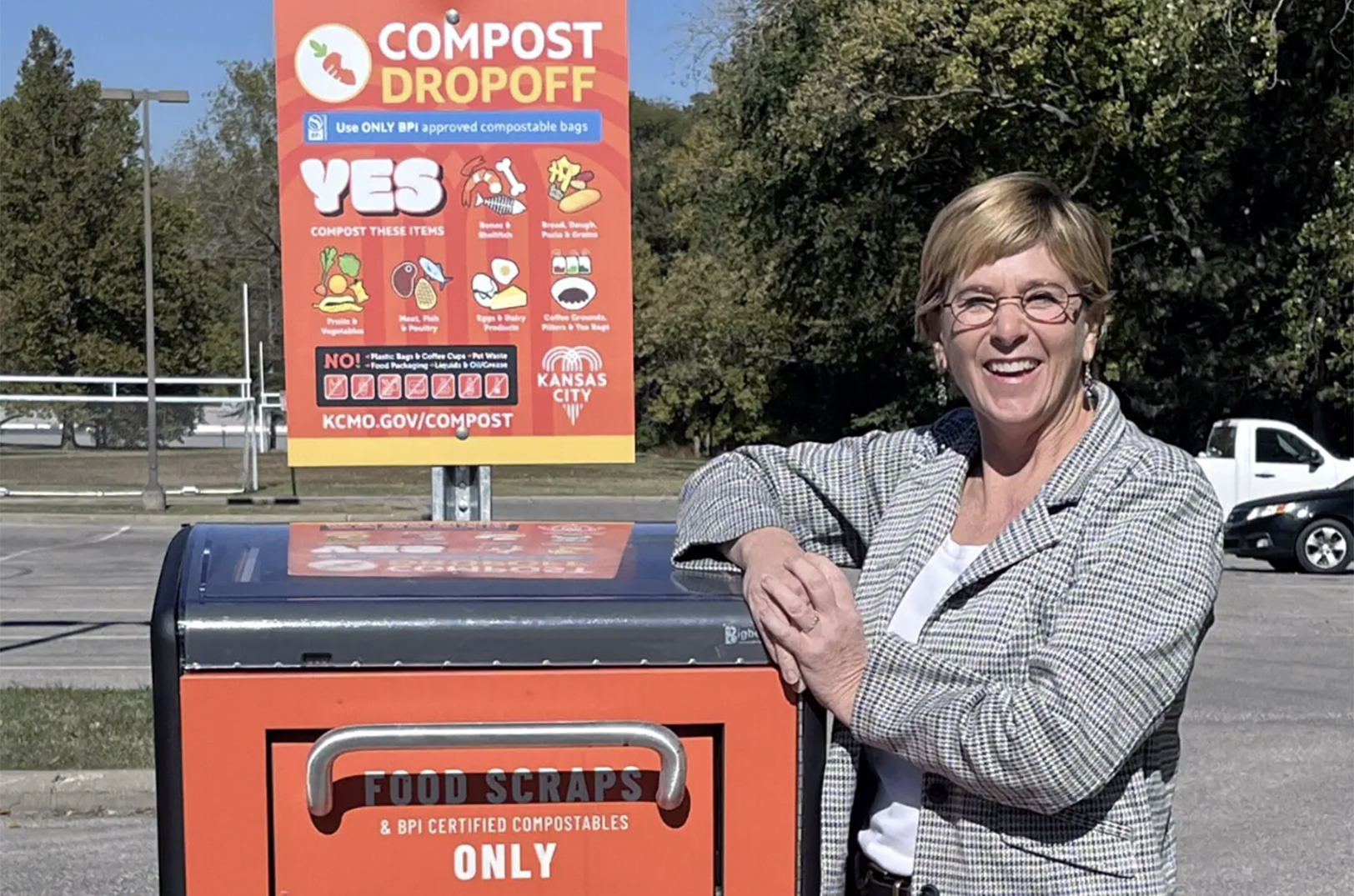
Newly introduced composting technology is already turning new ground in Kansas City, Kristan Chamberlain said, with more solar-powered compost cans arriving later this spring across the metro’s urban landscape.
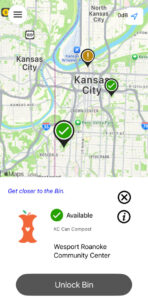
Mobile view for KC Can Compost’s app; courtesy image
Her social venture, KC Can Compost, installed three of the devices in October — free to use for KCMO residents wanting to deposit their soil-making food scraps. (Residents from outside the area are asked to pay $12.99 a month to participate.)
“KC Can is the (third entity) in the country — only behind New York City and Arlington, Virginia — to launch solar-powered smart cans for collecting food waste,” said Chamberlain, CEO and co-founder of KC Can Compost.
Five more of the cans are set to be deployed by April. And, there’s momentum: a new-and-improved model is coming soon, she added.
The only catch: All participants must register online beforehand so they can then download an app that allows them to unlock the smart cans.
Click here to register to download the app.
Laying the groundwork
Since 2019, KC Can Compost has been placing no-tech composting bins — large orange rolling trash-style bins — at participating Kansas City-area businesses and organizations in a bid to make urban composting convenient and easy.
To date, there are 19 member cans in use, with nine of those — and soon to be 12 — operated in partnership with the City of Kansas City, Missouri.
Click here to find KC Can Compost drop off locations.
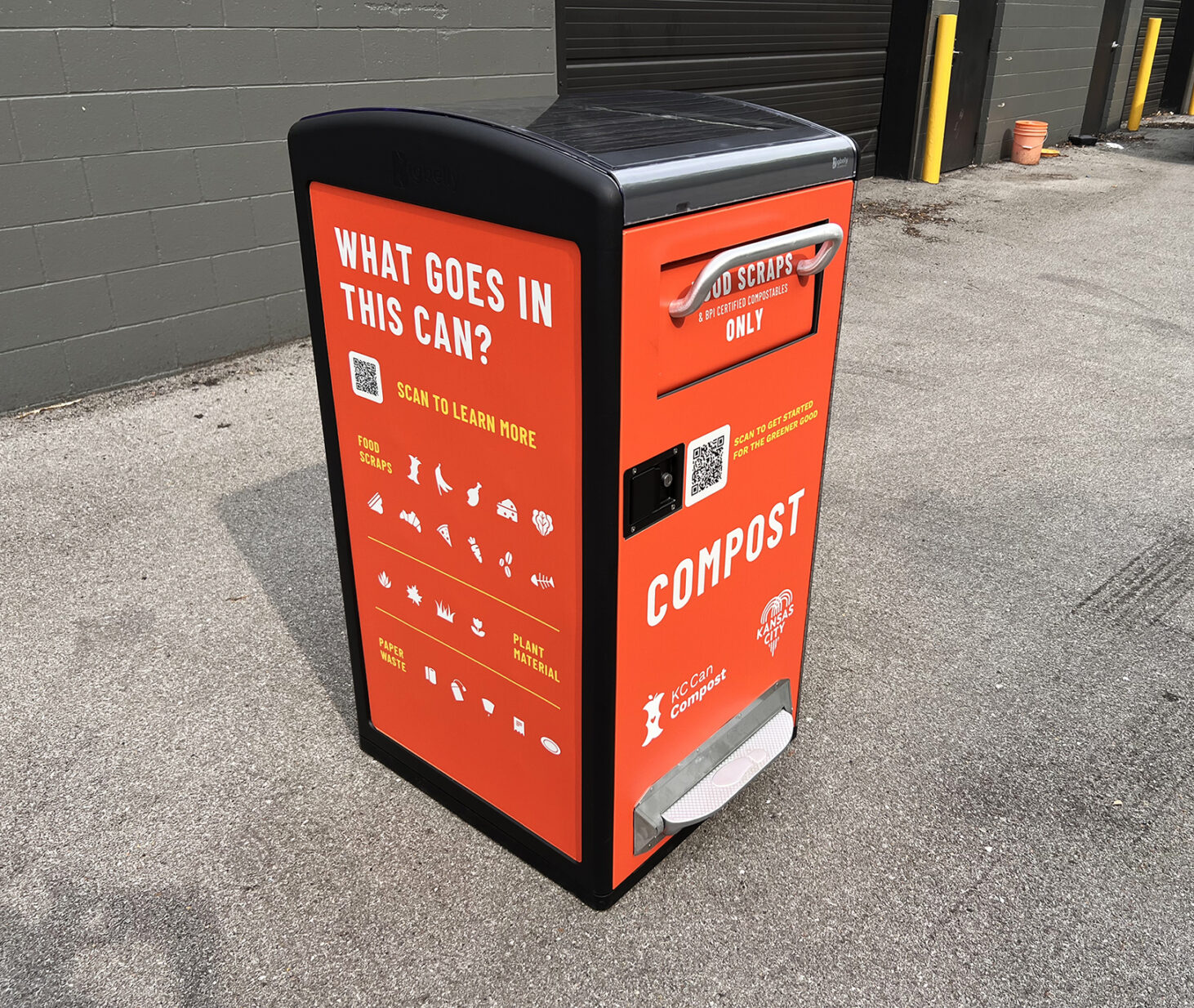
A smart cans from KC Can Compost; courtesy photo
The new smart cans push accessibility to a new level, said Chamberlain, noting a number of upsides to adding technology to the soil:
- The smart cans contain a sensor that alerts the KC Can Compost team when the can is full. This ensures efficient use of the pickup crew’s time and energy.
- The cans are solar-powered, meaning that the sensor inside and associated communications electronics do not require external energy. This prevents the release of any energy-related greenhouse gases from operation of the can itself.
- The cans are sited near high-traffic areas, ensuring that they are exposed to a sizable volume of potential composters.


Six years, 5 million pounds of waste diverted
KC Can Compost services hundreds of commercial and residential customers throughout the Greater Kansas City region and operates residential drop-offs sites around the city. To date, the venture has diverted 5,524,309 pounds of the region’s food waste from landfills, preventing 3,949,881 net pounds of CO2 from entering the atmosphere, according to Chamberlain.
If a family of four produces about 20 pounds or more of food waste a week, she added, keeping that amount away from a landfill can prevent about 745 pounds of CO2 from entering the atmosphere annually.
The EPA reports that in 2019, restaurants, food retailers and residential consumers wasted 66.2 million tons of food, and only 5 percent of that organic material was composted.
The agency goes on to report that, when added to yard waste — trimmings, wood cuttings, etc. — 51.4 percent of what ends up in U.S. landfills is in fact compostable organic material. Further, organic materials in landfills must break down anaerobically, and that process produces methane, a very powerful greenhouse gas. The EPA estimates organic waste in landfills accounts for 14 percent of total annual methane emissions.
According to the National Resources Defense Council, diverting organic materials from landfills has several large-scale benefits:
- The average cost to place a ton of material in a U.S. landfill is $55. With up to half of what is placed in landfills being organic and likely compostable, there is the potential for massive savings.
- Use of compost can reduce dependence on petrochemical fertilizers and pesticides, which means healthier soil and food. Also, reducing the demand for — and thus use of — these inputs has the potential to reduce greenhouse gas emissions.
- Adding compost to soil greatly increases its ability to store water and nutrients, reducing the need for supplemental waterings. In fact, increasing an acre of cropland’s organic matter by just 1 percent has the ability to increase that acre’s water storage capacity by 25,000 gallons.
Looking beyond the single family home, scaling composting to a business like a Costco or to a municipal building like the City of Kansas City’s City Hall naturally magnifies the impact greatly. The Kansas City Zoo now diverts more than 32,000 pounds of food waste a year. And, they’re not alone — the list of KC Can Compost partners is long and growing.
Click here to learn more about KC Can Compost’s April 25 “Fiesta for the Future” fundraiser.
Environment and employment
KC Can Compost began not just as a composting program — it has always had community revitalization at the heart of its mission, too, Chamberlain said.
Early on, the organization launched Green Core Training, an environmental literacy, green jobs and work readiness training program. Built on the Roots of Success curriculum, participants are introduced to more than 100 green jobs and career pathways. After graduation, they receive assistance finding employment.
So far, 270 participants have completed the program, and 165 of those have earned Roots of Success Certifications. 120 have also earned an official Environmental Specialist certification from the U.S. Dept. of Labor.
Haines Eason is the owner of startup media agency Freelance Kansas. He went into business for himself after a stint as a managing editor on the content marketing team at A Place for Mom. Among many other roles, he has worked as a communications professional at KU and as a journalist with work in places like The Guardian, Eater and KANSAS! Magazine. Learn about him and Freelance Kansas on LinkedIn and Facebook.

Featured Business

2025 Startups to Watch
stats here
Related Posts on Startland News

OHUB x KCUP set to debut ‘18th & Vine Summer Trep Series’ for black, Latinx startup builders
The first spoke of Opportunity Hub’s arrival in Kansas City debuts July 19 with a new monthly event series dedicated to business builders from black and Latinx communities. “This is a celebration of unity, creating a healthier ecosystem within Kansas City, Missouri,” said Jamilah Jones, a business development officer at the Economic Development Corporation of…

Minneapolis angel investment firm expanding to KC, names McCoolidge managing partner
A former leader of the Mid-America Angels fund could be the secret to establishing Minneapolis-based Sofia Fund as a new investment resource for women-led companies within Kansas City, said Cathy Connett. “The Midwest continues to be a hub of startup activity,’ said Connett, Sofia Fund CEO. “Extending our footprint to Kansas City gives us access…

Pure Pitch Rally returning in October with spot-cash funding; applications open now
The land sharks are already hungry for Kansas City’s top tech talent, said Karen Fenaroli, announcing the planned return of the Pure Pitch Rally this fall. “Not only does Pure Pitch Rally provide startups with the opportunity to earn much-needed cash funding, it gives local entrepreneurs direct access to the resources and people in our…

Travois earns rare B-Corp status for longtime work to ‘fill the gaps’ caused by 200 years of broken promises to Indian Country
Obtaining one of the world’s top scores as a Certified B Corporation is just the beginning for Kansas City-cultivated Travois. “Part of why we are different is because [the product] we have and offer is really impactful,” Elizabeth Glynn, CEO, said in explanation of how Travois — a company that promotes housing and economic development…