

Big win for UMKC: Unlocking top tier research status gives KC new competitive edge
February 14, 2025 | Tommy Felts
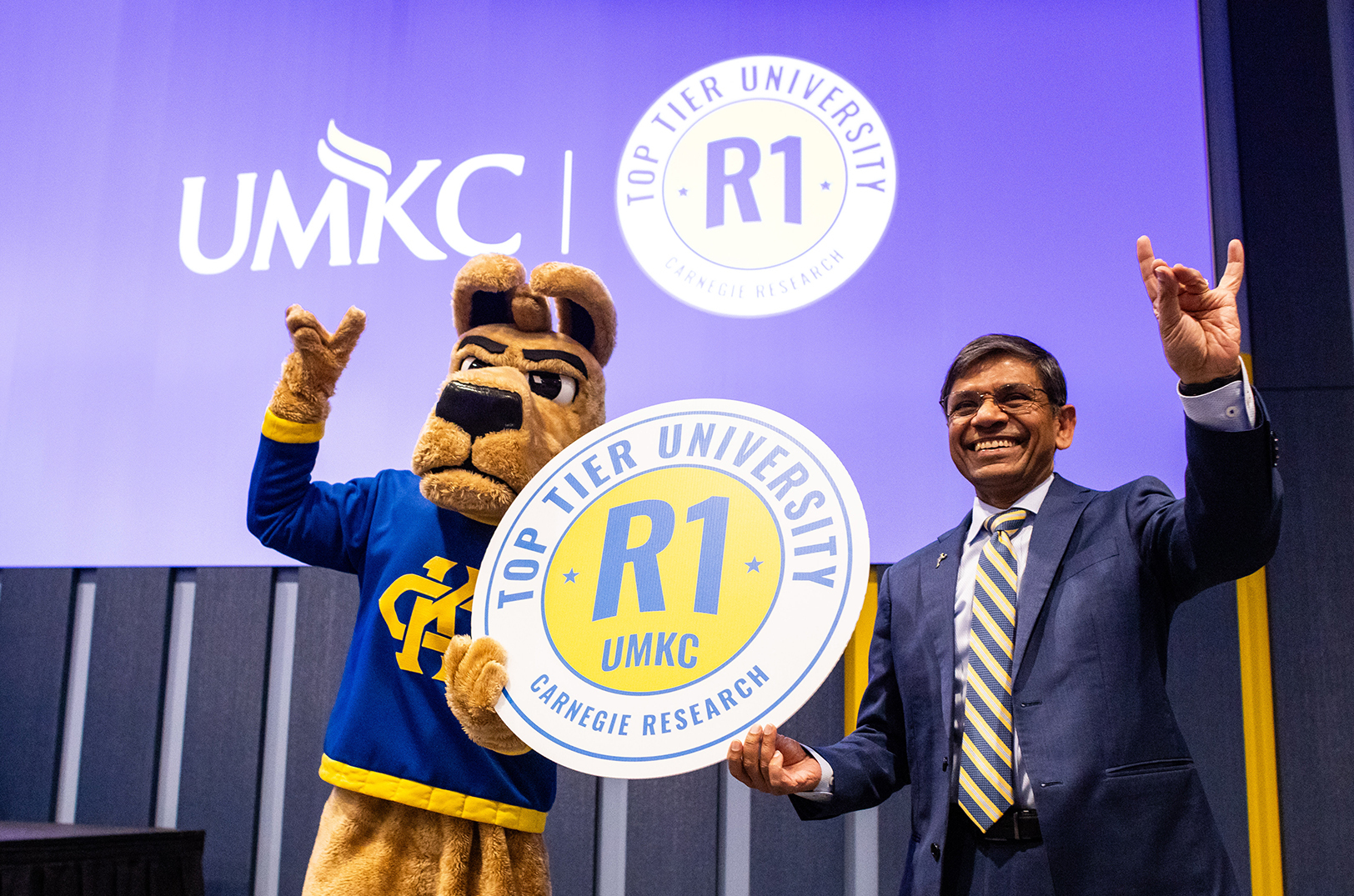
A new milestone for the University of Missouri-Kansas City — achieving status as Kansas City’s first Carnegie R1 research institution — is expected to help boost the region’s ability to start, grow and scale more startups, leaders said this week, emphasizing the role university-led research plays in innovation across industries and communities.
“It’s absolutely massive for Kansas City,” said Tim Cowden, president and CEO of the Kansas City Area Development Council (KCADC), noting the critical timing of such developments as the region prepares for the international spotlight of the World Cup. “R1 status elevates Kansas City on the world stage, attracting businesses, creating high-paying jobs and fostering a competitive edge in the global marketplace.”
The Carnegie Foundation on Thursday officially announced UMKC as one of 187 institutions given the R1 designation. It reflects a university’s commitment to high research activity, defined by a threshold of $50 million in total research spending and 70 research doctorates awarded annually. (UMKC spent $55 million, and awarded 134 doctorates.)
“From 2018 to 2023, UMKC more than doubled its research expenditures and almost quadrupled total research and sponsored grants,” said Mauli Agrawal, chancellor of UMKC. “And we are just getting started.”


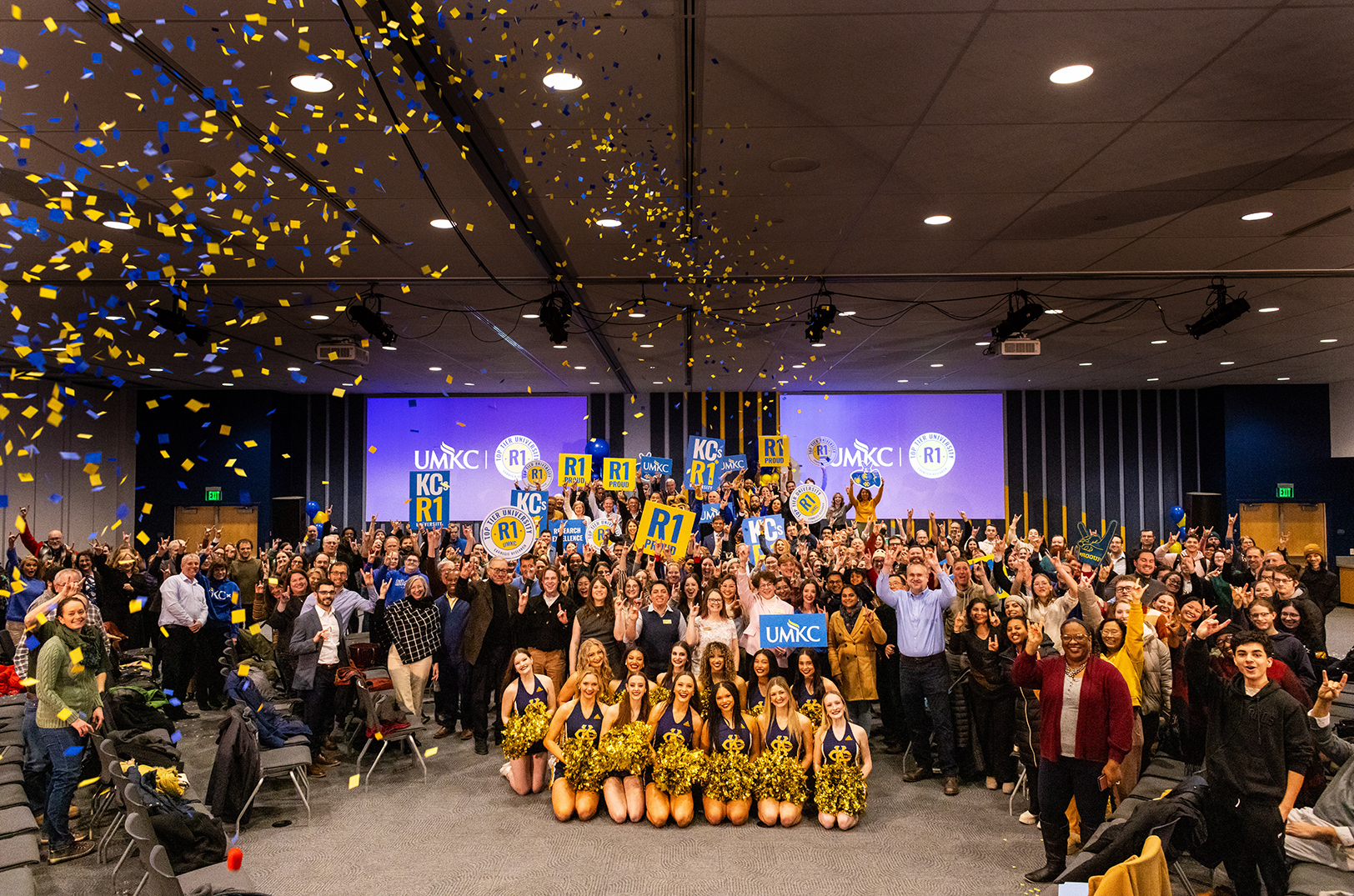
University leaders, students, economic development advocates and community members gathered on campus for a rally Thursday to celebrate the news — a big win for UMKC that was achieved five years ahead of a 2030 goal set in the university’s strategic plan.
“Carnegie is basically the crown at the top that recognizes you as one of the top research universities in the country,” Agrawal said, alluding to such existing R1 institutions as Columbia, Georgetown, Harvard, Johns Hopkins, Princeton, Stanford and Yale.
Click here to learn more about the behind-the-scenes efforts at UMKC to achieve R1 status.
“The affirmation of UMKC’s research enterprise as an R1 institution is a public demonstration of what Kansas City has known for a long time: UMKC is a world-class research institution,” said Melissa Roberts Chapman, president of the KC BioHub and Kansas City’s regional innovation officer. “What particularly excites me about this announcement is that UMKC’s efforts to grow its research enterprise have been paired with a strong focus on commercialization and entrepreneurship support.”
“This means that UMKC will continue to grow as a leader in scientific discovery, but also grow in the application of that research and its development into companies that drive our regional economy and improve the human condition,” she added.

Kasey the Kangaroo, flanked by UMKC officials, celebrates the university’s new Carnegie R1 research status; photo courtesy of UMKC
UMKC’s key research areas include advancing healthcare, defense and more with specialties in electromagnetic radiation and energy; advanced and critical materials; unmanned platforms; artificial intelligence, cybersecurity and data science and digital humanities.
Tangible impacts — from attracting world-class talent and culture to boosting the learning environment for students — will have a lasting ripple effect, said Dr. DeAngela Burns-Wallace, president and CEO of the Ewing Marion Kauffman Foundation.
“Carnegie R1 status enhances UMKC’s ability to address critical issues, like access to opportunity and fostering entrepreneurial ecosystems, that are central to our work,” she said. “The university’s dedication to innovative, community-driven research will amplify efforts to create a more dynamic Kansas City economy.”
In addition to UMKC, Missouri University of Science and Technology — another University of Missouri System campus — and St. Louis University also achieved R1 in 2025.
Click here for the full list of this year’s research activity designations.
Other nearby R1 universities include the University of Missouri in Columbia and Washington University — as well as regional innovation research hubs at the University of Kansas, Kansas State University and University of Nebraska-Lincoln.
Leveraging these collective resources in tandem with UMKC’s new designation can cultivate a new era stretching far beyond campus boundaries, said Roberts Chapman.
“Now, we can say publicly what we have known for a long time: that our region is home to four R1 research institutions,” she said. “Together, our four R1 universities rival the research expenditures and impact of a top-25 research university. To realize that potential, they must continually expand their capacity and willingness to work collaboratively.”
“The next horizon for the growth and development of our regional research enterprise will be for our four research institutions to coordinate and collaborate as effectively and seamlessly as if they were one world-class institution,” Roberts Chapman added.

Featured Business

2025 Startups to Watch
stats here
Related Posts on Startland News
Kauffman CEO: Foundation’s reset aligns Mr. K’s intent with KC’s needs of the moment
A recently announced strategy refresh for the Ewing Marion Kauffman Foundation will drive the organization’s collective impact in the community — honoring the vision of its namesake while recognizing the challenges Kansas City faces today, said Dr. DeAngela Burns-Wallace. “Mr. K had very distinct philosophies and ideas around how he wanted this work done,” explained…
Block by block: Prototype builds startup’s housing vision where everyone can afford their own castle
A mock home facade project on the grounds of Kansas City’s historic Workhouse Castle serves as a proof point for Godfrey Riddle’s rebooted Civic Saint — a social venture built on compressed earth blocks as its key to affordable, sustainable housing. “CEBs (compressed earth blocks) are great for Kansas City, because non-expansive sandy clay soil…

Resource revival: Digital Inclusion Fund relaunches with initial grants focused on devices
Kansas Citians can’t upgrade skills or devices they don’t already have, said organizers of a newly relaunched Digital Inclusion Fund — emphasizing a need to attack the metro’s digital divide at the infrastructure level. The fund is set to award up to $250,000 to 501(c)(3) public charities (including schools and churches) or governmental entities across…
New deal with lightwell keeps WeWork in Kansas City after closing Corrigan Station space
A freshly negotiated lease agreement with the developer behind the lightwell building in downtown Kansas City means WeWork will continue its two-floor coworking and flexible office space operation in the heart of the city’s central business district. WeWork has officially completed its lease rationalization with the assumption of its lightwell location contract, the company said…