

How Trump’s views on climate raise questions for Kansas’ biggest bet: a $4B Panasonic plant in De Soto
February 3, 2025 | Martin Rosenberg
Editor’s note: This story was originally published by Kansas City PBS/Flatland, a member of the Kansas City Media Collective, which also includes Startland News, KCUR 89.3, American Public Square, The Kansas City Beacon, and Missouri Business Alert.
Click here to read the original story.
Headwinds don’t dampen enthusiasm of company executives, government officials
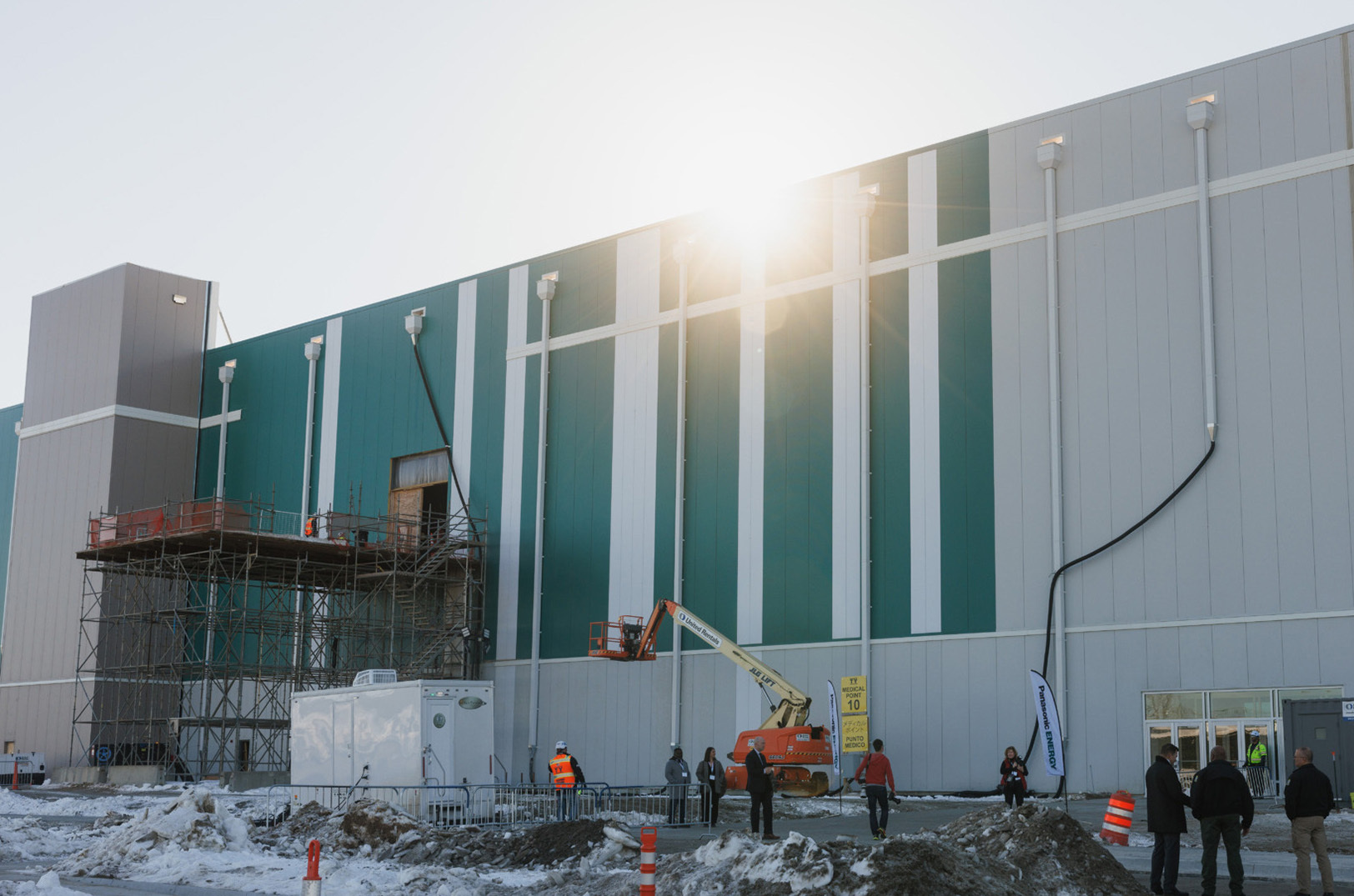
The mammoth $4 billion Panasonic electric vehicle battery plant nearing completion on the western edge of Kansas City is the biggest investment ever in the state of Kansas.
Now it looms as possibly the biggest paradox and largest question mark hanging over the state and its future fortunes.
The paradox is that one of the reddest states in America has placed such a sizable bet on a green technology at the dawn of one of the most conservative administrations in decades, led by a president who has no love for EVs and scoffs at the threat of the climate change they address.
The question is whether a sprawling new EV battery plant will be able to ramp up production to its full potential if President Donald Trump executes his plan to remove sizable industry subsidies and EV car buyers’ tax incentives.
“This is the $1000 question for us,” said Jeff Werner, Panasonic’s head of corporate and government affairs in Washington. “What’s going to happen?”

Jeff Werner, head of corporate and government affairs, Panasonic
Yet the company remains upbeat.
“The share of EVs is going to go up whether there is federal support or not,” Werner told Flatland in an exclusive interview. “We think we’ve hit a tipping point. The U.S. sector is growing significantly. We’re pretty bullish on growth.”
He added, though, that the pace of EV penetration of the domestic car market may be affected and might not be straight upwards.
Panasonic recently gathered the political elite of the region at its De Soto campus to celebrate the imminent start up of EV battery production, just months off, at what is billed as the largest such plant in the world.
It will employ 4,000 in a sprawling 4.7-million-square-foot facility that looms over the western approaches to Overland Park like the stockyards once straddled the West Bottoms.
Image makeover
It is already redefining Kansas.
“This represents a paradigm shift in how Kansans see Kansas,” said Kansas Lt. Gov. David Toland. “Kansas can do this bigger and better than anything we’ve done before in our history.”
Kansas bested 82 other locations around the nation in winning the investment.
It will pump $500 million in labor wages into the Kansas economy, boasted Gov. Laura Kelly, who clearly believes it ranks among her top achievements as governor.

Kansas Gov. Laura Kelly speaks to the press Jan. 17 at the Panasonic EV Battery Facility in De Soto, Kansas; photo by Chase Castor, Flatland
“This facility stands as a testament to vision and hard work,” she said. “It will benefit Kansas for decades.”
The state has made a sizable commitment to the project by investing $829 million, including a $500 million investment tax credit over five years and a $234 million payroll rebate over 10 years if the project achieves specified objectives.
Kickoff event
Dignitaries gathered in De Soto just a few days ahead of Trump’s inauguration. The president opposes subsidies for EVs and the electrification of transportation, preferring to rev up oil production and gasoline consumption.
Panasonic executives and local officials argued that the public’s embrace of electric vehicles is firm and growing. They said we are in a transition period and EV cars and the batteries that make them tick will remain in demand.
That will be true even if the $7,500 federal tax credit for EVs goes away, some said.
Brian Platt, city manager of Kansas City, Missouri, is looking for spinoff EV-related manufacturing to locate across the metro. “The market’s there and it’s got momentum. There is a need for them. Maybe we don’t need to subsidize them.”
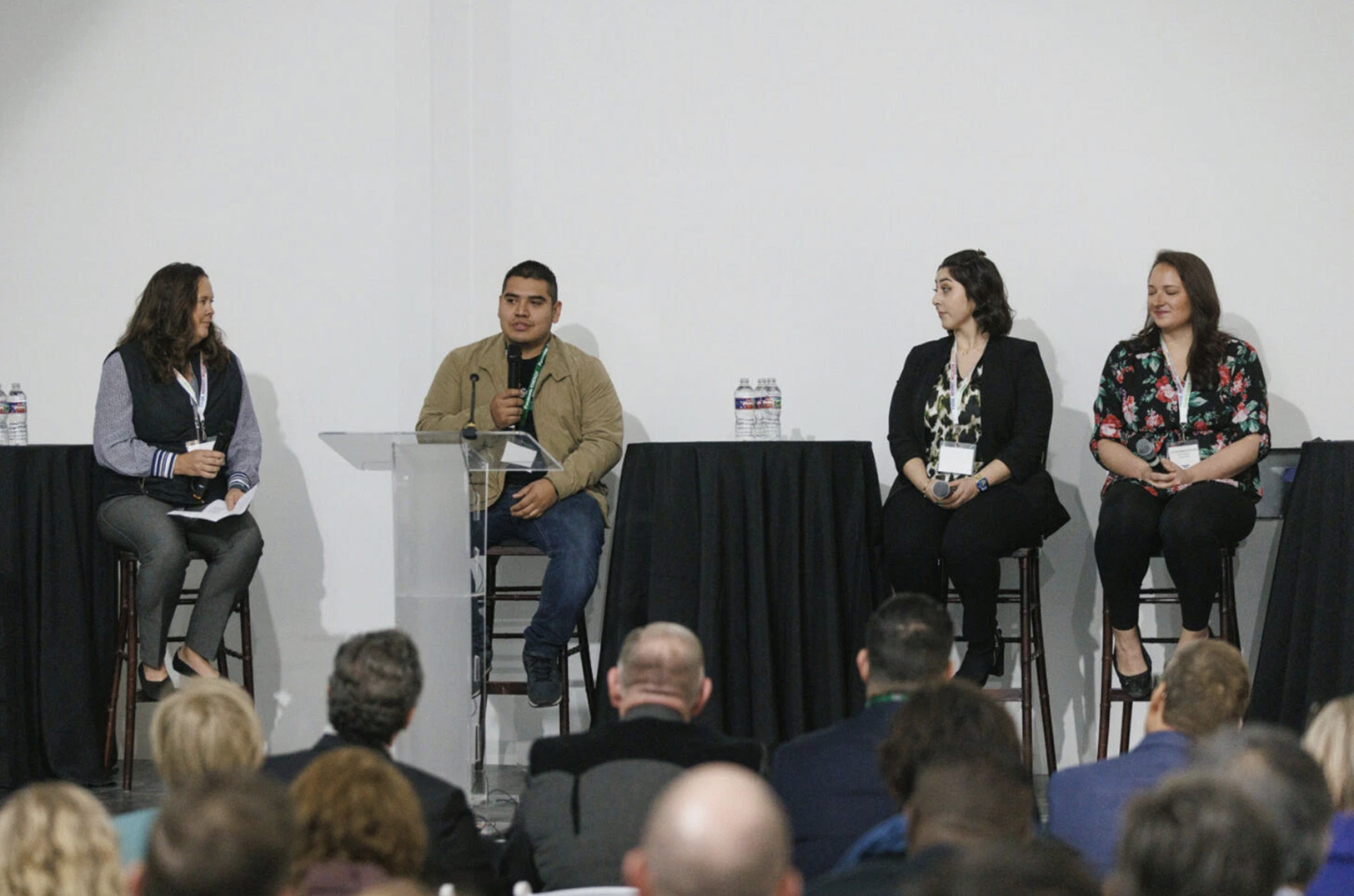
Panasonic employees Rene Jimenez, Natalie Zinai, and Andrea Navarro-Evans speak on a panel at the Panasonic EV Battery Facility in De Soto, Kansas; photo by Chase Castor, Flatland
China represents another potential challenge to domestic EV manufacturers and Panasonic.
The Asian superpower aims to conquer global markets with relatively inexpensive cars. Panasonic has no battery production in China and thus will have no share of Chinese successes.
Previously, China has taken over the global solar panel business, some say with unfair government subsidies.
If Chinese EVs are shipped in massive numbers to the U.S. West Coast, their impact on American automakers could rival that of the tidal wave of energy-efficient, small vehicles Japan sent our way in the 1970s, 1980s, and beyond.
If domestically produced EVs lose market share to Chinese manufacturers, what will be the impact on the De Soto plant?
The answer is unknown.
More uncertainties
Meanwhile, Trump is threatening to raise tariffs on Chinese goods. That is not a path favored by Panasonic, a global conglomerate based in Japan, a nation that has thrived from global trade.
“We are not advocating or pushing for that kind of protection,” Werner said. “You have to be competitive in the global marketplace. We need to be viable without tariff support.”
One additional unknown that looms over the Panasonic venture is tied to the sizable manufacturing tax credit it has started to receive.
The credits were issued under the Inflation Reduction Act crafted by the Biden administration to stimulate employment. Trump recently suspended disbursements under the act as his administration begins to define its own energy policies.
According to one published report, Panasonic potentially stood to receive $6.8 billion in federal tax incentives in coming years under the Inflation Reduction Act.
In an email to Flatland, Werner wrote, “Panasonic is eligible for the manufacturing tax credits under the Inflation Reduction Act. We have received the credit and it has been reported in our tax filings. Under the current law, we will be eligible to receive the credit in the future, which phases down and goes away in 2032. The Congress can change current law, so it is always possible to change. But there appears to be bipartisan support for certain provisions that are driving new investments.”
Werner did not specify the value of the federal tax credits, saying “the final amount will be determined by what we make and sell, so there is no way to know how much it will be.”
Panasonic determined the business case for the plant and decided to proceed with the investment before those tax credits existed, he said.
“The IRA credit is clearly very important, especially to helping develop the U.S. supply chain, and it has allowed us to weather some market headwinds,” Werner wrote.
Whether or not those headwinds will take on gale force strength in the months and years to come, De Soto property owners are pleased for now. Mayor Rick Walker said the sizable tax base of the plant has already facilitated a one-third property tax cut for his residents.
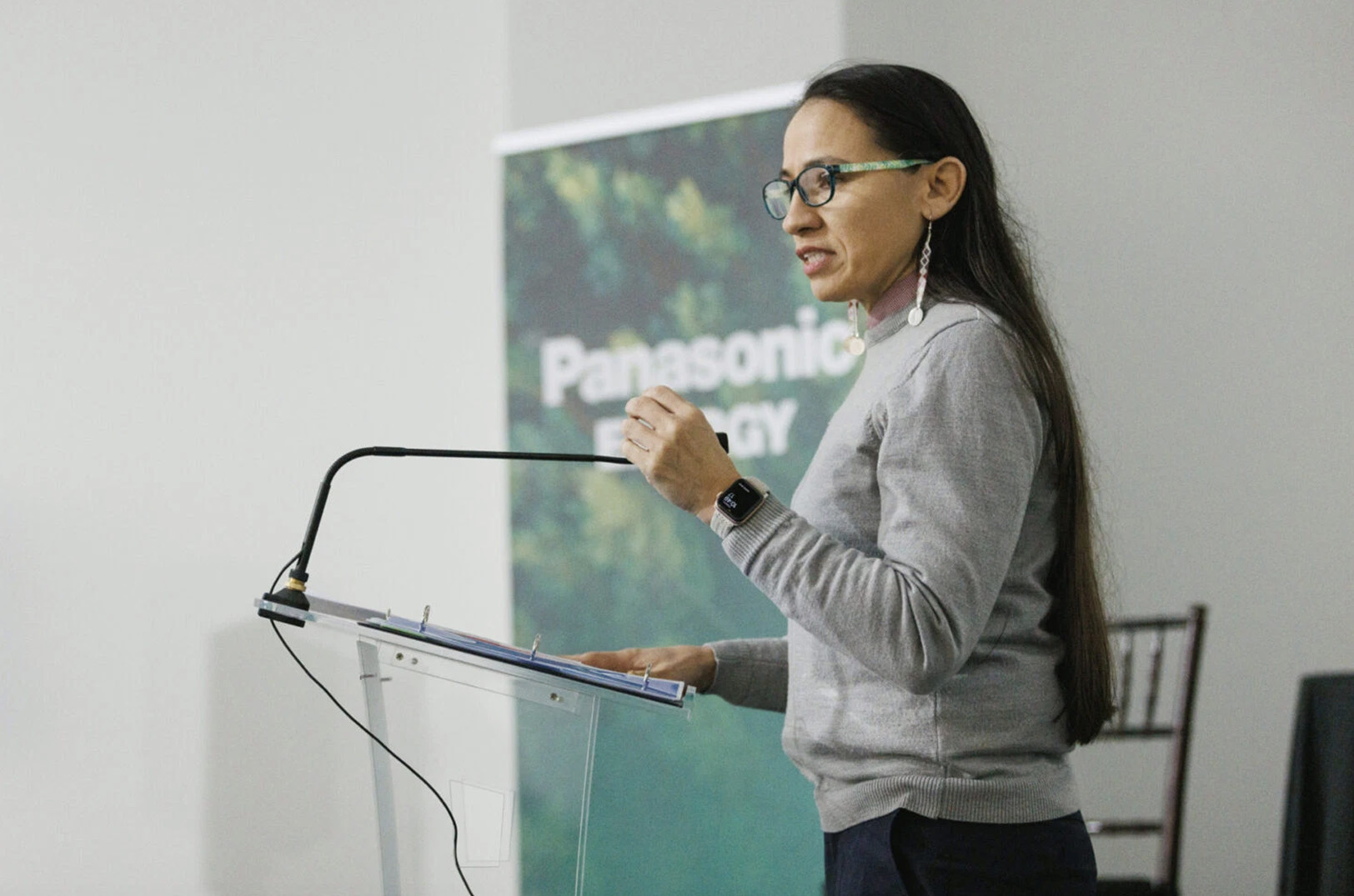
U.S. Rep. Sharice Davids speaks at a press conference at the Panasonic EV Battery Facility in De Soto, Kansas; photo by Chase Castor, Flatland
Panasonic expects to have 1,000 employees by this summer on the way to 2,000 by early 2026 and eventually 4,000.
It has taken 3,800 construction works to build the facility on the site of the former Sunflower Army Ammunition Plant, which left an environmentally degraded site and a stricken local economy when it closed in 1993.
“The lights are back on, and the jobs are here,” Walker said. “It’s about resilience. It’s about transformation.”
Added Allan Swan, president of Panasonic North America: “It’s going to be awesome. Every day I am reminded we made the right choice by picking Kansas.”
Kelly argued the plant “positions Kansas as a destination for innovation and industry” while U.S. Rep. Sharice Davids lauded “the generational impact this project is going to have.”
Martin Rosenberg is a Kansas City journalist and host of the Grid Talk podcast on the future of energy.

Featured Business

2025 Startups to Watch
stats here
Related Posts on Startland News
This one-day competition builds more than apps, organizers say; Hack Midwest aims to reveal what humans are capable of creating
Kansas City’s largest app building competition is set to return in September — with more than 300 software engineers competing in teams for a piece of $22,500 in winnings. Hack Midwest, which began in 2012, brings together developers for a 24-hour “hackathon,” during which the teams race against the clock — and each other — to…

Island vibes getaway: ‘Lei Away’ festival to showcase tropical flavors in landlocked KC
Kansas Citians won’t have to leave the city to enjoy a tropical escape during Labor Day weekend. The freshly announced Lei Away festival is expected to bring the spirit of the islands to the plains. “We are highlighting all the wonderful things that are tropical-centric in Kansas City, which is ironic because it’s so landlocked,”…
In second term, Mayor Q says he’ll help get City Hall out of entrepreneurs’ way as they build a more diverse economy
Creating economic equity in Kansas City goes hand in hand with building a sustainable city, said Mayor Quinton Lucas. “We will not be the city that we need to be — we won’t have the workforce, the entrepreneurs that we need — if we’re not actually investing in equitable tools in any number of ways,”…

Sandlot Goods takes a swing at a brick and mortar; new JoCo storefront expected to be a home run with brand’s fans
Sandlot Goods — Kansas City’s only local hat manufacturer — is hoping to score big with its first, dedicated, standalone retail space. The new location at Park Place in Leawood — 11530 Ash Street — is slated for a soft opening Aug. 15 and a grand opening Sept. 16, shared Garret Prather, Sandlot vice president…