

Start small, build demand, then scale: Founders offer blueprint to creating streetwear brands that outlast today’s trend
February 4, 2025 | Taylor Wilmore
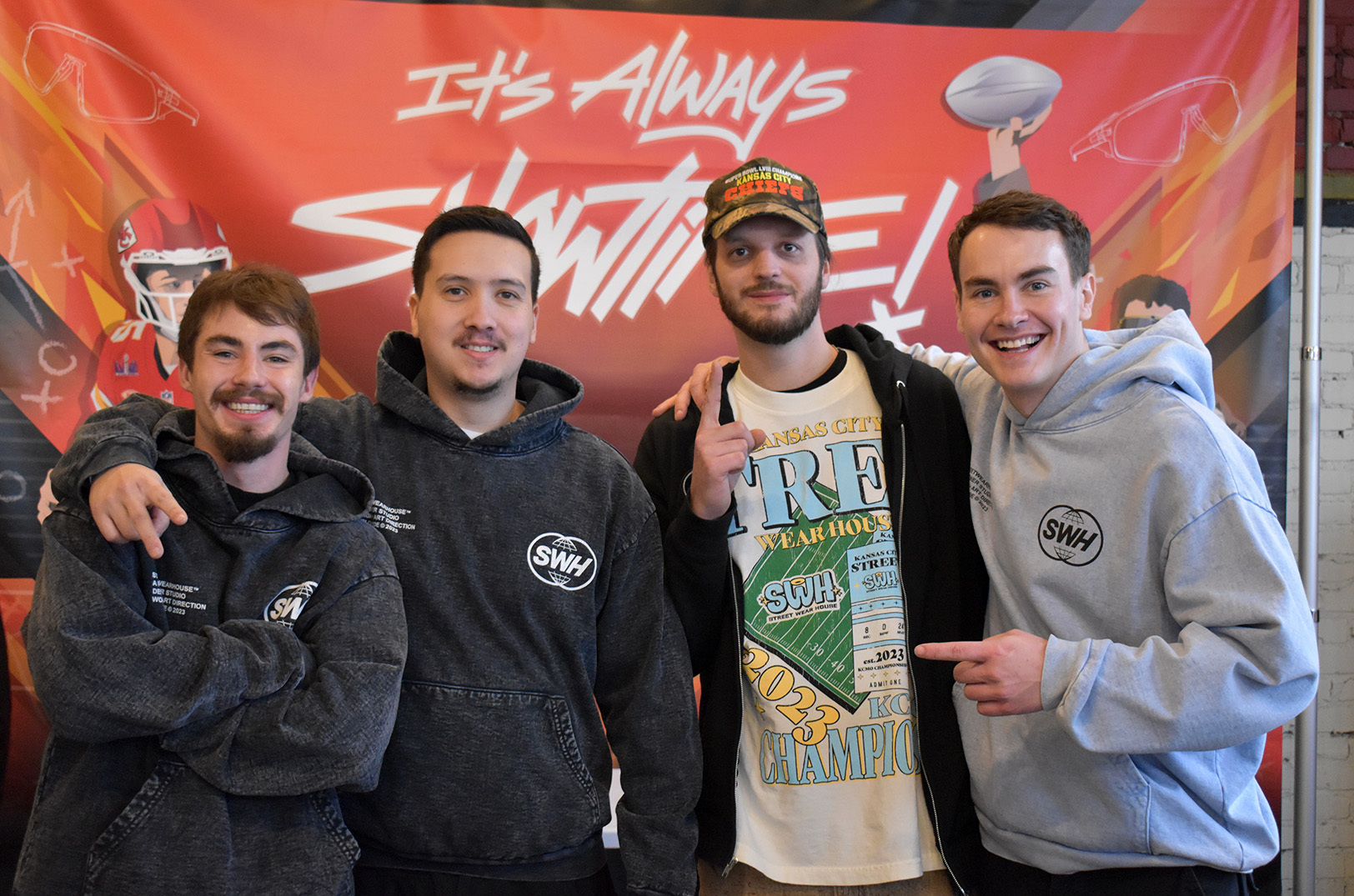
With Kansas City’s often-crowded apparel scene mobbed by designers hoping to cash in on the Chiefs’ Super Bowl success, building a lasting brand is about much more than just having a good idea that meets the moment, said Vu Radley.

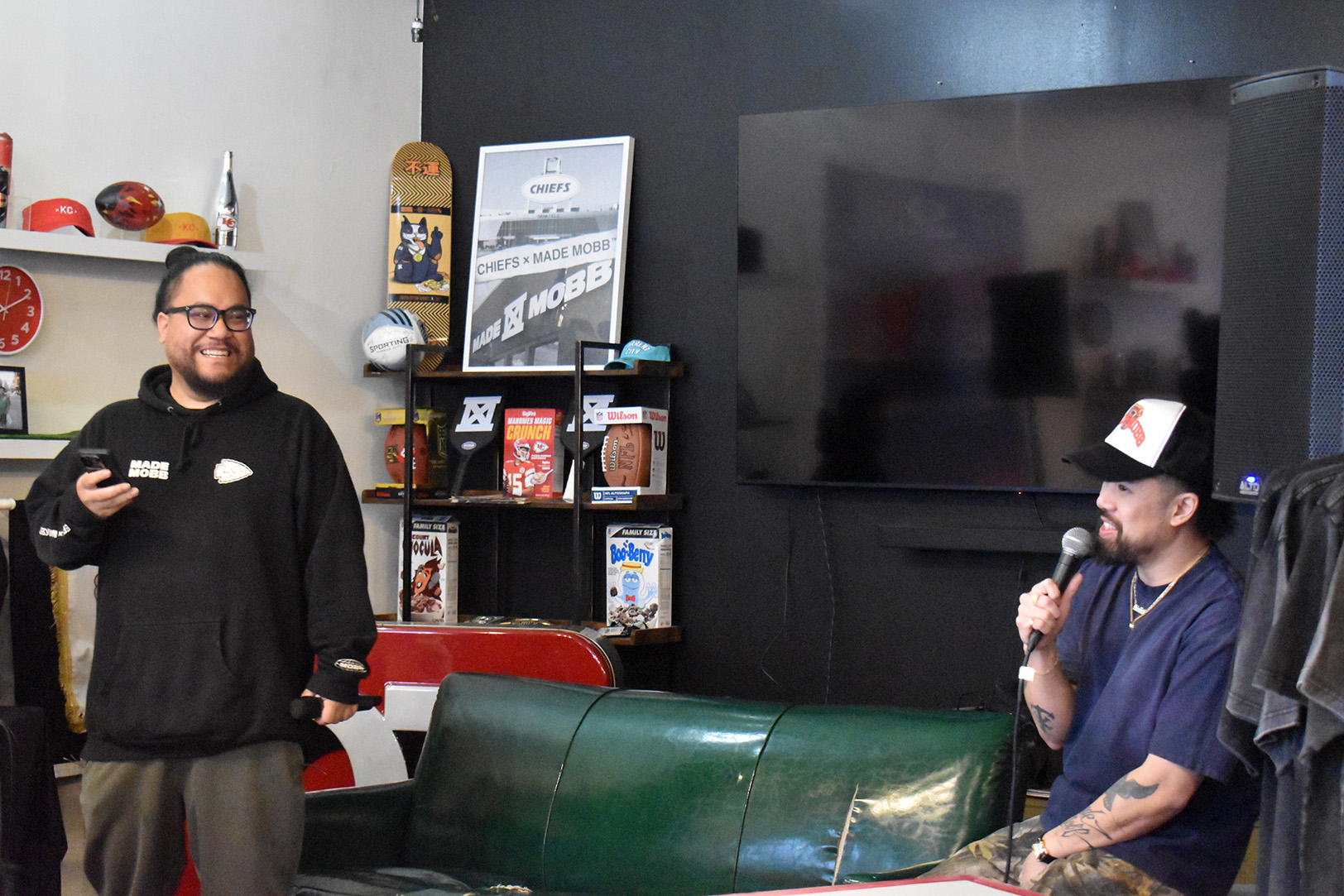
Vu Radley, MADE MOBB, during “The Blueprint: How To Launch Your Own Brand” event; photo by Taylor Wilmore, Startland News
“You have to know your ‘why’, who you are and why you’re doing it,” the MADE MOBB co-founder said. “That’s what keeps you going beyond the money.”
Aspiring streetwear and apparel entrepreneurs gathered Saturday in Radley’s storefront on Southwest Boulevard for a crash course in turning creative vision into a profitable business. Bringing together industry professionals from Kansas City’s fashion and marketing scene, the one-time event showcased underground insights on everything from production to branding.
“I’m giving y’all free game,” Mark Launiu, co-founder of MADE MOBB told the packed crowd.
“There’s no reinventing the wheel,” he added. “The blueprint is already out there, and we’re here to show people how to follow it in a way that works for them.”
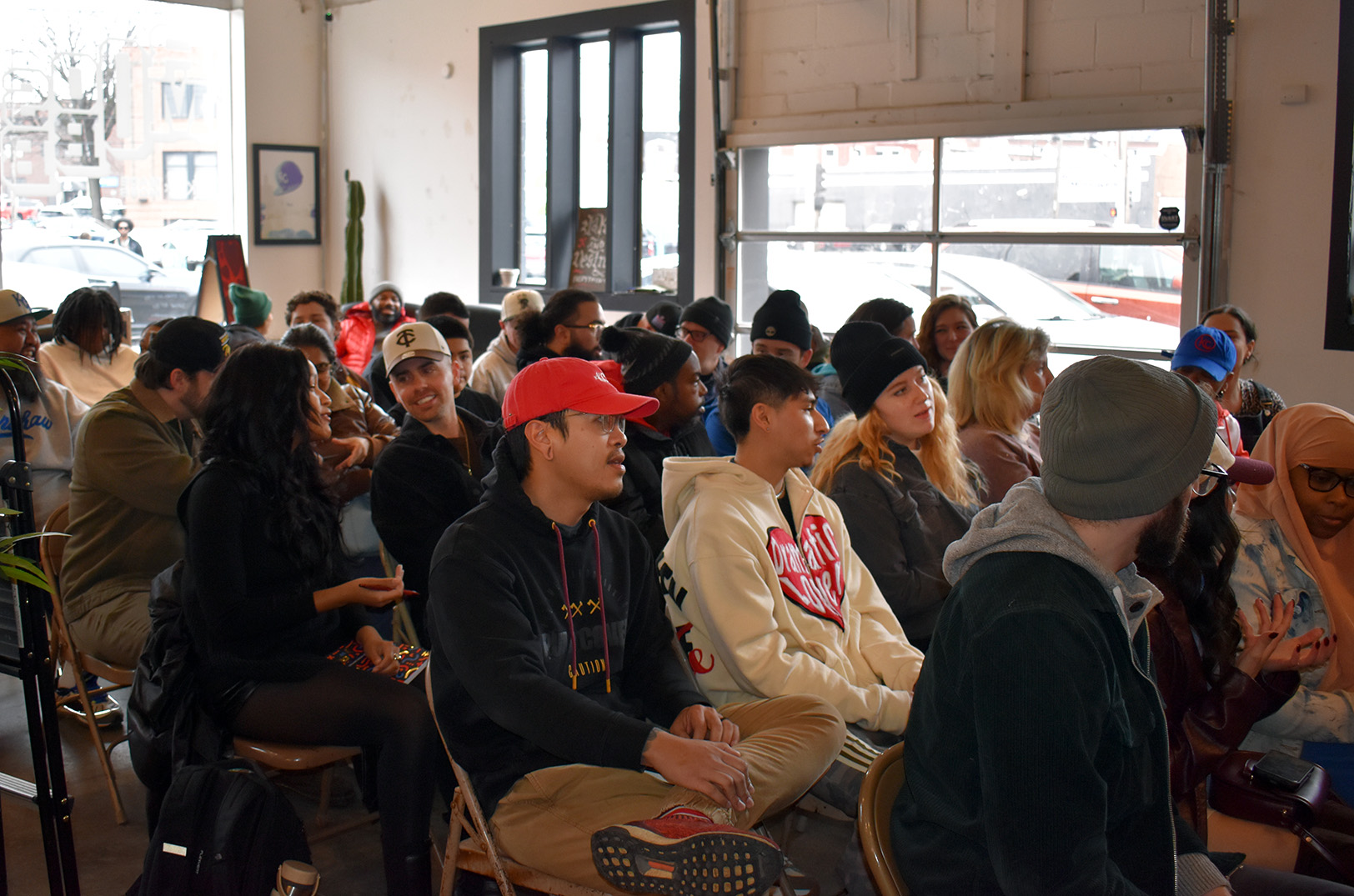

Making the hustle last
Understanding that the life of a clothing brand begins with truly understanding production is one of the biggest hurdles entrepreneurs face, said Tyler Love and Alex Trinkle, co-founders of the creator-focused print shop Streetwearhouse.

Tyler Love, Streetwearhouse, speaks at MADE MOBB during “The Blueprint: How To Launch Your Own Brand” event; photo by Taylor Wilmore, Startland News
“A lot of people think they need to start with a massive collection, but it’s really about testing the market first,” Love said. “If you have a dope design, you don’t need to print 100 pieces right away. Start small, build demand, and then scale.”
Trinkle stressed the importance of material selection and printing techniques.
“Screen printing lasts the longest, that’s why vintage shirts from the ’80s are still around today,” he explained. “Direct-to-garment printing has its place, but if you’re building a serious brand, you need to invest in quality.”
Streetwearhouse provided deeper insight into the screen-printing process, going in-depth on mesh count, ink selection, and curing techniques — topics that might seem trivial to hobbyist designers trying to rush orders before the Super Bowl, but critical for a company that wants to last beyond a two-week window.
“Every screen has a mesh fabric, and the lower the mesh, the lower the detail but the more ink it lets through,” Trinkle explained. “If you want to print something with fine detail, you need a high mesh count, like 305. But if you’re doing bold block letters, a lower mesh count, like 110, works just fine.”
Kyle Hemshrot, lead screen printer at Streetwear House, touched on curing ink properly to ensure long-lasting prints.
“If your ink isn’t cured at least 300 degrees, it’s going to crack and wash out,” he said. “A proper stretch test will tell you if the ink is set. If it cracks easily, it wasn’t cured correctly.”
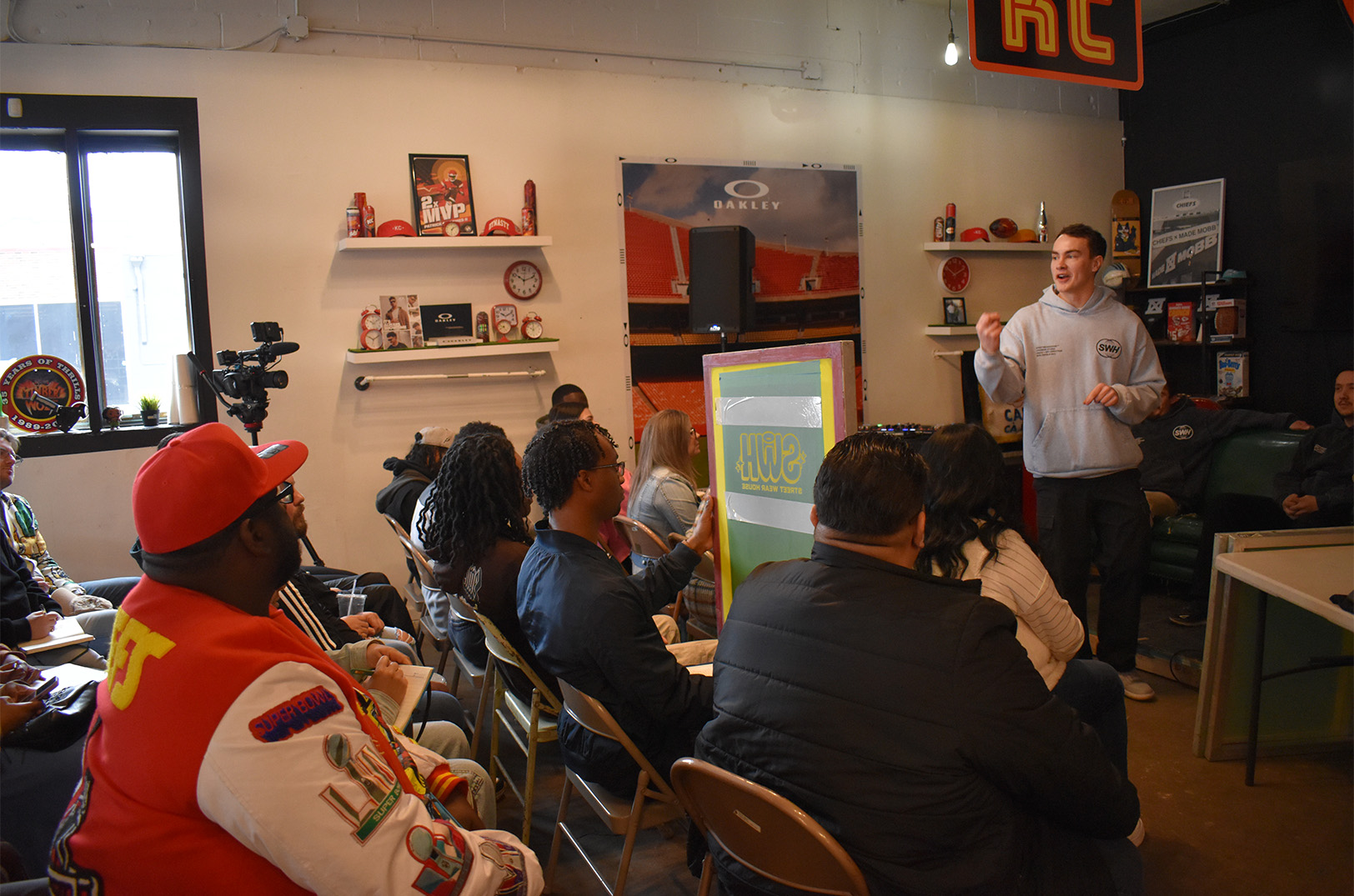
Alex Trinkle, Streetwearhouse, goes deep on screen printing during “The Blueprint: How To Launch Your Own Brand” event; photo by Taylor Wilmore, Startland News
Quality comes first
Love and Trinkle emphasized the importance of quality materials and understanding minimum order quantities (MOQs).
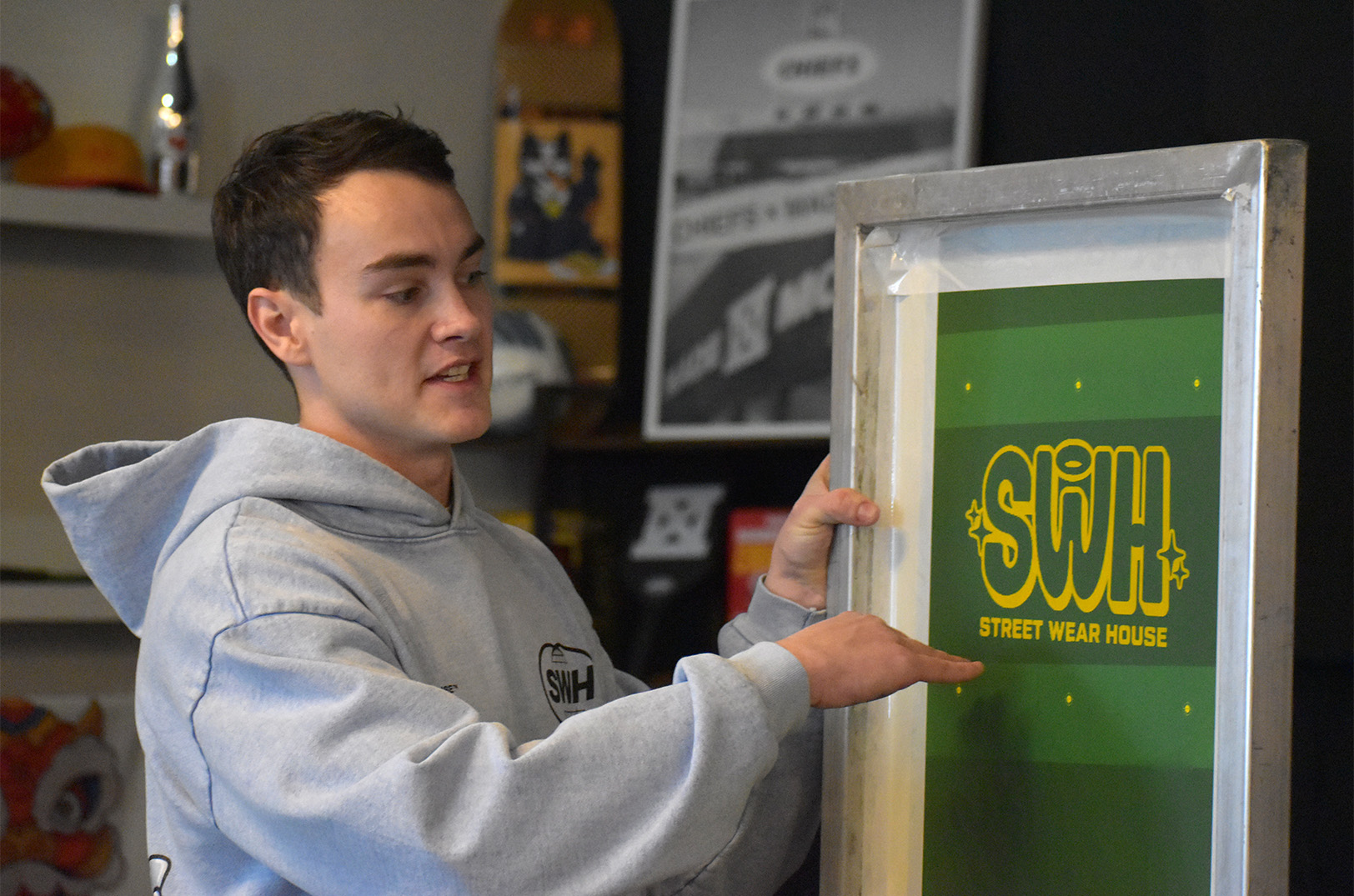
Alex Trinkle, Streetwearhouse, details screen printing techniques during “The Blueprint: How To Launch Your Own Brand” event; photo by Taylor Wilmore, Startland News
“If you want something basic, 24 pieces is the minimum. But if your design has four colors, we need a 48-piece minimum,” Trinkle explained. “Past seven colors, it usually requires 72 pieces because each color needs its own pass.”
Love added, “People focus too much on crazy designs, but simple designs can work just as well. Good art is crucial, but the other half is the quality of the shirt itself. Are you putting out something high-quality or something that wrinkles immediately?”
Beyond the shirts, Trinkle highlighted the impact of packaging.
“Your brand isn’t just the clothes; it’s the experience,” he said. “I used to ship merch in custom paint containers, and people loved it. It made them feel part of something special.”

Sam Kulikov, Social Apex Media, speaks at MADE MOBB during “The Blueprint: How To Launch Your Own Brand” event; photo by Taylor Wilmore, Startland News
Making a brand pop
A successful brand isn’t just about the product, Sam Kulikov said; marketing matters.
“When you’re starting out, don’t waste money on ads,” the co-founder of Social Apex Media said, emphasizing authenticity. “Build community first. People don’t buy just because something looks cool; they buy because they feel connected to your brand.”
He pointed to MADE MOBB’s success and its involvement in the community as an example.
“They didn’t just drop clothes and hope people would buy them,” he said. “They were out in the community, hosting events, showing up where their audience was. That’s how you build a lasting brand.”
Instead of focusing on paid social media ads early on, Kulikov suggested entrepreneurs create a culture around their brand.
“It has to be organic,” he said. “Host an event, partner with someone, build something meaningful, the customers will come.”



Getting Into retail with Made in KC
Emma Wolf, a buyer at Made in KC, wrapped up Saturday’s gathering with tips on wholesale distribution and pitching to retailers.

Emma Wolf, Made in KC, speaks at MADE MOBB during “The Blueprint: How To Launch Your Own Brand” event; photo by Taylor Wilmore, Startland News
A top priority: Entrepreneurs need a website or wholesale portal (MADE MOBB uses BrandBoom) to present their wholesale products professionally, she said.
“If all you send me is an Instagram link, it’s harder for me to work with. I need a website where everything is laid out properly,” Wolf said, giving advice on how to fill out Made in KC’s vendor forms.
She also stressed strategic bulk ordering.
“If you’re doing seasonal launches, develop relationships with retailers and keep them informed,” Wolf explained. “That way, they can place orders in advance, and you know exactly what quantities to produce.”
Like Radley, she encouraged entrepreneurs to think further than just selling a product and to reflect on what their brand represents.
“We’re not just looking for a great design. We want to know the story behind it,” Wolf said. “What does your brand stand for? How does it connect with Kansas City? That’s what makes a brand compelling.”
RELATED: Fantrepreneurs back in play as Super Bowl boosts small biz
Power of purpose and partners
In the fashion industry — especially Kansas City — networking and collaboration take brands to the next level, Launiu said.
“Partnerships help us go further,” he said. “When you leave here, don’t just take notes; connect with someone. Your network is your net worth.”
Brands need to be built on passion, persistence, and community, the panelists agreed. In other words: purpose.
“If you’re just chasing a check, you won’t last,” Launiu said. “You have to love what you’re doing because there will be hard times, and passion is what keeps you going. If you stay true to your vision and put in the work, success will follow.”
View this post on Instagram

Featured Business

Taylor Wilmore
Taylor Wilmore, hailing from Lee’s Summit, is a dedicated reporter and a recent graduate of the University of Missouri, where she earned her Bachelor’s degree in Journalism. Taylor channels her deep-seated passion for writing and storytelling to create compelling narratives that shed light on the diverse residents of Kansas City.
Prior to her role at Startland News, Taylor made valuable contributions as a reporter for the Columbia Missourian newspaper, where she covered a wide range of community news and higher education stories.
2025 Startups to Watch
stats here
Related Posts on Startland News

Fund me, KC: Garden Thorn wants to turn your thumb green
Startland News is continuing its segment to highlight area entrepreneurs’ efforts to accelerate their businesses. This is an opportunity for entrepreneurs — like The Handy Camel CEO Tom Gray — to share their stories to gain a little help from their supporters. If you or your startup is running a crowdfunding campaign, let us know…
Entrepreneurial foundation names local ‘startup champion’ as director
The Kansas City Startup Foundation’s year-long search for a new executive director ended right where it began. The foundation — whose mission is to unify Kansas City’s startup and entrepreneur community — recently hired Matthew Marcus as its executive director. Marcus, who most recently served as the foundation’s chairman, will begin his tenure in May. “It’s…

How wearables could change America’s pastime and Amazon’s big oops
In this week’s roundup of watercooler talk from the region’s startup hubs, we have the dish on Major League Baseball wearables, Amazon’s flub with expanding the digital divide and Chicago’s STEM workforce issues. Check out more in this series here. Mobile Commerce Press: Major League Baseball gives the nod to wearable technology No, this doesn’t…

The red carpet, garageband and laboratory of funding models
Editor’s note: The opinions expressed in this commentary are the author’s alone. “Funding! Funding! Funding!” It’s the warrior’s cry of the startup community. In the world of entrepreneurship, there’s an incredible amount of pressure to run a startup that can be described as “disruptive,” “innovative” and “scalable.” Those descriptions come with a hefty price tag,…