

Digital health startup aims to save medical providers time while bringing down cost of AI tech
February 11, 2025 | Nikki Overfelt Chifalu

CarePilot is on a mission to bring AI and automation to smaller medical clinics that don’t always have access to cutting-edge technology, shared founder and CEO Joseph Tutera.
The Overland Park-based startup’s ambient AI technology — designed to help those smaller practices operate more efficiently — captures patient-provider interactions in real time, automating administrative tasks and documentation, all while maintaining HIPAA compliance.

“If you were to ask the American Medical Association like, ‘Hey, what’s the No. 1 problem facing healthcare providers in the United States right now?’ one of the bigger reasons is the administrative burden,” Tutera explained, noting, “When a provider in the United States sees 20 patients, they have to create 20 patient charts for each of those visits.”
CarePilot — started in 2023 while Tutera was a student at Texas Christian University — allows providers to spend less time focused on paperwork and more time focused on patients, he continued.
“If a provider is spending half of their day just typing on a keyboard or dictating their narrative summary of a patient, that’s a huge burden. They hate it. The administrators hate it,” Tutera said. “And it’s a huge reason for claims getting denied. It’s a huge reason for position burnout. The concept of creating charts to replace this system is a super obvious use case for AI.”
One provider in Georgia said he went from taking home 10 charts a night to just one and spending four hours a day charting to just 30 minutes, noted Tutera, who was inspired by his experience with health care providers in his family and his proximity to rural hospitals and clinics in college.
Making this time-saving technology affordable is the startup’s focus.
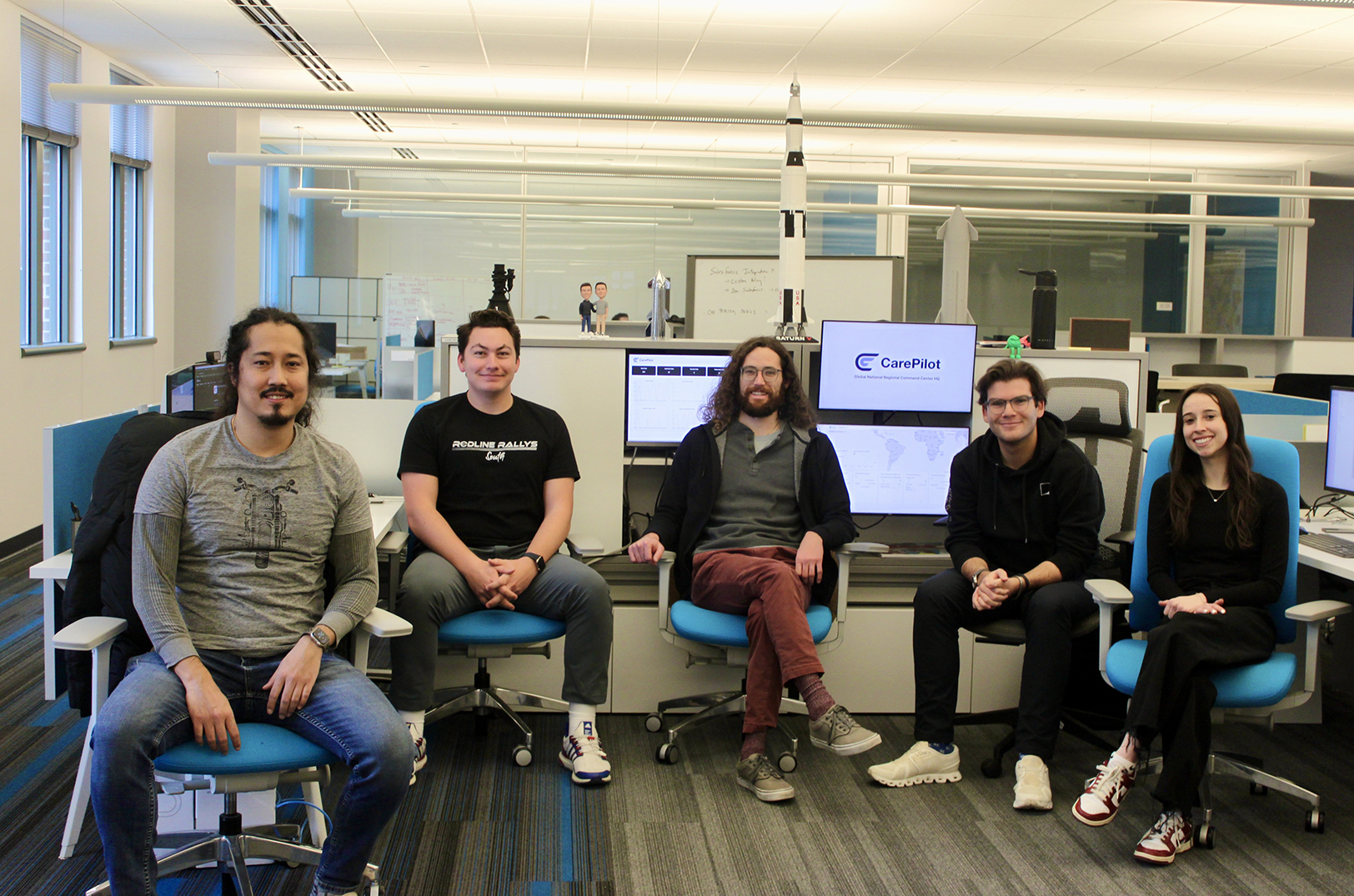
The CarePilot team — Samar Acharya, Tanner Helton, Cody Ptacek, Joseph Tutera, and Audrey Pino — at their Overland Park office; photo by Nikki Overfelt Chifalu, Startland News
“We’ve taken this cutting-edge technology — generative AI of large language models — distilled them down, made them less expensive to operate, and then serve them and sell them at the budget-friendly price that federally-qualified health centers or a rural health center can afford,” he continued.
“I will not pretend I invented the idea of the ambient scribe,” Tutera added. “But we’re trying to serve this very specific market in healthcare, which are these people that otherwise wouldn’t be able to afford it. That’s our uniqueness in the go-to market.”
Another quality that sets CarePilot apart, according to Tutera: the technology’s ability to learn each provider’s style.
“That’s where some of our technical work has been focused,” he said.
Since starting trials in March 2024, CarePilot — with co-founders Adam Blake, Tanner Helton, Samar Acharya, and John O’Hearn — has grown to more than 50 clients in 13 states and raised a little over $1 million in funding from local investors, he shared.

Josepha Tutera, CarePilot; photo by Nikki Overfelt Chifalu, Startland News
“We’ve got our first big partnership with a clinically integrated network done,” Tutera said, noting additional deals are in the works. “So the company went from thousands of dollars in annual revenue to hundreds of thousands of dollars in annual revenue very, very quickly.”
In 2025, Tutera hopes to grow CarePilot from 60-plus clients to 200 and add more engineers to the team, he said, plus expand the product by adding a coding feature that will help with claims processing.
“Not only is this product capable of writing your notes for you, it’ll be able to suggest what ICD 10 code you should have,” Tutera explained. “You click a button and add it to the note.”
Although he started CarePilot while a student in Texas, the Kansas City native knew when it was time to build the company, he wanted to do it in his hometown.
“There’s so much digital health here,” he said. “Of all the places in the United States to start a digital health company, Kansas City actually happens to be uniquely well suited for that, so that was pretty obvious.”

Featured Business

2025 Startups to Watch
stats here
Related Posts on Startland News

Embracing the chaos, LaborChart soothes the calamity of construction
Editor’s note: This content is sponsored by LaunchKC but independently produced by Startland News. Entrepreneurship is often attractive to personalities that don’t mind dealing with uncertainty. And though Ben Schultz never envisioned himself an entrepreneur, his experience as an electrical contractor forced him to embrace a myriad of unknowns in the construction industry. “Construction is…

Events Preview: Sports Hack for Social Change Competition
There are a boatload of entrepreneurial events hosted in Kansas City on a weekly basis. Whether you’re an entrepreneur, investor, supporter, or curious Kansas Citian, we recommend these upcoming events for you. WEEKLY EVENT PREVIEW Second Fridays at Village Square When: October 14 @ 4:30 pm – 7:30 pm Where: Village Square Coworking Studio Second…

Kansas Citians preparing for plethora of pitch competitions
A staple of early-stage business — the elevator pitch — will be on full display for the Kansas City community in coming weeks. Entrepreneurs from around the metro area have several upcoming opportunities to pitch their businesses or to hear other innovators deliver spiels on their firms. Here are few of those events. The University of Kansas’…

Royals, entrepreneurial stars fielding pitches from Kansas City educators
Children today require more than just a pencil and paper to complete their lesson plan. Thanks to a booming education technology market, teachers’ out-of-pocket spending goes far beyond the occasional pen, pencil or box of tissues nowadays. In 2013, teachers spent $1.6 billion annually to support their classroom. To alleviate the climbing prices of basic…