

Meet six coalitions earning grants through Kauffman Foundation’s new ‘Collective Impact’ funding pathway
January 31, 2025 | Startland News Staff
Systemic change happens when communities come together to drive transformation through collaboration, said Dr. DeAngela Burns-Wallace, announcing a half-dozen grants to high-capacity organizations with strategies to close economic mobility gaps in the Kansas City region.
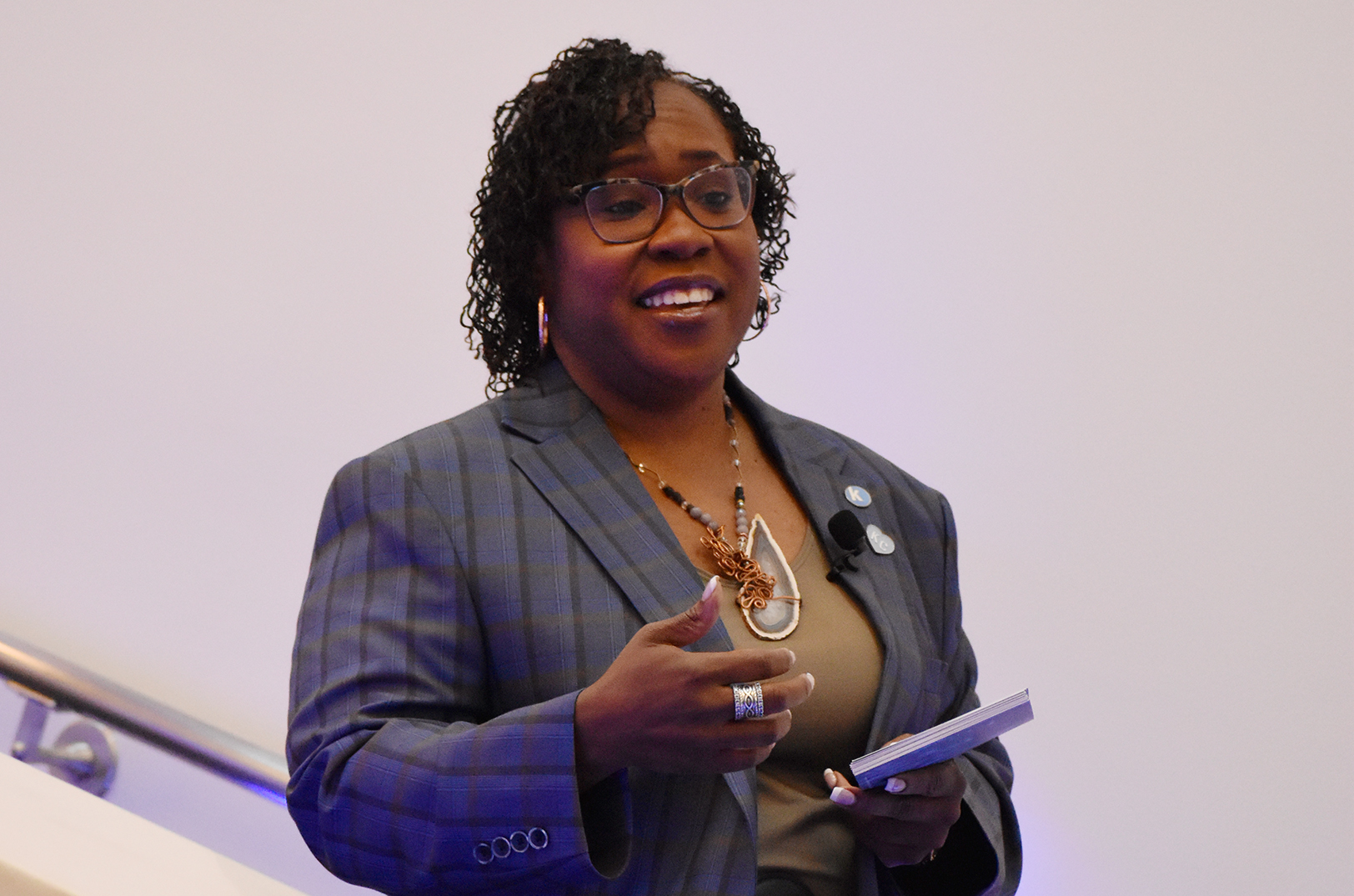
Dr. DeAngela Burns-Wallace speaks during the Sept. 19 Spark event at the Ewing Marion Kauffman Foundation; photo by Tommy Felts, Startland News
The “Collective Impact” planning grants of up to $500,000 are awarded to the winning coalitions are the first piece of a two-part grant concept from the Ewing Marion Kauffman Foundation, which could result in implementation funding of $5 million to $20 million over multiple years for successful projects.
“Hope grows when we come together with a shared purpose,” said Burns-Wallace, president and CEO of the Kauffman Foundation. “Through Collective Impact funding, we are harnessing the power of collaboration to drive meaningful change — addressing root causes, not just symptoms – and inspiring hope through impactful work that creates lasting opportunities for all.”
Sixty-eight organizations applied for the funding, which is part of the Foundation’s overhauled grantmaking strategy, announced in late summer. The influential organization’s new strategic priorities include college access and completion, workforce and career development, and entrepreneurship.
The high interest reflects a shared commitment to advancing collaborative solutions, said Burns-Wallace. This funding is designed to empower high-potential coalitions to plan for the creation of lasting, system-level impact.
“These organizations are tackling deep, complex challenges in our community – work that requires trust, collaboration, and a shared commitment to change,” she said. “Real progress happens when organizations come together, align their efforts, and build strong relationships. Our new Collective Impact funding pathway is designed to support coalitions in laying a strategic foundation that helps them move forward with purpose and create lasting change.”
The six winning coalitions represent a diversity of focus areas including technology, entrepreneurship credentialing, and aligned workforce pathways; each offering a community-centered focus and geographic reach across Kansas City. The just-announced grantees are:
- Coalition for Equity and Opportunity — Coalition members include Phoenix Family (lead), Economic Mobility Pathways, Goodwill of Western Missouri and Eastern Kansas, Great Jobs KC, KC Digital Drive, Pete’s Garden, and United Way of Greater Kansas City.
- Entrepreneurship Education Initiative — Coalition members include Kansas City Kansas Community College (lead), Piper Schools, Kansas City Kansas Public Schools, University of Missouri-Kansas City, Babson College, The Porter House KC, and The Toolbox KC.
- KC Tech Council — Coalition members include KC Tech Council (lead), Garmin, H&R Block, Panasonic Energy, JE Dunn, and Burns and McDonell. They also include training partners such as Per Scholas, Goodwill, WeCodeKC, i.c. Stars, and Apprenti, among others. Educational collaborators include the University of Kansas, Kansas State University, Rockhurst University, Metropolitan Community College, and the University of Saint Mary.
- Regional University Research Collective — Coalition members include KC Digital Drive (lead), the University of Kansas, Kansas State University and the University of Missouri – Kansas City.
- The Teach KC Collaborative: From Education to Economic Mobility — Initial coalition members include BLAQUE KC (lead), Teachers Like Me, The Educator Academy, Starting Early, Parent Power Lab, Urban League, Greater Kansas City LINC, Brothers Liberating Our Community (BLOC), 3rd District Kansas City Housing Accelerator, and The Latinx Education Collaborative.
- Workforce Partnership — Coalition members include Workforce Partnership (lead), Kansas Department of Corrections, Kansas City Kansas Community College, Kansas Chamber of Commerce, Reaching Out from Within, Starting Early, and Goodwill Industries.
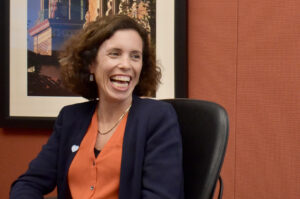
Allison Bajracharya, chief impact and strategy officer for the Ewing Marion Kauffman Foundation; photo by Nikki Overfelt Chifalu, Startland News
“We are truly inspired by the number of local organizations and institutions that are interested in working together to think and act differently in solving some of our regions’ most pressing systems-level challenges,” said Allison Greenwood Bajracharya, chief impact and strategy officer for the Kauffman Foundation. “These coalitions will now have the space to lead boldly, innovate thoughtfully, and create impact that resonates far beyond their immediate neighborhoods. Together, their work is a testament to the power of collaboration.”
The new Collective Impact funding pathway offers funding in two stages — planning and implementation. These initial six coalitions have nine months to finalize a plan to work together to create a clear action plan aimed at narrowing the economic mobility gap. These projects may be considered for longer implementation support in the future.
The Kauffman Foundation’s Collective Impact Model to address systemic issues is based on five conditions:
- Backbone Support – Creating and managing collective impact requires a separate organization with staff and a specific set of skills to serve as the backbone, or intermediary, for the entire initiative and coordinate participating organizations and agencies.
- Common Agenda – All participants must have a shared vision, or North Star, for change including a common understanding of the problem and a joint approach to solving it through agreed-upon actions.
- Mutually Reinforcing Activities – Participant activities must be differentiated while still being coordinated through a mutually reinforcing plan of action.
- Shared Measurement – Collecting data and measuring results consistently across all participants ensures efforts remain aligned and participants hold each other accountable.
- Continuous Communication – Consistent and open communication is needed across the many players to build trust, assure mutual objectives and create common motivation.
The Collective Impact projects reflects the Foundation’s mission of uplifting access to opportunities that help people achieve financial stability, upward mobility, and economic prosperity, regardless of race, gender, or geography, the organization said in a press release.
In November, the Foundation announced its first series of grants in its new “Capacity Building” grantmaking vertical, representing more than $11.2 million in funding to 53 organizations, largely based in the Kansas City region.
ICYMI: $11.2M+ awarded: 53 orgs tapped for first-ever tranche of Kauffman capacity building grants

Featured Business

2025 Startups to Watch
stats here
Related Posts on Startland News

How Trump’s win on DEI means fewer fresh foods for KC’s east side; USDA rakes back critical grant for farmers market
An ambitious plan to create greater food security through urban farming won’t be entirely uprooted by efforts to dry up federal funding for projects linked to equity and access, said Alana Henry — but its harvest likely will yield dramatically less. “Doing right by people is always the right answer,” said Henry, executive director of…

‘Black-owned dining passport’ launches in response to Trump’s attacks on diversity
A new effort encouraging support for local, Black-owned businesses — many in Kansas City’s historically redlined neighborhoods — is a timely reminder of the purchasing power in each diner’s hands, said Brandon Calloway. Kansas City G.I.F.T. on Friday launched the first edition of its “Savor The Flavor” Black-Owned Dining Passport, which features 13 restaurants. Diners…
As ICE threat scares customers, Kansas City businesses urged to ‘protect people working for you’
Editor’s note: The following story was published by KCUR, Kansas City’s NPR member station, and a fellow member of the KC Media Collective. Click here to read the original story or here to sign up for KCUR’s email newsletter. After a highly publicized raid on a Mexican restaurant in Liberty, Missouri, earlier this month, immigration advocates and attorneys are rushing…

In Good Company: This ‘hidden gem’ offers escape from club chaos, KC’s corporate nightlife
A new East Crossroads venue on McGee offers no clues of what’s inside. The black facade out front features no marquee. No neon lights. It’s the first indication that In Good Company is something different from neighboring Power & Light District hot spots. The goal: Good people. Good drinks. Good vibes. “It’s not a club.…