

Ancestry.com founder-turned-AI evangelist says rapidly advancing tech can uplift humanity, families
October 8, 2024 | Haines Eason
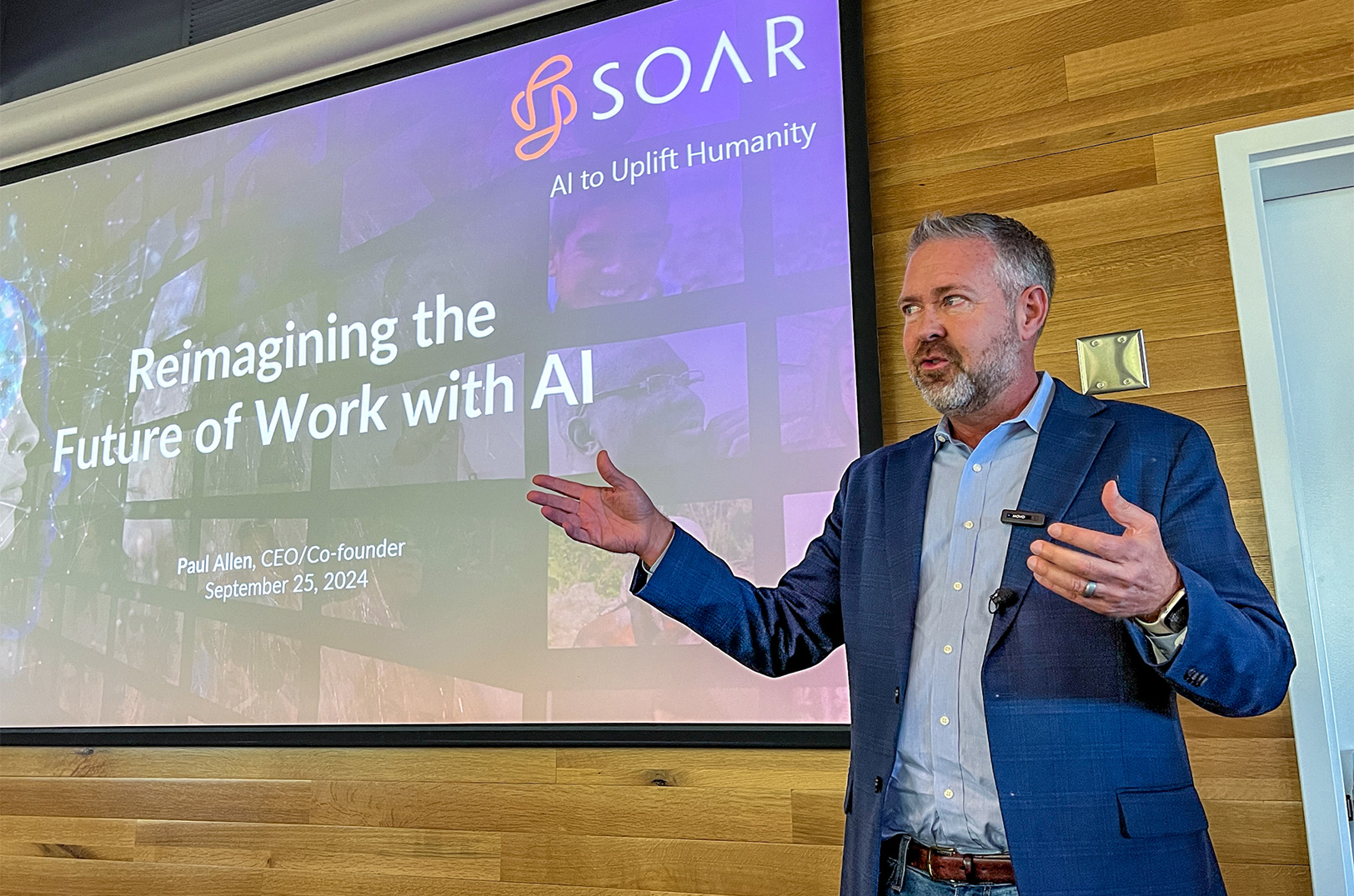
People across the globe are caught in an internet malaise, said Paul Allen, and tech visionaries’ response should be to renew humans’ dependence on faith and family and friendship and local community.
One of their most critical tools, he said: decidedly non-human solutions from the rapidly evolving landscape of artificial intelligence.
Allen — founder of ancestry.com and its predecessor myfamily.com — recently discussed the potential for AI to revolutionize human productivity, individual liberties and data ownership during a visit to the KU Innovation Park in Lawrence.
His most recent venture, Soar.com, is an AI studio the serial entrepreneur expects to serve as a multi-business incubator with a lofty goal: uplift humanity.

“We’re attracting funding and talent to roll out 15 companies, which we hope will take traditional human experiences that matter the most and turn them into top of mind AI assisted experiences,” Allen said.
He envisions Soar as a collective of portals, he said, specifically noting a soon-to-launch family portal that reflects successes and lessons learned from ancestry.com and myfamily.com — the latter Allen described as attracting 20 million users in two and a half years before being “sidelined by investors.”
A “faith portal” also is at the top of his priorities, he said.
“Imagine you’ve gone to a certain church for 30 years, and everything that the pastor or priest taught you is recorded by your AI, and you have the ability to search and retrieve what they taught about forgiveness two years ago in a sermon,” Allen said.
He pivoted from that idea to Soar’s citizen portal, which already contains 1 million hours of video footage from city, county and state meetings across the country. The goal: to empower users to find out quickly what their local governing bodies — school boards, councils, commissions, etc. — are talking about, what was said in the comment periods, and what decisions are being made.
“We’re so in the dark about what’s going on at every level of government because we don’t have the freedom to be full-time citizen observers,” Allen said.
“But if you have an algorithm you control and an AI that indexes all the meetings and soon all the documents that they produce, including the municipal budget … It’s hard for any of us to oversee our own government, but with AI, we might be able to do a much better job.”
Allen intentionally positions Soar in opposition to negativity that he says is the norm for social media and the internet as a whole.
“[Soar’s AI technology] is not an exploitative thing that finds out what you know about all your siblings and then advertises to you. It’s not advertising-based,” he said.
Soar instead will be funded by a “modest subscription, maybe a few dollars a month.”
“Facebook has billions of users, and they’ve broken up a lot of families,” Allen said. “They’ve broken up democracies. They’ve broken our trust in the news media. Facebook moved fast and broke a lot of things that were really important to humans.”

Paul Allen, founder of ancestry.com and the new AI-fueled portal Soar, speaks at the KU Innovation Park; photo courtesy of the KU Innovation Park
New powers, new names
As inventors, entrepreneurs and visionaries seek broad adoption of their innovations, Allen explained, they must make new concepts relatable.

Paul Allen, Soar
He underscored that point using a story about steam-engine inventor James Watt, who was able to explain his world-changing idea through a term many take for granted today: horsepower.
“As the engines got more and more powerful,” Allen said, “he could quantify how many horses a train engine replaced — maybe a thousand horsepower. Or, now a Bugatti? 18,000 horsepower. It’s a fun idea that an inventor of a device created a word to describe the power of the device to market the device.”
Allen has been searching for new terms himself — with the help of AI, he said.
“This is a ChatGPT experiment where I said, ‘Help me come up with a phrase like horsepower, but make it relevant to what AI and robots are going to be able to do,’” Allen recalled.
“So if you bought a robot and it had one ‘mind power unit’ — the capability of an AI system to perform cognitive tests at the level of one full-time human worker over the course of a 40-hour work week. So you could say, sample usage: ‘This AI system operates at 10 MP units, effectively replacing 10 human analysts in data processing tasks.’”
A heartbeat away from change
So where do humans fall in the new power dynamic?
“Imagine if we had vocabulary to show that humans have ‘heart power,’ and in your organization you better have enough heart power to offset the task power or the mind power that the AI robots are doing,” Allen said.
“‘Soul force’ was another AI-suggested term that could describe human gifts that an AI or robot would never have. They wouldn’t have ‘soul force’ or ‘heart power.’”
Even with all that heart, humans will face a future where an increasing number of jobs will be eliminated by AI and other advances, Allen acknowledged, noting new careers to align with the evolving nature of technology.
“Thirty years ago, cloud computing wasn’t around, so you couldn’t be an AWS engineer or an AI engineer,” he said.
“If we could imagine when AI and robots are doing all kinds of manual work and all kinds of cognitive work, what will our role be?” Allen continued. “No. 1: overseeing, guiding, creating things that need to be done by them. But No. 2: ethics rules. Making sure they’re not overreaching their boundaries that we created for them.”
Haines Eason is the owner of startup media agency Freelance Kansas. He went into business for himself after a stint as a managing editor on the content marketing team at A Place for Mom. Among many other roles, he has worked as a communications professional at KU and as a journalist with work in places like The Guardian, Eater and KANSAS! Magazine. Learn about him and Freelance Kansas on LinkedIn and Facebook.


2024 Startups to Watch
stats here
Related Posts on Startland News

Another point for Utopia: Small businesses score cash prizes in Access to Money competition
Patricia McCreary is on a mission to show that Kansas City leads the way on senior and disabled care, she shared. Winning the established business category of the SCORE Access to Money pitch competition puts her one step closer, McCreary added. She founded Margaret’s Place — an adult daycare, senior recreation and wellness center —…

Want on stage at GEWKC? Organizers need your ideas for 2024 entrepreneur event series
Kansas City’s business and entrepreneur community is invited to submit sessions for this fall’s Global Entrepreneurship Week-Kansas City, an interactive, community-driven educational experience organized by KCSourceLink. “Kansas City is gearing up for an even better Global Entrepreneurship Week in 2024,” said Callie England, director of GEWKC and marketing director at KCSourceLink, which has organized GEWKC…

Black & Veatch IgniteX accelerator adds six startups focused on carbon dioxide removal
An Overland Park-based corporate innovation hub is set to empower an international roster of startups involved in climate and decarbonization technology — just as news reports point to a record spike in atmospheric carbon dioxide levels and intensifying climate concerns. Six companies have been selected for the Black & Veatch IgniteX Carbon Dioxide Removal (CDR) Accelerator,…

CAPS Network selects first cohort for $951K initiative toward rural Kansas learning expansion
A significant U.S. Department of Education grant is expected to serve as a catalyst for CAPS Network’s ambitious plan to expand profession-based learning in rural America, with a particular focus on its home state of Kansas. Seven rural partner communities already have been selected. The federal funding came after impactful advocacy from U.S. Jerry Moran,…