

Here’s how a new data dashboard could help KCMO redirect funds to small businesses
September 5, 2024 | Haines Eason

A new data dashboard built to better understand Kansas City’s business needs — and guide the city’s response — is not only revolutionary for the metro, said Nia Richardson, it could be the first of its kind, period.
Small business advocates already are calling it a win.
“I don’t know of any other city or playbook I’m able to follow to say how to do this,” said Richardson, managing director of the KC BizCare Office, as well as the Office of Digital Equity for Kansas City, Missouri, which is leading the data effort.
In April, the city previously a $900,000 investment in KC Bizcare, and on Aug. 14 leaders followed by approving resolution 240632 — greenlighting an effort to create a data dashboard that will help Richardson’s team better understand the city’s small business culture and, from there, help the city government understand just how much tax revenue these businesses are generating.
“With the resolution passed, our next step is getting participation from all the departments that would have to support and share out data,” Richardson said, noting one of her first partners is the city’s data office, Open Data KC.
They’re now working to pull data for a “data lake.” From there, the team will decide how to make use of what they find.
[Editor’s note: Startland News is a partner of the KC BizCare Office.]
‘We’re doing it the right way’
Local entrepreneur advocates have been urging Kansas City’s government to more directly support entrepreneurs and small businesses by returning — or redirecting — small business tax revenue back into those enterprises.
The city has a notable small business funding gap, according to entrepreneurs like Eze Redwood and Tyler Enders, who for months have lobbied the city for funding solutions.
A small business leader on city council and ally of their cause welcomes the dashboard project as a step in the right direction.
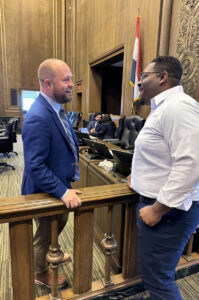
Wes Rogers, KCMO city councilman, speaks with Eze Redwood, entrepreneur, March 27 during a KCMO budget hearing; courtesy photos
“You can’t make any good decisions without data,” said Wes Rogers, Kansas City Second District Councilman and chairman of the city’s Small Business Taskforce.
Rogers’ family owns long-standing commercial-grade washing equipment business Prime Chemical Solutions.
“I’ve been in the state government; I’ve been in the city government; and I’m amazed by how often we just go into things blind without … actually looking at the numbers before we make a decision,” Rogers said. “And when you’re talking about something like business, thank God that we’re actually trying to find data before we do anything. So it’s a healthy process. We’re doing it the right way.”
The ball is now in KC BizCare’s court, he said, noting the council’s next task with regard to this issue will be to make sure there’s money to even fund a redirect.
New budget planning is currently in the very early stages, Rogers said, and budget work already is under way in the city manager’s office, which the council won’t see for a few more months.
The city council’s official budget review process begins in March 2025.
Rogers sees a potential redirect of funds as an investment — a way for the city to grow its bottom line, he said.
“The city’s in a budget crisis right now, and the next five years look pretty bleak,” Rogers said. “So we’ve got to make investments in our city that are going to generate tax revenue by investing in small business in a smart way, by using the taxes generated by small business to create more … successful small businesses. This is going to have a net positive impact on our budget, otherwise we wouldn’t be doing it.”
Other cities have expanded their budgets through this kind of effort, he said, pointing to El Paso, Tulsa, Louisville and Boise, Idaho.
“There’s other cities that have invested in small business a lot better than we have, frankly, and they’ve gotten a return on that investment,” Rogers said. “We’re on the front line of the data collection, but we’re not on the front line of being a good partner with our local small businesses, and the cities that have done a good job of that have seen a great return on their investment.”
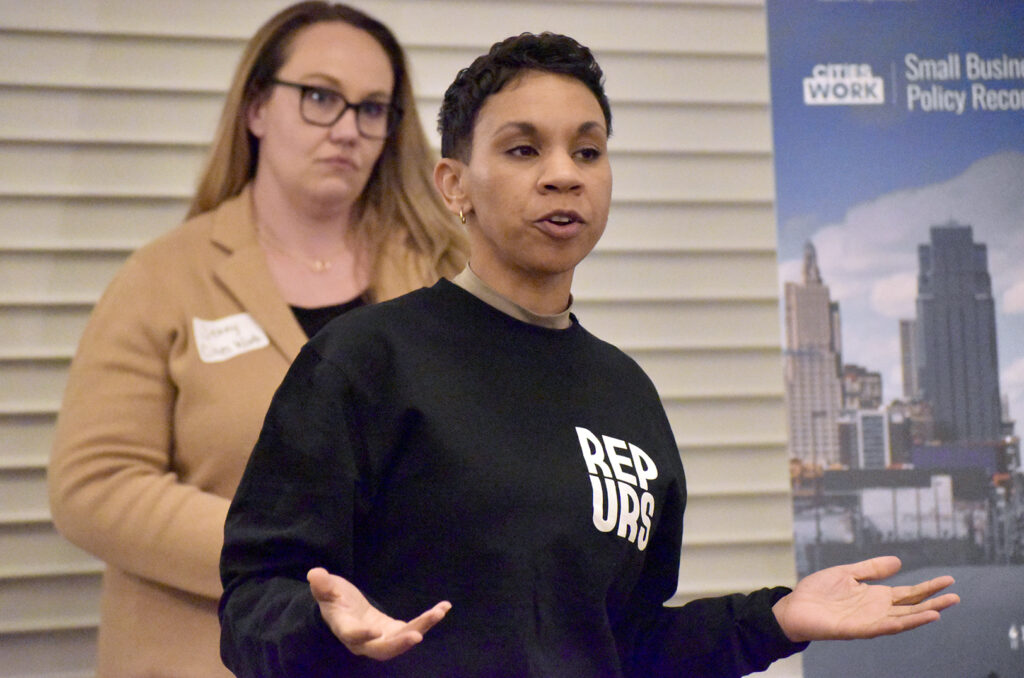
Nia Richardson, KC BizCare, speaks during a March 2024 event celebrating entrepreneurship and revealing Cities Work’s study on KCMO; photo by Nikki Overfelt Chifalu, Startland News
What data does the city know it needs?
“No. 1, I know demographic data is going to be missing because every application that I looked at, we don’t ask the demographics of the business owners,” Richardson said.
She notes the city has no info on business owner sex, race, primary language spoken, etc.
“I had somebody from the Wall Street Journal asking about black businesses that started during COVID that are still operating today. Well, I don’t know that — we don’t ask the demographic data to be able to support that or even know what they need or how to identify them based off the data that we have.”
However little Kansas City might know about its small business ecosystem, it’s still far ahead in its data work; so much so that Richardson and her office are already guiding other cities that are considering similar efforts.
Richardson is involved with city administrator networking organizations Living Cities and National League of Cities and meets regularly with officials from Atlanta, Memphis, Nashville, Miami and Charlotte, she said.
One more question Richardson still needs answered: What’s the definition of a small business?
“If we go off of (the Small Business Administration’s definition) … our definition of small business is pretty much 99.9 percent of all businesses that are running in America,” she said.
“It doesn’t help us on a local level when we say, ‘OK, we want to do something for small business, but we first have to define what that is,’” Richardson said.
A big milestone of success, she continued, will be defining who the city really intends to help so that any redirected funds can go to support the right businesses.


2024 Startups to Watch
stats here
Related Posts on Startland News

Smart city leader: Can technology predict deadly shooters before it’s too late?
A smart city is a safe city, Herb Sih said. And technology can help. “If you don’t have safety, you don’t have anything,” said Sih, managing partner at Think Big Partners, one of the key collaborators in Kansas City’s $15.7 million public-private Smart City initiative. Having grown up in St. Louis, Sih said he has…

T-shirt printer GOEX hopes to clad workers in dignity
A Kansas City T-shirt screen printer has a lofty mission: Turn local purchases into global impact. “Your dollar has value in how it’s treating others across the world,” said Ryan Hudnall, engagement director at the Global Orphan Project. Tucked away near Wyandotte and 31st streets, GOEX serves as an offshoot of the Global Orphan Project,…

Looping back? Missouri partners with Hyperloop to study 23-minute KC-St Louis route
Missouri’s prospects for landing a Hyperloop route apparently aren’t off the rails after all. Despite the company revealing four U.S. finalist routes in September — which did not include a proposed route through the Show Me State – Hyperloop One announced Tuesday it has entered into a public-private partnership with the State of Missouri to conduct…

Techstars Spotlight: GRIT Virtual builds 3-D tech into 2-D construction mindset
3-D should stay 3-D, said Chris Callen, CEO of GRIT Virtual. And with the rise of virtual reality and augmented reality technology, that philosophy can be applied to the construction of 3-D buildings, Callen said. Wichita-based GRIT Virtual is a software-as-a-service platform for large contractors. It uses VR software to streamline the workflow for construction…