

Inside KC’s SubTropolis: How Missouri businesses are looking below the surface for new opportunities
July 10, 2024 | Paige Gerling
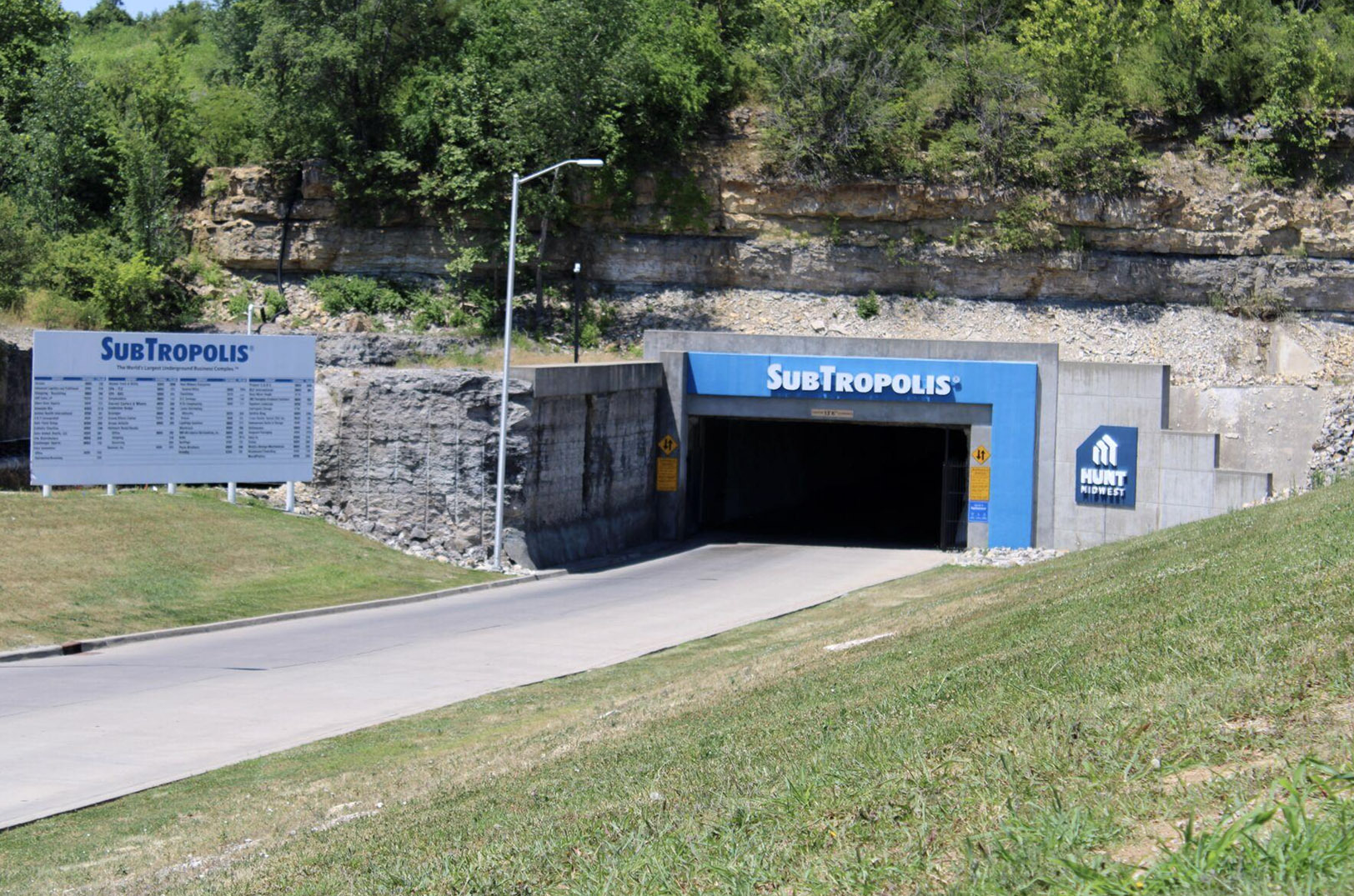
Editor’s note: This story was originally published by Missouri Business Alert, a member of the Kansas City Media Collective, which also includes Startland News, KCUR 89.3, American Public Square, Kansas City PBS/Flatland, and The Kansas City Beacon.
Click here to read the original story.
Visitors driving into SubTropolis on a recent morning were immediately greeted by rows of limestone columns. The pillars in the Kansas City underground business complex are illuminated by the lighting that lines the 16-foot-tall ceilings.
Semi-trucks and other vehicles occasionally rumble through. The complex is dotted with signs, acting as guides for drivers who weave through the maze of limestone pillars. Some areas are piled with shale, still in development, and some areas are home to businesses, storefronts and signs that stand out amongst the white-painted limestone.
SubTropolis is one of nearly a dozen underground business complexes located in the state. These subterranean facilities first started to emerge in the 1960s, as the state’s limestone mines became depleted.
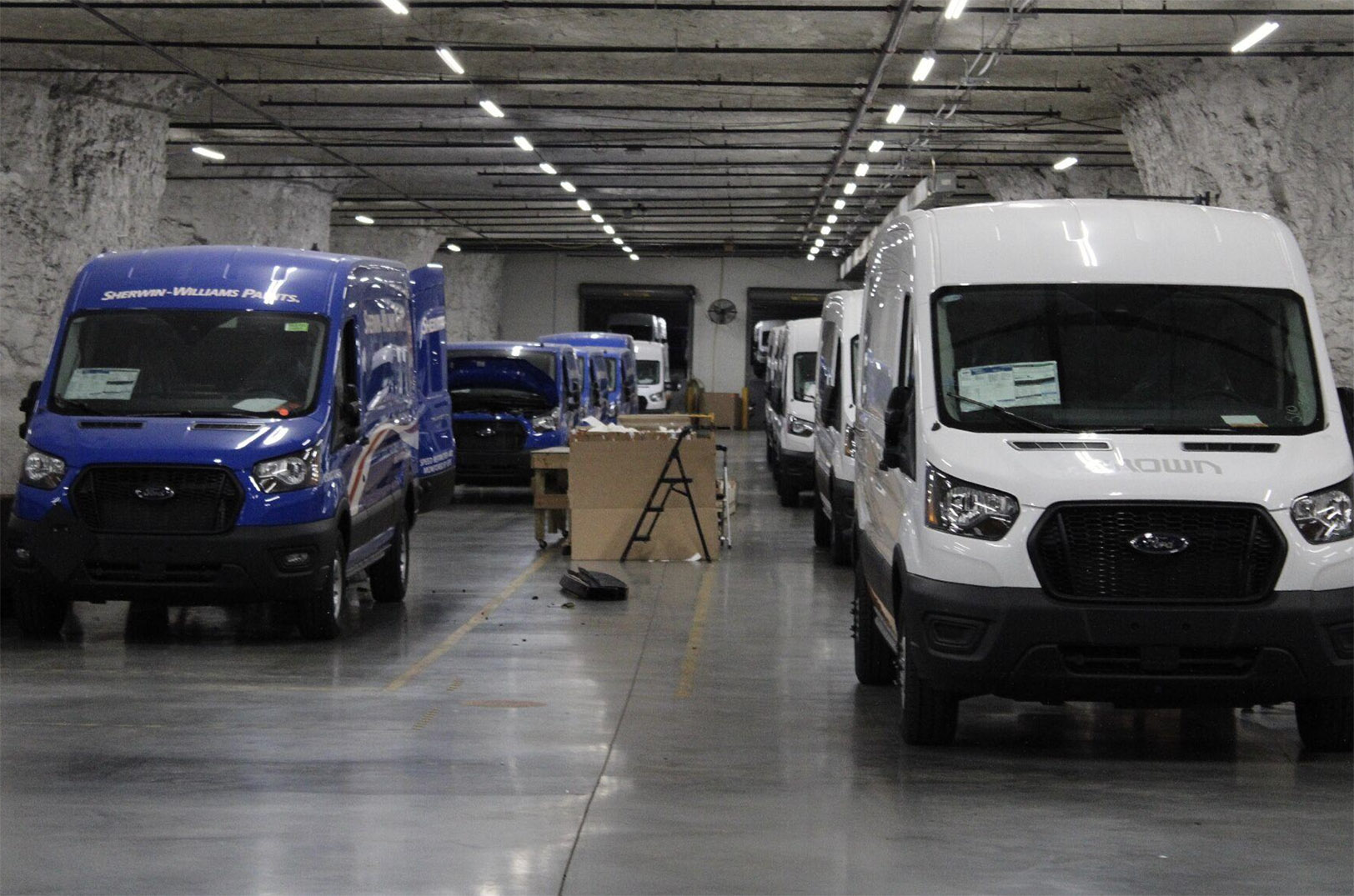
Vans are shuttled through SubTropolis’ “automotive alley,” where vehicles are upfitted and modified; photo by Paige Gerling, Missouri Business Alert
With over 7,000 recorded caves, Missouri is known by some as the cave state. While Missouri is home to many natural caves, it is also home to underground business complexes, which are usually old limestone deposits. Missouri’s unique underground spaces, while distinct from typical caves, are economic drivers hidden just below the surface.
Springfield Underground is a 3.2 million-square-foot underground business complex in Springfield. Businesses first started to settle in the complex in 1960, once enough space was cleared in the former limestone quarry.
SubTropolis is the largest underground business complex in the world. Similar to Springfield Underground, the complex initially started as a depression-era mine, with its hillside location convenient for limestone extraction.
In the 1960s, the mine was cleared out enough for businesses to start operating at the front side of the complex. Ford, Pillsbury and Russell Stover were the complex’s first clients.
Now, SubTropolis has over 8 million square feet of finished building space. Currently, another 6 million square feet is available for development for future use, for an eventual total of 14 million usable square feet.

The developed area of SubTropolis is the size of about 50 to 55 Arrowhead Stadiums, said Justin White, assistant vice president of operations for Hunt Midwest. A real estate development company held by the Hunt family, Hunt Midwest owns SubTropolis. The Hunt family also owns the Kansas City Chiefs.
Advantages of SubTropolis include the controlled temperature, which can cut energy costs. In an underground environment, like a cave, the air tends to stay relatively the same temperature year-round since it is insulated from outdoor elements.
The complex also offers the ability to construct buildings at a faster pace compared to an above-ground building. White said that buildings with up to 200,000 square feet of space can be constructed in approximately 120 days in SubTropolis. Since there are already floors and ceilings in place, it doesn’t take as long to acquire permits and complete construction.
“Especially in the permitting climate today and (with) lead time issues for a lot of (equipment), it allows us to stay far ahead of the curve for businesses either wanting to expand organic growth within the facility, or businesses who are moving to SubTropolis for the first time,” White said.
Springfield Underground also advertises similar benefits, with the climate-controlled space being attractive to its tenants, most of whom work in the food industry. Springfield Underground is owned by the Erlen Group, a real estate company based in Springfield.
“A lot of our tenants are using industrial space for distribution and storage. There is some manufacturing. Most of them value the space because it’s resilient, and it’s cost-effective for whatever their uses. So in most cases, it’s food,” said Christina Angle, chief financial officer of Erlen Group. “We’ve got a strong food manufacturing community here in Springfield.”
SubTropolis works with government agencies like the United States Postal Service, the National Archives and Records Administration and the Environmental Protection Agency. Other tenants include printing businesses and automotive companies.
NextPage, a printing company, has 180,000 square feet of office and printing space in SubTropolis.
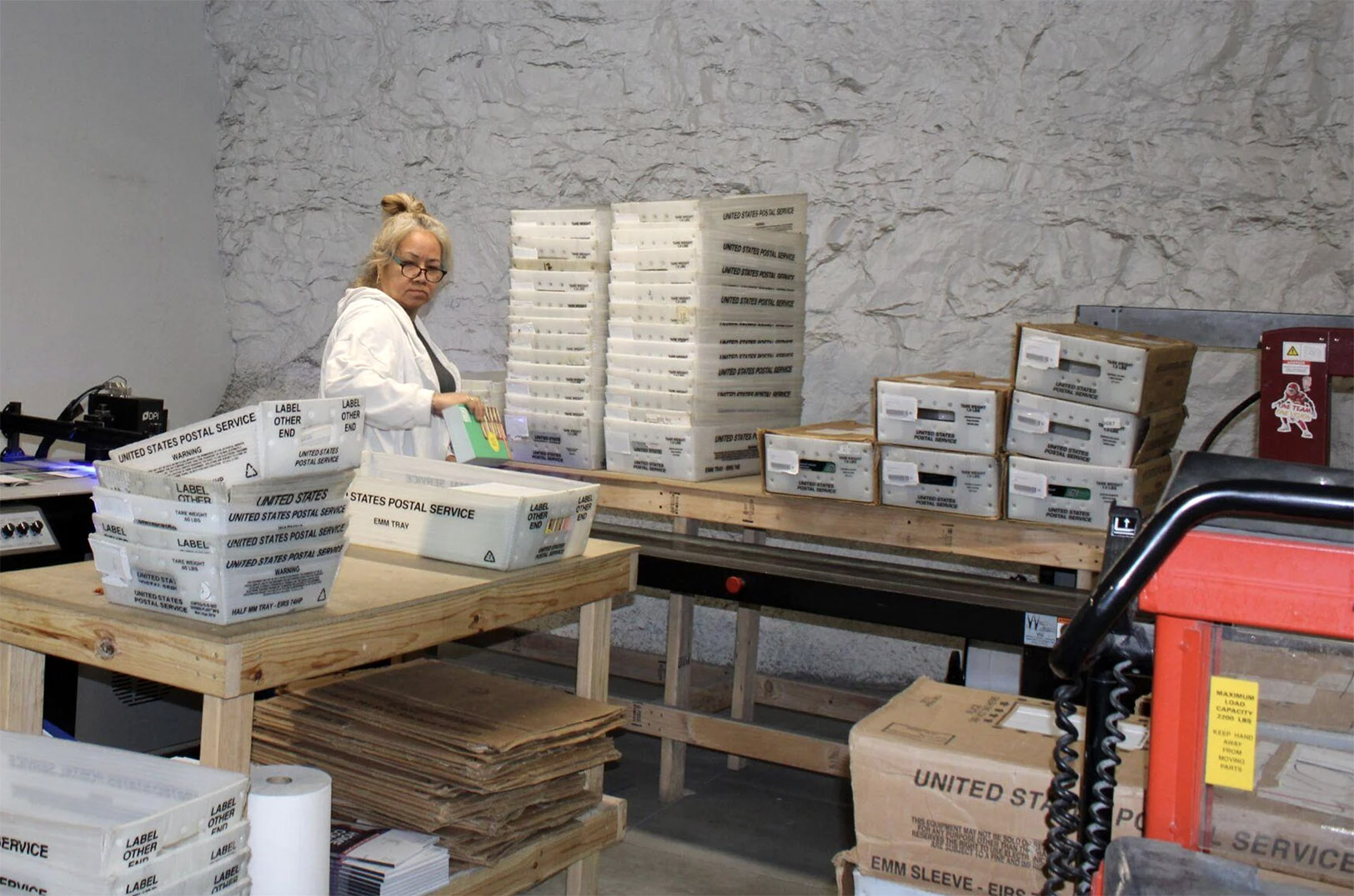
An employee at NextPage in SubTropolis sorts products; photo by Paige Gerling, Missouri Business Alert
“We use a lot of electricity, more so than a lot of tenants here in the underground because we’re running all kinds of equipment. And because we’re dealing with ink, we need to ensure consistent drying of the ink and management of the paper,” said Gina Danner, CEO of NextPage. “Paper is really a sponge. It absorbs moisture just like it’s something in your basement. So being in the underground allows us to more efficiently heat and cool and manage our humidity.”
Both complexes also house data centers that utilize the cooler temperatures and location to process data and interact with other businesses.
“We’ve got a data center that values it, because it’s out of the way of weather. So they have a lot less environmental risk, as well. The building’s not going to be taken out by a tornado, for example. They also use the 62-degree air as the kind of built-in air conditioning … to cool the servers,” Angle said. “And then they liked the fact that it’s protected … you don’t have people who can get in through sort of a backdoor from a cybersecurity risk perspective.”
Subash Alias, CEO of Missouri Partnership, a public-private economic development organization that aims to attract businesses to Missouri, said the state’s multiple underground complexes make it an attractive place for business.
“A lot of other states cannot make that claim,” Alias said. “So we really love being able to tout our underground capabilities.”
Alias said real estate is a key concern for some companies. Many underground complexes utilize columns of rock to support the limestone structure, which could pose obstacles for companies looking for wide open spaces. Alias said the underground division of SubTropolis is well-suited for companies seeking smaller sites and said that it contributes to diversification in the state, having both small and large sites available for businesses.
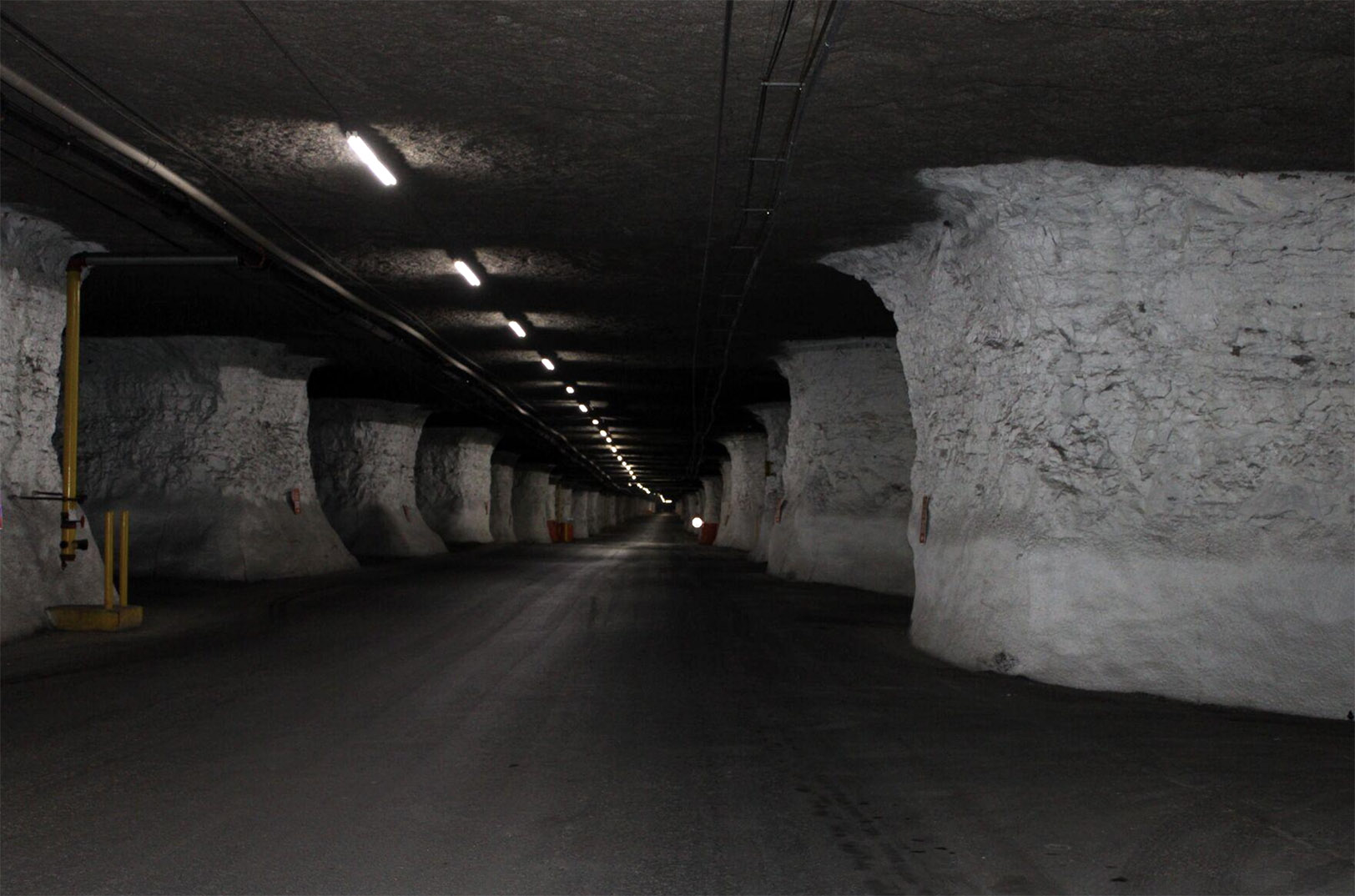
Pillars line part of the SubTropolis complex, where businesses have yet to occupy; photo by Paige Gerling, Missouri Business Alert
As for SubTropolis, the complex continues to develop, with upkeep being no small task. Painting the limestone is often a never-ending job.
“You can tell how quickly it gets dusty…” Zach Murdock, manager of corporate communications at Subtropolis said of the limestone. “By the time they’ll paint every pillar here just about every year, and they start at the front (and) work their way back. By the time they’re done, it’s January and they start all over again.”


2024 Startups to Watch
stats here
Related Posts on Startland News
Mommy Meals designs simple dinner kits for delivery to new moms
KC-cooked startup Mommy Meals aims to serve impact — not just dinner — attempting to tackle a growing mental health experience one hot plate at a time, said its co-founders. “I truly believe if you’re in a tough spot — you’re down on your luck, you’re in a dark spot — I always tell people ‘Go…
FlipSwitch VR visualizes scaling its active, multiplayer gaming concept from Crossroads
Kansas City could be the virtual reality hub of America, said Michael Eichenseer, predicting Crossroads-located FlipSwitch VR will jumpstart the movement with the help of First Fridays foot traffic. “The owners [KC natives Jim and Jamie Mahoney] definitely want to expand,” said Eichenseer, host and marketing manager for the “epic scale, free-roam, multiplayer virtual reality”…
PHOTOS: Startland’s biggest event yet celebrates 2019 future newsmakers
Founders, investors and audience members were treated to a glimpse of their potential futures Thursday night during Startland’s Startups to Watch in 2019 celebration. The premier event — presented at the Copaken Stage by Kansas City-grown and headquartered H&R Block — showcased 12 companies featured on Startland’s recent list of the most anticipated newsmakers for…

OP-based Innovation in Motion angel fund finds sweet spot in seed stage startups
A financial haven for entrepreneurs with fresh ideas in the agriculture, animal and human health spaces, Innovation in Motion (IIM) has made its ninth angel investment, said Lydia Kinkade. “We look for companies that are solving big problems, have a stellar team, and are poised to grow quickly,” said Kinkade, the Overland Park-sown fund’s managing…