

Resource revival: Digital Inclusion Fund relaunches with initial grants focused on devices
May 7, 2024 | Startland News Staff

Kansas Citians can’t upgrade skills or devices they don’t already have, said organizers of a newly relaunched Digital Inclusion Fund — emphasizing a need to attack the metro’s digital divide at the infrastructure level.

The fund is set to award up to $250,000 to 501(c)(3) public charities (including schools and churches) or governmental entities across three grant cycles in 2024, starting with devices grants. Applications open June 3.
“There is an ongoing need for devices, both at an individual level and a shared-use level,” organizers of the fund said in a press release. “Devices are a prerequisite for participating in digital life and are a fixed, hard cost that providers often don’t have the budget to cover.”
Click here for more information on the fund, which is led by KC Digital Drive and administered by the Greater Kansas City Community Foundation, with initial support from the Health Forward Foundation, Kauffman Foundation, Kansas Health Foundation and Google Fiber.
The second cycle of the Digital Inclusion Fund is expected to offer IT support grants (opening Aug. 1), followed by New Courses Grants (Oct. 1).
Each cycle has its own request for applications, application requirements and evaluation criteria. KC Digital Drive will provide applicant support through informational events, office hours and 1:1 assistance leading up to each grant cycle; and will provide tech support, and evaluation and reporting assistance to all grantees.
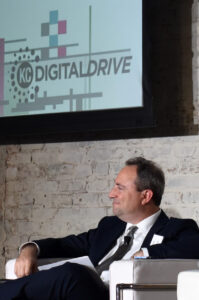
Aaron Deacon, KC Digital Drive, sits on stage during a 2022 event celebrating KC Digital Drive’s 10th anniversary; Photo by Channa Steinmetz, Startland News
“The digital divide continues to be a persistent barrier to participation in society in all its forms — from workforce and the economy to social and cultural life, from democracy and political decision-making, to education and healthcare,” said Aaron Deacon, managing director of KC Digital Drive.
“Digital inclusion is a compounding challenge bound up with many other barriers to participation in society — and technology and access alone will not resolve these issues,” he continued. “The fund aims to advance a more systemic strategy toward addressing the digital divide by filling specific programmatic gaps and signaling strong ongoing community commitment to the issue; and to attract new local money to this cause beyond existing funders, further strengthening the region’s competitiveness for state and federal dollars.”
Originally established in 2013 to address digital literacy and technology access, the Digital Inclusion Fund previously provided just under $1 million to 33 grantees over five cycles with funding from Google Fiber (or GFiber), the Sprint Foundation, The Illig Family Foundation, Polsinelli, Global Prairie and JE Dunn.
ICYMI: 10 years later: Google Fiber boosted city’s ‘capacity for collaboration,’ former mayor says
Now, based on findings from a recent funding landscape analysis white paper, KC Digital Drive is picking up where the former fund left off.
The relaunched fund aims to support 501(c)(3) public charities, educational or governmental entities that focus on digital inclusion access, affordability and adoption to increase participation in digital society for Kansas City’s most underserved and/or disconnected residents.
In addition to leadership from KC Digital Drive and the Greater Kansas City Community Foundation, the fund boasts an advisory council that includes Dred Scott, president of the Civic Council of Greater Kansas City; CiCi Rojas, president of Tico Productions; Adriana Pecina, impact strategist at Health Forward Foundation; and Rachel Merlo, head of government and community affairs (Central + OC, CA), GFiber.
“This is all about digital infrastructure in communities, and I’m most excited to see how this will impact grass-roots community organizations and help them to demonstrate the social impact of digital inclusion, and prove and improve year over year,” said Pecina.


2024 Startups to Watch
stats here
Related Posts on Startland News

Three fathers bring Whizz Bang potty-training game to market through Make48, Handy Camel
The Whizz Bang gamifies potty training and saves the bathroom floors of all parents, said Amy Gray. The device, which hooks on the underside of a toilet seat lid, emits a LED light target at the bottom the bowl. Once hit, the device plays musical praise, said Gray, the head of sales for Handy Camel,…

Reconciliation Services hopes to heal trauma in the heart of stigmatized Troost corridor
Commanded by Scripture, David Altschul journeyed into parts unknown, said his successor, Father Justin Mathews. In the mid-1980s, a philanthropic pull tugged at the heart of Altschul — a white, insurance salesman from Johnson County — and eventually led him into the distressed, history-rich neighborhoods that lined Troost Avenue on the east side of…

Thelma’s Kitchen cooks up pay-what-you-can cafe concept to preserve community
Twenty people once filled the kitchen of Thelma Gardner’s apartment in search of their next meal. Their hunger for food fueled her hunger for humanity, recounted Father Justin Mathews as he sat sipping coffee in the newly opened Thelma’s Kitchen. The pay-what-you-can restaurant — located inside of the Reconciliation Services building at 3101 Troost Ave.…
Operation Breakthrough bridge over Troost symbolizes ‘real community’ at an intersection
With reflection in his voice, Alvin Brooks paused. “The city has to be a partner,” the Civil Rights activist and veteran Kansas City Police Commissioner said as he spoke of the redevelopment of Troost Avenue — the well known racial dividing line, that has long isolated the east side of the Kansas City metro from the…