

For the loaf of the grain: Jonny Bakes bread, expands to keep community nourishment rising
May 23, 2024 | Jill Wendholt Silva
Editor’s note: This story was originally published by Kansas City PBS/Flatland, a member of the Kansas City Media Collective, which also includes Startland News, KCUR 89.3, American Public Square, The Kansas City Beacon, and Missouri Business Alert.
Click here to read the original story.
Brookside bread baker works to reestablish the local grain shed
Jon Szajnuk’s sourdough starter had gone dormant due to lack of care and feeding, lingering in the back of his refrigerator for a few years waiting for a renewed spark of interest.
When the COVID pandemic hit, Szajnuk revived the starter. In doing so, he unwittingly joined a community of homebound sourdough bread bakers gathering in the virtual space of the internet to trade recipes and baking tips.
“I just needed to make bread, and so I did. I don’t always learn things quickly. I don’t get things right the first time a lot, so I just needed to practice,” said Szajnuk, who has baked 20,000 loaves in the last four years.
His early practice loaves made their way to a few friends, which led to deliveries around the metro, which led to Jonny Bakes, a cottage bread bakery that is quickly outgrowing his 1920s Brookside bungalow.
Each Saturday morning at the Brookside Farmers Market, Szajnuk sells 140 crusty organic whole-grain sourdough loaves in about 90 minutes.
“It’s fresher, tastes better. It pretty obviously doesn’t look store bought, or have any stabilizers, or added preservatives to give it a longer shelf life,” said Kem Tae Lynch, who counts herself among Jonny Bakes’ die-hard customers.
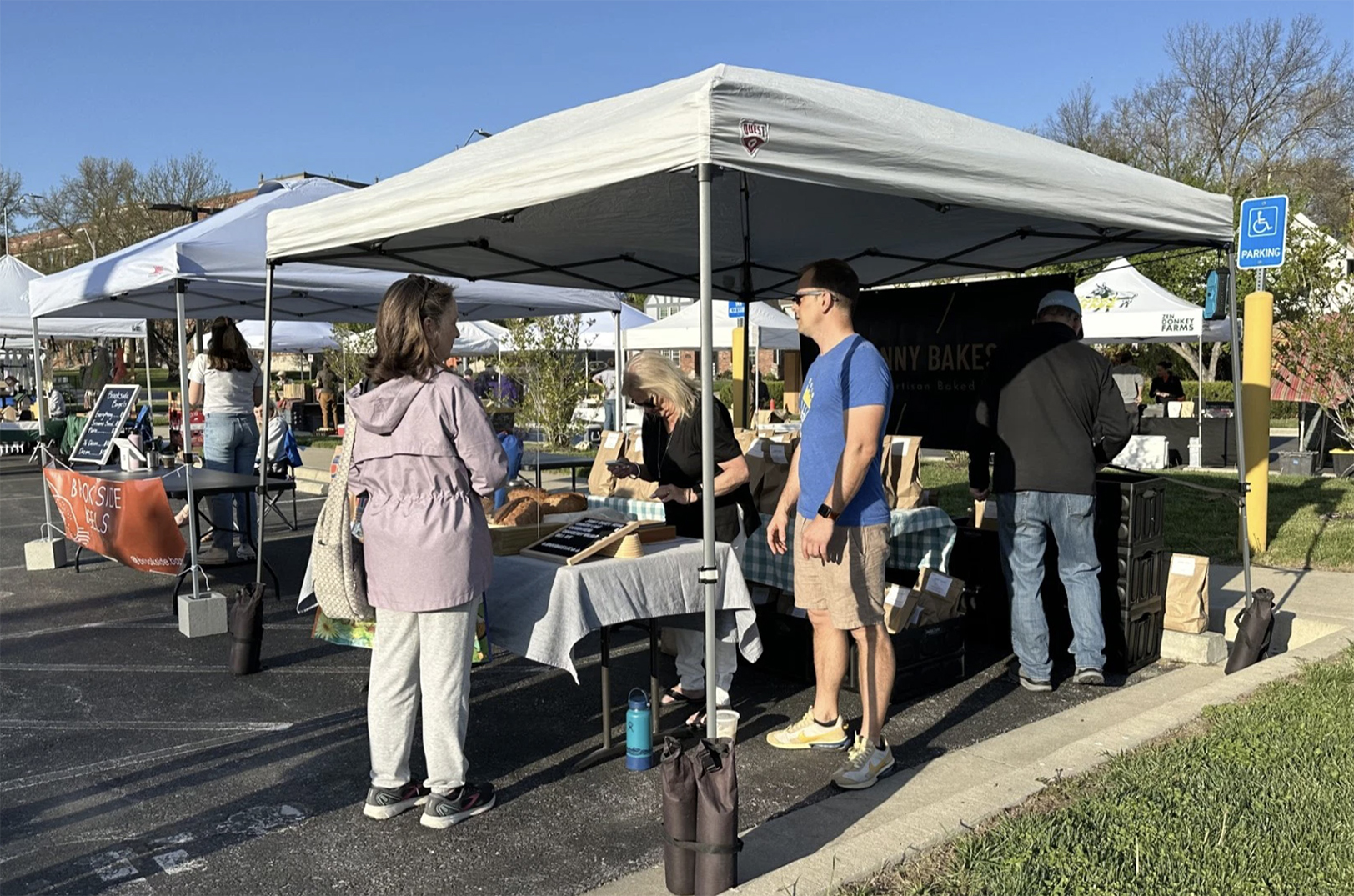
Jon Szajnuk sells bread every Saturday at the Brookside Farmers Market. Fans know to order early for pickup because he typically sells out in about 90 minutes; photo by Jill Wendholt Silva, Flatland
In turn, the Kansas City bread community has sustained Szajnuk through the ups and downs of life, including symptoms after a seven-hour delivery day in 2021 that led to a diagnosis of testicular cancer.
“The community I had built really rallied around me with meals and genuine concern and caring,” he said. “Those relationships are what sustains me when it’s a 16-hour day of hand shaping loaves in my backroom-converted-screened-in-porch.”
Bread in a Bungalow
On a recent Thursday morning, Szajnuk plops a tub of dough onto a work surface and kneads. He portions the elastic lumps and places them into oval baskets to proof. He already has more loaves rising in his basement cooler, which barely made it as it was rolled at a precipitous slant down the steep stairs and nearly scraped the ceiling when set upright.
Szajnuk removes the loaves from their snug baskets and slashes the crust with a razor blade — one long cut down the side for moisture to escape then a few shorter ones for a signature artisan bread aesthetic.
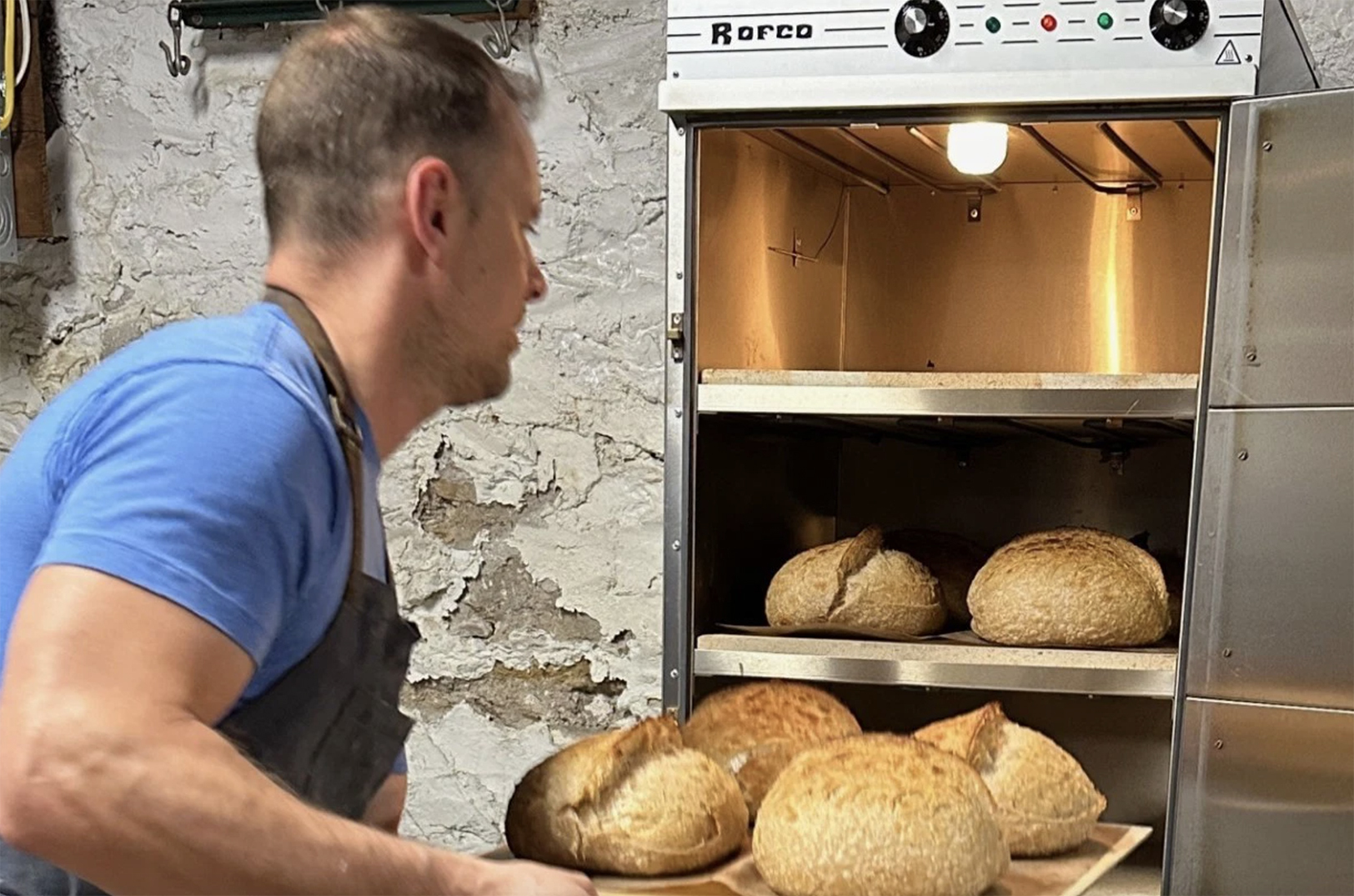
The loaves bake in a Belgian-made steam oven — steam being a crucial element in creating a harder, European-style artisan crust. After the loaves cool for a few hours, he packages them in craft-paper bags (“there’s no reason bread needs to be wrapped in plastic because it softens the crust’) and adds a label he affixes by hand.
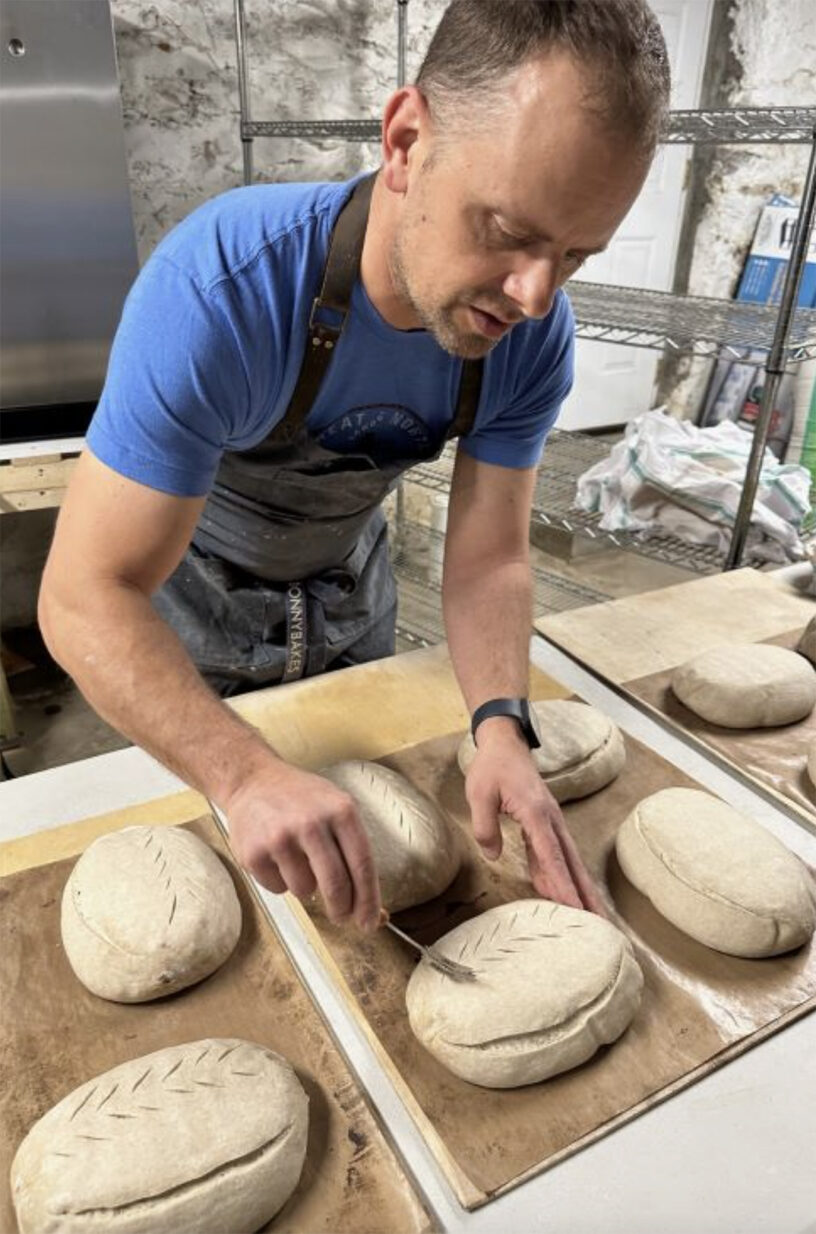
Jon Szajnuk uses a tool to etch designs with a purpose in the tiny bakery in his Brookside basement; photo by Jill Wendholt Silva, Flatland
His ingredient list is simple: flour, water and salt. Unlike commercial breads, he does not use commercial yeast, chemical leaveners or citric acid.
Szajnuk was an English major in college but found himself gravitating to jobs at bars and restaurants for the next two decades because, as he wryly jokes, “you can’t work on the English factory at the edge of town.”
He credits working with Harry Murphy of Harry’s Country Club (the one in River Market, not Bars & Tables in Westport, which he once owned) for sparking his interest in fermentation.
“We would sit down, split a beer of whatever was new and split a quarter ounce of whatever new whiskey he had brought in, and talk about fermentation and how the simplest things can be the best things, and it really guided all my future career decisions,” he said.
Szajnuk spent several years working at a brewery in Montana, where he learned more about fermentation and specialty grains. He worked on organic farms in Belize and, closer to home, at Cultivate KC.
He is as surprised as anyone to have stumbled onto his knack for baking bread.
“I just wanted to make bread I wanted to eat, and I found out a lot of other people want to eat that kind of bread, and it’s not that easy to find,” he said.
Regional Grain Economy
One of the distinguishing characteristics of Jonny Bakes loaves is they are made from freshly milled, locally sourced organic grains from Marion Milling located in the West Bottoms.
Will Berndt was a bread baker when Messenger Coffee + Ibis Bakery downtown had a local milling program. When the company was bought and onsite milling was stopped, Berndt continued efforts to recreate a regional grain economy by milling locally grown grains into flour.
“We mill every day, fresh, to order. We don’t add anything, and it hasn’t been sitting in a warehouse,” said Berndt, whose client list includes The Town Company, Zero Zero, Hemma Hemma and Fox and Bull Baking Co.
While Kansas is a historic region for growing grain, the Wonder Bread Era made it difficult to find locally milled flour. By contrast, Berndt works directly with farms like 180 Farms in Sweet Springs, Missouri, and mills the wheat a day before Szajnuk bakes his bread.
Marion Milling’s bread-and-butter is an heirloom wheat variety known as Turkey Red, which made its way to Kansas in the 1800s with Mennonite farmers, who settled in Marion County, Kansas. The variety thrived on the Central Plains but fell out of favor in the mid-1940s as grain milling conglomerates looking to streamline the process found it was easier to leave out the germ and bran because it is not shelf stable.
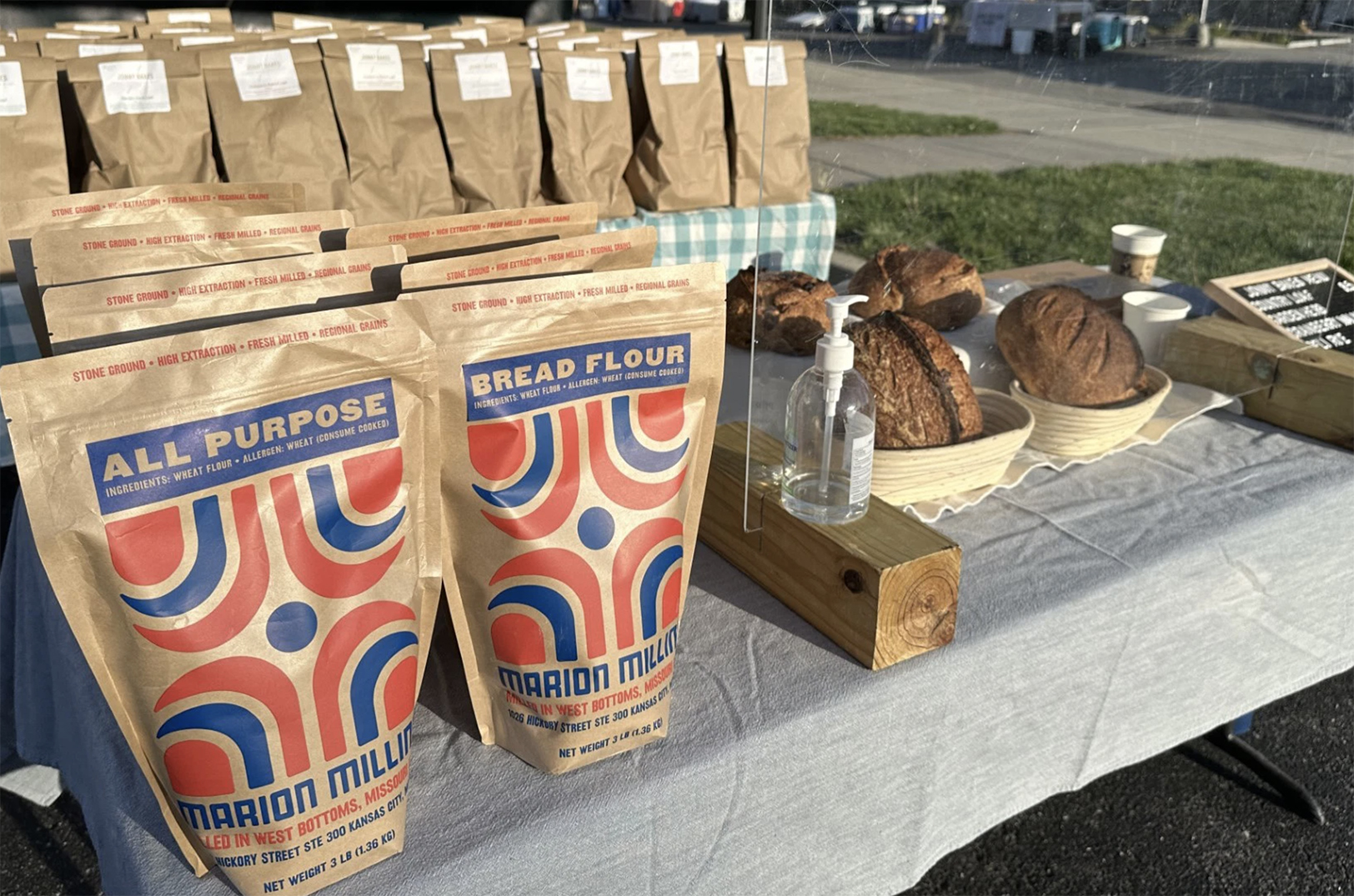
Johnny Bakes breads feature flour by Marion Milling, a local milling company in the West Bottoms that sources grain grown at local farms, including 180 Farms in Sweet Springs, Missouri; photo by Jill Wendholt Silva, Flatland
“Even if it’s high quality (flour), it’s probably still roller milled, so you’re just retaining the endosperm, the starchy part, but you’re leaving out the germ and the bran, which has all the nutrients and flavor,” Szajnuk said.
Jonny Bakes’ best-selling country loaf ($9) has a distinctly wheat-y flavor with sweet, grassy and nutty notes and a robust, chewy crust.
“I like the locally milled flour, to retain all the nutrients, and I’m confident there’s nothing in the bread I don’t want,” said self-declared “superfan” Valerie Lovan of Mission.
“It’s denser than most bread you get at the store,” said Brien Darby, a customer and executive director of Cultivate KC, who always has a loaf tucked away in the freezer.
Her husband bought an old-fashioned bread box to prolong the natural two-to-three-day shelf life. If the bread goes stale, they make croutons. But as a rule, the family tends to eat the bread faster than when they bought bread from the grocery store.
After she was unable to enjoy commercially made bread for 20 years, Darby finds the less processed bread is more easily digestible.
Szajnuk has heard similar anecdotal evidence from other customers, and he offers three possible explanations for a reduced sensitivity:
- The use of organic grain grown without fungicides and pesticides.
- A milling process that preserves the whole-grain nutrition (balancing the starch component).
- And sourdough’s natural fermentation, which is, in essence, a form of pre-digestion.
“Modern methods create consistent results but sacrifice flavor and digestibility,” he said.
Community Driven
Achieving a perfect loaf of sourdough bread will be a life-long endeavor for Szajnuk.
“I can’t always define why (bread baking) feels so natural for me, but there is something there. If there is generational trauma that we store within ourselves, perhaps there’s generational goodness also that our bodies respond to,” he said.
“It’s about trying to connect with people on a real level, and feeling like you’re feeding their souls with something that taps into their generational knowledge feels good. Wars have been fought over bread and the sustaining power of such a simple thing.”
To keep up with the current demand, he’s added a mid-week bake of 25-35 loaves for the Urbavore Urban Farm’s online store and more as an add-on to their community supported agriculture program. But he is working six days a week and can’t keep up. What’s worse, he hates to tell potential customers who drive in from Blue Springs that he is sold out.
In response, Szajnuk is making plans to move out of the house and find a small bakery where he can expand and add baked goods that have a higher profit margin.
“I’m very risk averse, but I’m now accepting the course… and trust in the community I’ve built and the people I’ve gotten to know, and I have faith that’s why it’s going to work,” Szajnuk said.
Szajnuk has joined the Artisan Grain Collaborative, a nonprofit collection of Midwestern farmers, bakers, brewers and millers dedicated to rebuilding a local grain shed. Displayed on the table next to his loaves of bread at the Saturday markets, Szajnuk helps sell bags of Marion Milling flours.
“I could give you a bag of flour and you couldn’t eat it and live, but you turn grain into flour and bake bread that will sustain life, and I like to remember that when people are freaking out about their starter,” Szajnuk said.
Jill Silva is a James Beard award-winning food editor and writer.


2024 Startups to Watch
stats here
Related Posts on Startland News

Dreamgirl hits the start button at SXSW; why the KC band tells its peers to break out of the Midwest
Editor’s note: The following story is part of Startland News’ coverage of the SXSW conference in Austin. Click here to read more stories from the 2022 trip. AUSTIN — Dreamgirl describes itself as a family — a bit dysfunctional at times, but nonetheless family, members of the Kansas City-based band shared, laughing the morning before their…

Climate change innovation, leadership must be built at the local level, Buttigieg tells SXSW
Editor’s note: The following story is part of Startland News’ coverage of the SXSW conference in Austin. Click here to read more stories from the 2022 trip. AUSTIN — The keys to solving climate change could already be in the ignition, Pete Buttigieg said, empowering a crowd of innovation leaders to sit in the passenger…
Sit Foundry takes a stand for ‘lost art’ of upholstery amid fast furniture’s climate threat
Alex Krause Matlack is bringing what she teaches in the classroom to Kansas City’s entrepreneurial ecosystem as she pursues Sit Foundry — an all-inclusive reupholstery design studio. “In the first week of my Intro to Entrepreneurship class, I tell my students to go out into the world and take notice of the problems they face.…

De-risking a dangerous job: How a window washing startup is raising the bar (and hose) with drones
It’s a nightmare to clean the windows of multi-story buildings, said Andrew Brain. “It’s incredibly unsafe for folks to be hanging on the side of buildings — and it’s incredibly expensive for them to be there. Insurance liability has gone up 300 to 400 percent. … I was thinking that there’s got to be a…