

FAQ: How KC’s riverfront is going from a dumping ground to an entertainment district
May 20, 2024 | Josh Merchant
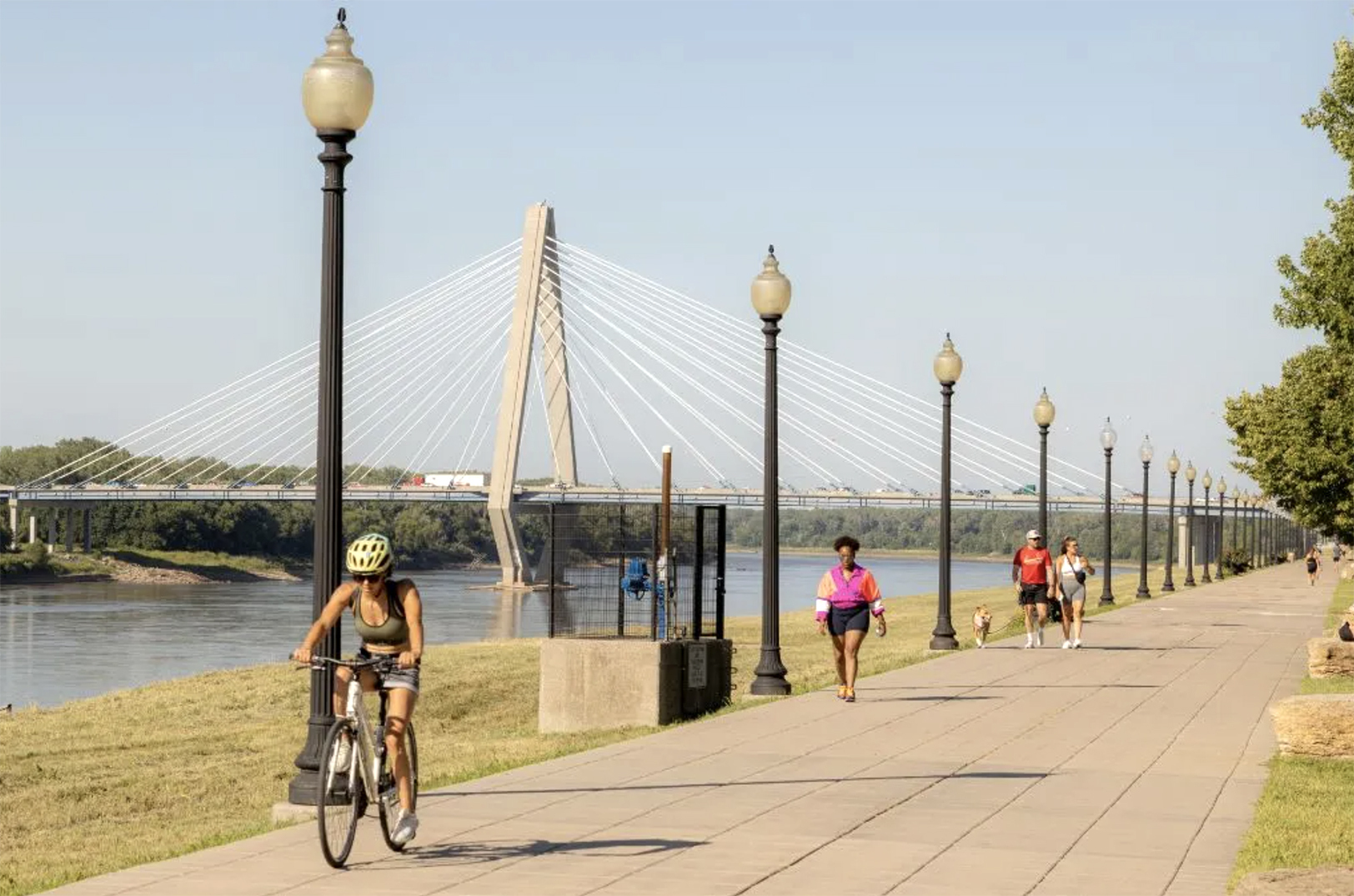
Editor’s note: This story was originally published by The Kansas City Beacon, a member of the KC Media Collective, which also includes Startland News, KCUR 89.3, American Public Square, Kansas City PBS/Flatland, and Missouri Business Alert.
Click here to read the original story from The Kansas City Beacon, an online news outlet focused on local, in-depth journalism in the public interest.
A sparkly new development coming to Kansas City’s riverfront?
Like we haven’t heard that line before.
Seemingly every decade like clockwork, somebody pushes an idea that would finally put Kansas City’s 55-acre blemish along the Missouri River to good use. And, inevitably, the proposal ends up elsewhere — and the riverfront remains empty.
It’s not for lack of trying. In the seven decades since the city took over this land, public officials and profit-sniffing developers have made pitches for turning the riverfront into a premier spot for a baseball stadium, an aquarium, government offices, a marina — the list goes on.
But this time, it looks to be finally happening. Like, really, truly happening.
Since 2015, the lots lining the riverfront have started quietly filling up with apartments, a beer garden, a boutique hotel and the world’s first soccer stadium built for a women’s pro team.
In a few months, the Berkley Riverfront will break ground on the next stage of development, bringing storefronts and more apartments next to the KC Current stadium.
After that, the construction will stretch west along Berkley Parkway toward River Market. When it’s done, its backers promise Kansas City a walkable neighborhood that mixes apartments and stores connected to downtown by a streetcar line and pedestrian walkways.
But building a neighborhood from scratch is a massive undertaking, and minor decisions can determine its fate for decades.
The Beacon has prepared a guide to what Kansas City residents can expect from the new riverfront district.
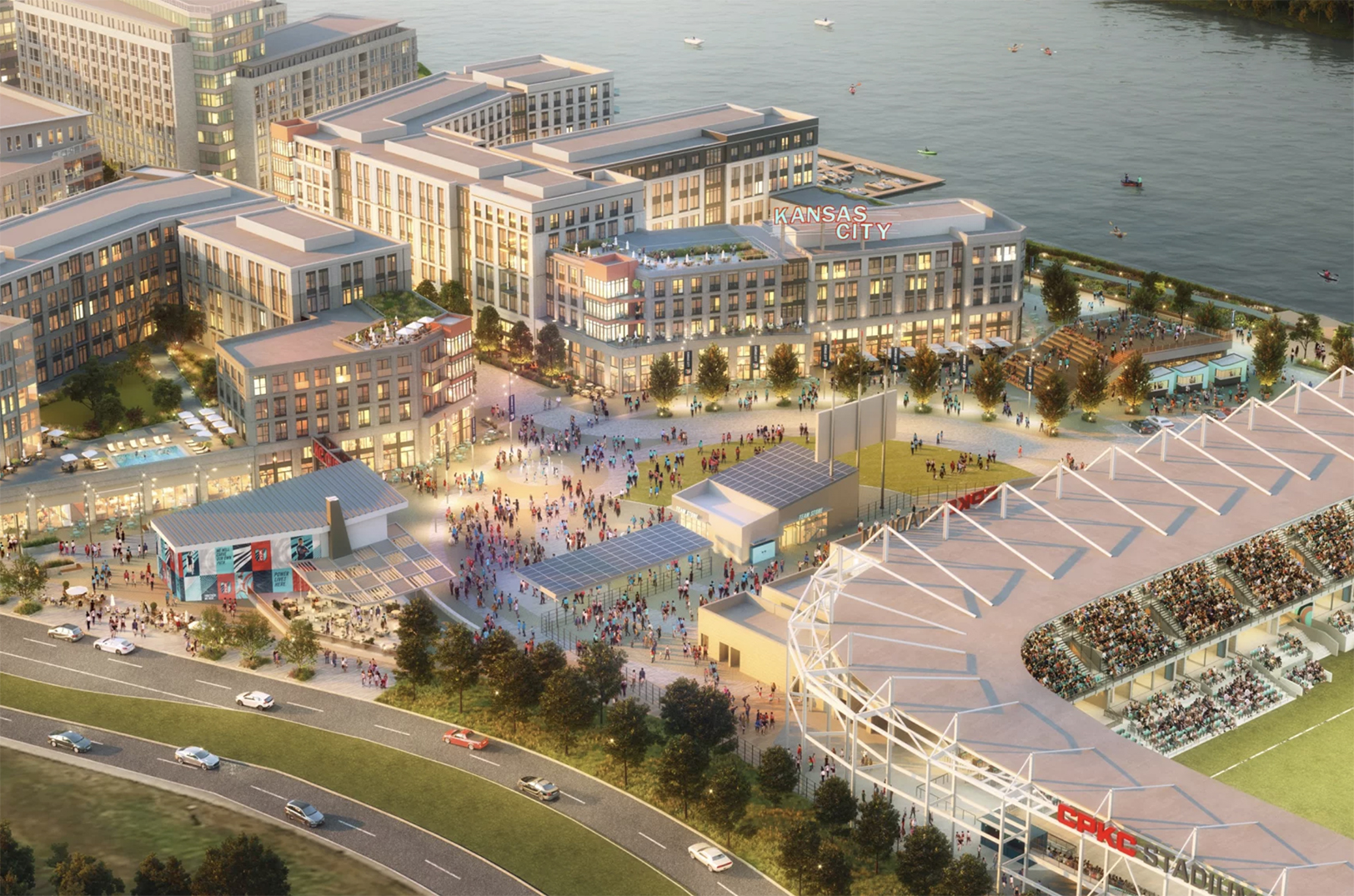
The Kansas City Current and Port KC proposed building an entertainment district and mixed-use development around CPKC Stadium on the Berkley Riverfront; rendering courtesy of the KC Current
Who’s in charge of the development?
A state agency called the Port Authority of Kansas City oversees development projects along riverways, railroads and near some airports.
Port KC took ownership of the riverfront several decades ago and its leadership — appointed by the mayor — holds the power to OK projects and hand out tax breaks to spur development.
The new riverfront project has worked with developers like the Mississippi-based Thrash Group (which will operate a boutique hotel and beer garden), and the riverfront’s latest expansion is part of a partnership with the KC Current.
Because Port KC is a state agency, it’s exempted from city development ordinances. That’s why its projects aren’t required to include affordable housing and go through a less rigorous financial analysis than projects overseen by the city’s Economic Development Corp.

CPKC Stadium, the new home of the Kansas City Current, sits on the Berkeley Riverfront; photo courtesy of the KC Current
Are my tax dollars involved?
Kind of.
Like most public transportation, the new riverfront streetcar extension gets tax dollars from the federal government, the Kansas City Area Transportation Authority, City Hall and KC Streetcar. The federal government is contributing $35 million and local taxpayers are adding $26 million.
The actual developments indirectly receive tax money through incentives.
Port KC still owns the land being developed, and as a government agency, it doesn’t owe property taxes. When it leases the land to developers, the agency has the freedom to set custom tax rates that are lower than what the developer would ordinarily owe.
The latest phase of development will only pay 5% to 10% of its property taxes for the next 10 years. After that, it will pay 100% of its property taxes.
In short, Port KC doesn’t give developers tax money, but it gives away tax breaks at the expense of libraries, schools and mental health services.
That’s why those taxing jurisdictions have criticized Port KC and the Berkley Riverfront project for being overly generous. They say Port KC projects don’t face the same level of financial scrutiny as city-approved developments.
Port KC argues that an empty riverfront generates no tax revenue, so any development — even at a discount — offers a chance to take some of the tax burden off other property owners.

The Kansas City Current and Port KC announced a vision for a new walkable district on the Berkley Riverfront around CPKC Stadium; rendering courtesy of the KC Current
When is construction going to be complete?
Some construction is already done.
The KC Current is hosting matches at the stadium, and hundreds of people already live in the two apartment complexes that opened a few years ago.
The Origin Hotel will open its doors on July 3 and a beer garden is expected to open by September.
The next major stage of construction, including 200 apartments and 23,000 square feet of retail, will break ground after this year’s KC Current season ends in November. Meredith Hoenes, a spokesperson for Port KC, said developers want to finish the first phase within two years, before the 2026 World Cup.
The rest of the 11-acre project has a 10-year construction timeline.
When can I take the streetcar down there?
The streetcar will extend from River Market along Berkley Parkway to a stop just outside the Origin Hotel, a quarter-mile west of the stadium. Construction began on March 1, with a two-year construction timeline.
It’s expected to be finished before the 2026 World Cup.
Is there going to be affordable housing?
That depends on your definition of “affordable.”
The first phase of construction — including those 200 new apartments — will have 20 units set aside for people making less than 50% of the metro area’s median income.
That means a studio for $900 per month, a one-bedroom for $1,025 per month and a two-bedroom for $1,280 per month.
When it’s done in 10 years, 1,038 total units will be constructed. About 100 of those will be set aside for people making 50% of median income.
What was there before?
Almost two centuries ago, the first white settlers camped along the Missouri River, at a place called the Town of Kansas.
But aside from those archaeological remnants, the area has sat empty for about a hundred years.
Kansas City bought the land in the mid-20th century and, since the 1980s, it’s been used as a dumping ground for random debris, like the Kemper Arena’s collapsed roof and rubble from the demolished Wayne Miner housing complex.
Most of that debris was cleaned up for the Lewis and Clark bicentennial celebration in 2004.
The U.S. Army Corps of Engineers created a wetlands restoration area farther downstream. That will remain mostly untouched during the development.

A sign welcoming people to the Berkley Riverfront; photo by Carlos Moreno, KCUR
When did development start?
Kansas City has been trying to make use of its riverfront since at least 1947.
An early plan called for turning it into a marina and nine-hole golf course. In the 1950s, plans to turn it into a new baseball stadium district fell apart.
Port KC tried again in the 1990s and offered up the land to Sprint (the telecom company that has since been swallowed by T-Mobile) for corporate offices. The project ended up in Overland Park.
In 1998, Kansas City built a heritage trail and park, named after former mayor Richard Berkley, and it seemed like plans were finally moving forward.
“You’ll see this become a premier site in Kansas City in the next five years,” a Port KC chairman said in 2000.
Not so much.
A state-commissioned study in 2002 found that the park had been extensively contaminated by toxic coal tar in the late 19th century. That put plans on hold for another decade.
After a couple more failed pitches, Port KC finally convinced developers to build apartments on the riverfront in 2015.
That kicked off a steady stream of projects culminating in the KC Current stadium, which broke ground in October 2022. Now, the KC Current is overseeing a development master plan breaking ground this fall.
Will any of it be preserved as natural spaces and parks?
The wetland restoration isn’t going away, Hoenes said.
About three acres will be removed from the five-acre ecosystem to bring more trails and public access. In the end, Port KC plans to put five different acres into a wetland preserve.
The large grass lawn north of the existing apartments will stay there and Port KC plans to extend the riverfront trail west along the levee toward Liberty Street in the West Bottoms.


2024 Startups to Watch
stats here
Related Posts on Startland News

Mixed Mutt fetches new home for doggie ice cream shop inside Crossroads pup space
Opportunity continues to bark for Mixed Mutt Creamery, Sherri Corwin said, announcing the dog-friendly ice cream shop will soon move from its Midtown storefront to join forces with another pet-focused small business in the Crossroads Arts District. “This is a huge opportunity for growth,” Corwin told Startland News, detailing a new partnership between Mixed Mutt…
Who’s getting funded in KC? The answer requires a long look in the mirror, analysts say
Editor’s note: Startland News asked industry experts to take an early look at the data behind the 2021 Kansas City Venture Capital-Backed Companies Report — the culmination of a three-month collaboration between UMKC’s Technology Venture Studio and Startland News, and presented by Mylo, a Lockton Company. Below are some of their leading takeaways, along with…

2021 Kansas City’s VC-Backed Companies Report
Higher headcounts and more than a billion dollars in funds raised. The 2021 Kansas City Venture Capital-Backed Companies Report provides a rare snapshot into the bustling, two-state metro’s growth-stage, venture-backed companies. The 2021 report — the culmination of a three-month collaboration between UMKC’s Technology Venture Studio and Startland News — reflects not only ongoing deal…
Microwave meals to dating apps: How Sally Williams harnesses the power of new products for founders
After 40 years in the game, a nearly lifelong career might leave little room for surprises. Yet for Sally Williams, every rise of the sun brings new opportunities, revolving largely around Kansas City’s potential to push the bounds of innovation, she said. “I have clients who have products in the International Space Station and I…