

Some 18th & Vine leaders say losing downtown stadium could have ‘a tremendously negative impact’
April 5, 2024 | Lawrence Brooks IV
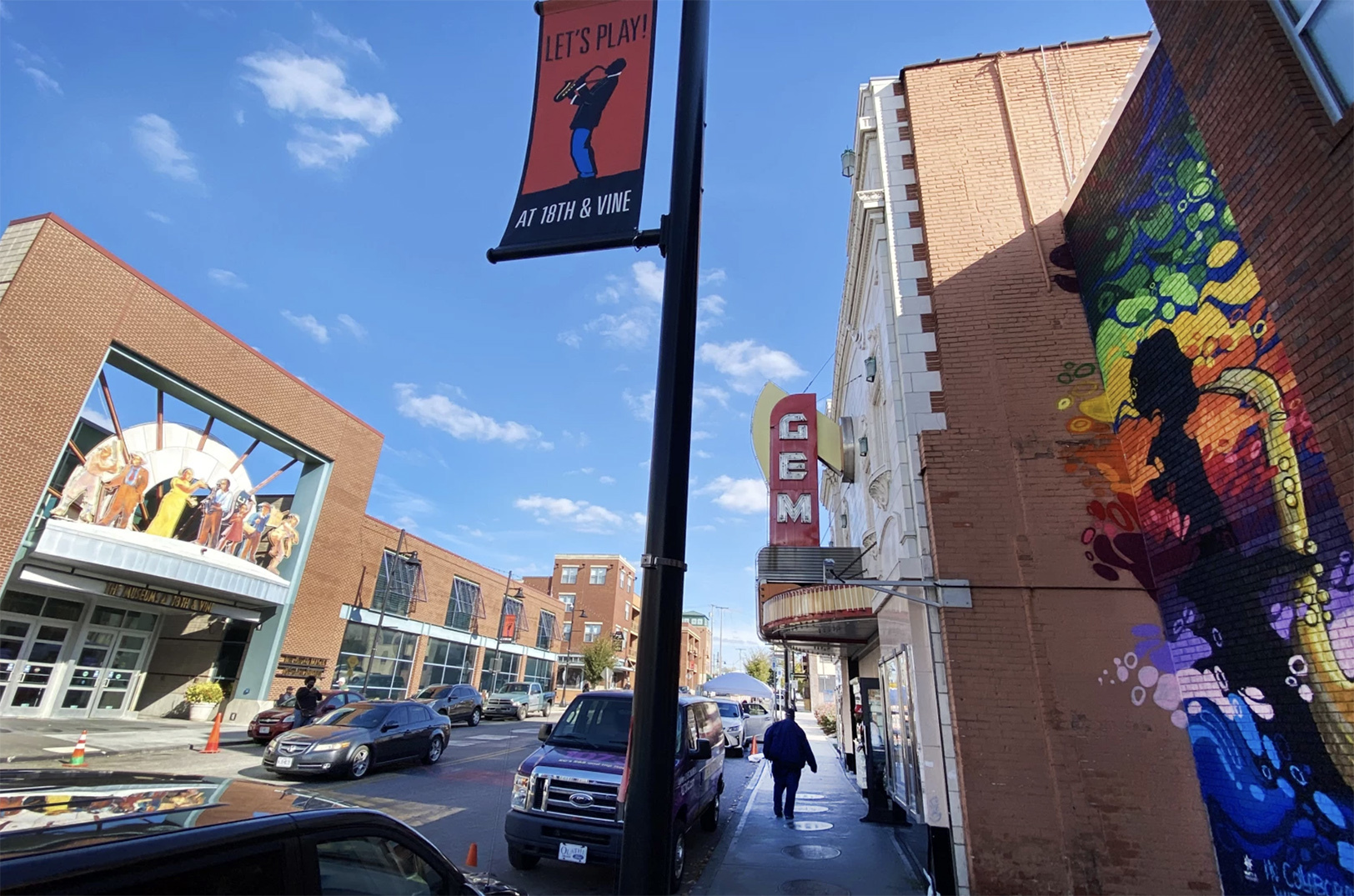
Editor’s note: The following story was published by KCUR, Kansas City’s NPR member station, and a fellow member of the KC Media Collective. Click here to read the original story or here to sign up for KCUR’s email newsletter.
Businesses were split on their reaction to the vote on April 2 that rejected the extension of a 3/8th-cent sales tax for a ballpark in the Crossroads; Some said the loss of a downtown stadium just blocks away would hinder progress in the district. Others said the campaign was doomed from the start
It was at the Paseo YMCA, a stone’s throw from Kansas City’s Negro Leagues Baseball Museum ,tucked between Vine Street and Highland Avenue on 18th Street, that Andrew “Rube” Foster founded the Negro National League in 1920.
Known for their aggressive and fast style of play, Black baseball players weren’t allowed to compete in Major League Baseball until Jackie Robinson, once a Kansas City Monarch, broke the color barrier in 1947. The Monarchs was one of the Leagues’ most famous teams until it disbanded in the early 1950s.
Bob Kendrick, president of the Negro Leagues Baseball Museum in the heart of the historic 18th & Vine district, said to reject the tax for a new downtown ballpark is to ignore this illustrious legacy.
“In a city that has known great championship sports franchises, none more important than the great Kansas City Monarchs,” he said. “So we’ve got a tremendous legacy that we hang our hat on.”
Kendrick believes that legacy, as well as the 18th & Vine district, may be left in limbo now that the dust has settled after Jackson County voters rejected the extension of a 3/8th-cent stadium sales tax. The current tax expires in 2031.
The proposed stadium was to be built in the Crossroads Arts District. As part of the plan, the Kansas City Star Press Pavilion property and some businesses in the Crossroads would be demolished.
Kendrick said the failed election was a missed opportunity for the Black community and the 3rd District, a neighborhood he’s dedicated his life’s work to preserving.
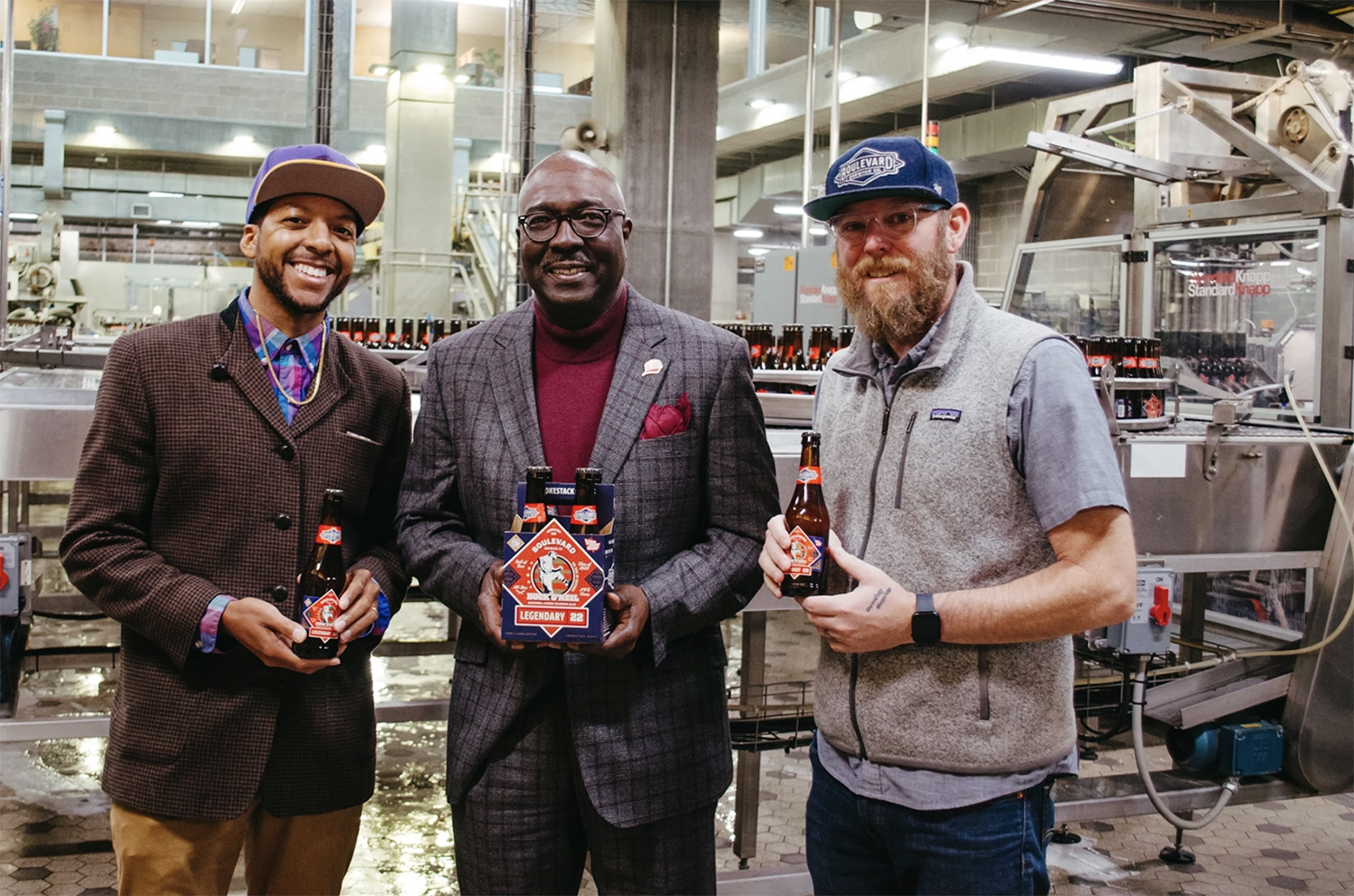
Kemet Coleman, co-founder of Vine Street Brewing; Bob Kendrick, president of the Negro Leagues Baseball Museum; and Adam Hall, Boulevard and Duvel/Moortgot; photo courtesy of Vine Street Brewing
“If we can’t get a resolution on this, I think it’s gonna have a tremendously negative impact on historic 18th & Vine from the standpoint that the ballpark would’ve brought a level of commerce to this district that is sorely needed,” Kendrick said. “And not just the district, but the East Side overall, an area that has been often overlooked, undervalued and underserved.”
Henry Service, 57, is a criminal defense and family law attorney who owns the historic Lincoln Building at the intersection of 18th and Vine Streets. The building went up just a year after the Negro Leagues was established and, in its heyday, leased space to Black professionals and entertainment venues.
“I think it’s gonna be bad for the city,” Service said of the “no” vote.
“I think the jazz district especially has lost an opportunity based on its proximity to the development because we are already on survival mode here and we’re not going to have a potential lifeline for the district.”
Kendrick argues the Negro Leagues Museum, combined with tourism dollars attracted by a new ballpark, would support such revitalization.
“This downtown ballpark is really important, and I would love nothing more than to see a new Negro Leagues Baseball Museum open right around the time that a new downtown ballpark would open,” Kendrick said, “(and) what that would mean in terms of creating this pipeline here from the historic 18th & Vine (neighborhood) to downtown.”
But not all community business owners feel the same way.
Andrea Shelby, 56, owns The Kansas City Blues and Jazz Juke House. It’s a popular bar, grill and dance spot in the district just steps to the east of the Negro Leagues Baseball Museum. The business also serves as a hub for Kansas City’s two-step dance community and Black creatives who often perform live on Monday nights at “Open Mic Soul Sessions.”
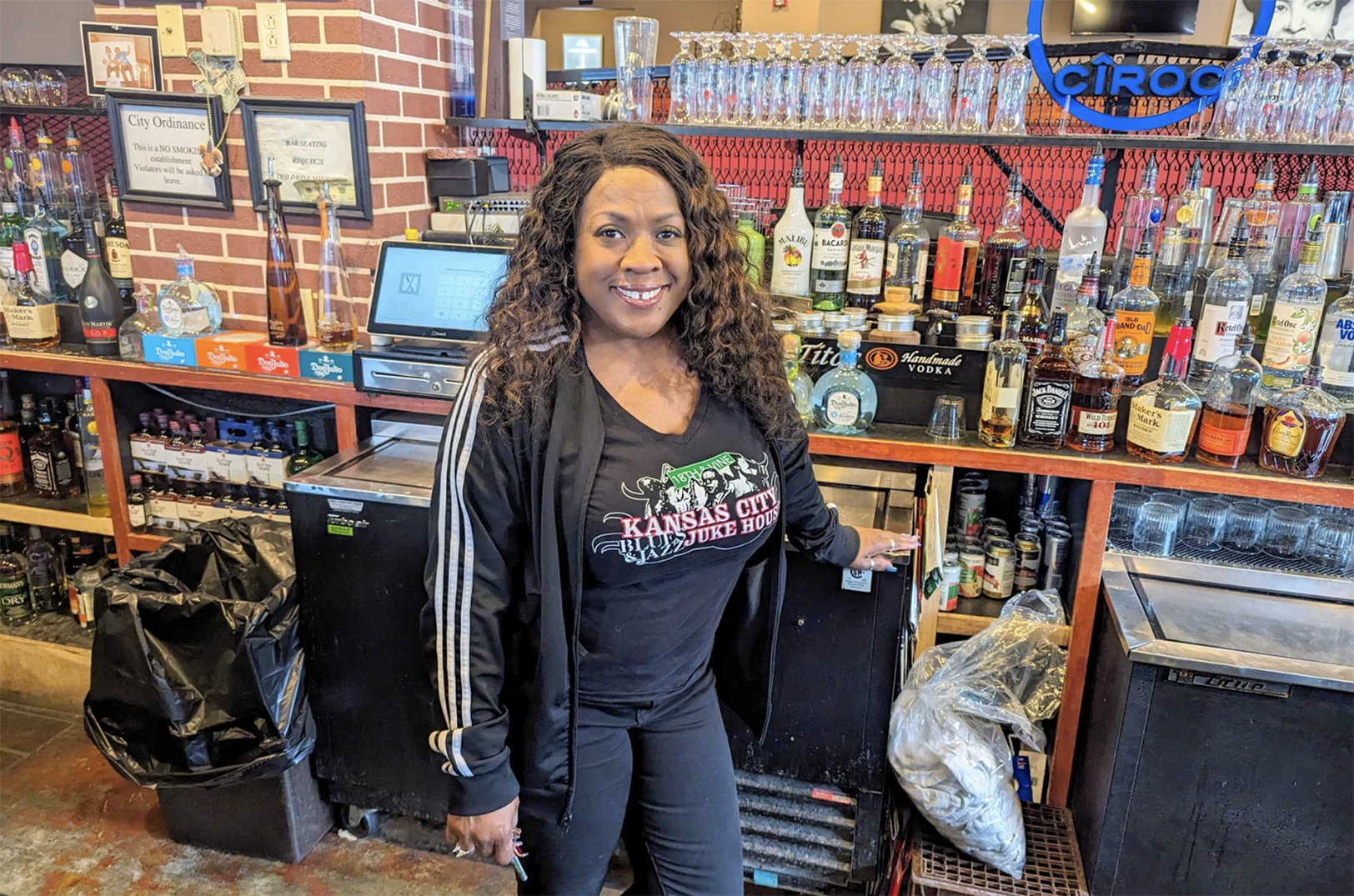
Andrea Shelby, the owner of the Kansas City Blues and Jazz Juke House, came to work early to prepare the bar before opening for their popular Wednesday 2-step nights. The Juke House is the most popular Bar and Grill on the Vine district and it located just east from the Negro Leagues Baseball Museum; photo by Lawrence Brooks IV, KCUR
Shelby said she believes voters rejected the Royals and Chiefs proposal by such a large margin because of a lack of transparency around details of the Community Benefits Agreement and what she called “arrogant public messaging.”
“I feel like 58% voted no because it wasn’t a clear, precise proposal,” Shelby said. “I feel like it was rushed and I feel like once they added the Kansas City Chiefs on the ballot, then it kind of changed a lot of things for Jackson Countians.”
RELATED: Crossroads small biz owners to Royals: Come back with a better plan (and put it in writing)
Shelby also believes a sales tax is regressive, especially for Kansas Citians who live on the East Side, and who may spend more of their monthly income on necessities and services for daily survival than those who live west of Troost.
In addition, Shelby said decades of broken promises to make improvements in the jazz district and surrounding urban neighborhoods also contributed to the “no” vote.
“There’s a lot of things that we can improve on the East Side: better sidewalks, better neighborhoods, less violence, (a) better school system, things like that,” she said. “I think if those things were put in place, we wouldn’t have a problem with voting yes.”
Shelby suggested supporters were fearmongering with threats the teams would leave town, or hurt businesses like hers if the sales tax extension did not pass.
“I don’t think it has any negative implications for the Vine District,” Shelby said.
To the east of Shelby’s business is the Director’s Cut Barbershop.
Ricardo Beccera, aka “Cardo Cuts,” is a professional barber and said the deal seemed rushed from the start. He said the public messaging was off-putting to everyday working people.
“Like (Jackson County Executive) Frank White said, they got time to bring it back to the table and rework things,” he said. “I just think that it was really a smack in the face to the small businesses and all the little people out here that work hard everyday for the billionaires to come in and say, ‘get out the way,’ essentially.”
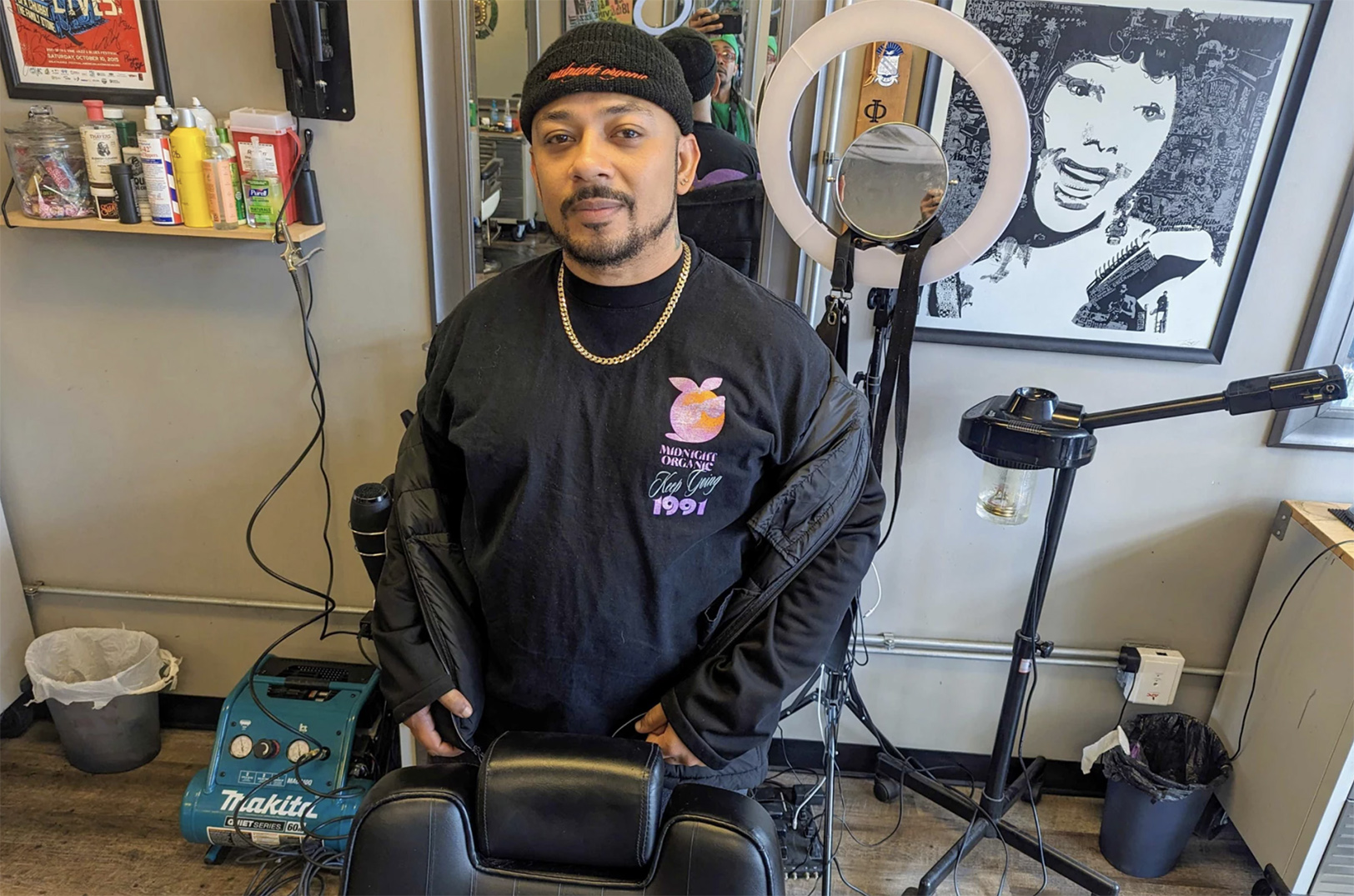
Ricardo Becerra standing at his booth at the Directors Cut Barbershop on the east end of 18th and Vinem; photo by Lawrence Brooks IV, KCUR
Beccera, 37, didn’t hold back on why he felt Jackson County citizens chose to say no to wealthy team owners or what the future looks like for businesses in the jazz district.
“You have a business that generates a lot of money, billions of dollars. Pay for it yourself,” he insisted. “You’re a billionaire (so) move your business downtown. I think that from a small business perspective here on 18th & Vine, we have our own issues as far as renovating the area and bringing business. We can’t count on them to bring our business. We got to bring it ourselves.”
The barber also doubted rumors that the Royals and Chiefs may potentially move away from Kansas City as a result.
“I don’t think they’re gonna leave. We have them till 2031 and the first time that they signed that 3/8th-cent sales tax, they were supposed to put a dome on top of the stadium and they never did it. And that was, that was years ago,” Beccera said. “You got to follow through with what you promised the first time, which is renovating that stadium however you need to. And then we can work things out.”
Jason Parson, 50, is the owner of Parson and Associates, a communications firm located in the jazz district. As the grandson of Kansas City jazz great Jay McShann, and co-owner of the building that houses Kansas City’s first Black brewery, Vine Street Brewing, he says he’ll always be committed to this district.
Parson recently organized a community forum at Vine Street Brewing where Royals owner John Sherman made his case to the Black community to vote “yes” on the sales tax extension. A couple dozen residents attended, and most in the audience seemed to support the ballot measure. However, there were some expressions of opposition during his presentation and Q&A.
Parson said he is disappointed with the outcome and, if recent history is any indication, he worries that Kansas City could lose its sports teams.
“Those that think it’s not possible, shame on them,” he said. “As far as the Royals are concerned, you see what’s happening with Oakland and Las Vegas. They went from a city that had no professional franchises, to one that’s checking many of the boxes, whether it’s a football team, (the) WNBA or hockey.”
“I would argue that if we were to ever lose the Royals and the Chiefs, we certainly would not get another professional baseball or football team back in my lifetime,” Parson said.
In spite of this week’s defeat, the Negro League Baseball Museum’s Bob Kendrick said he understands that the voters of Jackson County have spoken. However, he expects the conversation to continue about a downtown ballpark in the shadow of the shrine the Black baseball.
“It was the will of the people not to pass this measure. We all respect that as part of the democratic process,” Kendrick said. “So I am very hopeful that we can get another measure up for consideration.”

Featured Business

2024 Startups to Watch
stats here
Related Posts on Startland News

Exclusive listen: Coffee entrepreneur, bandmates tease new music, how they find harmony between notes
Golden Groves was ready to pour its music for audiences in 2020, but when stages across the world — including Boulevardia in Kansas City — went dark, members of the local indie rock band refined their flavor. “Our collective history is with jazz and rock in roll, but we each bring in our own unique musical…

In the Black: Why Venture Noire is bringing capital resources from Arkansas to KC’s founders of color
It’s time Black-led companies went from over-mentored and under-resourced to well-connected and infused with capital, Keenan Beasley said, announcing plans for establishing more equitable entrepreneurial ecosystems that begin, in part, with a presence in Kansas City. “Kansas City is a very mature market,” Beasley, founder of Venture Noire, said of what he’s observed among the…

Comeback KC Ventures launches program to fund, accelerate COVID solutions in region
A new Kansas City-based program is recruiting 20 fellows — from among the metro’s first-time entrepreneurs and established businesses — for an effort to help accelerate innovations, products or service lines that are solving needs exposed by the pandemic. “The public health crisis posed by COVID-19 ignited a need for rapid change and innovation,” said Jim…

‘It’s not just a brand for me anymore’: How Grace & Grind put the selfless in self-care, Black wellness
Kharissa and Wesley Forte were once on the verge of divorce. But after deciding to give their relationship a final push, the two went to counseling. The experience was revelatory, they said, noting it ultimately prompted them to create their own online media company — Grace & Grind — to share lessons and their story with…