

He’s touched every ꓘ at The K for 25 years; meet the man who gives mud baths to 200+ balls before each game
March 19, 2024 | Nikki Overfelt Chifalu
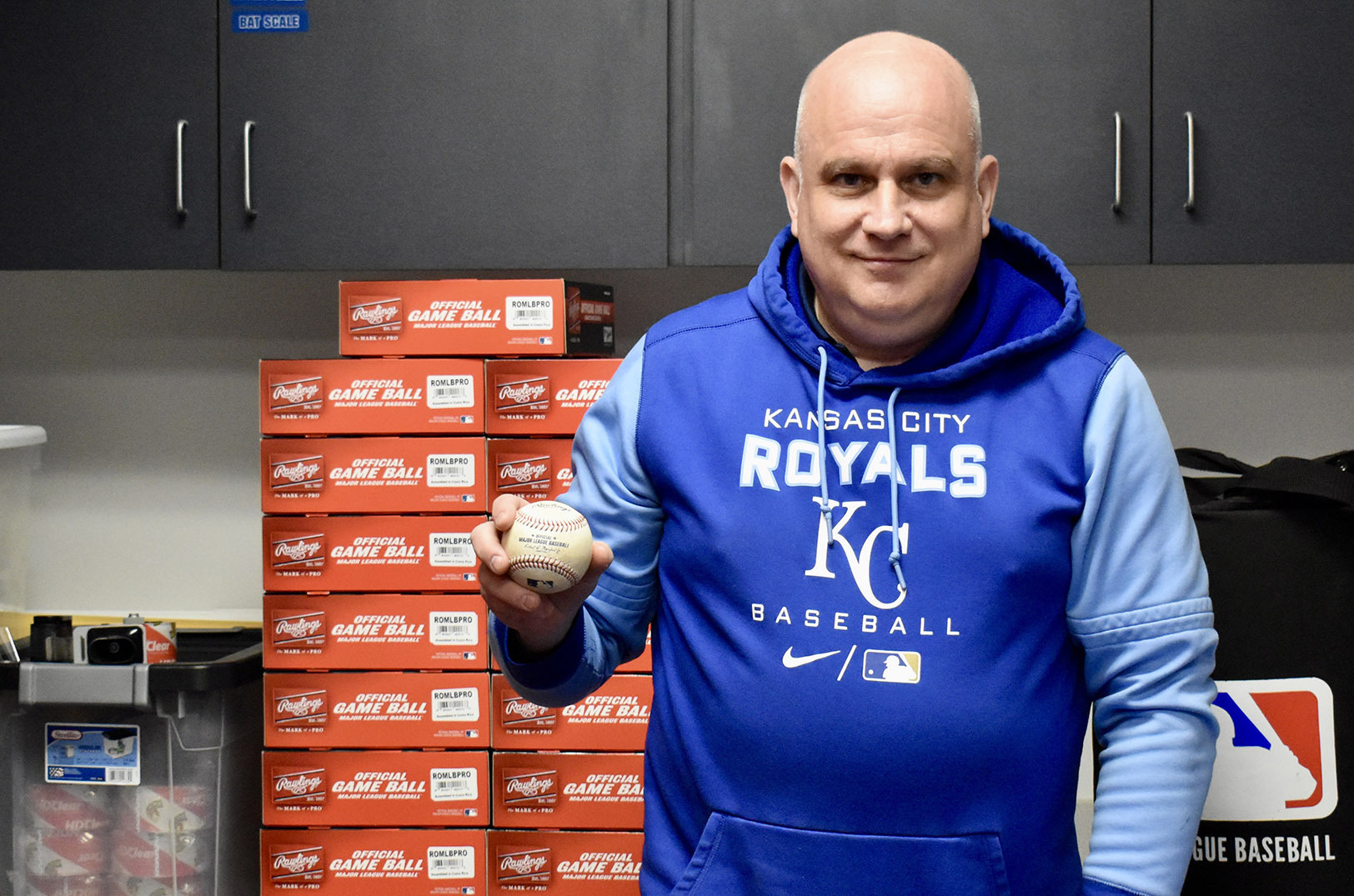
Every baseball that crosses home plate at Kauffman Stadium likely received a mud bath from Tom Walsh, he shared.
Before every home game — including opening day March 28 — the Kansas City Royals clubhouse and umpire services manager is in charge of preparing 204 balls in line with the strict regulations of Major League Baseball, he said, which means rubbing each ball with a special, league-approved mud.
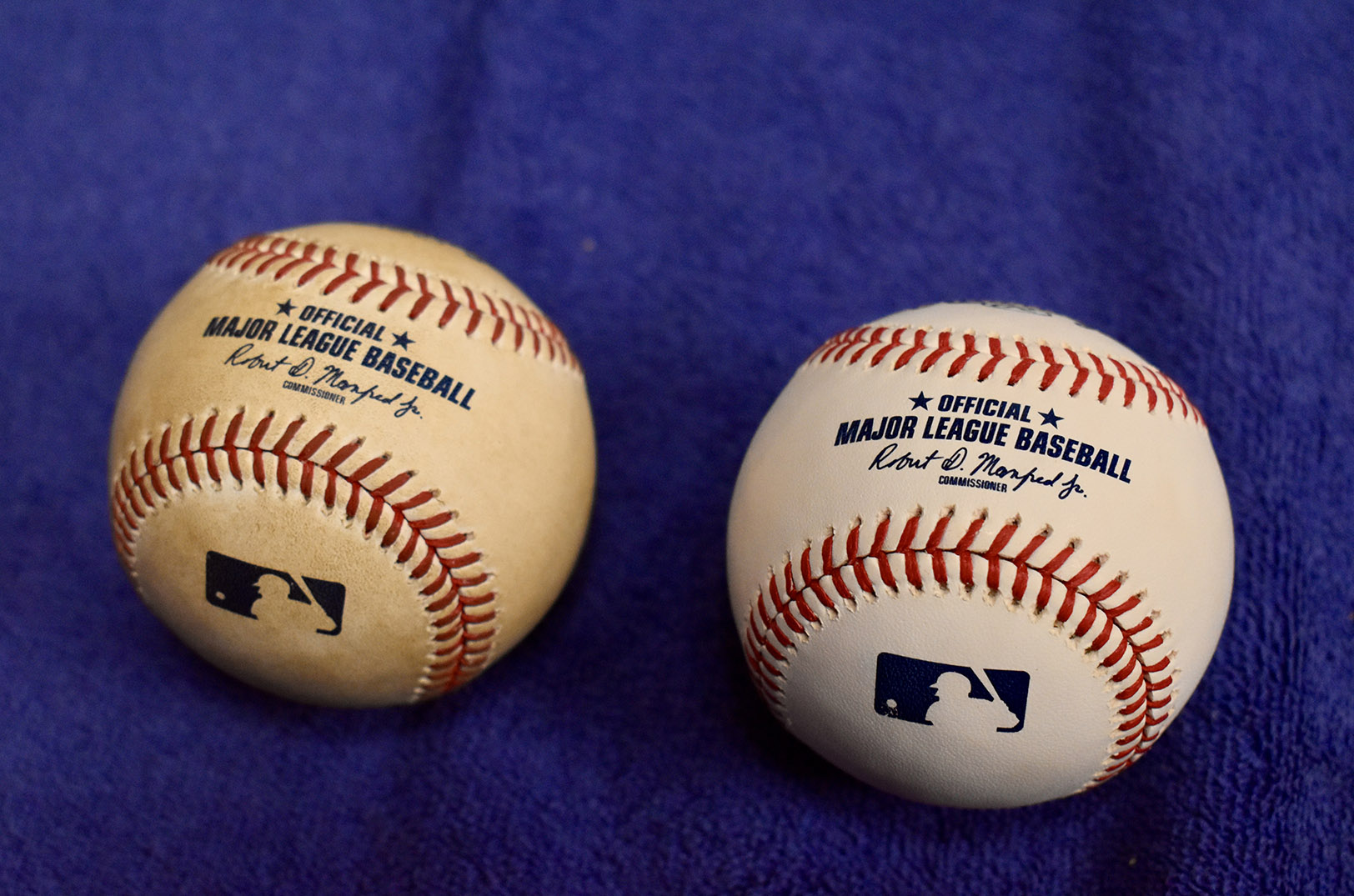
A rubbed, game-ready ball versus a out-of-the box ball; photo by Nikki Overfelt Chifalu, Startland News
“It helps with the slickness,” noted Walsh, who has worked for the Royals organization in some capacity for 42 seasons. “That averages out to 16,524 balls for the year.”
Lena Blackburne Rubbing Mud — “baseball’s magic mud” — has been taking the sheen off new baseballs since 1939, according to the family-run company.
“It’s a mud from New Jersey,” Walsh said. “No one knows its location. It’s a secret location.”
Rawlings — the company that makes the baseballs — has tried multiple times (and failed) to make a ball that doesn’t require a mud bath.
“You might as well stay with history and use what works,” Walsh noted. “They’re always trying to modernize things now.”
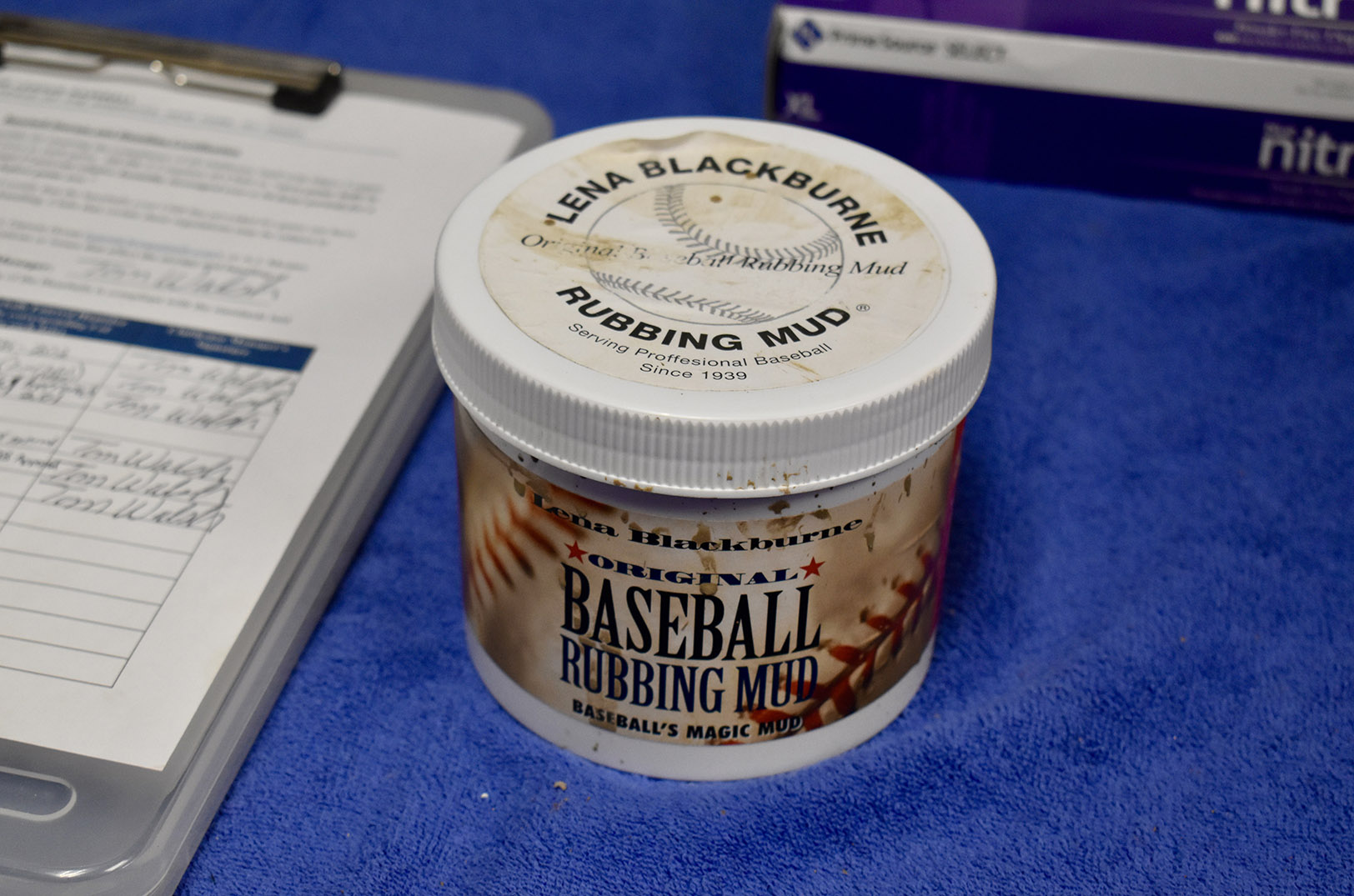
Lena Blackburne Rubbing Mud in the ball room of the Royals clubhouse; photo by Nikki Overfelt Chifalu, Startland News
The rubbing mud — which the company describes as “resembling a cross between chocolate pudding and whipped cold cream” — is different from normal mud because of the way it sticks to the ball and provides a better grip, Walsh explained.
“Pitchers like them dark, but the hitters don’t,” he continued. “‘They’re saying I can’t see them; they’re too dark.’ So you’re trying to keep both sides happy. But now MLB is involved and they say, ‘This is how we want it.’”
Click here to learn more about the history of the Lena Blackburne Mud from CBS.
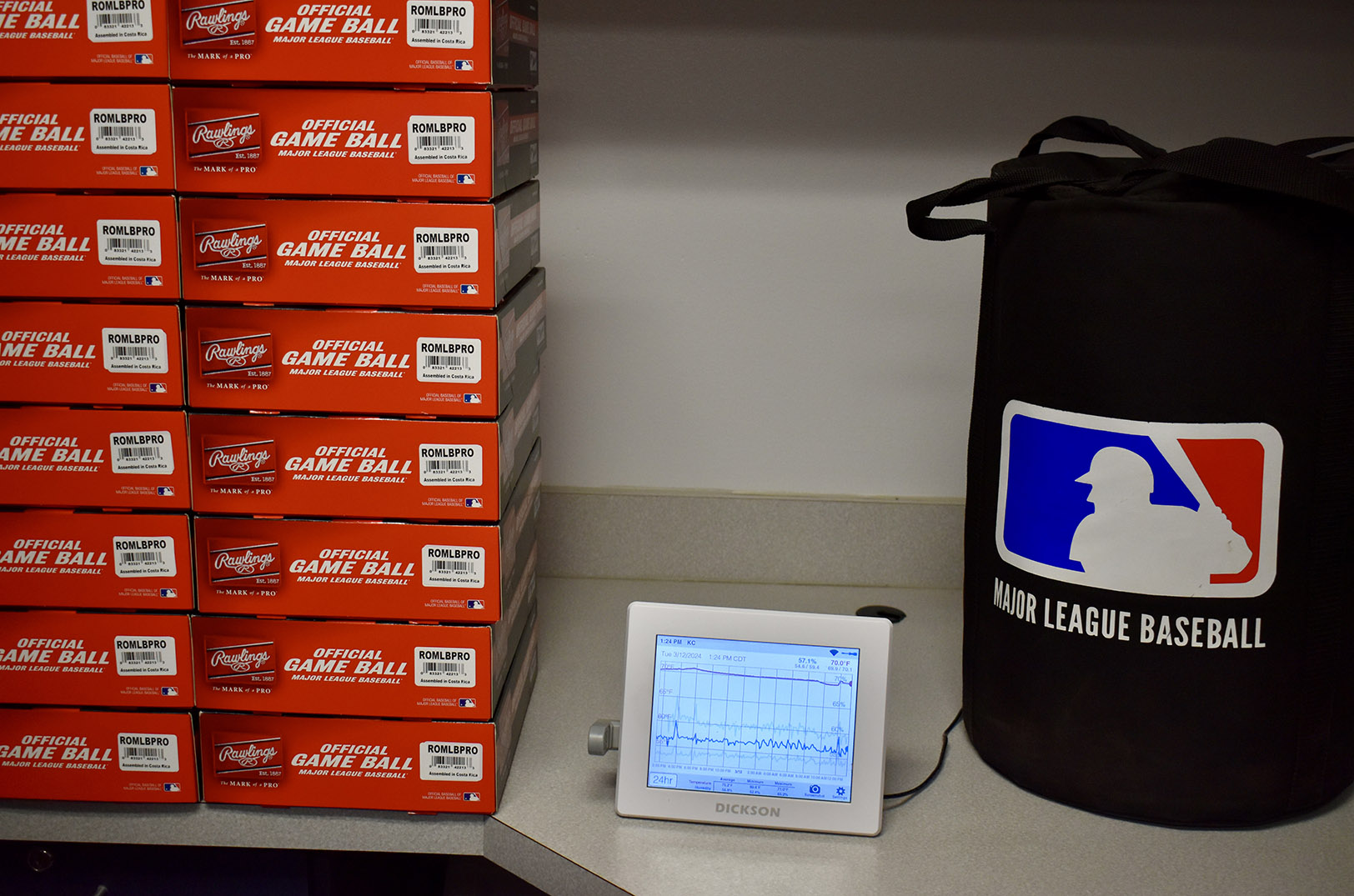
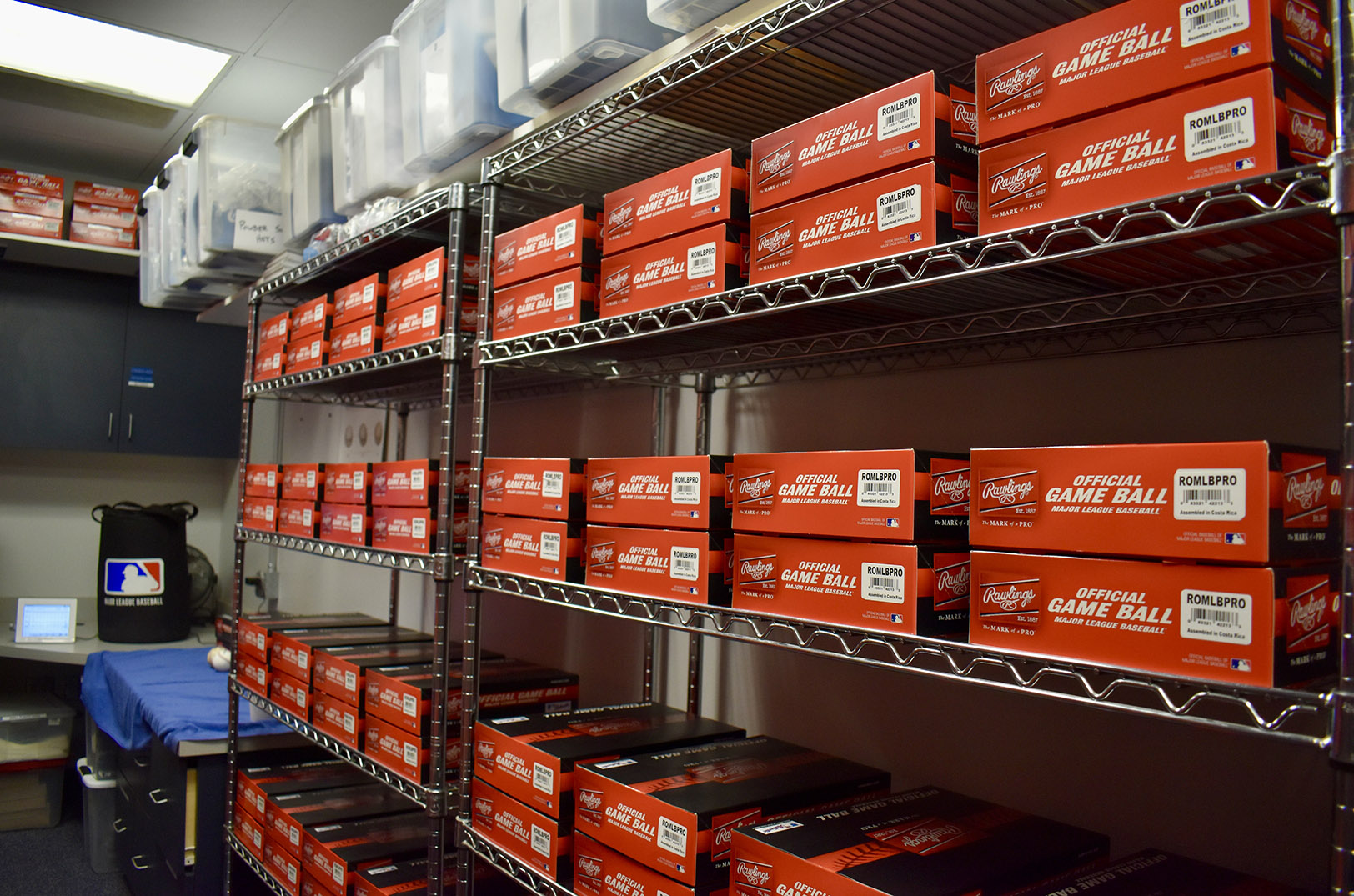
The league-approved mud is just one of many guidelines Walsh must follow to get the baseballs prepped for a game, he said. It all starts with how the baseballs are stored in the clubhouse.
“We have a humidor back there, which we just installed a few years ago,” Walsh explained. “So they want the room kept at a certain temperature in the humidity.”
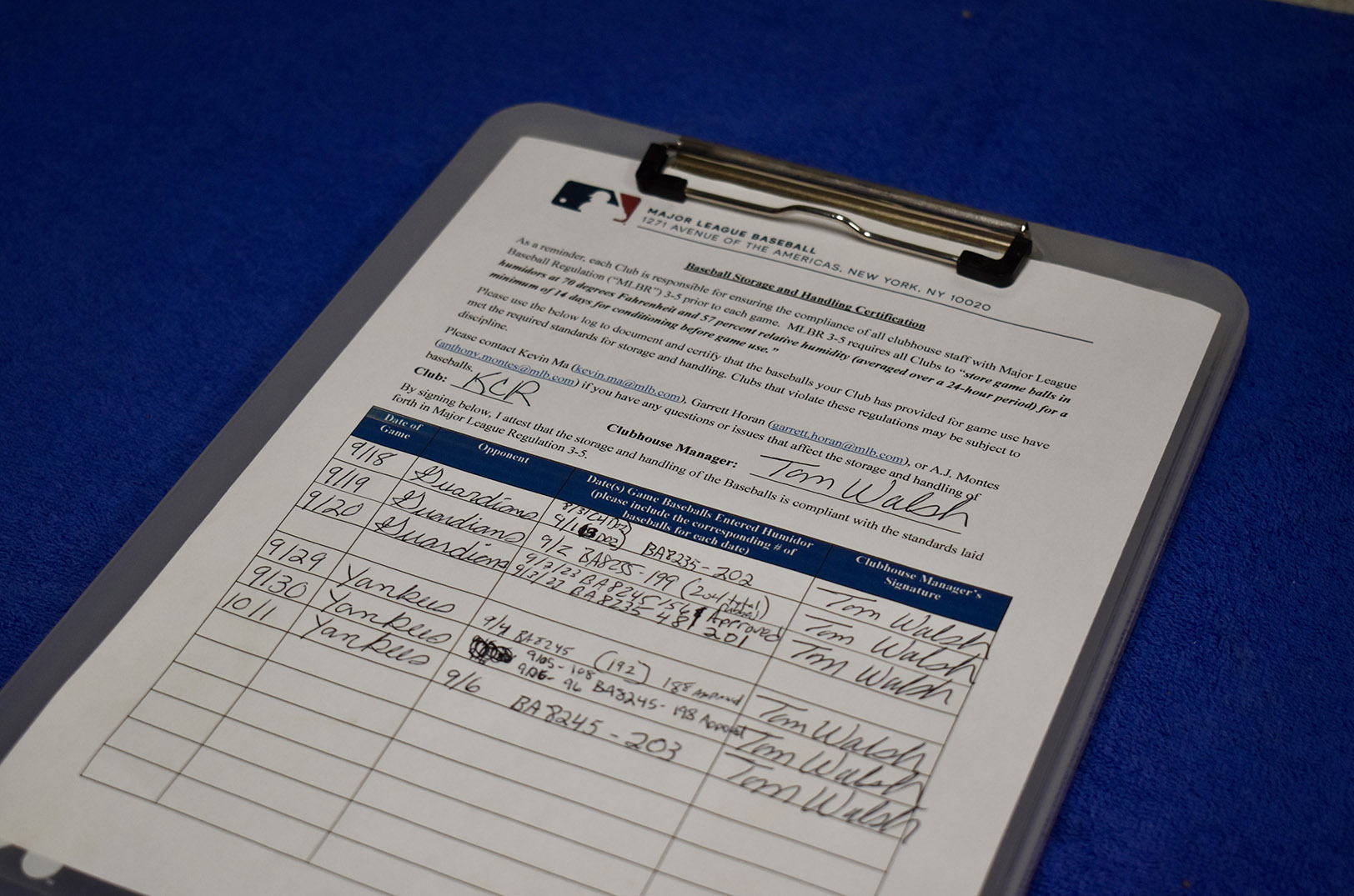
MLB game ball tracking forms; photo by Nikki Overfelt Chifalu, Startland News
According to MLB, the game balls must be stored at 70 degrees and 57 percent humidity for at least 14 days before they are used.
“There’s a sheet we fill out each day,” he added.
When a shipment of baseballs is received, Walsh said, he puts a date and number on the box, then an “R” once they have been rubbed. But the 17 dozen game balls can’t be rubbed until the day of the game. Once he’s done, a local league representative inspects the balls and sends photos to MLB for approval. It’s only once they’ve been approved that the balls are placed in the big, black MLB bag and taken to the umpires.
“Basically, I’m on a pass/fail thing every day,” Walsh explained. “I’ve been lucky they’ve been passed every time.”
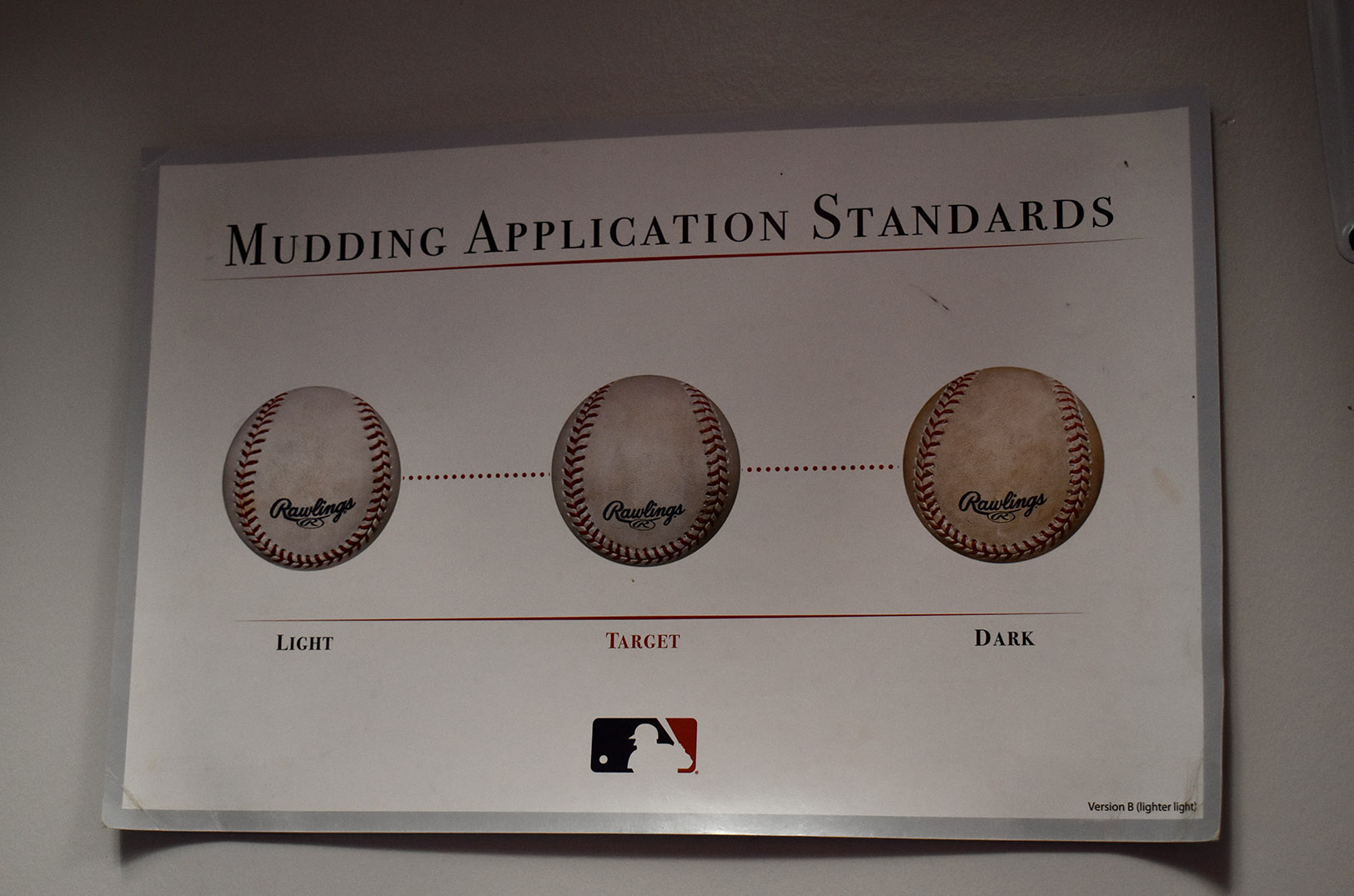
A poster shows the gradients of rubbed game balls; photo by Nikki Overfelt Chifalu, Startland News
Any baseballs that aren’t used during the game, he noted, aren’t allowed to be used for the next game. He sends the extras on the road with the team and to the bullpen bags.
“So they don’t go to waste,” Walsh added.
After 25 seasons of working in the Royals clubhouse and rubbing countless game balls with mud, Walsh — who has his own bobblehead in the Royals Hall of Fame — hasn’t tired of the task, unknown to many outside the sport.
“I don’t mind doing it,” he noted. “Everybody’s got their day-to-day duties. It’s just like any other job.”
Walsh — who worked as a team manager/equipment manager while a student for the University of Kansas baseball team under the late Marty Pattin, a former Royals player — started working for the Royals during the 1981 season in the maintenance department while still a student at KU.
In 1987, he became the visiting clubhouse assistant, then moving to the Royals clubhouse in 1998. He counts the World Series wins in 1985 and 2015 at the top of his favorite moments list.
“I wanted to work in sports,” he said. “I was pretty lucky to get an opportunity to work here.”


2024 Startups to Watch
stats here
Related Posts on Startland News

KC Fed: Want to strengthen Kansas City’s job market? Narrow skills gap caused by digital division
Digital division in Kansas City is taking its toll on the local workforce, said Jeremy Hegle. More must be done to allow skilled workers access to technology — in turn offering them a chance to succeed in a rapidly growing electronic economy, added Hegle, Federal Reserve Bank of Kansas City senior community development advisor. In…

Vote now: Kansas Citians vie to lead tech, education panels at SXSW 2019
A cadre of Kansas Citians are hoping to take the podium at one of the nation’s largest tech and innovation conferences in 2019. At least four Kansas City tech and entrepreneurship leaders are vying for panel or speaking spots at the 2019 South by Southwest conference March 8-17 in Austin, Texas. SXSW recently opened voting…

Nominations for Techweek 100 list of premier KC innovators close Sept. 9
It’s not a ranking. Techweek 100 celebrates the whole spectrum of individuals and organizations who are impacting the business and technology landscape on a significant scale in cities like Kansas City, organizers said. Nominations close Sunday, Sept. 9. “Honorees include fast-growing technology companies, prominent sector investors, key contributing enablers of the digital ecosystem, those at…

Lenexa teen IDs winning medical solution with Parkinson’s detection tech FacePrint
Stanford University will have to wait. Eighteen-year-old Erin Smith is taking her medical technology venture, FacePrint, on the road. The Johnson County teen has been selected to join two prestigious fellowships to further develop FacePrint, which is a diagnostic and monitoring Tool for Parkinson’s Disease. She’s been tapped for $25,000 from the Davidson Institute for…