

Royals ballpark plan gains support among longtime Crossroads advocates, though questions linger
March 14, 2024 | Kevin Collison
Editor’s note: This story was originally published by Kansas City PBS/Flatland, a member of the KC Media Collective, which also includes Startland News, KCUR 89.3, American Public Square, The Kansas City Beacon, and Missouri Business Alert.
Click here to read the original story.
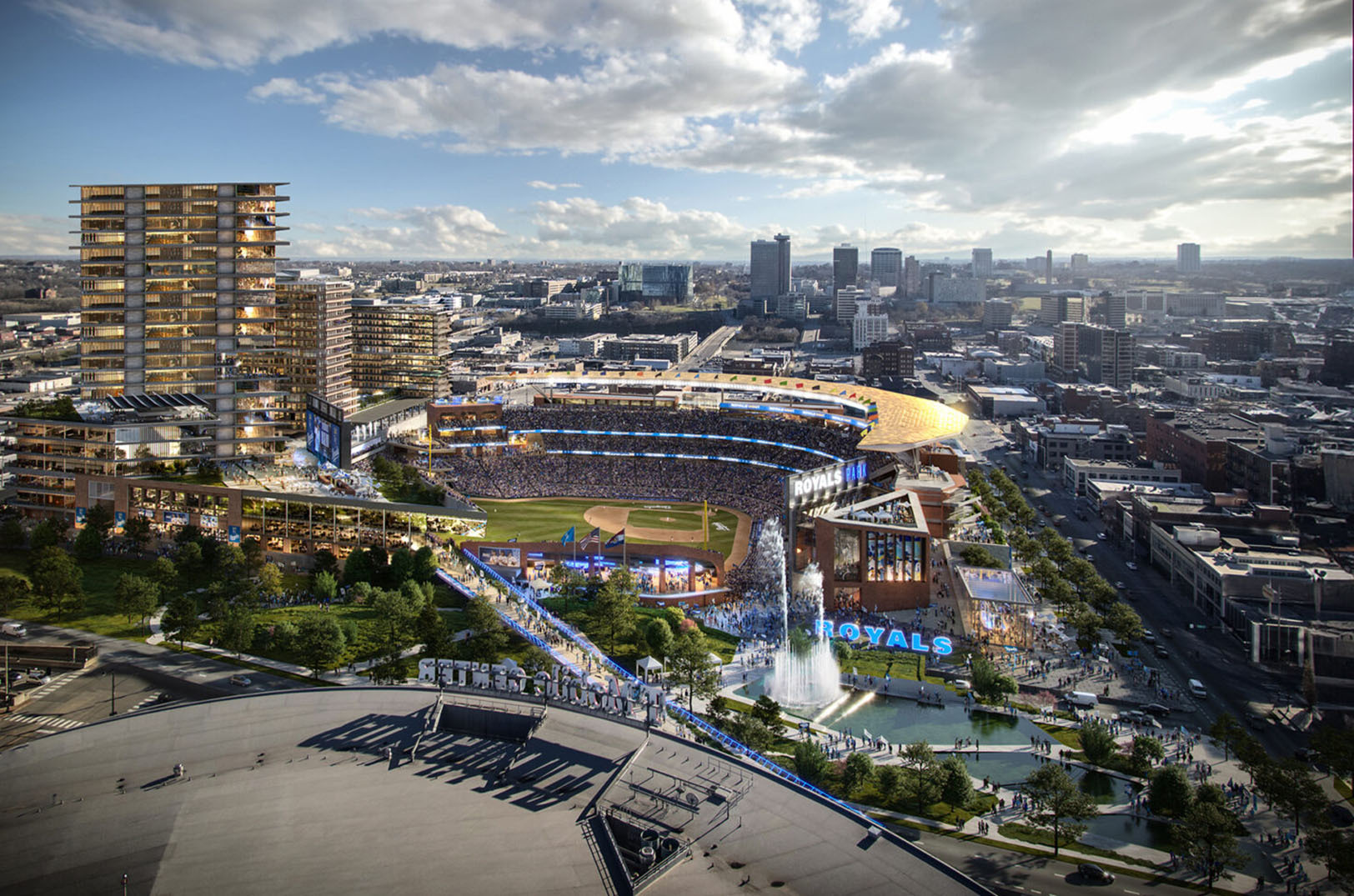
The Kansas City Royals’ controversial Crossroads ballpark plan has qualified support from some longtime property owners as well as the woman who spearheaded downtown’s revival more than 20 years ago.
“I believe the location they’ve zeroed in on is terrific,” said former Mayor Kay Barnes, who served from 1999-2007.
“It’s in close proximity to what’s been developed and will benefit not only the immediate region but also other areas.”
Jackson Countians will vote April 2 on a 3/8-cent sales tax to help finance a new Royals downtown ballpark and improvements to Arrowhead Stadium for the Chiefs.
The project proposed for a six-block area southeast of Truman Road and Grand Boulevard across Interstate 670 from the T-Mobile Center and Power & Light District has been criticized by many of the business owners that would be displaced.
ICYMI: ‘Out of touch’ ballpark plan leaves Crossroads small biz owners feeling betrayed
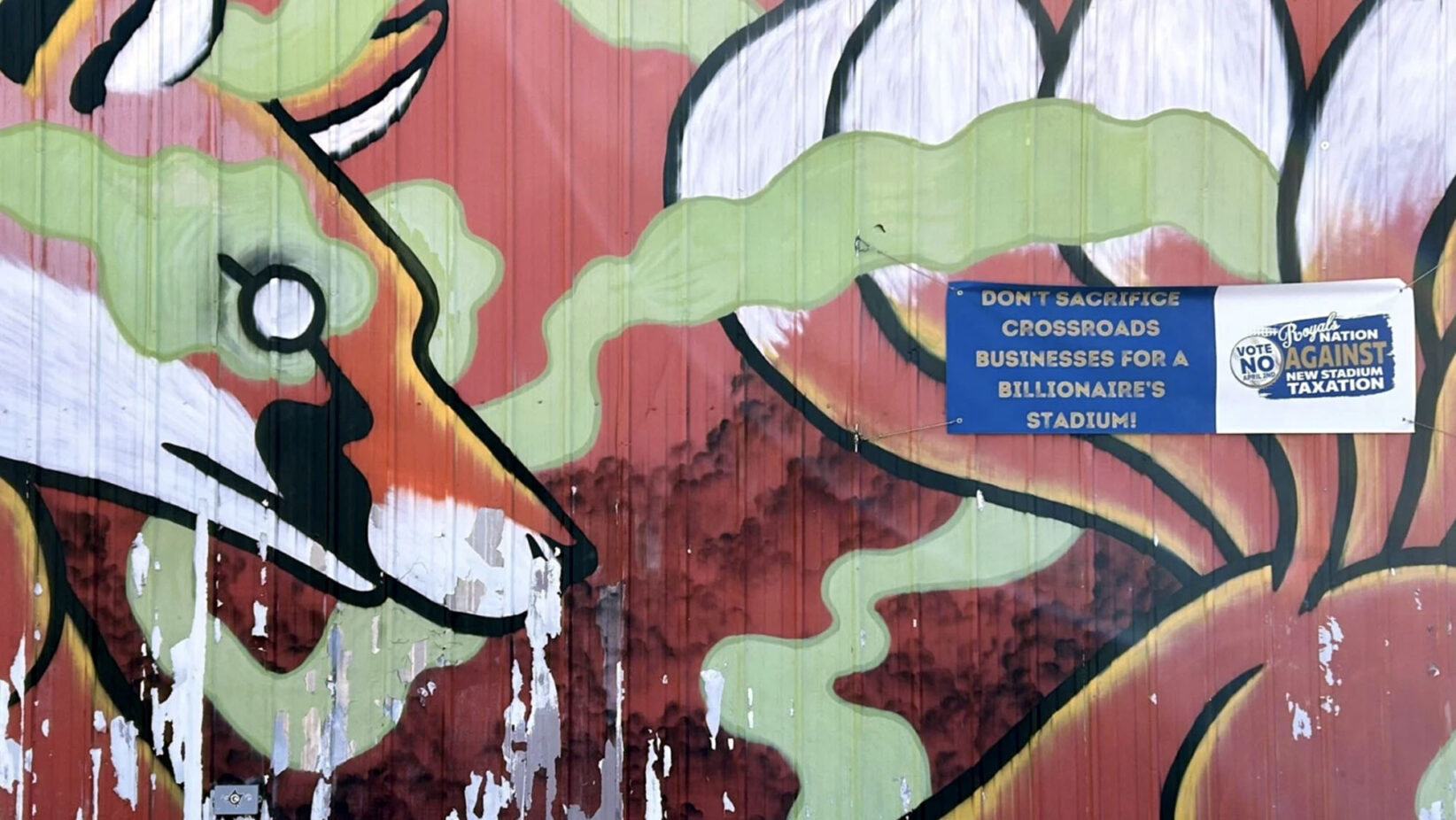
Many small business owners and members of the arts community in the Crossroads are opposed to the proposed Royals ballpark in the neighborhood. Photo by Kevin Collison, Flatland
But some property owners with a longer stake in the Crossroads see the benefit of regularly bringing tens of thousands of new visitors to the area. They also note some of the louder critics are relative newcomers to the neighborhood.
“Some of the more vocal opponents have been there four or five years,” said Butch Rigby, a longtime Crossroads developer. “People with a longer-term perspective realize you need more people down there.”
Rigby, who owns a building near the ballpark site at 1701 McGee St., includes himself among those who were convinced the Royals had set their sights on a location in the undeveloped East Village area of downtown.
“I came around to understanding why the Crossroads is a better choice,” he said.
“The primary reasons are it won’t compete with the Power & Light District, which the city is on the (financial) hook for, and it’s also two blocks from the streetcar versus six blocks at the East Village.”
Matt Abbott owns 10 properties within the proposed ballpark site. He also has another 30 properties throughout the Crossroads, a sprawling district that stretches from Broadway on the west and U.S. 71 on the east between I-670 and the Kansas City Terminal Railway tracks.
“I’ve been committed to downtown redevelopment for 20-plus years,” Abbott said. “This is bigger than a stadium.
“It contributes to the long-term branding of downtown Kansas City. It also creates synergies that allows underutilized, industrial parts of the East Crossroads to expand with better uses.”
As for unhappy business owners, including some of his tenants, Abbott said the Royals leadership has assured him they will be made whole.
“I’ve had multiple conversations with (Royals president) Brooks Sherman and (owner) John Sherman,” he said. “They care about helping every business owner and understand their needs.
“They want to help relocate or buy some of them out and are working on a plan to communicate with every property and business owner.”
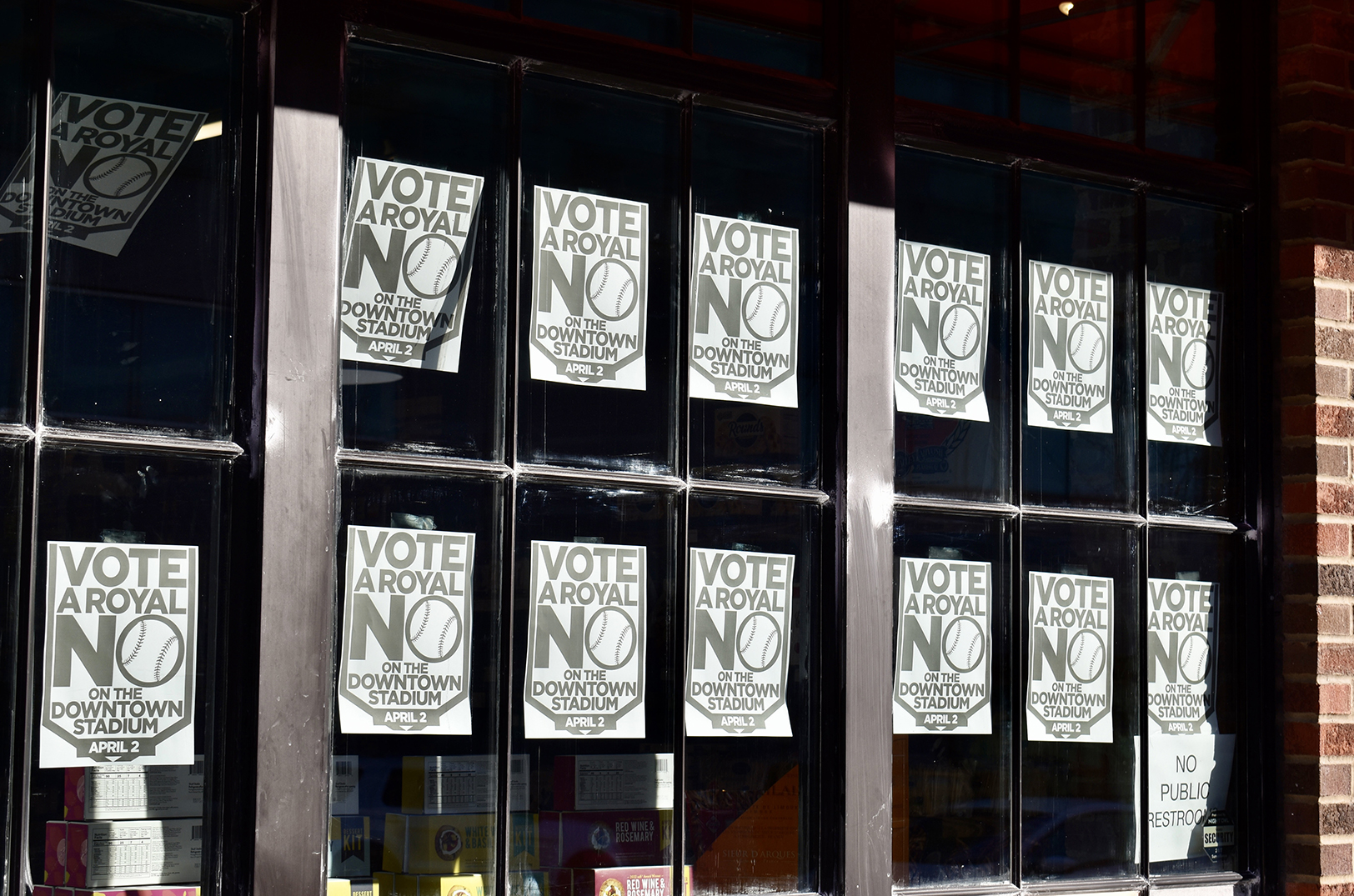
“Vote No” signs stuck in the windows on The Pairing in the East Crossroads; photo by Nikki Overfelt Chifalu, Startland News
Abbott added: “I think the stadium announcement caught a lot of people off guard. With changes there are unknowns and fears.”
Tyler Enders, the founder of Made in KC, the popular vendor of locally made products, operated a shop at 509 E. Locust St. from 2016-20. He still owns a building at 18th and Walnut streets that houses artists and other makers.
“I’m probably in the 99th percentile of people in Kansas City who know the Crossroads well,” Enders said. “I’m super excited about the ballpark and I think it’s a good opportunity to connect downtown with the Crossroads.”
Enders is empathetic toward the small businesses that would be dislocated by the project. He observed many opponents are unified by the sense of solidarity associated with their response to the recent COVID pandemic.
“There was not enough information in the way it was rolled out by the Royals,” he said. “There’s a true fear of cultural change.
“I have full faith the Royals will take care of the dislocated businesses and they will be better off.”
Rigby believes East Crossroads businesses near the ballpark, particularly the microbreweries, distilleries and eateries, should do well.
“I think they will thrive before and after the games,” he said.
“They’ll have great crowds as long as the Royals effectively park fans. There are a lot of beer drinkers and I also think wine bars will do well.”
The project is also supported by Vince Bryant, the developer of the historic former Kansas City Star office building south of the ballpark site. He’s renovating the building into office space, as well as a food hall and market.
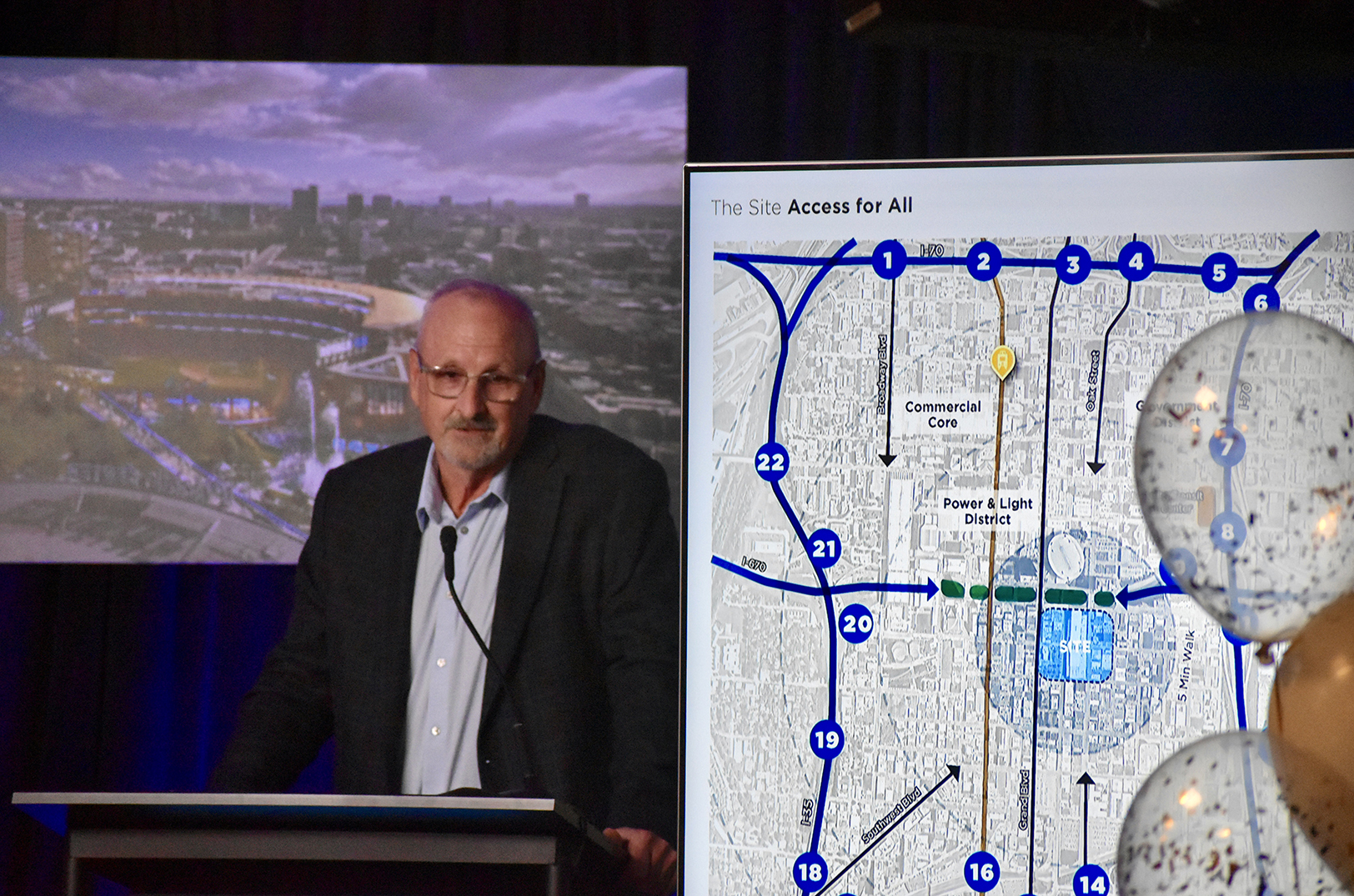
Earl Santee, Populous, speaks about parking access during a February ballpark announcement event at Kauffman Stadium; photo by Nikki Overfelt Chifalu, Startland News
Parking may be the biggest worry shared by property owners and their tenants.
While the team architect estimated there are plenty of spaces available downtown already to accommodate fans, many are concerned people won’t be able to find them.
“When I say I support the ballpark, I do,” Rigby said. “But I do believe the answer that there’s already plenty of parking is not a practical way to talk about parking.”
One of Rigby’s tenants in the building he owns at 1701 McGee is an event space operator.
“He’s concerned about parking and what it will do to them,” Rigby said. “There’s a lot of small businesses that won’t be able to conduct their businesses if it coincides with a ballgame.
“We need to do something about parking, we need to do something about public safety, and we need to better guide people to where the parking is available.”
Rigby suggested the East Village site passed over by the Royals, much of which is owned by the city, would be a good location for parking for the time being. It’s about four blocks from the proposed ballpark site.
He also noted the streetcar, which by the time a ballpark would open would run along Main from the University of Missouri-Kansas City to the riverfront, will be a solid alternative to transport fans.
Suzie Aron, a major Crossroads property owner and longtime advocate for the area, also offered qualified support for the ballpark location. But she is concerned about access.
The current plan calls for closing Oak Street. Maps also show Grand Boulevard being narrowed to two lanes as part of the “Making Grand Grand” redesign concept that has been discussed for more than 15 years.
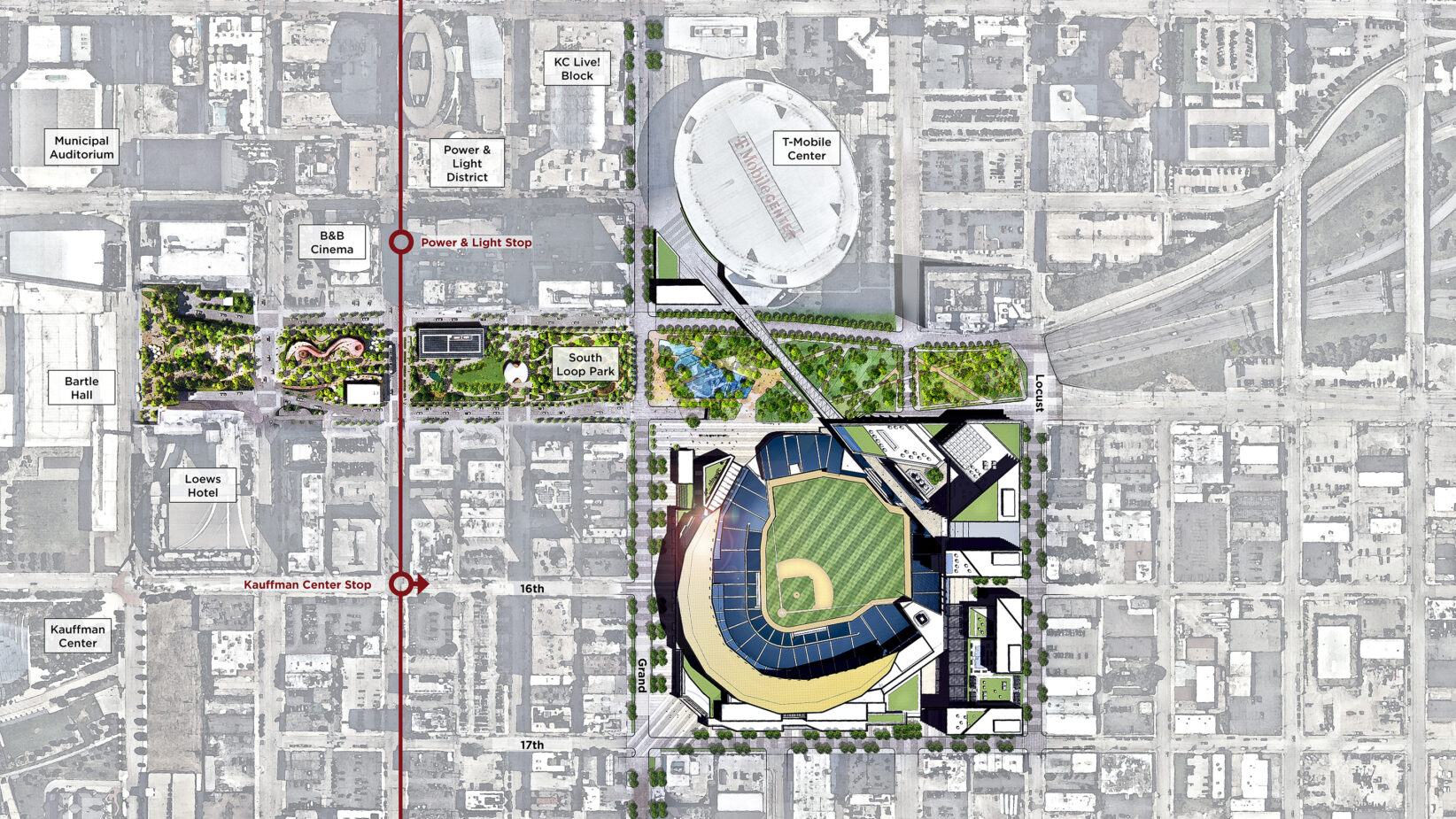
The site map for the proposed downtown Royals ballpark also includes two city blocks for mixed-use redevelopment east of the stadium; rendering courtesy of Populous
In addition, some of the proposals being considered for the South Loop Link, a proposed park that would deck I-670 from Wyandotte to Grand, also call for street closures, notably Walnut.
“For me, access is major,” Aron said. “If it backs up traffic people will be discouraged and won’t come to the Crossroads.”
One alternative, she suggested, would be to leave Oak Street open. The ballpark renderings show its footprint doesn’t extend past Oak. It’s the expected spinoff development that pushes the development site farther east to Locust.
Aron noted that keeping Oak open and incorporating the existing buildings and businesses on the east side of the street would go a long way toward reducing criticism of the plan.
“I’d be thrilled to have them as a neighbor if we could figure out a way to assimilate the Oak Street clientele rather than lose them,” she said.
As for concerns a ballpark would hurt East Crossroads arts-related uses, including music venues such as The Truman, RecordBar and the outdoor concert space at Grinders, Aron believes the area can have both baseball and music.
“I’ve seen angry people and talked to people who love it and want to have an office there,” she said. “There’s real respect for John Sherman and that family. I think they’ll be kind to the creative community.”
This is not the first time a ballpark has been pitched downtown.
The idea was considered 20 years ago during the first major wave of downtown redevelopment that brought the Power & Light District, the former Sprint Center and the H&R Block headquarters.
The problem was that the then-owner of the Royals, David Glass, preferred to stay at the Truman Sports Complex.
“The reason it didn’t move forward was the owner said ‘no,’” former mayor Barnes said. “Many of the rest of us thought it was a good idea, but he was not interested.”
Fast forward to John Sherman, who signaled his intention to move downtown shortly after buying the Royals in 2019. Barnes said a new ballpark at the East Crossroads would build on all the other investments made by the city.
It also would likely help reduce the city subsidy, estimated at $10- to $15 million annually, for the Power & Light District.
The entertainment district developed by the Cordish Cos. of Baltimore has never generated the tax revenues expected to repay its city-backed bonds.
“I have no doubt that having the stadium there and having all those people coming to the area dozens of times will greatly enhance the commercial, retail, housing and everything else going on,” Barnes said.
“There’s no way it won’t increase traffic and business within the Power & Light District.”

Featured Business

2024 Startups to Watch
stats here
Related Posts on Startland News
Kauffman Foundation launches initiative to topple startup barriers
During an annual trip to Washington D.C., Ewing Marion Kauffman Foundation CEO Wendy Guillies urged the U.S. Congress to take action to eliminate barriers for entrepreneurs to launch new businesses. In her 2017 State of Entrepreneurship address, Guillies said that millions of Americans are being left out the U.S. economy and that trends of dwindling…
In address to Congress, Victor Hwang urges action on entrepreneurship deficit
Tapping into his own entrepreneurial story, the Ewing Marion Kauffman Foundation’s vice president of entrepreneurship testified before Congress on cutting obstacles to starting a business. Before the U.S. House Small Business Committee, Victor Hwang joined an expert panel of entrepreneurs and researchers to discuss common struggles entrepreneurs face, possible solutions and emerging trends. As Republican…

Kansas City milkman Matt Shatto launches new ag tech company
Matt Shatto — co-founder of the the popular Kansas City dairy Shatto Milk Company — is trailblazing new sustainable tech to help farmers reap more crops and reduce costs. Launched in 2016, Kansas City-based TerraManus Technologies created a patented device that helps farmers better manage soil and allocate water resources. The “TerraStar Disk” looks like a plastic…
Google Fiber losing ‘hundreds’ of employees but continues KC expansion
Google Fiber is reportedly trimming its employee count after announcing its new CEO. Business Insider reports that months after its former CEO Craig Barratt resigned, Google Fiber has hired Gregory McCray as the new leader of Access, the division of Google’s parent company Alphabet that includes Google Fiber. The gigabit provider also will lose “hundreds”…