

Economists: Tax dollars don’t make a stadium possible; they fund a gold-plated vision for major league sports
March 7, 2024 | Josh Merchant
Editor’s note: This story was originally published by The Kansas City Beacon, a member of the KC Media Collective, which also includes Startland News, KCUR 89.3, American Public Square, Kansas City PBS/Flatland, and Missouri Business Alert.
Click here to read the original story from The Kansas City Beacon, an online news outlet focused on local, in-depth journalism in the public interest.
Say you’re at a restaurant and you begin to salivate over the menu’s lobster thermidor or a flute of champagne. You might balk at the price — unless someone else is paying the bill.
Owners of teams worth billions think the same way.
Economists say that “gold plating effect” makes stadiums more expensive when taxpayers pitch in.
The phenomenon gets more pronounced as financial transparency fades. (Think about the likelihood of ordering that lobster if your dinner receipt was private or public.)
On April 2, Jackson County voters will have a say in whether the Royals and Chiefs will get $1 billion each for upgrades to Arrowhead Stadium and the construction of a ballpark in the Crossroads Arts District.
Some ballots have already been cast, but the Royals have yet to share the team’s full plan for paying for the KC Royals stadium.
That lack of transparency, experts say, could lead to more lavish spending on upgrades like video screens the size of houses, retractable fields that roll around on motorized wheels or luxury suites with kitchens and multiple bedrooms.
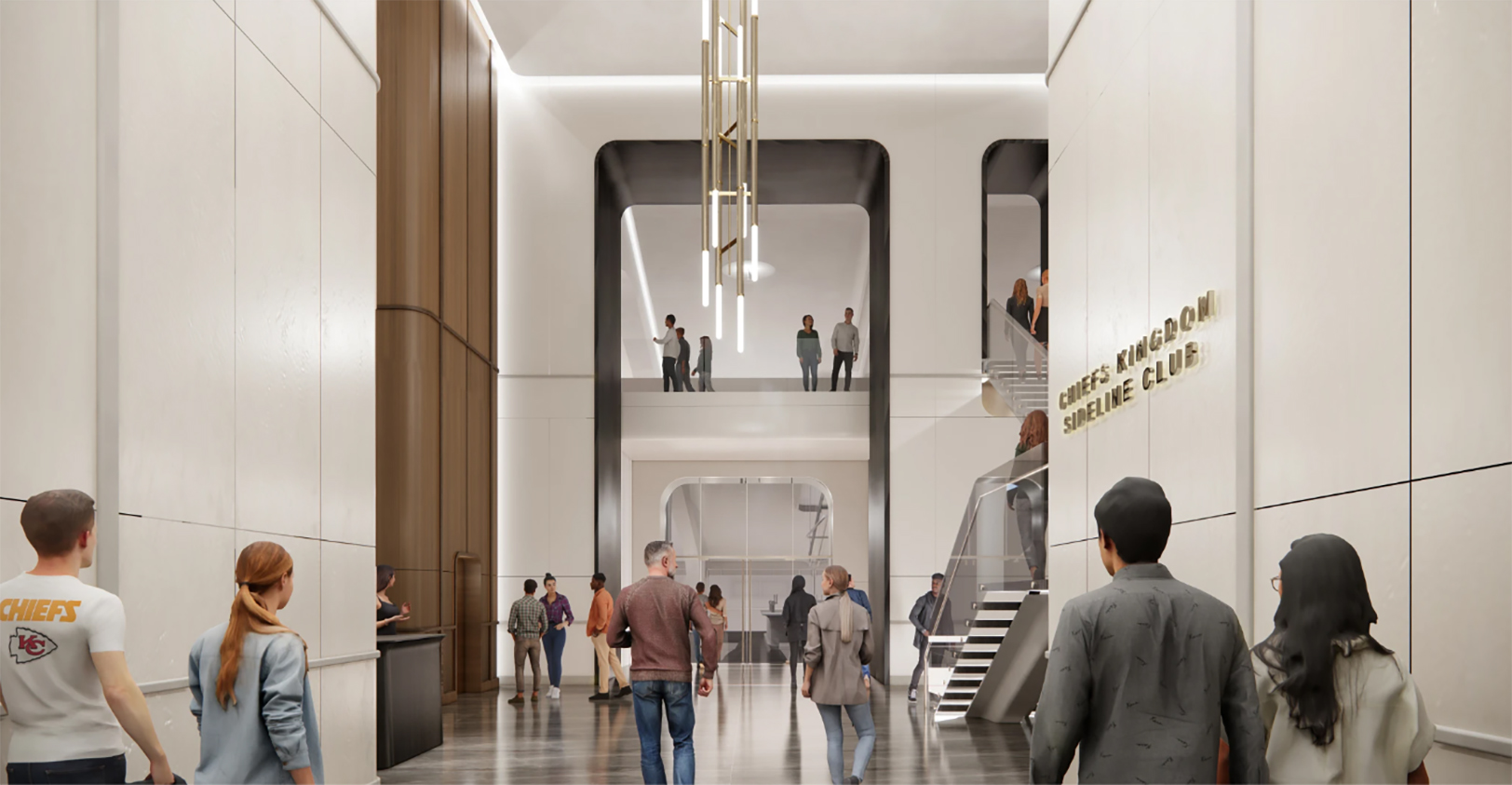
A rendering from the Kansas City Chiefs shows upgraded Chiefs Kingdom Sideline Club access to Arrowhead Stadium; images courtesy of the Kansas City Chiefs
RELATED: Chiefs tease 16 Arrowhead upgrades coming to KC stadium if voters pass April 2 sales tax
Nearly half of NFL and MLB subsidies go toward showy upgrades
The gold plating effect is a relatively straightforward concept.
“In a nutshell, if you split the cost of something, you buy more of it,” said Geoffrey Propheter, a public finance professor at the University of Colorado-Denver.
Propheter studied more than 100 stadiums across the country and found that when taxpayers contribute more money to stadium projects, the cost per acre increases.
On average, for every $1 million that taxpayers spend on baseball or football stadiums, roughly half of that money goes toward upgrades and “extravaganzas.”
One example of what Propheter calls an “opulent” upgrade is the Texas-sized jumbotron at the Dallas Cowboys stadium. The $40 million screen — a total of 11,350 square feet — set a Guinness World Record in 2009 for the planet’s largest high-definition video display.
“If you were to pay the entire bill yourself for a facility, would it look like this?” Propheter said. “Is that additional improvement going to generate more revenue for me than what it costs?”
Other examples listed in his study include the 50-foot-by-150-foot retractable glass doors at the Sacramento Kings stadium or the grass field at Phoenix’s State Farm Stadium that can roll in and out of the stadium at the pull of a lever.
At Kansas City’s own publicly funded Arrowhead Stadium, the Hunt family enjoys a multilevel six-bedroom, three-bathroom luxury suite, complete with a spiral staircase, a fireplace and stained-glass windows.
The best way to prevent the gold plating effect, Propheter said, is to make sure everyone is paying for their own decisions — which means that the government gets involved in design decisions.
But there’s also a much simpler answer.
“If you want to minimize gold plating, minimize the subsidy,” he said. “Smaller subsidies mean smaller gold plating.”
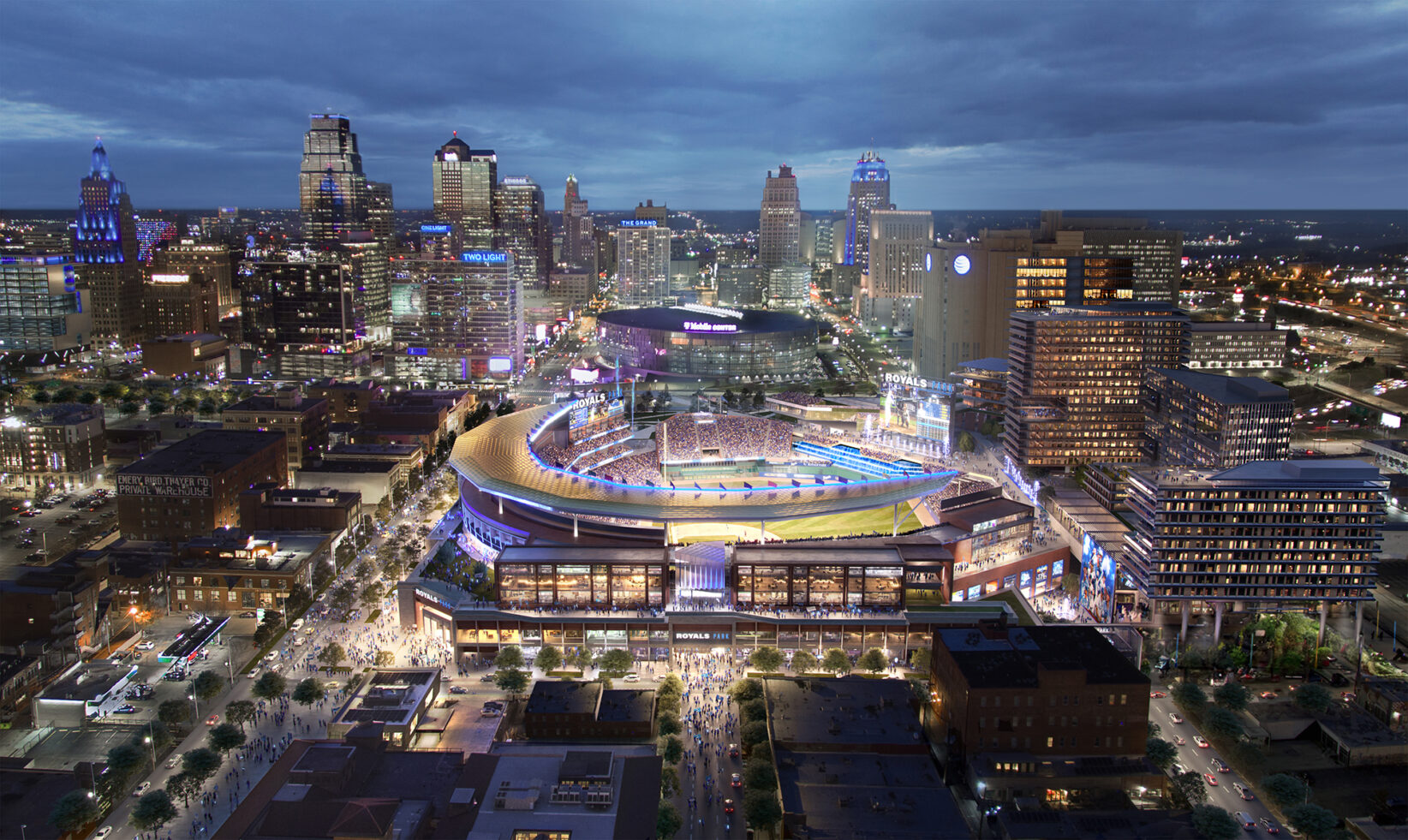
Rendering of the Royals’ proposed ballpark district in the East Crossroads, looking north; rendering courtesy of Populous
Economists agree that public stadiums should only get $10 million to $30 million in subsidies
While voters debate subsidizing the Chiefs and the Royals online, at coffee shops and at public meetings, decades of economic research show that stadium subsidies almost always represent poor investments of public dollars.
“It’s as close to conclusion as you’re gonna get an economist to agree to,” Propheter said. “This thing is going to cost you more money than it provides in benefits.”
A new campaign ad paid for by the Chiefs and Royals advertises a $1 billion investment in Kansas City, which would bring “good-paying jobs” and “small-business growth.”
But economists will tell you that these jobs are often displaced from other areas of the city. Any economic benefit pales in comparison to the $2 billion taxpayers will spend over the next 40 years.
This leaves “intangible” benefits, like the civic pride of having big league baseball and football teams.
“People love their teams,” labor economist Laura Dresser from the University of Wisconsin-Madison told KCUR’s Up to Date. “People are worried about not having their teams, and the team is something about the image of the community.”
Dresser is advocating for Kansas City to adopt a community benefits agreement, similar to one adopted in Milwaukee, that would hold the teams accountable to a set of measurable economic benefits. The teams missed a Feb. 14 deadline to finalize the agreement.
The Chiefs and Royals push the sales tax extension with an implied threat that, without the money and a new lease, they might take their teams to another county, to Kansas or, less likely, to another market.
It’s difficult to quantify the value of civic pride, but economists use a model called “contingent valuation” to estimate these kinds of intangible benefits.
The model uses techniques borrowed from environmental economics for studying things like how much money someone would be willing to pay to preserve public land or save an endangered species.
Contingent valuation finds that the civic pride of having a major league sports team is worth a fraction of the proposed $2 billion subsidy.
“We’re talking less than $20 to $30 million,” Propheter said, “and that’s being generous.”


2024 Startups to Watch
stats here
Related Posts on Startland News
Jazz musician opens sell-out BBQ spot; here’s how he’s spicing up KC’s chorus of flavors
Even with more than 90 barbecue restaurants across the metro, Gerald Dunn still figured there was room for his flavor profile on the Kansas City food scene. But before opening Dunn Deal BBQ in Grandview, he made a pilgrimage of sorts, stopping in to see legendary Ollie Gates. He reveres the local barbecue pioneer and…
For the loaf of the grain: Jonny Bakes bread, expands to keep community nourishment rising
Editor’s note: This story was originally published by Kansas City PBS/Flatland, a member of the Kansas City Media Collective, which also includes Startland News, KCUR 89.3, American Public Square, The Kansas City Beacon, and Missouri Business Alert. Click here to read the original story. Brookside bread baker works to reestablish the local grain shed Jon Szajnuk’s sourdough…
Thai Orchid opening in Northland: How this family business is getting out of its comfort zone with street food focus
A second location for a longtime Johnson County restaurant is expected to honor the origin story of the family business — building on its menu with a new emphasis on casual Thai street food items and small plates. Thai Orchid — a Mission, Kansas, restaurant that has been in the Rojjanasrirat family for 26 years…
mySidewalk teases Sidekick — a data assistant at the forefront of AI’s difficult-to-simple transformation
A new purpose-built community data and visualization tool from mySidewalk is designed to revolutionize decision making and empower those willing to embrace change when supplied with accessible and reliable data. The Kansas City-based govtech company this month announced the beta launch of Sidekick, an AI-powered data assistant meant to drive meaningful progress through insights gleaned…