

Urban designer behind Royals’ Crossroads ballpark pioneered the modern MLB stadium (and he has the bats to prove it)
March 27, 2024 | Nikki Overfelt Chifalu
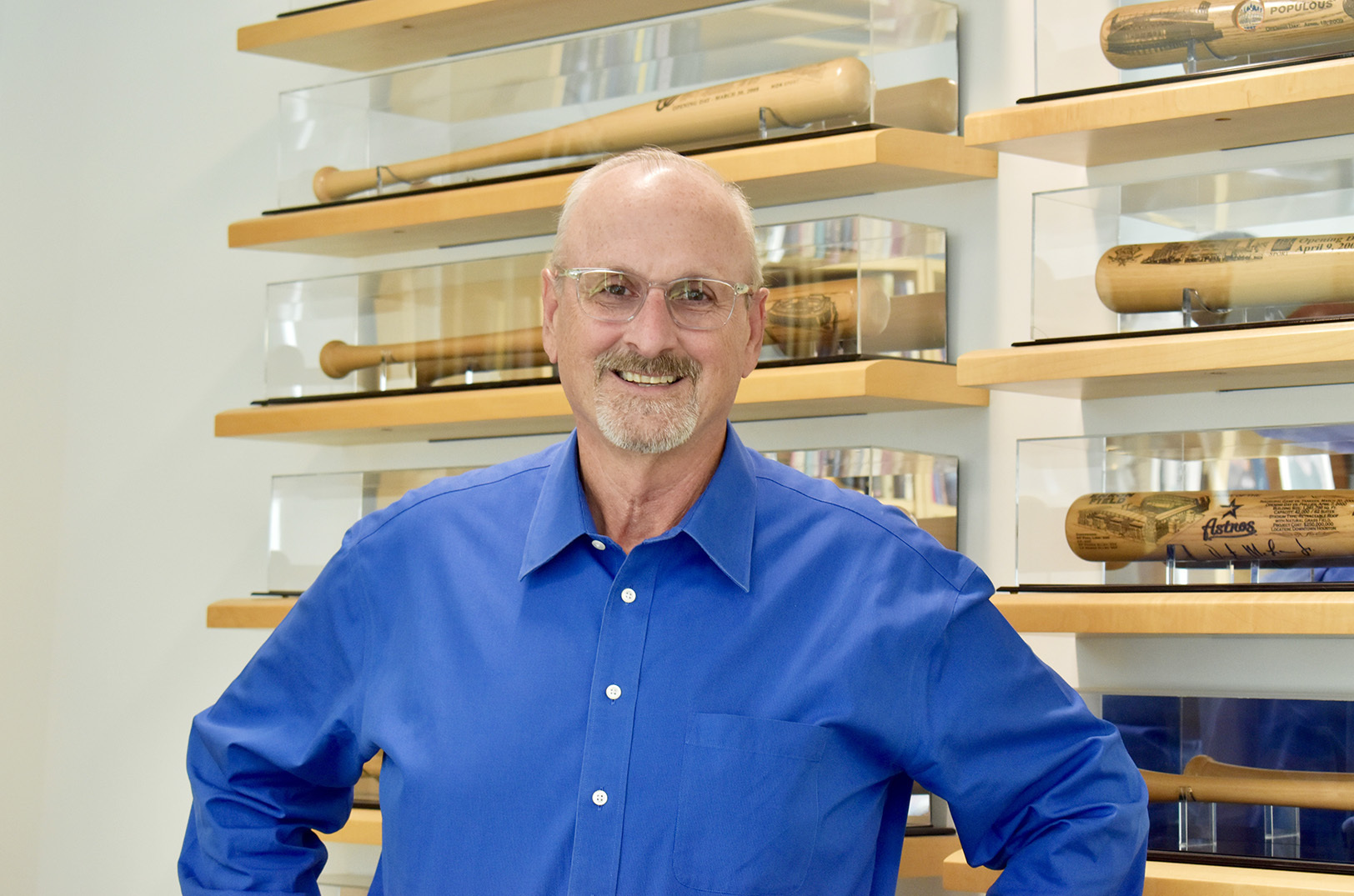
It’s difficult to find a Major League Baseball stadium that Earl Santee hasn’t influenced with his philosophy of community-oriented design.
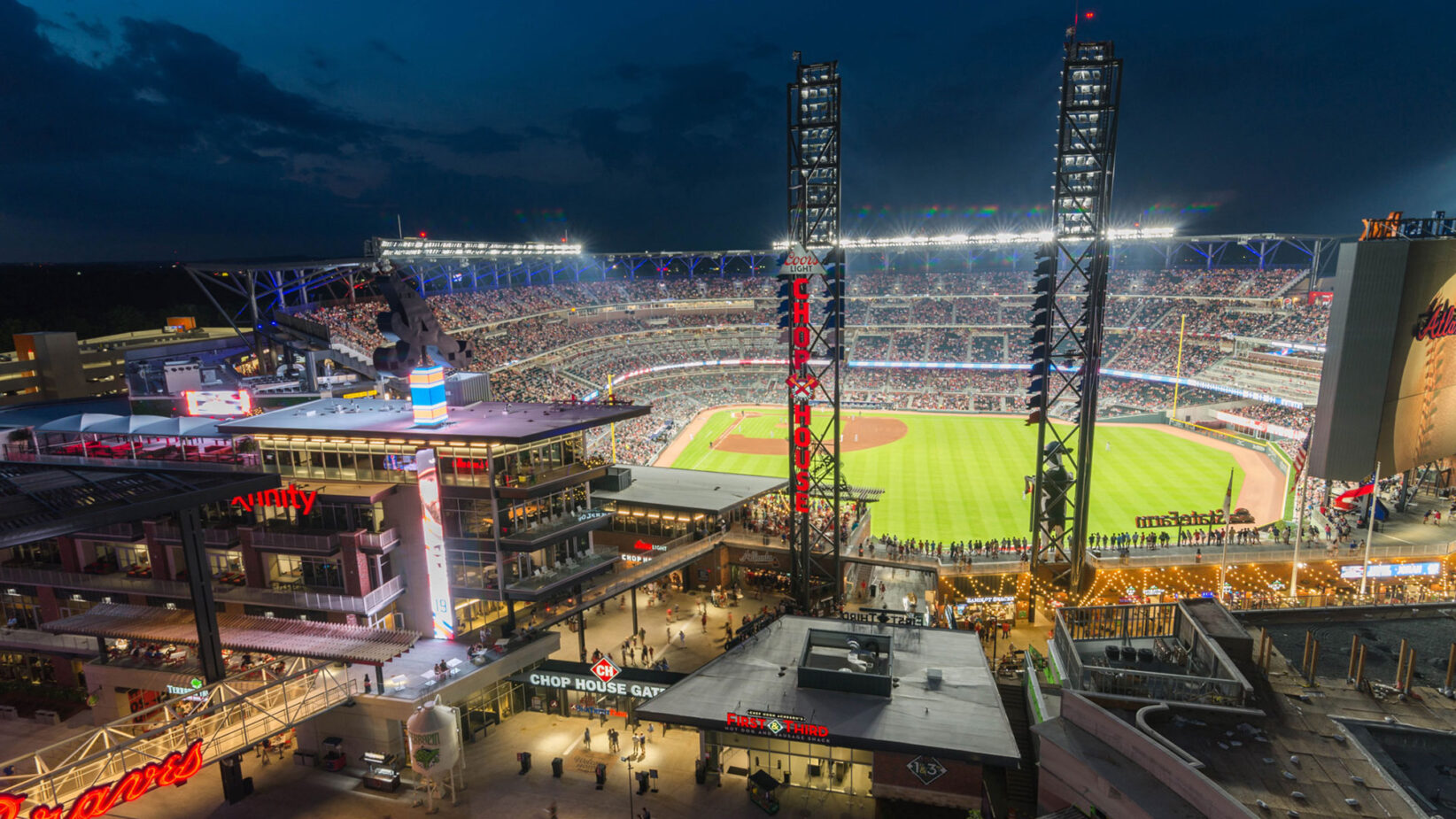
Called the “Godfather of ballparks,” Santee — the recently named CEO of Populous and literal architect of the proposed Kansas City Royals ballpark district in the East Crossroads — either designed or renovated two dozen of the 30 MLB stadiums, he shared, including Truist Park in Atlanta, Target Field in Minneapolis, and PNC Park in Pittsburgh.
Populous rendering of PNC Park in Pittsburgh, Pennsylvania, a project led by Earl Santee; image courtesy of Populous
“There was a period of time where I had five new ballparks going on at the same time,” Santee explained. “I’m not sure how I survived.”
Custom baseball bats commemorating each design project he led line the wall of Santee’s office at Populous Americas Headquarters on the Country Club Plaza.
“The fun part of our job is creating something new and innovative that is unlike anything else across the country,” he added. “It’s what fascinates me and why I’m still here.”
Santee — a native of Kansas City who also is senior principal, global chair, and founder of the design firm — considers himself an urban designer first and an architect second.
“We’re just not designing the ballpark,” he explained. “We’re designing the communities around the ballpark and then how that’s all connected.”
“I’m an urbanist by nature,” Santee continued. “So I know how I can make things connect. The importance of shared experiences or connected experiences is something that I know really well.”
Although ballparks are his first love, he’s also worked on projects outside baseball, including Texas A&M’s Kyle Field and Baylor University’s McLane Stadium. In his nearly two decades at Populous, he’s designed more than 60 projects.
Click here to check out Populous’ portfolio of projects — from equestrian facilities to motor sports and esports arenas to international football complexes.
“Now in my 39th year, I still love doing what I do,” Santee said. “I’m motivated by the work, motivated by the people who work with me, and motivated by the opportunities that our clients give us. That’s all been really great.”
“It’s easy when you love something and people know you do,” he continued. “They know that you’ve got that passion. Then it’s easy to share that with people and it’s easy to share that with clients, specifically.”
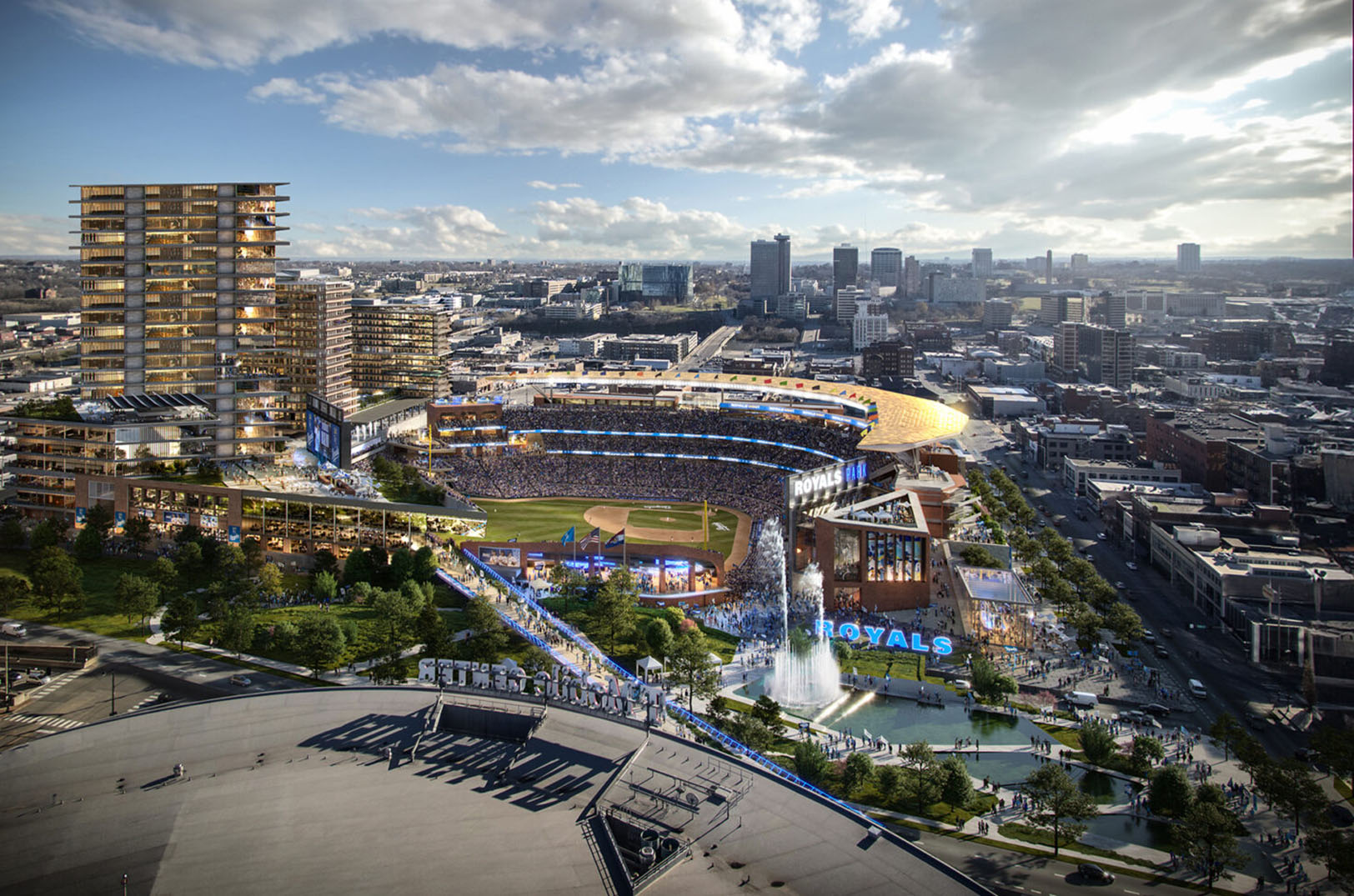
Rendering of the Royals’ proposed ballpark district in the East Crossroads, looking south; rendering courtesy of Populous
Early innings
Santee — a graduate of Hogan Preparatory Academy High School and the University of Kansas — found his passion for drawing in his youth, he shared, taking summer classes at the Kansas City Art Institute. He also loved to build, working alongside his father with his residential construction company and taking architectural drafting classes during high school.
“That solidified my interests,” Santee added.
After graduating from KU with an architecture and environmental design degree, he worked for a few years in Tulsa, Oklahoma, before returning to Kansas City. In 1985, he joined the design firm HOK.
“I have always been a sports fan,” Santee said.
“The sports architecture industry was created with the invention of HOK Sport,” he continued, which became Populous in 2009. “It was the first, I think, specialized sports practice in America at the time. So it didn’t take much convincing for me to come over and it’s been a blast ever since.”
Santee’s early work featured a heavy focus with NFL stadiums, he noted, including his first project: suite additions to Mile High Stadium in Denver. Then in 1987, he worked on a minor league baseball stadium on the Mississippi River in Davenport, Iowa.
“I fell in love with the ballpark architecture and the history of it and the legacy of baseball in America,” he explained. “I think that cemented my love of what I would go forward with over time.”
Then Santee was called up to the majors — working with the Detroit Tigers in 1989 and New York Yankees in 1991. He spent a tremendous amount of time in each city where he face a new project, he said.
“I felt like I needed to understand a place; to do, so I needed to be there,” he added.
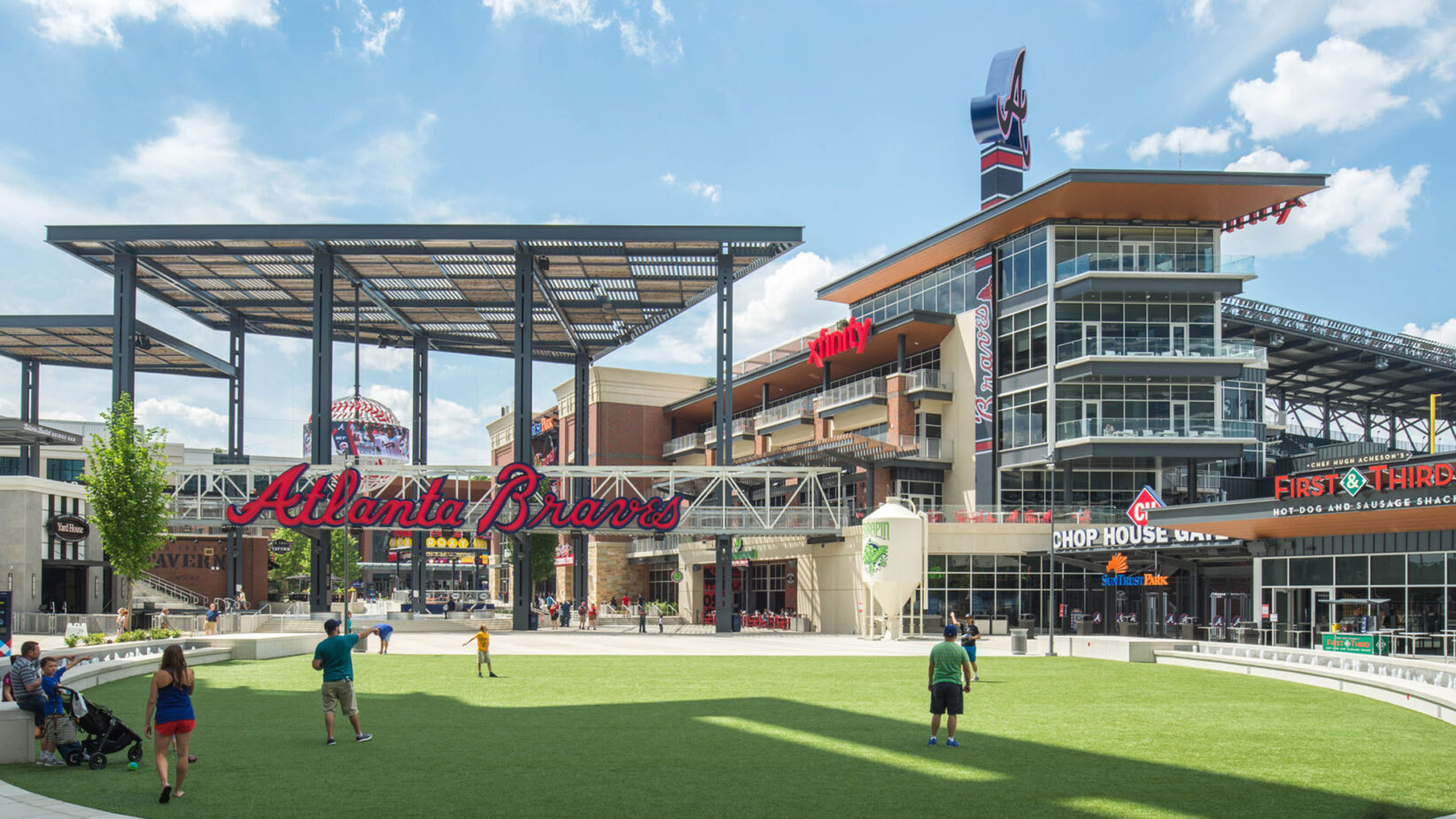
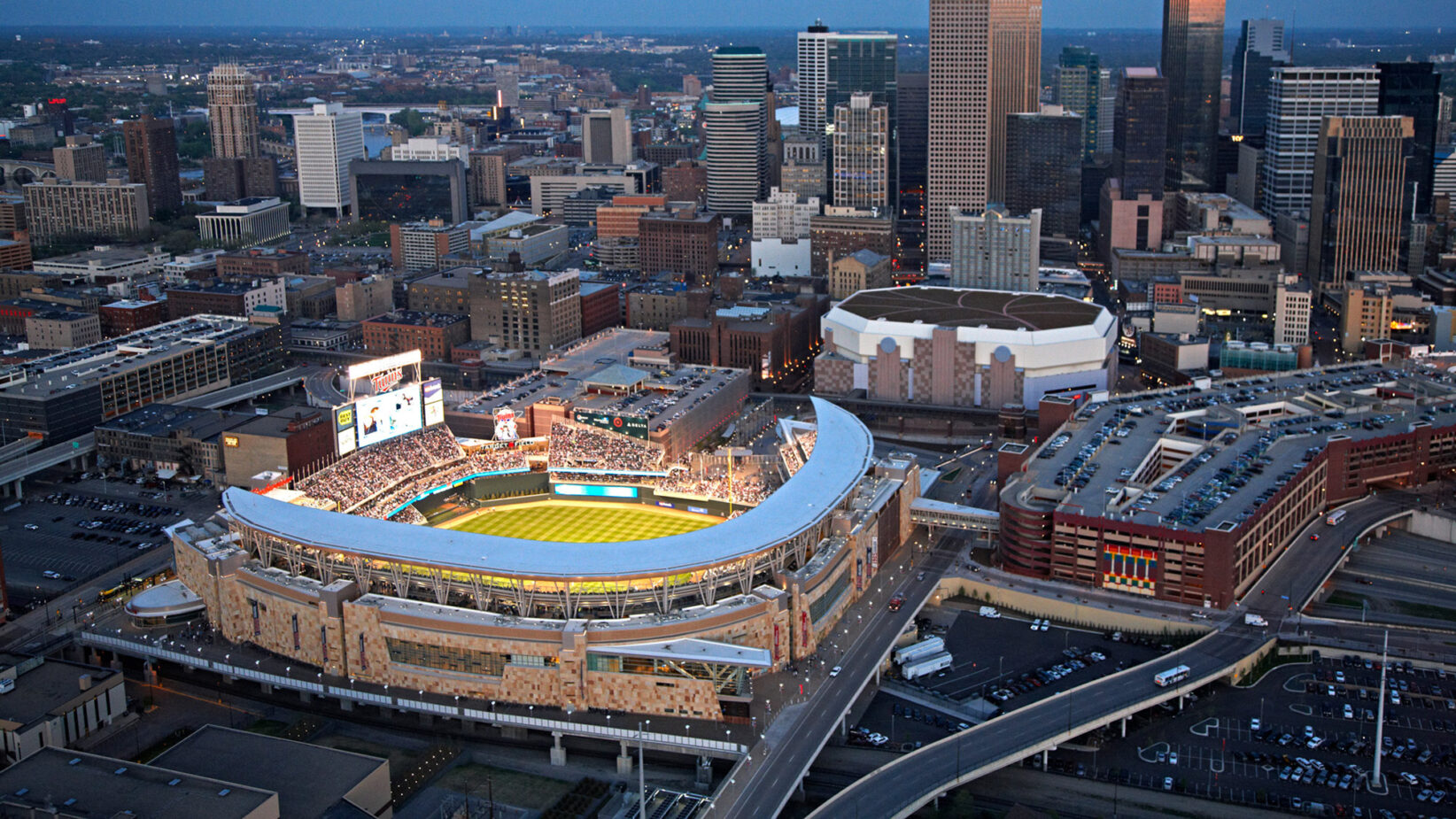
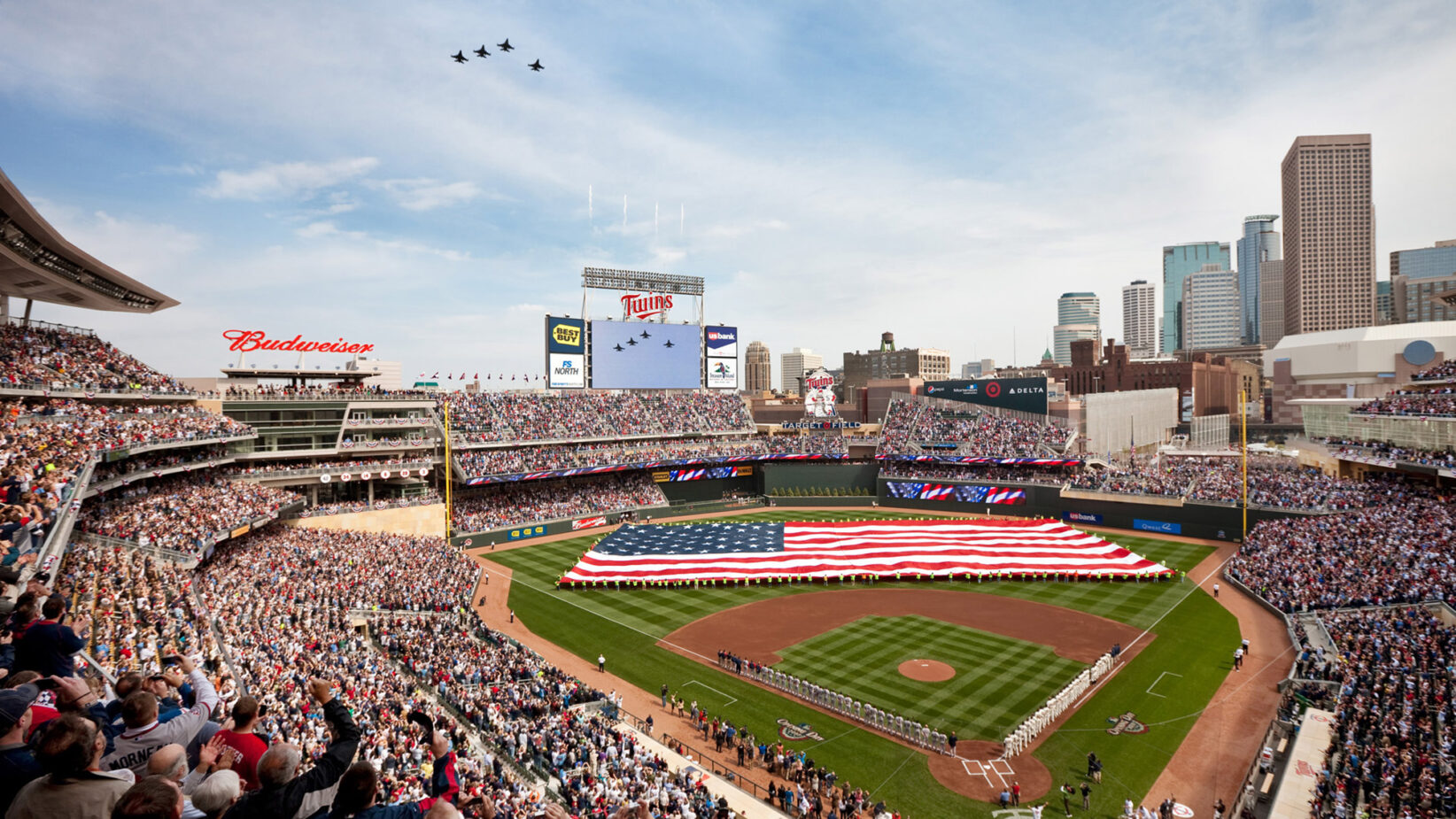
Santee’s most memorable ballpark projects often go back to the people involved, he shared, including the Houston Astros owner who gave him a list of rules to go by when designing the downtown ballpark — which Santee still keeps in his office; working with the Yankees for 17 years through three or four different mayors and the terror attacks of Sept. 11, 2001; falling in love with the city of Pittsburgh and the people that embraced him; and the challenge of building Target Field at a spot in Minneapolis where people said it couldn’t be done.
“People often ask, ‘What’s my favorite project?’ Santee said. “What I answer is that they all build off one another. So it’s additive. The most important thing is that with the experience I have, I can say I’ve pretty much seen every condition and every issue and feel like my creative skills are good enough that I could resolve most things that come before me.”
“And I would say that it’s helped me here in Kansas City with just how we look at the community,” he added.
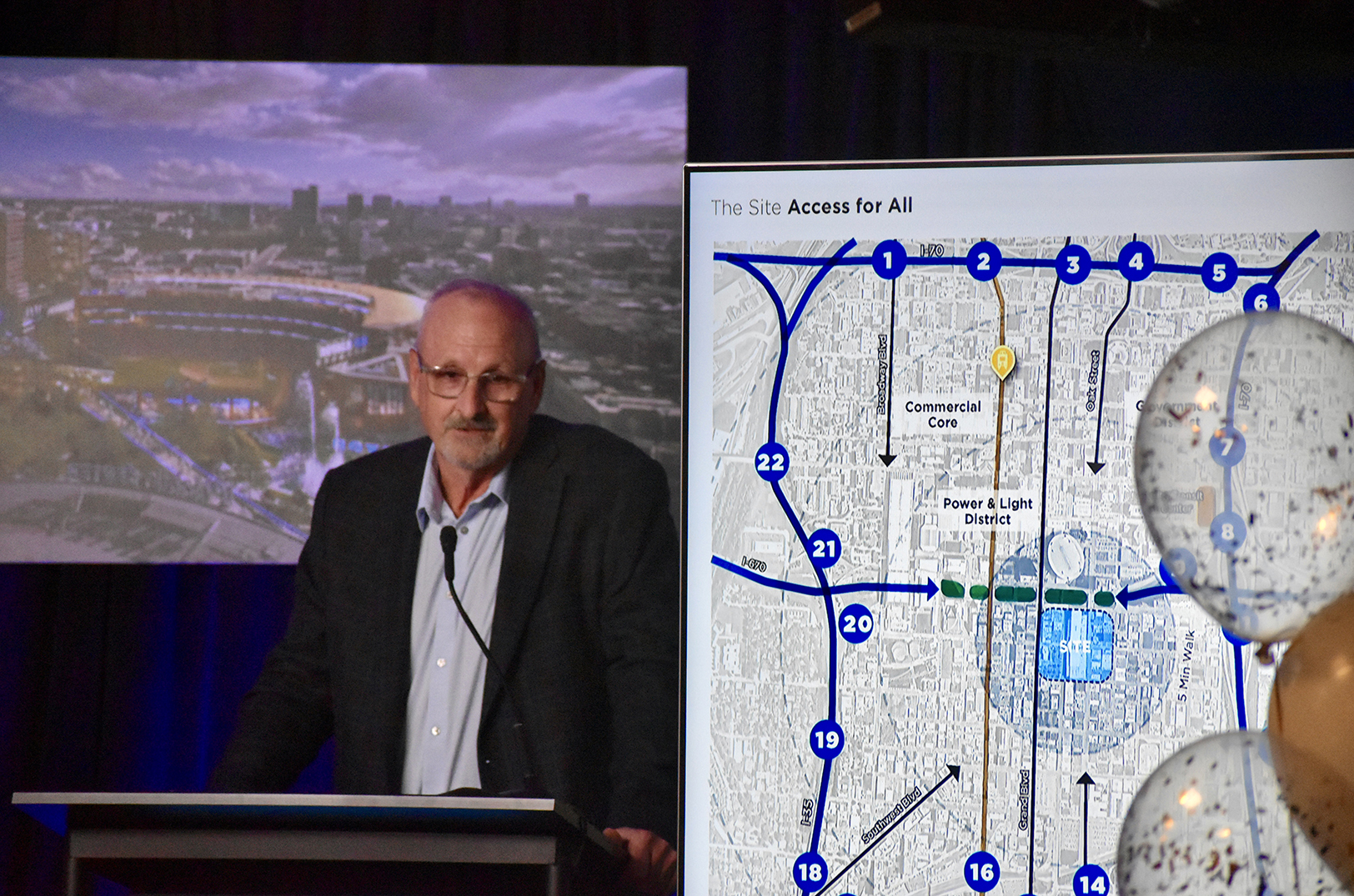
Earl Santee, Populous, speaks during an announcement event at Kauffman Stadium; photo by Nikki Overfelt Chifalu, Startland News
On deck
Santee’s next big project and challenge could be his hometown ballpark, as the Royals aim to build his design in the East Crossroads.
“I know what makes baseball tick,” he explained. “I know the business of baseball. I know the sport of baseball. I know how you sell it, how you market it, you experience it, and what it means to a city.”
“I call it the spirit of the place,” Santee continued. “I understand what that means. It feels really esoteric and like something soft, but if you’ve been to Wrigley Field in the afternoon, it’s a real thing. I think that’s what I bring to Kansas City.”
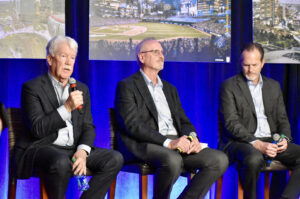
John Sherman, chairman and CEO of the Kansas City Royals, sits alongside Earl Santee, Populous, and Brooks Sherman, Royals, during an announcement event at Kauffman Stadium; photo by Taylor Wilmore, Startland News
The design of the new stadium, he shared, reflects his urbanist philosophy: it’s people-first.
“We tend to spend a lot of time talking about access, transportation, and parking,” he explained. “I’m more interested in what people do when they’re not in their cars.”
Although he did note that the first step in any site evaluation project is to bring in a traffic engineer.
“This is by far the most accessible site,” he added.
RELATED: Royals change ballpark design to keep Oak Street open
What excites Santee most about the East Crossroads site, he said, is how easily it connects to things that are considered the essence of Kansas City, including art and music at venues like the Kauffman Center for the Performing Arts, the T-Mobile Center (another high-profile Populous project), the Music Hall, the Convention Center, Crown Center, and even the Country Club Plaza.
“The streetcar clearly is the conduit that makes a lot of that happen for us,” he noted.
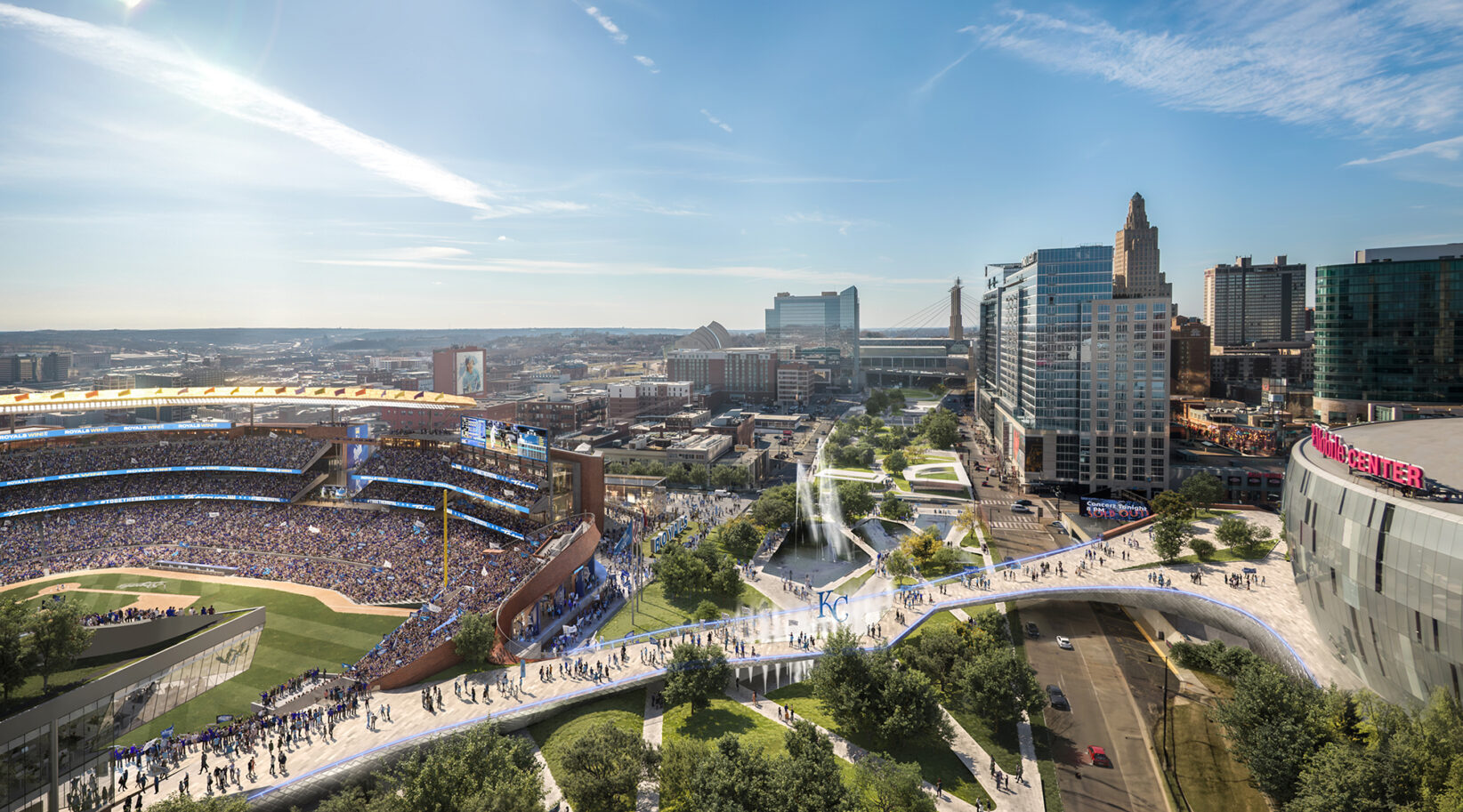
A rendering of the Royals new ballpark district in the East Crossroads connects the arts district to downtown Kansas City; rendering courtesy of Populous
The South Loop Link project — a proposed sustainable urban park that would extend over the 5.5-acre stretch of I-670 from Wyandotte Street to Grand Boulevard and will link the Central Business District to the Crossroads Arts District — is an intriguing piece of the puzzle for the potential ballpark project, Santee added.
“It makes downtown Kansas City feel whole,” he explained. “We’ve always fashioned Kansas City as this great city of parks, the ‘City of Fountains.’ I think having something that allows us to put that front and center is really a huge thing. In fact, that’s what will make it feel more authentic here than anything else. We can design a great ballpark, but having a great park with it, that’s as much icing as I could put on that cake.”
Overall, Santee shared, the potential stadium in the East Crossroads will be a much more extroverted experience than at Kauffman Stadium — the Royals’ current home at the Truman Sports Complex, east of downtown.
“It’s all about what’s on the field,” he said of The K. “This is gonna be about what’s outside of the ballpark. I don’t want walls. I want people to be able to access the building, walk around the building and experience — not just the game itself — but by virtue of how it’s organized right now, you have a constant view of downtown.”
“I think the big consequential difference is that you’ll feel the city and experience the city differently than you would anywhere else,” he added.
The demographics of fans who attended games 10 years ago at Kauffman Stadium is different from those who will attend games in 2028 — when the Royals hope to open the new stadium — Santee noted. And those demographics will change again in 2040.
“Having the ability to evolve to meet societal changes is really an important part of what we do,” he explained.
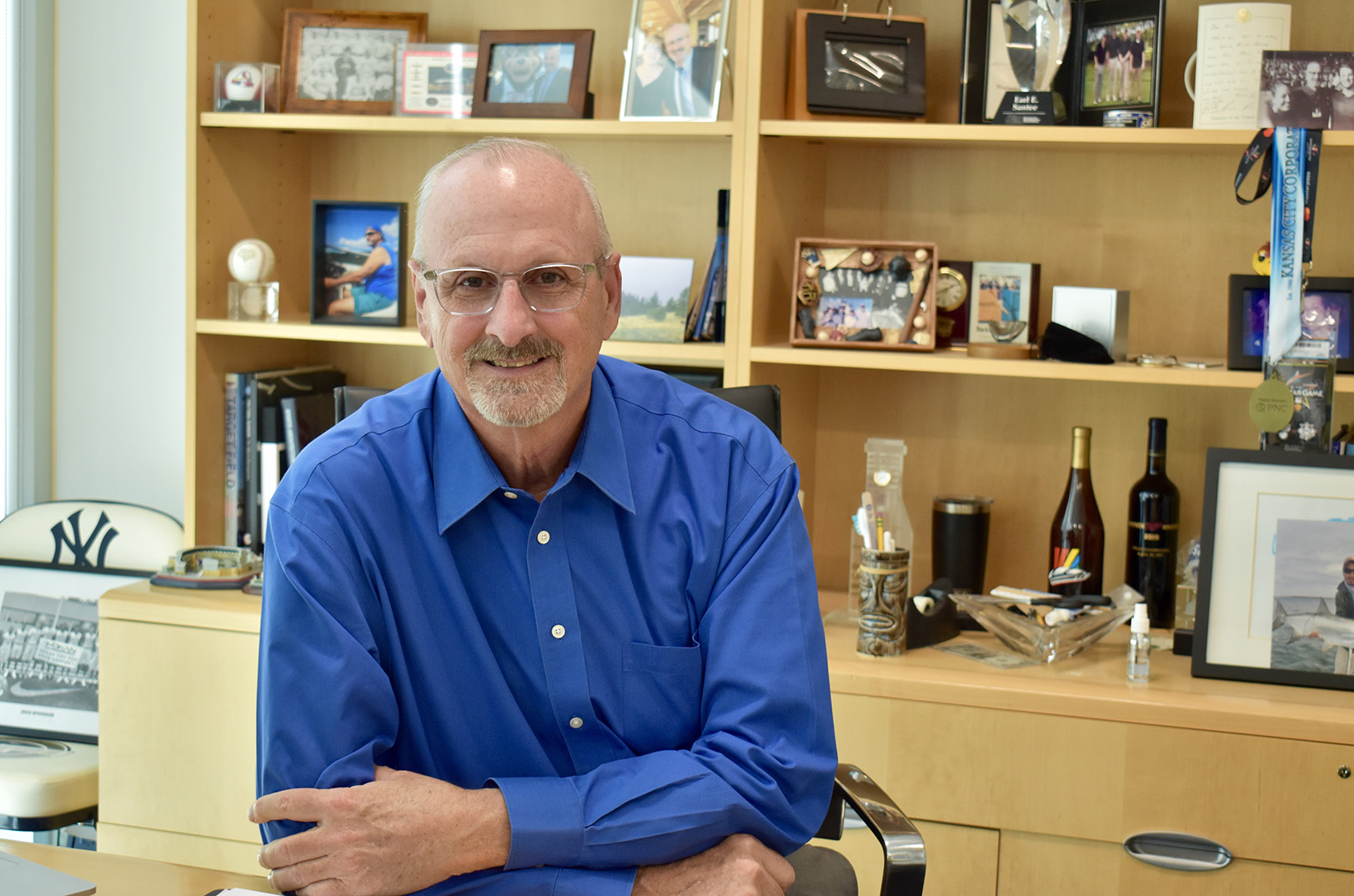
Earl Santee, Populous; photo by Nikki Overfelt Chifalu, Startland News
If the East Crossroads stadium gets built, Santee sees it impacting downtown Kansas City and the Crossroads like successful similar projects in Denver and San Diego.
“I think that the ballpark — with bringing two and a half to three million people to a site each and every year — will have a huge impact on the rest of a natural evolution and development that would happen around the site,” he said. “My hope is that more and more people choose to live and work downtown and in the Crossroads. I think that there’s a value there that will happen.”
“I could see where we’ll start seeing some of the parking lots getting filled with housing and other development pieces,” Santee added.
The ballpark designer believes the project — which could hinge on the outcome of an April 2 stadium sales tax vote — could be the opportunity that pulls together Kansas City’s groupings of urban development, including Westport, Crown Center, the Plaza, and Brookside.
“It really could be the community center,” Santee said. “It may be what brings all the people of Kansas City together in a way that we haven’t quite found out how to do.”


2024 Startups to Watch
stats here
Related Posts on Startland News
Cafe Cà Phê returns to the West Bottoms with second location for KC’s popular Vietnamese coffee shop
A Cafe Cà Phê satellite location inside 12th Street Post in the West Bottoms is the perfect step for continuing the mission of Kansas City’s only Vietnamese coffee shop, shared founder Jackie Nguyen. Just shy of the one year anniversary of its Columbus Park space, Cafe Cà Phê celebrated the grand opening of its new…
She wanted to bring her favorite foodie magazine to KC; her mother’s sudden death put this publisher’s plans on the back burner
Lauren Cook’s passion for Edible Communities magazine drove her appetite to revive it in Kansas City, she shared, but an unexpected life change has her hoping to hand the publisher’s apron to someone else. Cook purchased the license to publish the city-specific food magazine — each independently run by publishers in metros across the country…
Digital Sandbox alum earns new round of funding — this time for sports tech; Meet the latest batch of just-funded startups
From making the college admissions process easier for students to summarizing books and podcasts using artificial intelligence, the latest startups to join Digital Sandbox KC are a great example of the creativity of this region’s entrepreneurs, said Jill Meyer. The four newly selected companies are expected to receive up to $20,000 in project funding and…

Her red sauce is dynamite but Ragazza’s owner gives the chef title to her Italian heritage
Family is baked into the core of Laura Norris’ restaurants, she shared, from the Italian recipes served at Ragazza in Westport to the brother-sister duo running the new Enzo Wine Bar and Bistro together in the River Market. She opened Ragazza, which now sits at the corner of 43rd and Main streets, in 2013 and…