

Building your eco-friendly dream home can be time suck, co-founders say; a new app gives renovators the keys to energy efficiency
November 3, 2023 | Nikki Overfelt Chifalu

KINGSTON, New York — Sustainability shouldn’t just be an add-on for new homebuyers or renovators, said Brad Johnsmeyer, noting recent improvements in technology make critical upgrades to elements like insulation, water heaters, and solar features more financially accessible — but not always approachable to the everyday person.

“It’s gotten to the point where it’s almost a bad decision to not include sustainability,” said Johnsmeyer, a native Kansan and co-founder of the startup EcoHome. “It’s a little bit more expensive upfront, but those costs are coming down all the time. And then your monthly operating costs — your heating bill, your electricity bill, your water bill — those are all gonna go down.”
“Homebuyers are increasingly expecting those kinds of features to be in a house,” he added.
The problem: Most people don’t know how to navigate the technical complexities involved with retrofitting a home with sustainable and environmentally friendly upgrades, he said.
“We realized that there’s a real mismatch between the information that’s available for homeowners who want to build something or do a construction project and the people who actually will do those construction projects for them,” Johnsmeyer explained. “A contractor or an architect has a huge amount of information that homeowners just don’t know unless you’ve been through that before.”
The information gap is even more significant, he noted, when it comes to eco-friendly homes and high-performance homes.
EcoHome — which Johnsmeyer launched with fellow Jayhawk Thad Allender — serves as a roadmap app for homeowners that bridges sustainability and home improvement, providing them with the tools and resources needed for a successful renovation project while helping them curtail their carbon footprint.
“We realize that there’s this big opportunity to actually really help the environment and do things for the world, but also make your house a lot healthier and a lot cheaper to run, plus just have a better experience in your home,” said Johnsmeyer.
Click here to explore how the app’s project planner works.
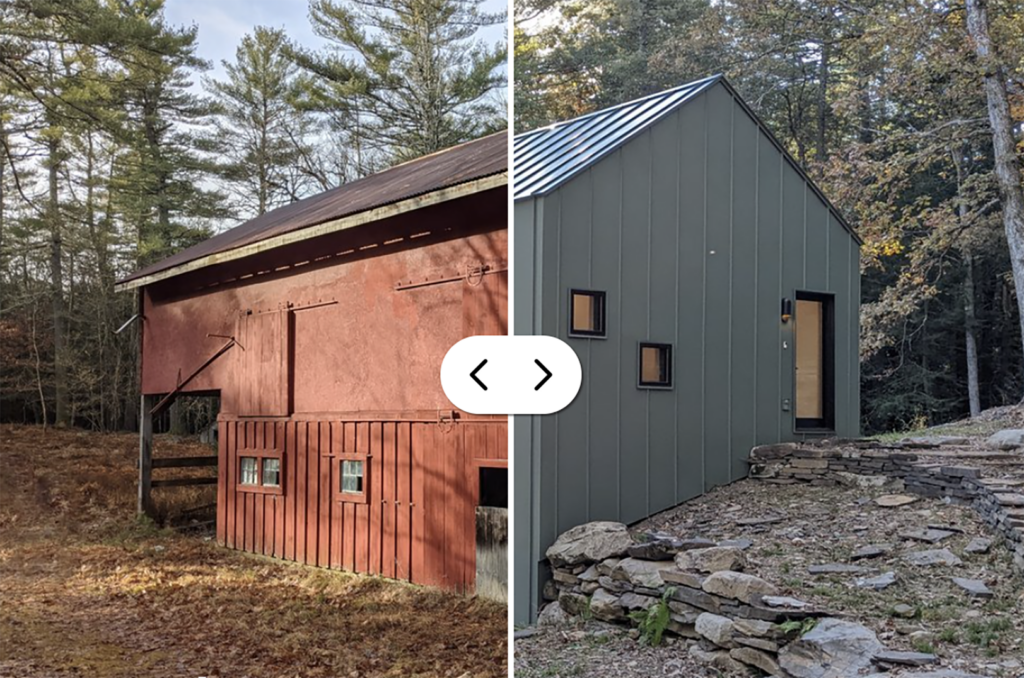
A journey to smarter builds
University of Kansas graduates Johnsmeyer and co-founder Allender didn’t know each other during their upbringings in Kansas, but met through mutual friends in New York; connecting, in part, because of their shared experience in the home renovation and tech spaces. Johnsmeyer worked for Google for 15 years and Allender founded two previous tech startups, including a website creation tool for photographers and artists that was acquired.
Over the course of the past decade, both completed significant construction projects at their respective homes, said Johnsmeyer, who currently lives in a house built in 1887. He’s renovated four houses and Allender has built three homes in the past eight years.
Many of their friends relocated upstate from New York City during the pandemic; buying older houses or building houses, noted Allender, who acted as his own contractor on his latest passive-inspired home build.
Because of their home renovation experience, Allender and Johnsmeyer found themselves fielding a lot of questions about the process.
“So we were like, ‘Let’s build something that helps answer questions that all of our friends are having — and that all the rest of the homeowners were having too — and also add in an eco-friendly component,’” Allender recalled.
The app presents an opportunity for people to dramatically improve their energy efficiency, he emphasized.
“I’m really excited to help people on that journey,” Allender said. “If we can help people do smarter renovations that go smoothly and aren’t full of those nightmare stories that you hear, I’ll be really thrilled.”
It starts in our homes
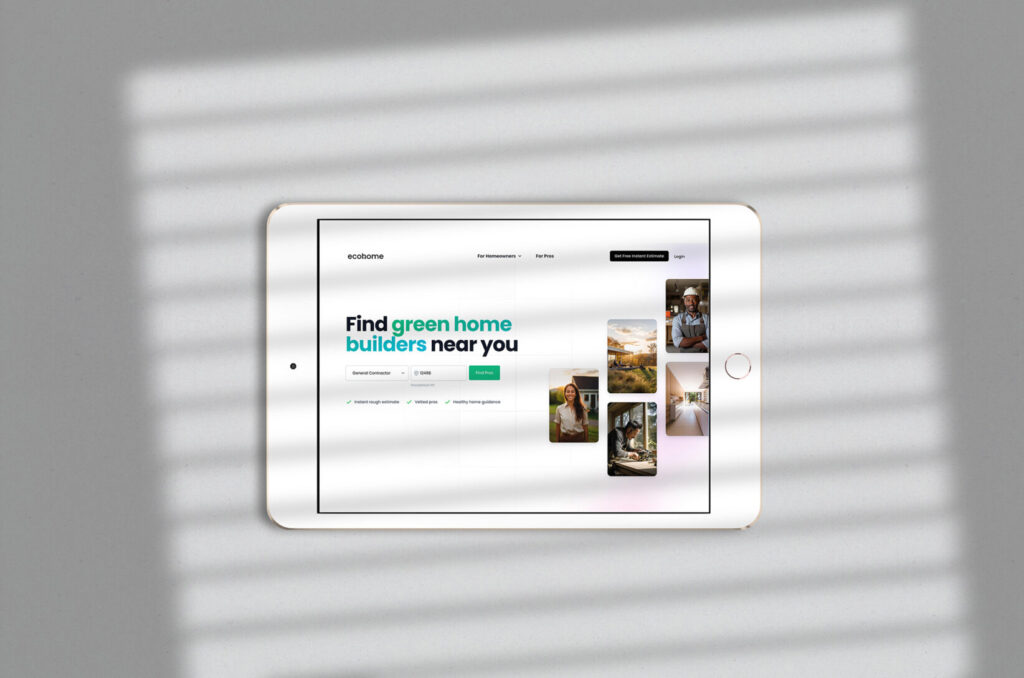
The EcoHome app — which Allender and Johnsmeyer bootstrapped — provides homeowners with a project planner that allows them to estimate construction costs, explore design options through AI, budget, chat with experts, plus connect with vetted contractors and architects.
For example, if a homeowner wants to do a kitchen renovation, Allender said, they can enter in specific details about the project in the app. The EcoHome app offers a calculator that takes the square footage, the quality level, and other parameters and creates a quick pre-estimate for the project cost.
“That kind of helps to make you aligned with real market situations,” he explained, “because we were realizing that homeowners had no idea what things might really cost. We were kind of shocked. Then contractors would feel the brunt of questions like, ‘Why does it cost this much?’ and then they have to explain things. So we do all of that education upfront.”
Through the app, homeowners can also request bids from contractors who are suited for the project they are undertaking, Allender noted. The contractors can then see the scope of the work and decide whether they want to accept or decline the chance to bid.
“All of this happens within the app,” he added. “Typically, it’s a manual process and nobody knows the moving pieces and how it works. Here, you can click a few buttons and find who you want to work with and get an estimate.”
This also helps out the contractors and architects, Johnsmeyer said, as it can be difficult for them to make sure they are using their time wisely.
“If you get a homeowner who doesn’t really know what’s going on — through no fault of their own — it becomes really a big time suck for an architect or contractor to put together a proposal and spend all that time educating people,” he explained. “So there’s kind of this serendipitous relationship that we think we can help with.”
“If you get homeowners who are really smart and then connect them with contractors, you save the contractors time and also help the homeowners be able to find somebody that they can really trust to bring their vision to life,” Johnsmeyer continued.
With each project on the app, homeowners also receive an eco score, Allender noted, that helps them to understand the cost-value analysis of the project.
“It provides both a return on investment metric and then also an eco score,” he added. “That’s something that most homeowners really don’t think about.”
“We all have an important role in the future of the world and reducing our energy consumption individually is really important,” Allender continued. “And that starts at our homes. There is a larger upfront cost, but it pays itself off relatively quickly. So the sooner that we can help homeowners with that problem, hopefully we bring value to the table and can help with their education and then also help contractors find work that helps improve the world.”


2023 Startups to Watch
stats here
Related Posts on Startland News

This keychain could stop an opioid overdose; carry the antidote — not the burden of guilt
ST. LOUIS — Easy access to life-saving naloxone (better known by the brand name Narcan) could’ve prevented the fatal overdose of Danielle Wilder’s close friend in college, the tragedy-prompted entrepreneur said. Her friend was in possession of naloxone — a fast-acting medicine that can reverse the deadly impacts of an opioid overdose when delivered near-immediately…

Brookside restaurant spot shifts from Irish to Mexican flavors as two families expand their dream
Two longtime friends and their daughters — all seasoned restaurant workers — are joining together in a new East Brookside restaurant they can call their own. Muy Caliente Grill & Cantina is scheduled to open later this month at 751 E. 63rd St., Suite 110, in the former Brady & Fox restaurant. Owners Fredy Rivera…
Landlord’s solution to Kansas housing crisis: 3D print his own home inventory
TOPEKA — Regularly confronted with a lack of supply in the housing market — and the subsequent higher prices — landlord and general capital investor Chris Stemler faced a multi-dimensional challenge. “I thought to myself, ‘How do I help solve an inventory problem?’ the Topeka-based Trident Homes founder said. “I know I’ve got renters who…

Just-launched retail hub gets first tenant, battling ‘blight of the heart’ on Troost corner
‘We are each other’s bootstraps’ Transforming a long-vacant building along Troost into a space for neighborhood small businesses is about empowering the entrepreneurs already living and working in the east side community, said Father Justin Mathews. The newly unveiled RS Impact Exchange — built within the renovated, 1920-built Baker Shoe Building at 3108-3116 Troost Ave.…