

This Kansas gardener sued to sell fruit and honey; Now her town will allow urban farming
September 26, 2023 | Celia Llopis-Jepsen

Editor’s note: The following story was published by KCUR, Kansas City’s NPR member station, and a fellow member of the KC Media Collective. Click here to read the original story or here to sign up for KCUR’s email newsletter.
Ottawa city officials are trying to strike a balance between people who want to produce food and the interests of their neighbors
OTTAWA, Kansas — Ottawa will now allow small-scale urban agriculture — a move designed to accommodate residents who want to raise chickens and to resolve a homeowner’s lawsuit over the right to sell fruit and honey.
City lawyer Blaine Finch said the goal is to let residents produce food in their yards without impinging on the welfare of their neighbors.
“Frankly, agriculture is one of the original activities in this area,” Finch told city commissioners at a recent meeting. “The city hall is built on the site of Tauy Jones’ wild berry patch … It’s as old as the community, if not older.”
The rules allow small-scale farming in neighborhoods, as long as it doesn’t create nuisances like bad odors or lots of customers visiting residential streets.
The change is a victory for Ellen Finnerty, a fruit gardener and aspiring beekeeper who sued the city earlier this year.
RELATED: Kansas gardener sues for the right to sell honey and fruit from her Ottawa yard
She had been working on a backyard orchard for a few years and taking community college classes on beekeeping. Her goal is to sell fruit and honey at a local farmer’s market.
But Ottawa’s codes didn’t allow that. The rules banned people from running home businesses that involve animals. They also appeared to prohibit so much as selling a tomato grown in your backyard.
Not anymore.
The commission voted last week in favor of a suite of codes that acknowledge urban agriculture and set rules for it.
The new rules allow people to keep hens for egg-laying. They also set guidelines for beekeeping.
And the rules distinguish urban farming from other kinds of animal-related work. That means it will now be legal to take homegrown honey and eggs to the farmer’s market.
Some other kinds of animal businesses, such as at-home dog kennels, remain banned.
Finnerty was scared that the city’s previous rules put her at risk of fines or jail. She challenged the rules with representation from the Kansas Justice Institute — the legal arm of the Kansas Policy Institute, a small-government think tank.
Her lawyer argued the city’s rules violated the Kansas Constitution, which guarantees the rights to life, liberty and the pursuit of happiness.
Ottawa’s lawyer asked the judge in a filing to throw out Finnerty’s case. But the filing also signaled city officials were open to changing the codes. It said officials were already working to address public requests to allow chicken coops.
The city entered talks with the Kansas Justice Institute to resolve her lawsuit.
Now that the commission has approved urban farming codes, the institute put out a press release calling the change a victory.
“The city, to its great credit, understood there wasn’t a good reason to prevent Ellen from starting her home-based business,” said Sam MacRoberts, the group’s litigation director.
Advocates for buying and growing food locally say that urban farming can provide fresh food with fewer transportation costs and carbon dioxide emissions.
Some cities are tweaking their rules to accommodate that.
Lawrence changed its codes in 2016 to loosen rules for residential crops and allow beekeeping and sales of honey and other homegrown foods. Indiana, meanwhile, struck down all municipal beekeeping bans in 2019.
Celia Llopis-Jepsen is the environment reporter for the Kansas News Service. You can follow her on Twitter @celia_LJ or email her at celia@kcur.org
The Kansas News Service is a collaboration of KCUR, Kansas Public Radio, KMUW and High Plains Public Radio focused on health, the social determinants of health and their connection to public policy.


2023 Startups to Watch
stats here
Related Posts on Startland News
STEAM Studio team coding best fit for boy’s 3-D-printed prosthetic arm
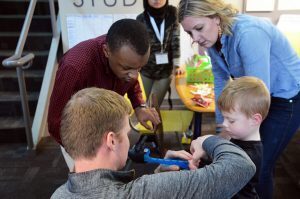
Four-year-old Hudson Borton extended his arm Wednesday, as his father fitted a 3-D-printed prosthetic to the boy’s upper arm and elbow. The light blue plastic piece mimicked the size and length of Hudson’s right arm, though his father and Mandi Sonnenberg, co-founder and director of STEAM Studio, agreed the new device wasn’t yet a perfect…

KC-based SouveNEAR vending machine startup prepping to scale up
SouveNEAR offers travelers a piece of KC — from KC, said co-founder Tiffany King. The Kansas City-based startup, which repurposes vending machines to sell locally made souvenirs, is in its fourth year of steady, organic growth, King said. As a member of ScaleUP! KC new class, SouveNEAR is preparing to grow the business and turn…

Google, Techstars partner to lower barriers for March 23-25 Startup Weekend
A new partnership with Google will allow Techstars to present this month’s Startup Weekend free of charge to Kansas City participants, said John Coler. “It opens up the opportunity to reduce the barrier for entry for those who either would not usually use their discretionary income or (do not) have the ability to pay for…

Food, IoT, blockchain and AgTech startups join 2018 Sprint Accelerator class
With its fifth cohort of early-stage firms, the Sprint Accelerator scoured the globe for a brood of ag, food and tech startups that aim to leverage area corporate partnerships. The Crossroads Arts District-based accelerator announced on Monday nine new startups that will participate in its 90-day, mentor-driven program. The accelerator pairs startups with wireless carrier…