

Sips on the shelf: Whiskey inventory app pours order into collectors’ private honey holes
August 17, 2023 | Nikki Overfelt Chifalu

Startland News’ Startup Road Trip series explores innovative and uncommon ideas finding success in rural America and Midwestern startup hubs outside the Kansas City metro.
WICHITA — Whiskey connoisseurs can now take their collections digital, shared Dave Cunningham, an enthusiast whose new app tracks the high-value, sought-after liquor.

Dave Cunningham, Whiskey Shelf, Flint Hills Group
In February, Cunningham — with the help of his software development team at Wichita-based Flint Hills Group — launched Whiskey Shelf, a whiskey inventory app.
“It’s a passion of mine; it’s a hobby,” explained Cunningham, who has 118 bottles in his personal collection. “So I know that people that are into whiskey are kind of obsessive about it. I know one person in Wichita who has 1,000 bottles. I’ve never seen anything like it.”
“Some of these people are collectors,” he continued. “They don’t open all the bottles; they want to collect them. No human being can possibly consume hundreds of bottles of whiskey, so they share things. They want to show it off and it’s very social.”
The app allows users to track their inventory — including the levels of bottles — valuations, wish lists, and infinity bottles, the Flint Hills Group founder and CEO noted.
“There’s a couple of apps that I had used that I liked some of them,” Cunningham added, “but there was no good app that would inventory your whole system.”
The Whiskey Shelf database includes about 7,700 different whiskies and also includes an option for users to suggest a bottle if they scan it and can’t find it on the app, he said.
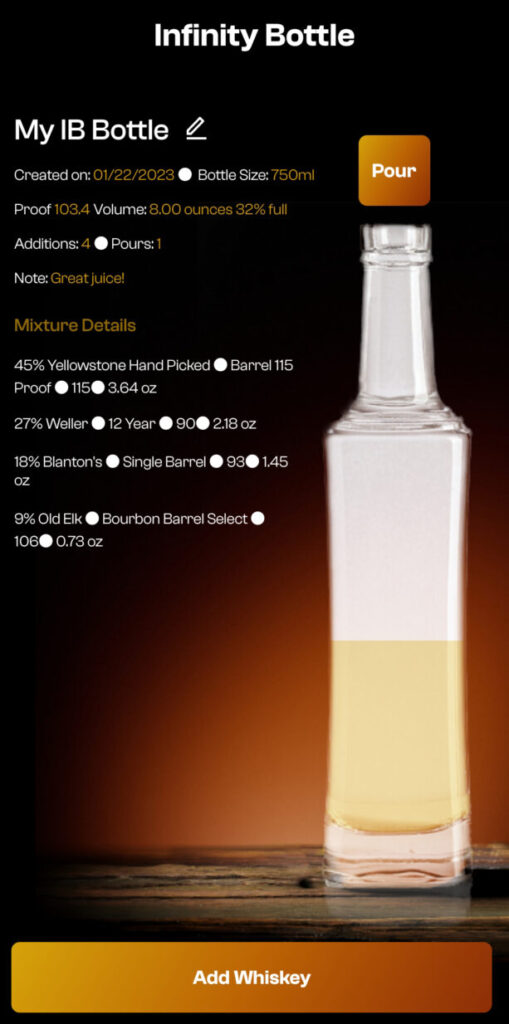
“So if you had a bottle of Woodford Reserve and you use the app to scan it, it brings all that data and then you can add the price, the store, where you are storing it in your place, and how you rate it,” Cunningham continued, noting additional available data, as well as Infinity bottle capabilities.
Infinity bottles involve a “quirky” behavior by some hardcore whiskey fans, he explained, when there isn’t a lot left in a bottle.
“What a lot of people do is they’ll take that last one or two ounces and they’ll pour it into a bottle, and they’ll log it in — like two ounces of Blanton’s and or whatever on this date,” he said. “They’re basically creating a blend of their better whiskeys as it gets down to the bottom. They’re also making sure that bottle has less air in it because they’re pouring pours from a whole bunch of bottles. And the air is what kind of oxidizes the whiskey so you’re making it last longer.”
The app currently has 4,100 users, 80 percent of those being in the United States, Cunningham shared. A couple users on the app have more than 800 bottles of whiskey.
“If you have 10 or more bottles, it’s a great app,” he added.
The app is free, he noted, although a premium subscription is offered; the price depends on the number of a user’s bottles. Perks for the subscriber include detailed reports, multiple wish lists, random bottle selecting, and up to three infinity bottles.
“We’re trying to grow our subscribers into the hundreds,” he continued. “It’s just a little below 100 right now. So it’s not a huge number of people, but we modeled this after an app called CellarTracker, which was created by a Microsoft exec that created a website to track his wine collection [before expanding the concept to track other users’ wine collections too].”
“So he has about half a million people that access it — he built it 20 years ago — and he’s been improving it,” he added. “Now he has 40,000 paid users. So it’s a pretty profitable business for him. Whiskey Shelf is just really still getting launched.”
Cunningham — who has funded the app venture himself — said the feedback so far from users has been “beautiful.”
“People say there’s nothing like this that exists anywhere,” he continued. “They love the app. They love how it works.”
The only negative feedback, he noted, is that users want to be able to add liquors that aren’t whiskeys.
“They want to store their entire liquor collection,” he added. “We haven’t done that so far.”
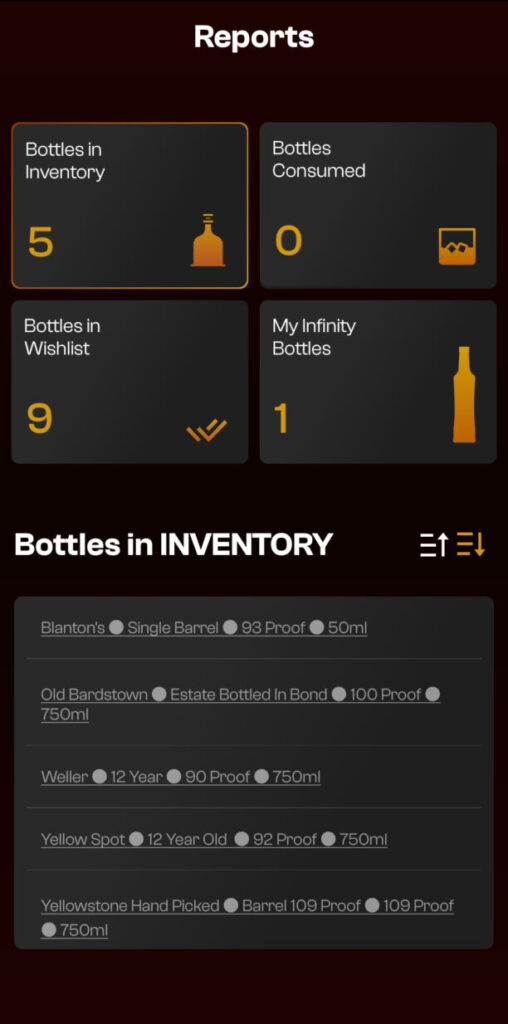
Users are also asking for photos of the bottles, Cunningham shared, which he plans to add to the app’s capabilities in the near future.
“We said ‘We can do this a lot faster if we skip the pictures for now and add them later,’” he said. “We’ll do that eventually, but it’s going to be a project.”
He noted that he and his team designed, developed, and released the entire project in four and a half months.
“That’s lightning fast, honestly, for a functioning piece of software,” he explained. “So that’s an iOS app, an Android app, a cloud dashboard with a big database and a website that connects it all together as a minimum viable product. And then our plan was to take feedback from the users and add things that we’ve missed or mistakenly put together.”
As the founder of Flint Hills Group — a custom software company Cunningham launched seven years ago — he’s used to designing projects for clients, but Cunningham and his team decided they wanted to make something of their own, he said.
He was inspired by Campfire, a tech startup class he teaches at Groover Labs that is based on Stanford University’s Y Combinator course.
“I said, ‘I want to apply what we teach in Campfire to determine what’s a good idea to build and what’s a good problem to solve,’” he continued. “So we had a contest at Flint Hills Group for ideas. We had 17 different ideas that people proposed and applied a 10-point grading scale from Campfire to make a decision on the winner.”
He noted the project has helped him to better understand what it’s like to be on the other side of software development as the customer.
“I have so much more respect for what my customers go through because I lived in their shoes now,” he explained. “It’s hard work being the customer and coming up with requirements and what you want.”
As for the future of Whiskey Shelf, Cunningham shared, its developers plan to add educational resources to help the user better understand whiskey and how to pick out flavors.
The next upgrade to the app will include a social feature, he said.
“Similar to like a Facebook paradigm — where you have friends — they want to have whiskey friends,” Cunningham added. “I want to be able to have my friends see my collection through the app.”
This story is made possible by Entrepreneurial Growth Ventures.
 Entrepreneurial Growth Ventures (EGV) is a business unit of NetWork Kansas supporting innovative, high-growth entrepreneurs in the State of Kansas. NetWork Kansas promotes an entrepreneurial environment by connecting entrepreneurs and small business owners with the expertise, education and economic resources they need to succeed.

Featured Business

2023 Startups to Watch
stats here
Related Posts on Startland News

Developer conference hopes to boost KC’s tech profile
A group of local tech talent is banding together to bring global exposure to Kansas City’s tech scene. Set to kick off Wednesday, the two-day Kansas City Developer Conference hopes to engage techies with all aspects of software development. In addition to connecting developers, the seventh-annual conference aspires for a bigger mission: to put KC…

Blooom makes national TV debut
Overland Park-based financial tech firm Blooom hopes to seed new growth opportunities after a recent national TV appearance. Blooom CEO Chris Costello and President Greg Smith hopped onto Fox Business Tuesday to discuss 401(k) management and their company, which created an online 401(k) management tool that’s seen solid early traction. The tool uses a flower in various…

KC tech firms respond to ‘bleak’ millennial voter turnout
A meager millennial voter turnout in Kansas City’s recent municipal elections is compelling local organizations to combat apathy with technology. More Kansas Citians 90 and older cast ballots in the City of Fountain’s 2014 municipal elections than voters under 30, according to a study by Kansas City-based civic engagement company mySidewalk. A paltry 0.7 percent…

Lean Lab announces new, mature fellowship class
The Lean Lab, an education innovation incubator, announced its second cohort of fellows who hope to bring meaningful change to Kansas City education. In the 2015 class, 10 fellows with seven solutions for Kansas City’s urban education will be participating in the Lean Lab’s summer program. Fellows arrive at the program with ideas in various…