

Hemp could be the next superfood: How one state-backed company is connecting farmers to retailers now
August 12, 2023 | Matthew Gwin
Startland News’ Startup Road Trip series explores innovative and uncommon ideas finding success in rural America and Midwestern startup hubs outside the Kansas City metro.
AUGUSTA, Kansas — A Kansas company specializing in agricultural and industrial hemp hopes that a collaborative, educational approach in a burgeoning industry will benefit farmers, the environment, and end users of hemp products.

Sarah Stephens, Midwest Hemp Technology
Midwest Hemp Technology employs a unique business model, serving as a connector between hemp farmers and retailers, said CEO Sarah Stephens.
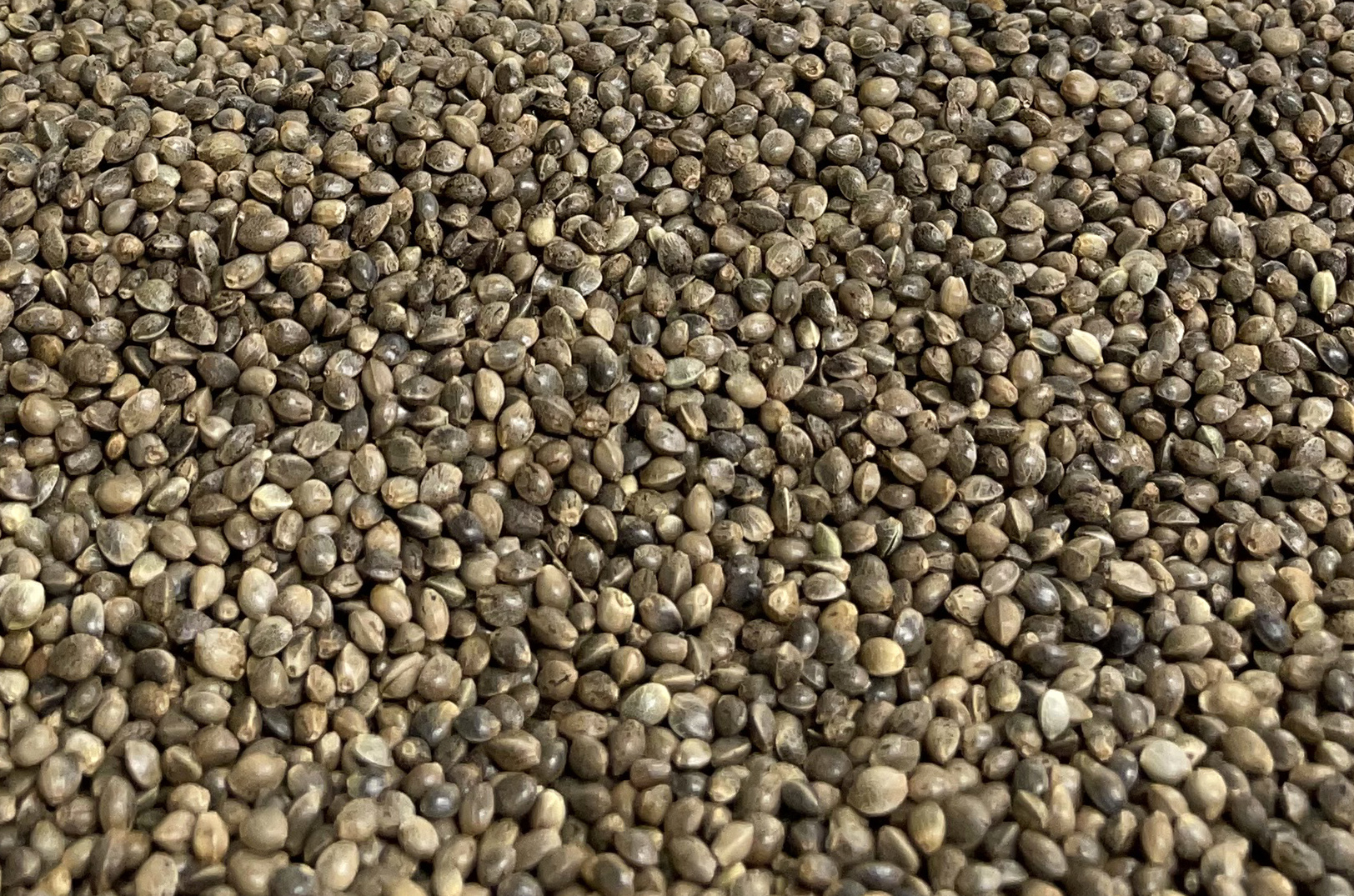
The company purchases hemp grain and fiber from farmers in Kansas and other Midwestern states, then processes the plant into seeds, hurd, and short-strand fiber at its four-acre facility, according to Stephens.
“It is a little bit atypical to develop the supply and the demand side — and maybe one day we won’t be doing so much of that — but because we are about 80 years out from farmers growing industrial hemp and industry knowing what to use it in, there’s just a big gap in the market knowledge about what to do with hemp,” Stephens said.
“You can’t just open a processing facility and wait for people to come,” Stephens said. “It’s really important to work with farmers so you know who’s going to be supplying your facility. … Beginning with the end in mind is important.”
Because of the rapid change occurring in the industry, educating growers is key, said Stephens, who also serves as president of the Kansas Hemp Consortium.
“We try as much as we can to educate, because I know there’s a lack of information,” Stephens said. “I know there’s a lot of bad information, because it’s wrapped up with medical cannabis or the cannabis industry.
“Even getting people to understand how different it is, how the uses are different, how the processing is different, we appreciate that chance to talk,” she continued. “Everybody can find how they connect [with hemp], and there’s a lot of blue sky.”
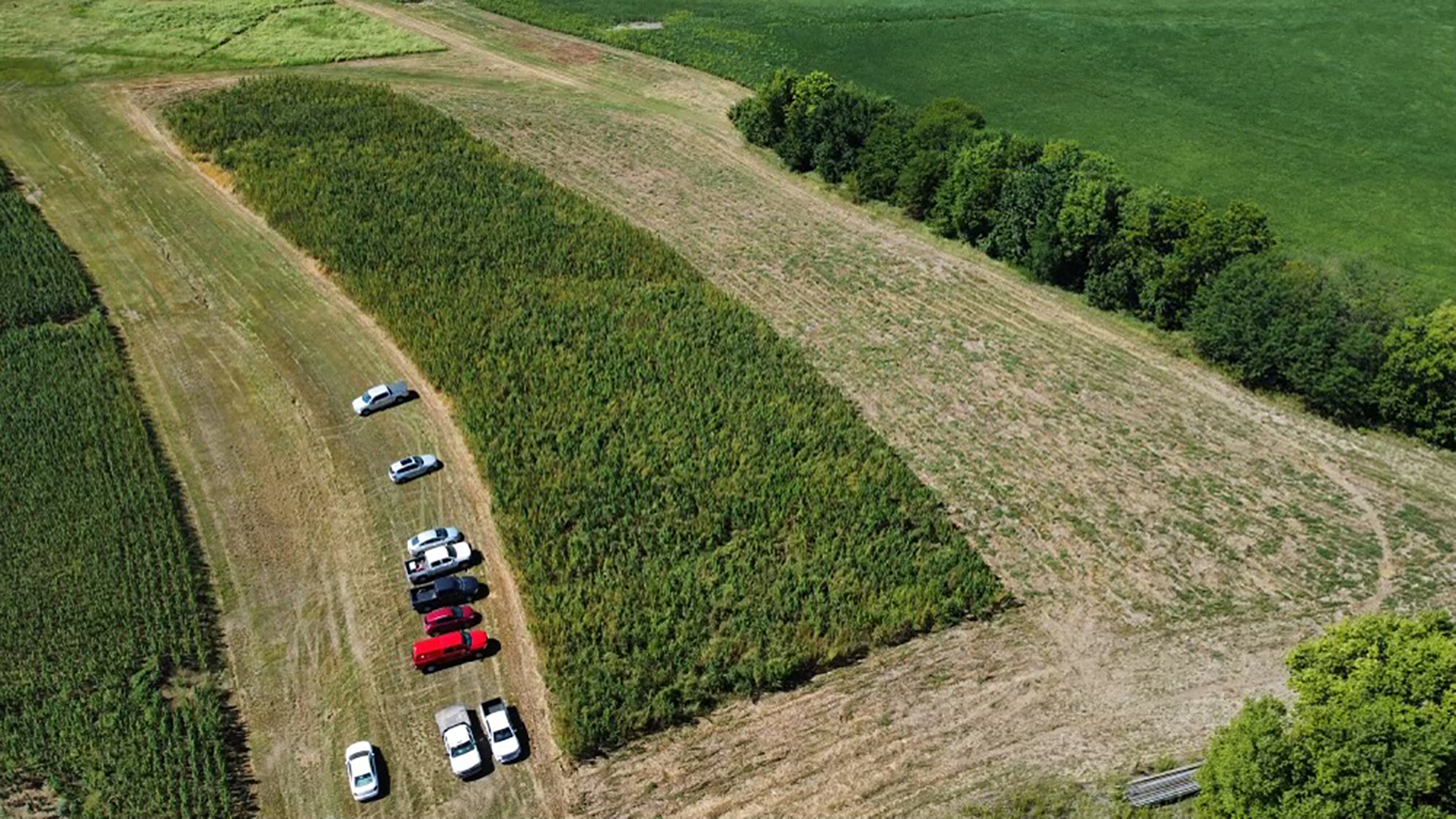
Midwest Hemp Technology site near Augusta
From unthinkable to investable
In June, Midwest Hemp Technology announced that Entrepreneurial Growth Ventures now holds a stake in the company’s Augusta facility as a result of a matching private investment facilitated through the GROWKS Equity Fund.
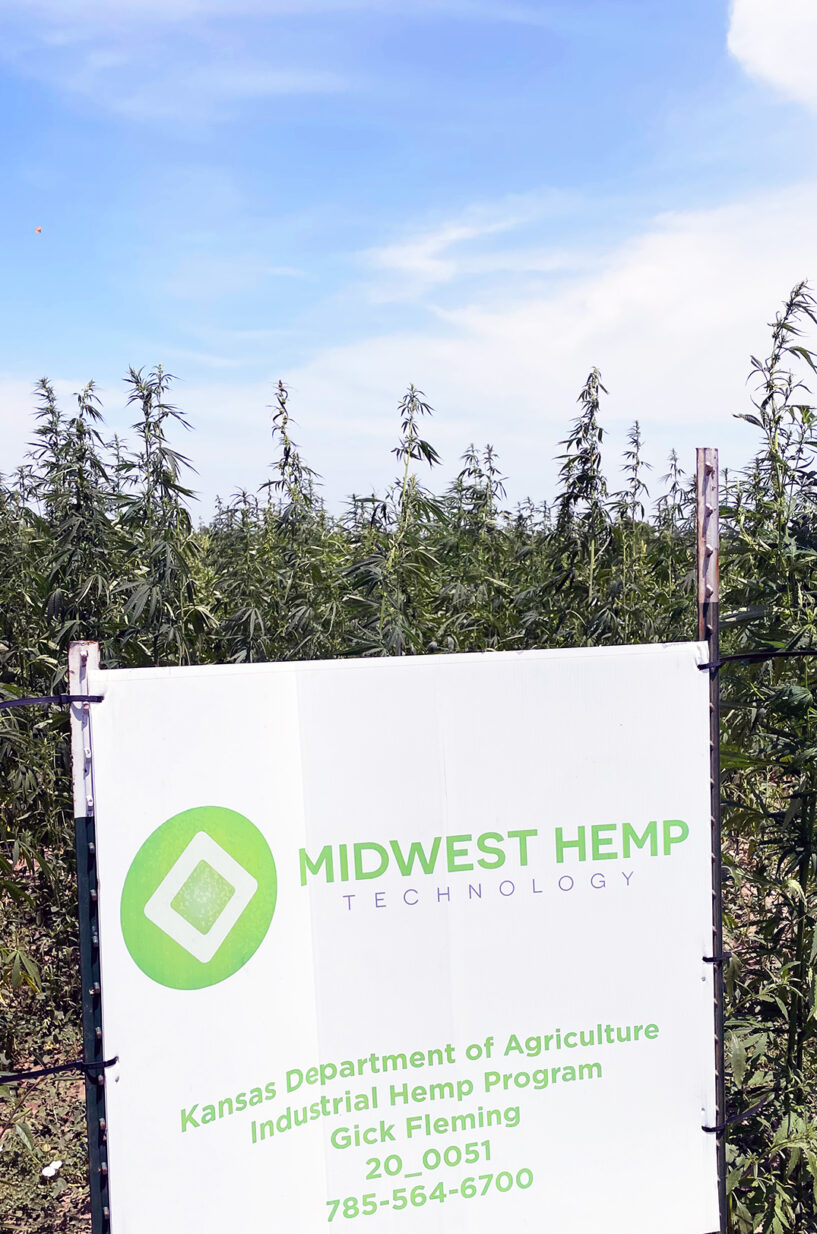
Midwest Hemp Technology site near Augusta
“As much as the dollars are helpful, that sort of nod to the legitimacy of the industry is very helpful,” Stephens said. “Of course, they bring a lot of mentorship, connections, networking, and advice that is also very helpful.”
State investment in a hemp company would have been unthinkable not long ago, as the crop underwent 80 years of prohibition until successive farm bills in 2014 and 2018 loosened regulations, according to Stephens.
Still, Stephens lamented that agricultural hemp facilities continue to face what she views as overly-strict state regulations that are meant to be applied to cannabis producers.
“At our facility, we do not have any cannabinoids,” Stephens said. “We are still regulated like we just might. … It makes it unnecessarily difficult.”
However, Stephens noted that hemp regulations in Kansas are being loosened overall, pointing to next year’s reduction in the cost of a licensing fee to grow hemp from $1,500 to $500. A licensing fee to grow hemp in Missouri costs only $25, she added.
“There are still going to be some barriers, but generally I feel like they are loosening and we’re moving in the right direction as far as Kansas regulations are concerned,” Stephens said. “That’s what it’s going to take to really encourage people to grow at scale.”
Capturing new uses
Currently, Midwest Hemp Technology sells products for human consumption using a consumer-facing brand called Hempy’s Heart, Stephens said.
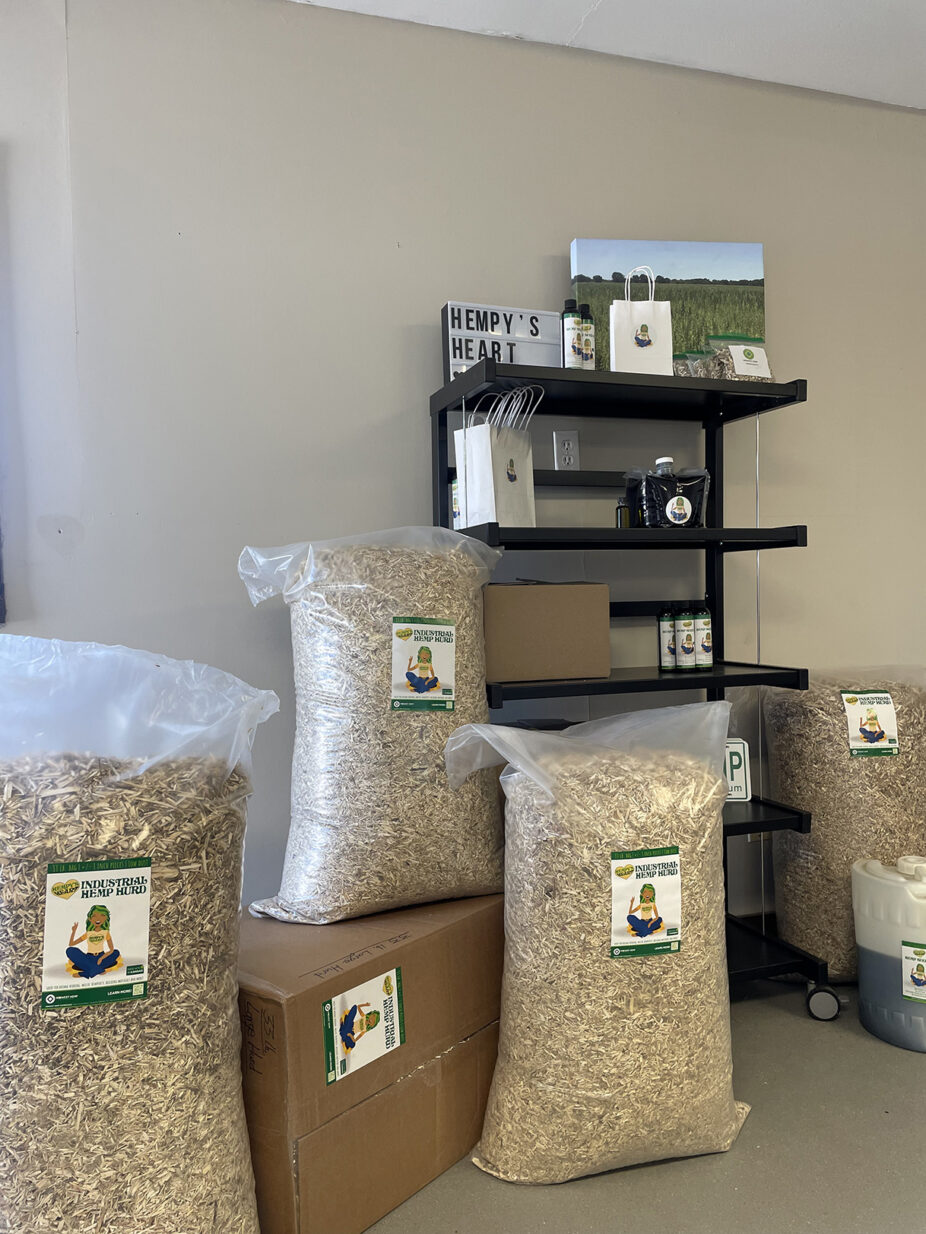
Hemp products at Midwest Hemp Technology’s Augusta facility
The products are made from hemp seeds, she added, and include options like hemp protein powder and hemp seed oil.
Hemp seed oil is also safe for use on skin, according to Stephens, though hemp seeds are still illegal for use in cattle feed, which she described as “absurd.”
“Once that first domino falls, I think we’ll really see the feed producers go, ‘Oh, this is actually going to happen. It’s not just the hemp people making stuff sound better than it actually is,’” Stephens said, acknowledging that the process will take a significant amount of time.
Hemp hurd can be used for animal bedding, though, as well as for fungus-resistant mulch and renewable building materials.
As a crop, hemp has the potential to positively impact the environment and provide a sustainable agricultural option, Stephens noted, highlighting the plant’s carbon capture ability.
“The carbon capture element of hemp is really exciting because the plants are growing eight to 10 feet tall, so there’s a lot of biomass and a lot of carbon capture, both in the plant and then in the soil,” Stephens explained.
The company is still in the early stages of understanding what carbon capture will mean for the hemp industry, Stephens admitted, calling it an “unsettled space.”
“Carbon capture will be one more thing that could tip the scales in hemp’s favor in the farmers’ eyes, because hemp is going to generate higher carbon credits than any other traditional commodity,” she said.
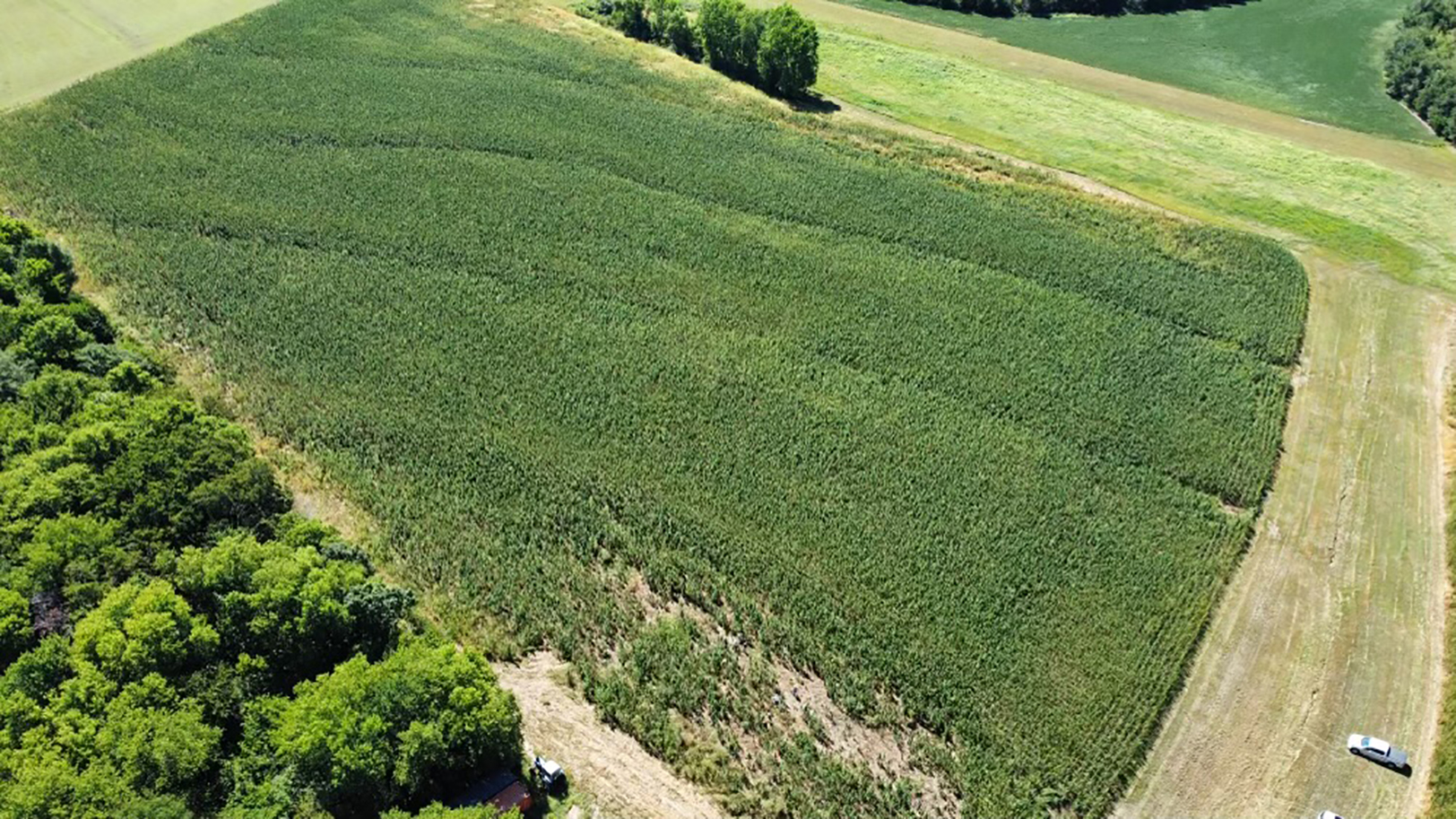
Midwest Hemp Technology site near Augusta
Fiber rich in potential
Looking ahead, Stephens feels confident that hemp’s moment is coming, even though the industry in Kansas may still be fledging — only 560 acres of hemp were harvested in the state last year, she noted.
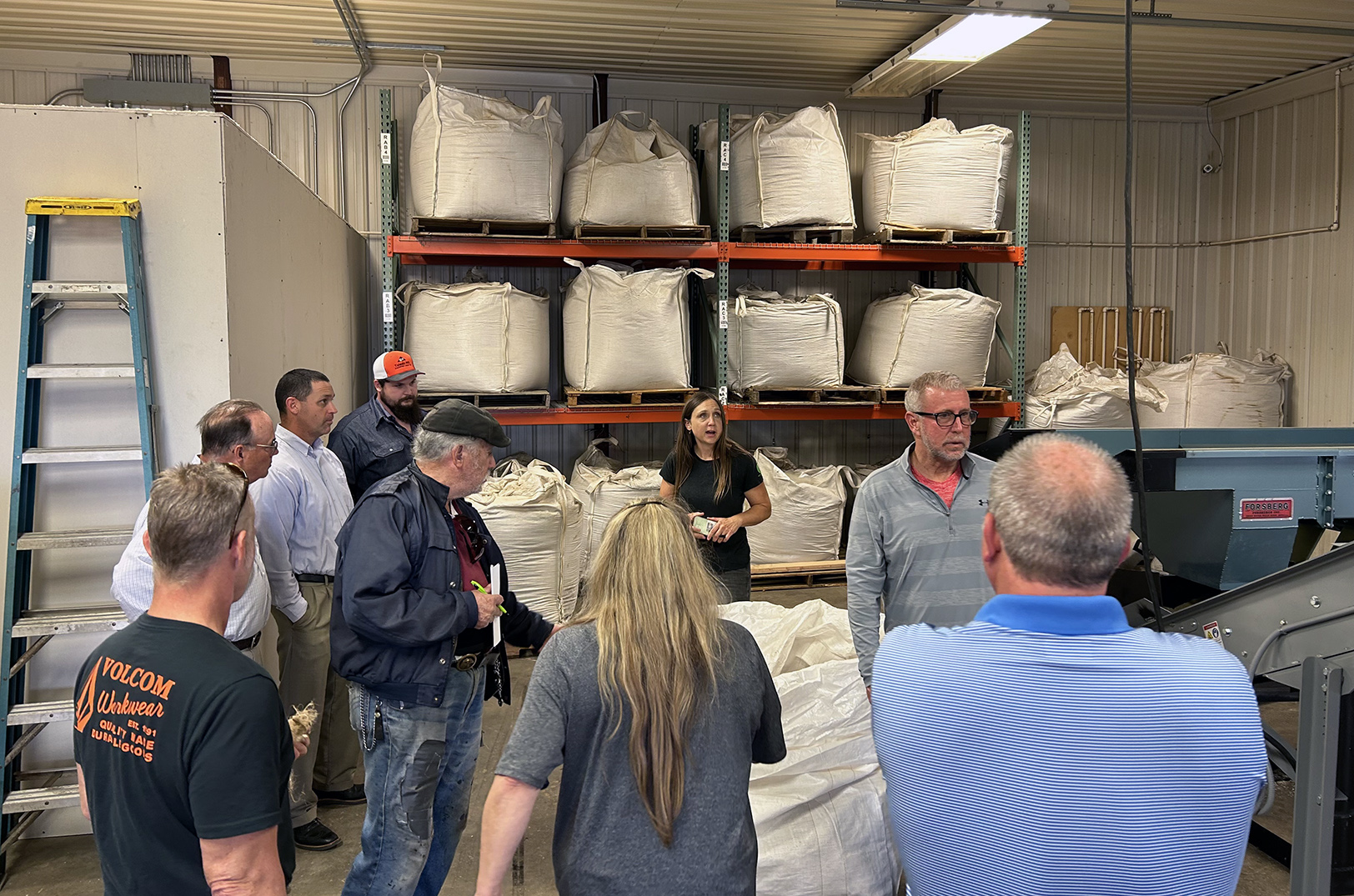
Business leaders tour the Midwest Hemp Technology site near Augusta
“I think it’s coming up slowly but steadily moving in the right direction,” said Stephens, who began growing in 2019.
During that time, Midwest Hemp Technology plans to prove its model at the Augusta facility it opened last November, then replicate that in additional Kansas hubs, according to Stephens.
She lauded the efforts of “a lot of innovative people” who are committed to expanding the hemp industry.
“I see a lot of that among entrepreneurially-minded people who know there’s so much potential, and we’ve got to get started,” Stephens said. “I feel like soon the Cargills of the world are going to be ready to pay attention.”
In the meantime, Midwest Hemp Technology will continue developing relationships with local farmers, creating environmentally-friendly products, and educating the world on the benefits of hemp, Stephens said.
“It’s not quite to the tipping point, but I think it’s definitely moving there,” Stephens said. “It is going to happen. Hemp is going to have its moment as a superfood. The fiber side is going to find its way into manufacturing. It’s going to happen, and I think it’s up from here.”
This story is made possible by Entrepreneurial Growth Ventures.
 Entrepreneurial Growth Ventures (EGV) is a business unit of NetWork Kansas supporting innovative, high-growth entrepreneurs in the State of Kansas. NetWork Kansas promotes an entrepreneurial environment by connecting entrepreneurs and small business owners with the expertise, education and economic resources they need to succeed.

Featured Business

2023 Startups to Watch
stats here
Related Posts on Startland News

SNAP cuts are ‘worse than they look on paper’: Food access advocates warn shelves could go bare overnight
Chef Shanita McAfee-Bryant doesn’t mince words about perceptions of the hungry Kansas Citians she serves daily through her award-winning culinary social venture. “These are the people who — if you listen to the rhetoric — are deemed ‘lazy,’” the founder of The Prospect KC’s NourishKC Community Kitchen told Startland News. “We know the narratives being…

LISTEN: Fermenting a clean future through products from meat alternatives to skin creams and baby formula
On this episode of Startland News’ Plug and Play Topeka founder podcast series, we chat with Francesca Gallucci of Natáur, a Baltimore-based biotech company that’s reimagining how essential nutrients are made. Combining synthetic biology, metabolic engineering, and eco-friendly fermentation, they’re producing bio-based taurine (and other naturally occurring sulfur compounds) without relying on petroleum. Gallucci takes…

KCMO slashes fees for outdoor dining permits, launches dining trail for grant winning projects
Kansas City has officially eliminated outdoor dining permit fees, reducing the cost from $850 to zero, thanks to the momentum created by a city-led initiative to encourage investment in outdoor dining experiences, city leaders announced this week, unveiling new plans to promote funded businesses and their projects. Launched in 2024, the Outdoor Dining Enhancement Program…
World Cup will produce KC small biz millionaires in just weeks, leaders say, but it’s only the start
Kansas City can’t look at the World Cup in 2026 as one big event where businesses are going to make good money for a while, and then everything goes back to normal, said Wes Rogers. “This has to be the beginning of the next chapter of our city,” the 2nd District Councilman for Kansas City,…