

This startup designed roads that pay for themselves (and charge your electric vehicle while driving)
March 8, 2023 | Matthew Gwin
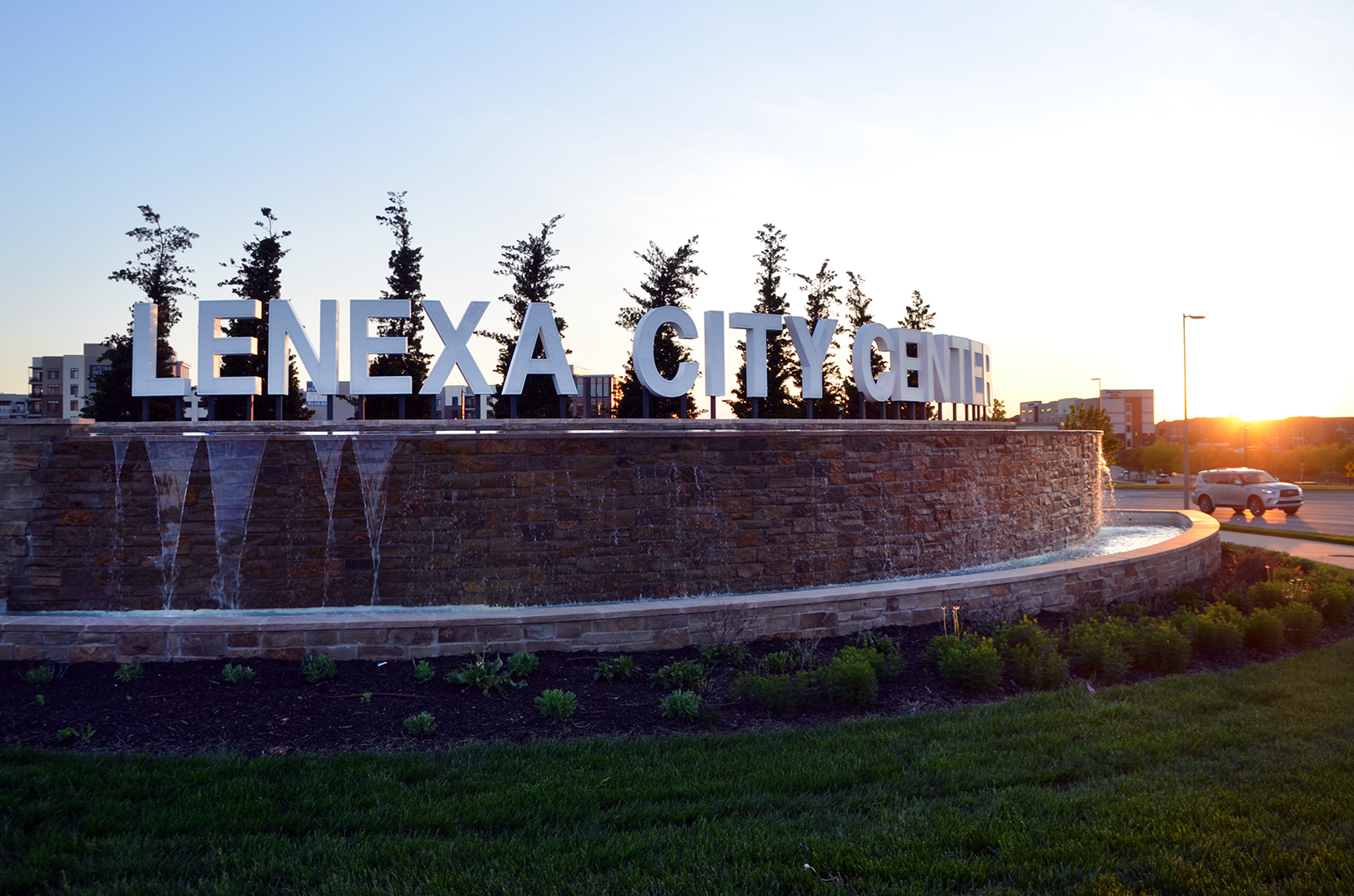
Longtime Kansas City startup Integrated Roadways is earning recognition for the company’s plans to transform roads into “smart roads” by embedding digitally connected technology directly into the pavement — coming soon to Lenexa City Center.
Called the smart pavement system, Integrated Roadways’ patented precast concrete pavement slabs provide Internet connection and sensing technology to vehicles driving along the road, with the ultimate goal of turning public road infrastructure into a financially self-sustaining asset.

Tim Sylvester, Integrated Roadways
“Essentially every economic asset that we interact with pays for its own existence from the services and assets that it provides to the community,” said Tim Sylvester, founder of Integrated Roadways. “That’s how a grocery store works; you pay for food, and therefore food is always available.”
“There’s really only one economic dependency that is not paying for its own existence and relies entirely on public subsidies, and that’s actually the underpinnings of our entire economy: the roadways,” Sylvester continued. “So if every other aspect of our economy can pay for itself, why can’t roads?”
Private interests funded public infrastructure until about 100 years ago, Sylvester said, and he believes the smart pavement system’s potential for third party applications will allow the roadways to fund themselves by generating revenue from value-added services.
“We have this vision where the road is paying for its own existence because of the services that it provides to the community,” Sylvester said. “What that means for the community is that traffic is making money off of those services, so the road is constantly sustaining its own existence, and there are clear economic incentives to maintaining the full functionality, quality, and operation of the road.”
Self-funding infrastructure would mark a vast improvement to the current model that’s highly reliant on the whims of politicians, Sylvester added.
“We’re basically bringing roads back into the active economy and giving all of the incentives required to keep them in good shape, which we feel is a much more sustainable approach to public infrastructure than begging Congress to pass a major transportation bill,” he said.
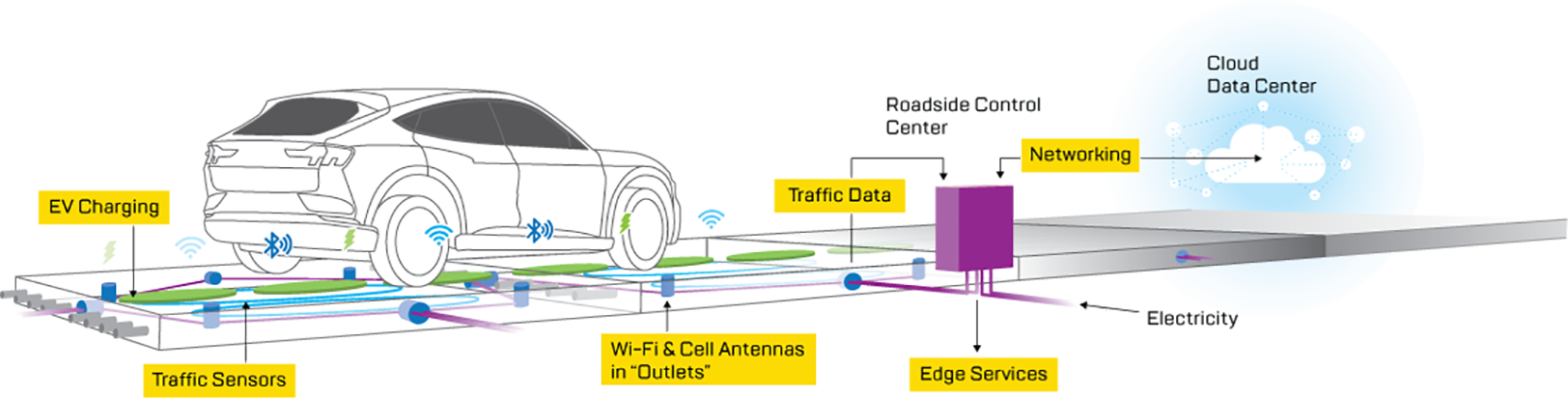
Smart Pavement goes beyond precast alternatives by transforming the road into a sustainable digital infrastructure platform supporting real-time traffic data collection, connected, electric, and autonomous vehicles, Smart Cities, Intelligent Transit Systems, and Internet of Things; illustration by Integrated Roadways
Test drive
Integrated Roadways will receive a local opportunity to prove the smart pavement system’s value, having secured a 10-year, $250 million concession from the city of Lenexa to upgrade the streets in and around the Lenexa City Center at 87th Street and I-435.
The Phase One groundbreaking is set for this year, Sylvester said, with the initial focus on upgrading major roads — namely Renner Road and 87th Street — to allow them to better support electric and autonomous vehicles.
Eventually, Integrated Roadways hopes to create a “hop on, hop off,” connected, electric, autonomous shuttle that runs through the Lenexa City Center, Sylvester said.
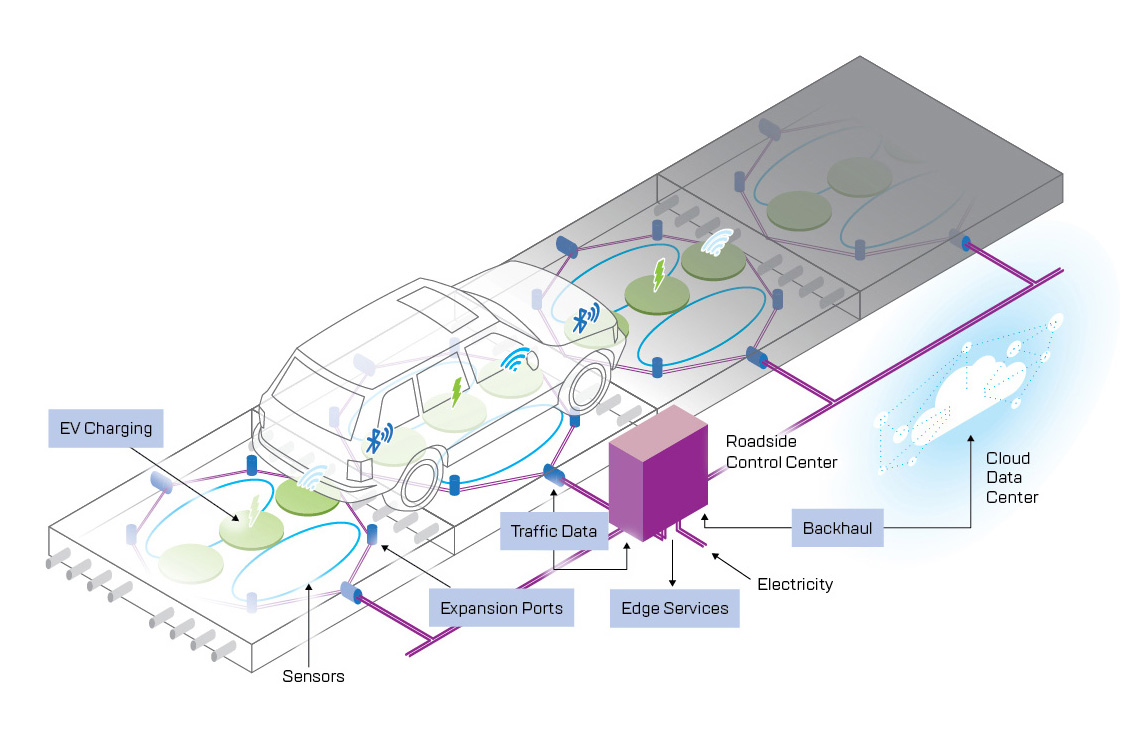
With wireless charging systems built directly into Smart Pavement, electric vehicles can charge while parked or while driving. In-motion charging can keep your vehicle fully charged at interstate speeds, ensuring you arrive at your destination with a full battery; illustration by Integrated Roadways
Crucially, the smart pavement system delivers wireless electric vehicle charging in the pavement, allowing EVs to charge without having to stop, which Sylvester described as necessary to promote the adoption of electric vehicles and curb pollution.
“For most people, they cannot really adopt electric vehicles if they have to stop every 200 to 300 miles to charge for an hour or two,” he said. “This is the only real way that you can drive the adoption of commercial electric vehicles — which, by the way, commercial vehicles pollute way more than private vehicles do, so that is the single most important cohort to convert to electric anyway.”
By shifting maintenance costs of the highest-traffic roadways to private enterprise, Integrated Roadways will relieve pressure on municipalities’ budgets, Sylvester said, allowing cities to improve roads often passed over for improvements.
“This approach actually creates a compound, multitudinous benefit for literally everybody involved,” Sylvester said. “It’ll take some time to get there because anything that costs this much and has this much of an impact on a municipality takes time to do correctly.”
“But our vision is — in the same way that the internet takeover was slow and then fast, and the smartphone takeover was slow and then fast — we think digital infrastructure is going to be the clear winner, and the preferred choice for the next generation of cities,” he continued.
Paving a new way forward
The sensing technology and Internet connectivity built into the smart pavement system will also be transformational for autonomous vehicles, Sylvester said, just as Integrated Roadways hopes it will be for electric vehicles and communities.
“Every sort of tech that uses and relies on data is also reliant on a network of some kind, so it was obvious to me that connected, electric, and autonomous vehicles would need the roadways themselves to be turned into networks,” Sylvester said.
The wireless Internet connection will provide drivers with real-time information about traffic, road conditions, and accidents. In fact, smart vehicle technology can automatically call for help when an accident occurs or a vehicle leaves the roadway.
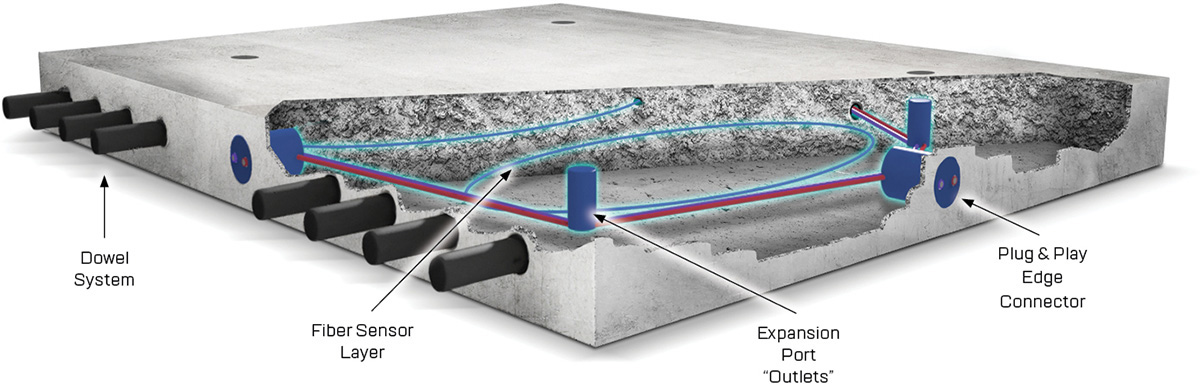
Integrated Roadways Smart Pavement system is modern, durable pavement solution that builds quickly and lasts longer than traditional asphalt or concrete pavement while requiring less maintenance and providing valuable new services and capabilities; illustration by Integrated Roadways
Sensors within the pavement function similar to a laptop trackpad, feeling the position, weight, and velocity of each vehicle on the road, which will provide improved navigation for autonomous vehicles, Sylvester said.
“By moving the equipment out of the autonomous vehicle and into the infrastructure, the vehicle is cheaper, the need to dispose of a vehicle because of minor damage is reduced dramatically, and the vehicle is more reliable because it relies on independent infrastructure that can be easily tested and maintained, compared to a personal vehicle,” Sylvester said.
Integrated Roadways’ technology should also help local businesses use traffic data to improve operations, Sylvester said, comparing it to the way tech giants invest heavily in understanding the audiences who visit their websites.
“How is it that you can spend $1 million or $2 million to deliver a restaurant and know nothing about the organic traffic in the area of that restaurant?” Sylvester said.
He shared a story of a friend who opened a bar in a heavily-trafficked area that ultimately went out of business, in part because of a lack of data.
“I said, ‘There’s so many cars there. How in the world did you go out of business?” Sylvester recalled. “He said, ‘They all had to turn left in order to get into my business, so they would keep going.’ If he would have started a coffee shop, then traffic’s on the other side of the roadway in the mornings, people would have turned right to get into his business and it would have been fine.”
“There’s no way to know this information for a traditional business coming from a traditional roadway,” he added.
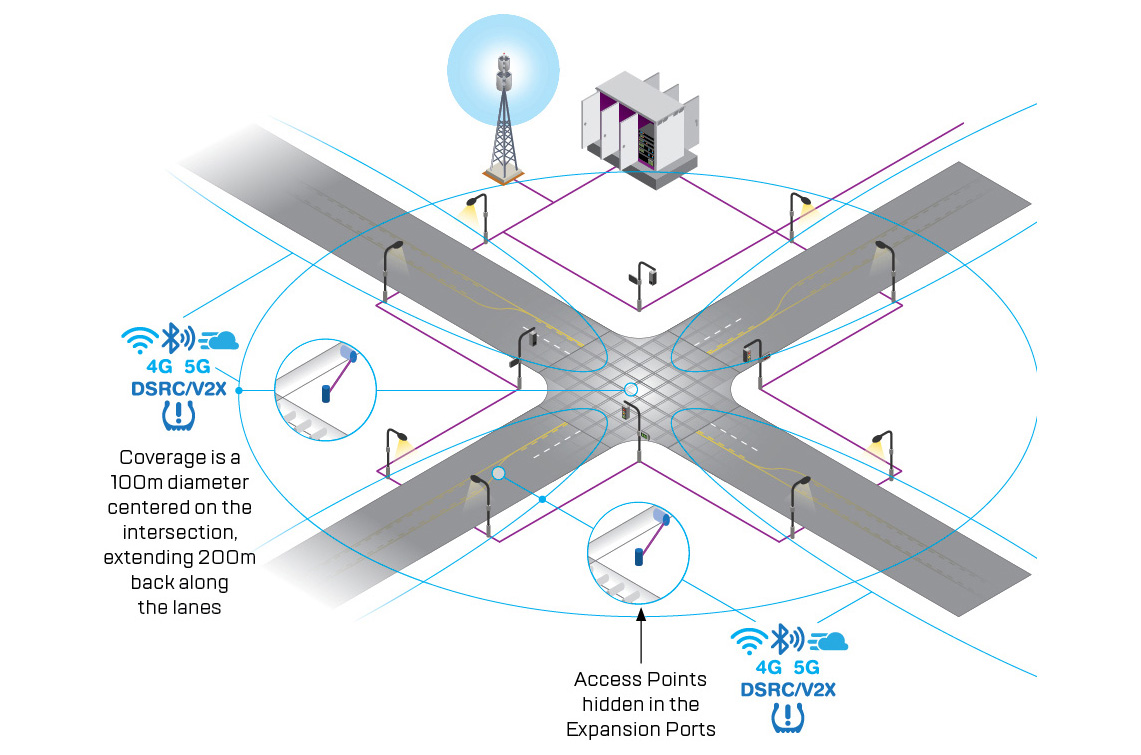
With Smart Pavement, open-access dense distributed antenna systems are built in. Hidden inside Expansion Ports in the roadway, Smart Pavement deploys ultrawideband antennas that are fully virtualized and sliceable so that multiple tenants can operate multiple protocols at the same time, on the same antenna; illustration by Integrated Roadways
Sensing the need for transformation
Overall, Integrated Roadways hopes to leverage its technology to benefit local communities and bring public road infrastructure into the 21st century and beyond, Sylvester said.
The precast concrete pavement slabs can and will be produced locally, he said, noting that more than 1,000 precast concrete facilities operate across the nation.
“We need to replace 75 percent of all the roadways in our nation within 10 years. The cost is going to be greater than America’s gross domestic product. If we don’t tackle this now, and build roads — not for ourselves — but for what people are going to need in 10, 20, 30 years, if we refuse to look forward to the future, how much future do we really have?”
— Tim Sylvester, Integrated Roadways
Along with the road construction and each additional aspect of replacing traditional roadways with the smart pavement system — which lasts four times longer than asphalt — Sylvester said the infrastructure updates create investment opportunities in local communities.
“The money also gets spent primarily in your community as well for the fabrication and construction activities and the ongoing operation,” he said. “We see this as a way to re-center some of our economies back to the local community after an extensive period of outsourcing.”
He contrasted the approach to multinational organizations like Amazon, that he said often profit off communities without properly re-investing in them.
“We’re talking about enabling reinvestment in the local economy so that the infrastructure and the business activities of that local economy benefit the citizens of that economy and not people in other places,” Sylvester said. “Maybe it’s time for our communities to take back a little bit of that control and a little bit of that economics.”
With an eye toward the future, Integrated Roadways builds its technology to “anticipate the needs of a roadway over the next 50 years,” Sylvester said, as opposed to building public infrastructure the same way as it was built 100 years ago.
“Why are we building cities based on the opinions and preferences of people who have passed away and will never come again, instead of recognizing that we build cities for the next generation?” he said. “We build buildings and infrastructure that are durable, not to make our lives easier — which is nice — but to make lives easier for the people who come after us.”
Noting that modern society seems to have “lost that thread,” Sylvester warned that the future could turn bleak if people don’t reverse course toward a more sustainable environmental, technological, and financial approach.
“We need to replace 75 percent of all the roadways in our nation within 10 years,” he said. “The cost is going to be greater than America’s gross domestic product. If we don’t tackle this now, and build roads — not for ourselves — but for what people are going to need in 10, 20, 30 years, if we refuse to look forward to the future, how much future do we really have?”


2023 Startups to Watch
stats here
Related Posts on Startland News

Biotech startup’s $6.5M Series A expected to cultivate expanded workforce, research capabilities
Ronawk’s Bio-Block Universe has already revolutionized cell and tissue production, Tom Jantsch said, and the recent investment of $6.5 million is set to further research and development. “We have really changed the paradigm of how not only cell culture is done, but how researchers are able to scale. They can go from the bench, all…

J Rieger continues its international push, adding whiskey distribution to northern neighbors
Fresh off its win as the KC Chamber’s top international small business, J. Rieger & Co. announced its expansion into Nova Scotia — a milestone as the Kansas City-based distiller enters the Canadian market. “We are thrilled to bring our range of artisanal spirits to Canada for the first time,” said Ryan Maybee, co-founder of J.…

Mid x Midwest returning in November with renewed vision to connect KC founders, VCs
The pilot Mid x Midwest event in fall 2022 supported the idea that early-stage tech founders and investors are hungry for more conversations post pandemic, Dan Kerr and Maggie Kenefake shared, spurring the return of the invite-only meetup in November. “We both showed up that morning to Hotel Kansas City and we walked into the…

PrairieFood grows power of its micro-carbon ag solution with a pipeline of human connection
Startland News’ Startup Road Trip series explores innovative and uncommon ideas finding success in rural America and Midwestern startup hubs outside the Kansas City metro. LAWRENCE — Entrepreneurship is all about networking, Robert Herrington said. “You never know where a pivot or direction is going to come from,” said Herrington, an early member of the Pipeline…