

New book from KC heavy hitters: Keep your pitch firmly in the feels; avoid being forgotten before you leave the room
March 23, 2023 | Diana Kander and Tucker Trotter

Editor’s note: The following contains an excerpt from “Go Big or Go Home,” a new book by Diana Kander, Kansas City serial entrepreneur, and Tucker Trotter, CEO of Overland Park-based Dimensional Innovations (DI). Click here to learn more about “Go Big or Go Home,” available March 28.
The secret to a winning pitch isn’t necessarily coming to the table armed with an argument full of logistics and details, say the Kansas City authors of a new book about closing big deals; it’s often found in an emotional connection that hits the potential customer or partner in the gut.
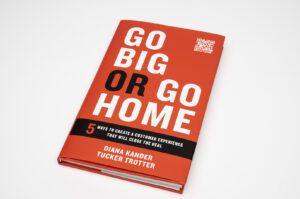
“Go Big or Go Home” by Diana Kander and Tucker Trotter
“‘Go Big or Go Home’ is the greatest collection of the most memorable pitches in film, sports, business, and philanthropy. These stories come from individuals and organizations that decided to go big or go home because their deals were too important to fail,” write Diana Kander and Tucker Trotter.
Kander is a keynote speaker on curiosity and innovation and a New York Times bestselling author. A serial entrepreneur who entered the United States as a refugee at the age of eight, she has launched and sold millions of dollars of products and services.
Trotter is the CEO of Dimensional Innovations (DI), an experience design and build firm in Kansas City that liberates people from mediocre experiences. DI has created award-winning experiences for organizations like Disney, Google, Microsoft, and numerous professional sports teams, while being named an Inc. 5000 Fastest-Growing Company seven years.
“One day, you’ll have a pitch that matters just as much,” according to the authors. “And when you do, you can follow the five tools outlined in this book to create an experience that will close the deal.”
Keep reading for an excerpt from the forthcoming book “Go Big or Go Home.”
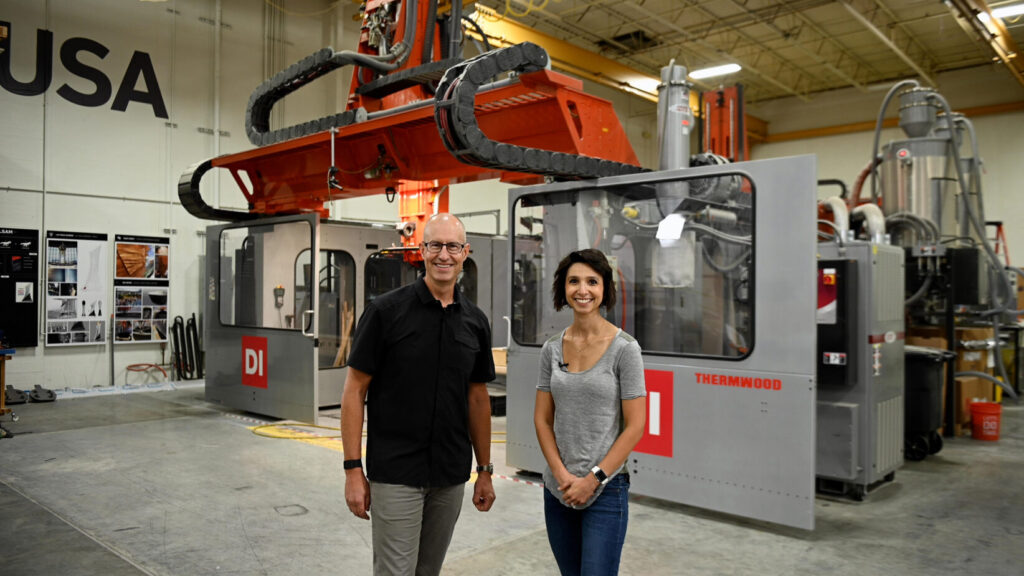
Tucker Trotter and Diana Kander at Dimensional Innovations in Overland Park
Chapter 2
Why Moments of Magic are Essential
People don’t pay attention to boring things.
The average SAT essay takes about 30 minutes to write. Want to guess how long it takes to grade? Five minutes? Ten?
According to a veteran SAT essay reviewer, about 45 seconds.
The trick is that SAT readers aren’t looking at what was written, only how. Their job is to essentially scan the page looking to see that students satisfy the test’s requirements: Is there a thesis statement stating a clear position? Two specific examples? A brief conclusion? Is the language sophisticated or crude? Is the sentence structure complex or basic? These questions determine the student’s grade, so it is all the readers care about.
Moreover, most of the reviewers find that the instant they finish grading an essay, they immediately forget what was in it. The only ones they seem to remember are the trainwrecks or the ones that made them laugh, and the trainwrecks are a lot more common.
We spend most of our workdays on autopilot, doing whatever the equivalent of grading an SAT essay is — tasks that we are so used to doing that we don’t really have to think very hard about them. It’s an emotionally neutral state. That’s why we don’t remember most of what we do on a given day.
This is especially true for people who are on the receiving end of a lot of sales presentations. If you only pitch the way your audience expects you to pitch, they’re not really going to be listening to what you’re saying, only how you’re saying it. And later, when they talk about your pitch, they’re going to be talking about how they started counting the number of times you said “Let me be clear” or how they couldn’t stop watching the vein on the side of your neck bulge. What they won’t remember, though, is anything you said.
Psychologists have long understood that we forget about 50 percent of new information within an hour of hearing it. That goes up to 70 percent within 24 hours and 90 percent after a week. This is a death sentence for most B2B (or as some call them, “Boring to Boring”) presentations, because by the time your potential client has met with all the potential vendors and is ready to make a decision, they’ve already forgotten most of the compelling arguments you made.
Fortunately, the rate at which our prospects forget can be significantly influenced by the amount of emotion we can trigger in our pitch. This explains why you have such vivid memories of every part of Sept. 11, 2001, and why you can remember the weather on your wedding day, but you have no idea what happened on Aug. 11, 2001, and you likely don’t remember the weather just one month ago. The higher the emotional peak, the deeper a memory will sear into our brains.
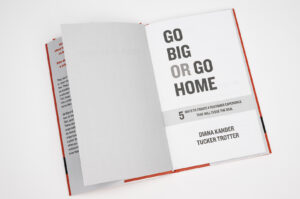
“Go Big or Go Home” by Diana Kander and Tucker Trotter
Go Big or Go Home pitches are designed to create these emotional peaks. We call them magic moments. They are like a refresh button for the attention span.
Magic moments force the customer to disengage their autopilot system and give you their full attention.
Even when clients simply enjoy the pitch, that isn’t enough. Enjoyment is standard, and standard isn’t memorable. When you fail to create even a single magic moment that changes how the clients feel, their enduring memory of the presentation is the experience of feeling nothing, which is the worst possible outcome from a presentation. If you’re not creating emotional peaks, you’ll never be memorable — you’ll just be another commodity, reduced to competing on price.
That’s why, when creating an experience, you must ask two questions: First, what can you do to deliver that emotional punch? And two, when will you do it? A lot of professionals talk about how they want the audience to feel at the end of a presentation. But none of us “feel” anything for more than a few seconds.
And if you can’t quite tell when your emotional peaks take place, then you don’t have any.
We suggest that when preparing your pitch, you should literally map out the emotional moments of the presentation.
Graphing it out visually doesn’t just help you tell where the peaks of your presentation are; it also lets you know the valleys — and that matters just as much. Inevitably, some parts of your presentation are going to be less exciting.
That’s OK. The trick is to make sure that those less exciting parts (logistics, legal, whatever else) don’t last too long and don’t come too close together. Plotting your pitch lets you continually switch up the emotional tenor of the presentation to make sure that your audience doesn’t slip.
Click here to learn more about “Go Big or Go Home,” available March 28.

Featured Business

2023 Startups to Watch
stats here
Related Posts on Startland News
Keto crust on the rise: Fattyhead bakes ingredients for expansion into new distribution deals
Laura Manivong is feeding a hunger for keto diet-friendly pizza crusts that already stretches to freezer aisles across the metro — with stores and distributors salivating for more. “Out of the blue, I just called Sam Paris and Paris Brothers,” Manivong, founder and CEO of Fattyhead Keto Crust, said of how a recent distribution deal…

Victor Hwang’s parting message to Kauffman, KC and beyond: ‘We make a powerful tribe’
Editor’s note: The opinions expressed in this commentary are the author’s alone. Victor Hwang is the outgoing vice president of entrepreneurship at the Ewing Marion Kauffman Foundation. Click here to read more about his planned departure from the leading ecosystem building organization. Today is my last day in the office, as I transition out of…

Boddle scores $25K AT&T Aspire audience award thanks to tough love on duo’s most difficult pitch
Just because a pitch is tough doesn’t mean it won’t payoff, said Clarence Tan. “Smiles will take you miles,” Tan, CEO and cofounder of Boddle Learning, said of his and co-founder Edna Martinson’s latest pitch at the AT&T Pitches and Purpose contest in San Francisco — the pair’s most difficult presentation to date, they said…

Fund Me, KC: My Bear Jeff spreads comfort to child trauma survivors, bear to bear
Startland News is continuing its “Fund Me, KC” series to highlight area entrepreneurs’ efforts to accelerate their businesses. This is an opportunity for entrepreneurs — like Rachel Cohen with her My Bear Jeff campaign — to share their crowdfunding stories to gain a little help from their supporters. Who are you? Rachel Cohen, Chief Bear Officer…