

Cannabis biz expected to grow like a weed after MO voters light recreational marijuana
November 9, 2022 | Tommy Felts

Tuesday’s vote in favor of recreational marijuana in Missouri shows Kansas City’s obvious appetite for legalization, said Michael Wilson, whose cannabis startup sees a vast new market opened by the election outcome.
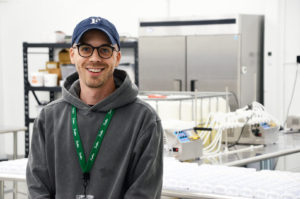
Michael Wilson, Franklin’s Stash House
Statewide, Missouri poll-goers this week approved the high-profile constitutional amendment with 53.1 percent of the more than 2 million votes cast. In Kansas City, support was even stronger, with Jackson County voting 68 percent in favor; Platte County, 62 percent; and Clay County, 61 percent.
The majority of voters in Kansas City-adjacent counties in Missouri — Buchanan, Cass, Johnson and Ray — also supported the effort.
“With the passing of Amendment 3, it’s clear Missourians are ready to end the prohibition on cannabis,” said Wilson, co-founder of Franklin’s Stash House, following the election result’s announcement. “Today is a monumental day for not just Missouri, but our nation as whole, as this is a huge step in a great direction.”
RELATED: From bud tenders to cannabis vendors, a new crop of weed jobs are coming to Missouri
Businesses like Franklin’s see an expanded revenue stream four years after Missouri first legalized the use of medical marijuana in the state. Wilson expects the potential customer base for cannabis products in Missouri to jump from 200,000 to 2 million with the amendment’s passage.
Recreational marijuana sales are expected to begin in February in Kansas City.
“You’re going to see lines out the door. You’re going to see inventory gone all the time,” Wilson said before the vote, predicting customer reaction to potential legalization. “When people ask what we’re ramping up for, it’s February and March. The people who are well positioned are going to make an exorbitant amount of gross revenue.”
Click here to read more about the products ready roll out when legalization hits.
The now-passed Missouri Amendment 3 allows use of marijuana by adults 21 and older without a medical marijuana license, sets a 6 percent tax on marijuana sales, and expunges arrest and conviction records of non-violent marijuana offenses (except for driving under the influence and sales to minors).
‘Ending prohibition is just the beginning’
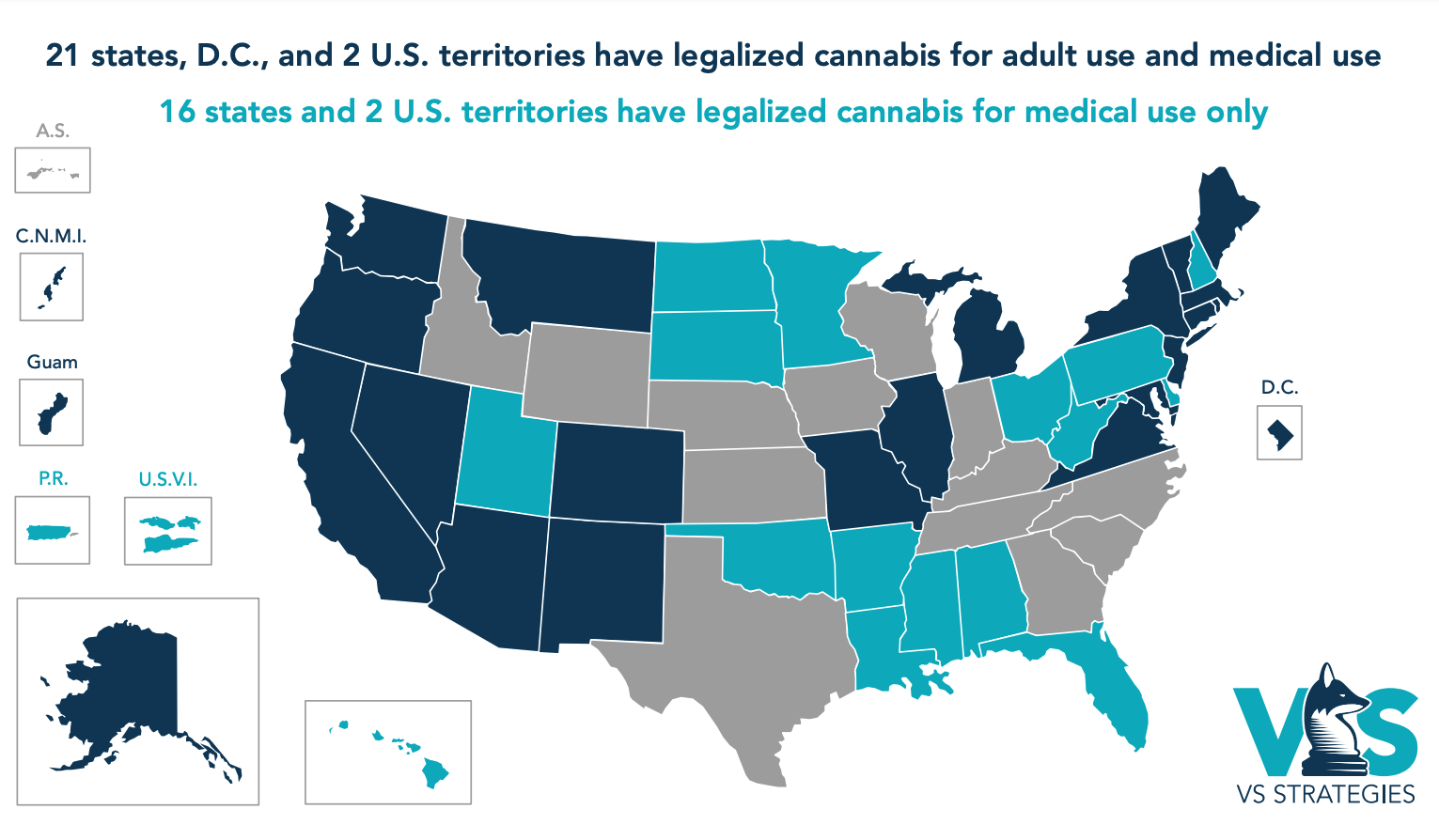
While a similar ballot measure in Maryland passed Tuesday, such legalization efforts are not assured success or universal acceptance across the U.S. Cannabis legalization measures were defeated by voters this week in Arkansas, North Dakota, and South Dakota.
“After decades of anti-cannabis laws and propaganda, it comes as little surprise that many voters have concerns,” said Mason Tvert, partner at VS Strategies, a national cannabis advocacy group. “History has shown that the more people learn about the issue, the more likely they are to support legalization. It’s not really a question of whether these states will end cannabis prohibition, but a question of when.”
Tvert — who co-directed the 2012 Colorado legalization initiative, Amendment 64, and worked on successful legalization campaigns in Alaska, Nevada, Maine, and Massachusetts — applauded the wins at the hands of Missouri and Maryland voters, pointing to the inevitable business benefits of legalizing.
“With legal cannabis in these two states comes new economic opportunity,” he said. “Expansion of the regulated cannabis market will result in new businesses, more jobs, and significant tax revenue. There is still plenty of work to be done when it comes to implementing the new law and ironing out all the rules. Marijuana-related policy discussions will become the new norm in state and local governments, much like we see with alcohol. Ending prohibition is just the beginning.”
Click here to learn more about what comes next as Missouri adapts to legalized recreational marijuana.
Growing a market in Missouri and beyond
In Kansas City, a well-timed expansion for Show-Me Organics is set to bring greater production capabilities to match the budding demand just around the corner.
The Springfield, Missouri-based cannabis company announced last week its acquisition of an 80,000-square-foot cannabis operation in Kansas City that already produces more than 1,000 pounds of high-quality flower per month for dispensaries throughout Missouri.
Click here to read more about the acquisition from Holistic Industries, one of the nation’s largest, private multi-state operators in the cannabis industry.
Genetics and flower produced at the site are expected to be used for Show-Me Organics’ four popular cannabis brands: Vivid, Missouri’s Own, Buoyant Bob, and Blue Sage, which collectively are sold in 95 percent of Missouri dispensaries.
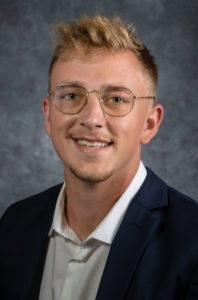
Boston Dickerson, Show-Me Organics
“We’re very excited to serve the entire state of Missouri, and to establish Vivid as one of the best cannabis brands in the Midwest,” said Boston Dickerson, the Kansas City-based co-founder and CEO of Show-Me Organics. “We have some logistical steps to complete over the next couple of months, so that we’re ready to open to the general public on Feb. 7, 2023.”
The company’s acquisition of the Kansas City grow facility solidifies Show-Me Organics as a vertical player in the emerging industry, Dickerson said, emphasizing the operation provides a stable supply chain of top quality cannabis amid the growing demand.
“Our house of brands are built on a reputation of quality and innovation, so it is essential for us to have consistent supply of top quality flower, regardless of whether it is a medical or recreational market,” he said.
Dickerson is buoyed by the potential to one day export Missouri-made brands like Vivid to the world — pending federal legislation to expand the market even further.
That time could be coming relatively soon, said Tvert, noting the domino effect that follows local measures like Missouri’s.
“Adoption of these laws at the state level could have significant implications for reform at the federal level,” he said. “With each successful legalization measure, there are more members of Congress who represent states where cannabis is legal for adults, generating tax revenue, and creating jobs. Members opposed to legalization are forced to reexamine their position and learn more about the issue, and supportive members typically get even more engaged.”
Wilson believes marijuana will be mainstream within a decade, the Franklin’s co-owner said.
“We want to see this move forward. We want the normalization. The next generation wants this normalization. It’s gonna happen,” Wilson said. “It’s just hard to be patient for it, especially when we know the customers are already out there.”

Featured Business

2022 Startups to Watch
stats here
Related Posts on Startland News
Students struck by KC gun violence search for solutions at MECA Challenge
Editor’s note: MECA Challenge and Startland News are both programs of the Kansas City Startup Foundation, though the content below was produced independently by Startland. For more information on the relationship, click here. Escaping the cycle of gun violence can seem impossible, said Lea Thompson, still wearing a cast on her hand after being shot…
STEAM Studio team coding best fit for boy’s 3-D-printed prosthetic arm
Four-year-old Hudson Borton extended his arm Wednesday, as his father fitted a 3-D-printed prosthetic to the boy’s upper arm and elbow. The light blue plastic piece mimicked the size and length of Hudson’s right arm, though his father and Mandi Sonnenberg, co-founder and director of STEAM Studio, agreed the new device wasn’t yet a perfect…
KC-based SouveNEAR vending machine startup prepping to scale up
SouveNEAR offers travelers a piece of KC — from KC, said co-founder Tiffany King. The Kansas City-based startup, which repurposes vending machines to sell locally made souvenirs, is in its fourth year of steady, organic growth, King said. As a member of ScaleUP! KC new class, SouveNEAR is preparing to grow the business and turn…

Google, Techstars partner to lower barriers for March 23-25 Startup Weekend
A new partnership with Google will allow Techstars to present this month’s Startup Weekend free of charge to Kansas City participants, said John Coler. “It opens up the opportunity to reduce the barrier for entry for those who either would not usually use their discretionary income or (do not) have the ability to pay for…