

How investments in Black businesses can help close KC’s racial wealth gap
November 25, 2022 | Mili Mansaray
Editor’s note: This story was originally published by The Kansas City Beacon, a member of the KC Media Collective, which also includes Startland News, KCUR 89.3, American Public Square, Kansas City PBS/Flatland, and Missouri Business Alert.
Click here to read the original story.
When Denisha Jones launched her business, Sweet Peaches Cobblers, in August 2020, it was just her, her husband and her mom in a community kitchen — taking orders, making the cobblers and doing deliveries.
Now she has a team of individuals helping her sell cobblers in stores and at events and festivals across the country, including the Kansas City BBQ Festival.
Jones’ speedy evolution from mom-and-pop business to successful entrepreneur had a lot to do with overcoming traditional financial barriers confronted by small and especially minority-owned enterprises.
“There has been a lack of resources for small businesses, such as myself,” she said. “They want you to be at a certain level before they can offer you any type of resources from their company,” she said.
Black business owners typically receive less financing from banks. According to the Federal Reserve, 80.2 percent of white business owners received at least a percentage of the funding they requested from a bank, in comparison to 66.4 percent of business owners who are Black, indigenous and people of color.
Jones’ niche product presented other challenges.
Frozen food products require storage spaces and packaging expertise that aren’t easily found around Kansas City, she said.
“I’ve had to go outside of the state of Missouri just to obtain some of the resources that I need in order to grow and expand my business.”
But Jones last year became the recipient of a game-changing $25,000 grant from Generating Income For Tomorrow, or GIFT, a nonprofit launched in 2020 to foster economic prosperity and wealth in Kansas City’s Black community. Since its creation, GIFT has assisted Black-owned businesses east of Troost Avenue, the city’s historical racial and economic dividing line.
“We don’t want to fuss about what people aren’t doing for us, we don’t want to argue about it, we just want to be a solution and begin to change the inner city and build up Black communities where we grew up,” said Cornell Gorman, GIFT’s chief operating officer and co-founder.
The GIFT grant
GIFT is specific about the rationale for where and how it invests.
In Kansas City, the poverty rate in ZIP codes east of Troost Avenue is 36 percent, and three-fourths of the residents are Black, the nonprofit notes. In ZIP codes west of Troost, or in the section of Kansas City north of the Missouri River, only about 5 percent of residents live in poverty, and 91 percent of residents are white.
“This area was intentionally disinvested into and the reason it was disinvested into was because Black people were over on this side of the town,” Gorman said.
“So historically, it has been extremely difficult for students, for homeowners, for business owners, to get the capital, to get the resources, and get them the help they needed in order to be successful in homeownership, in education, and in business entrepreneurship.”
Since its launch, GIFT has distributed $687,000 to 42 Black businesses. They include a hair salon, a car customization service, a food truck and others that provide essential goods, promote access to health and employment or encourage community, entertainment and self-improvement.
GIFT provides 12 grants per year and has set a goal of reaching $1 million in funding before the end of this year. The potential for job creation is a priority for applicants. GIFT recipients have so far created more than 60 new jobs, Gorman said.

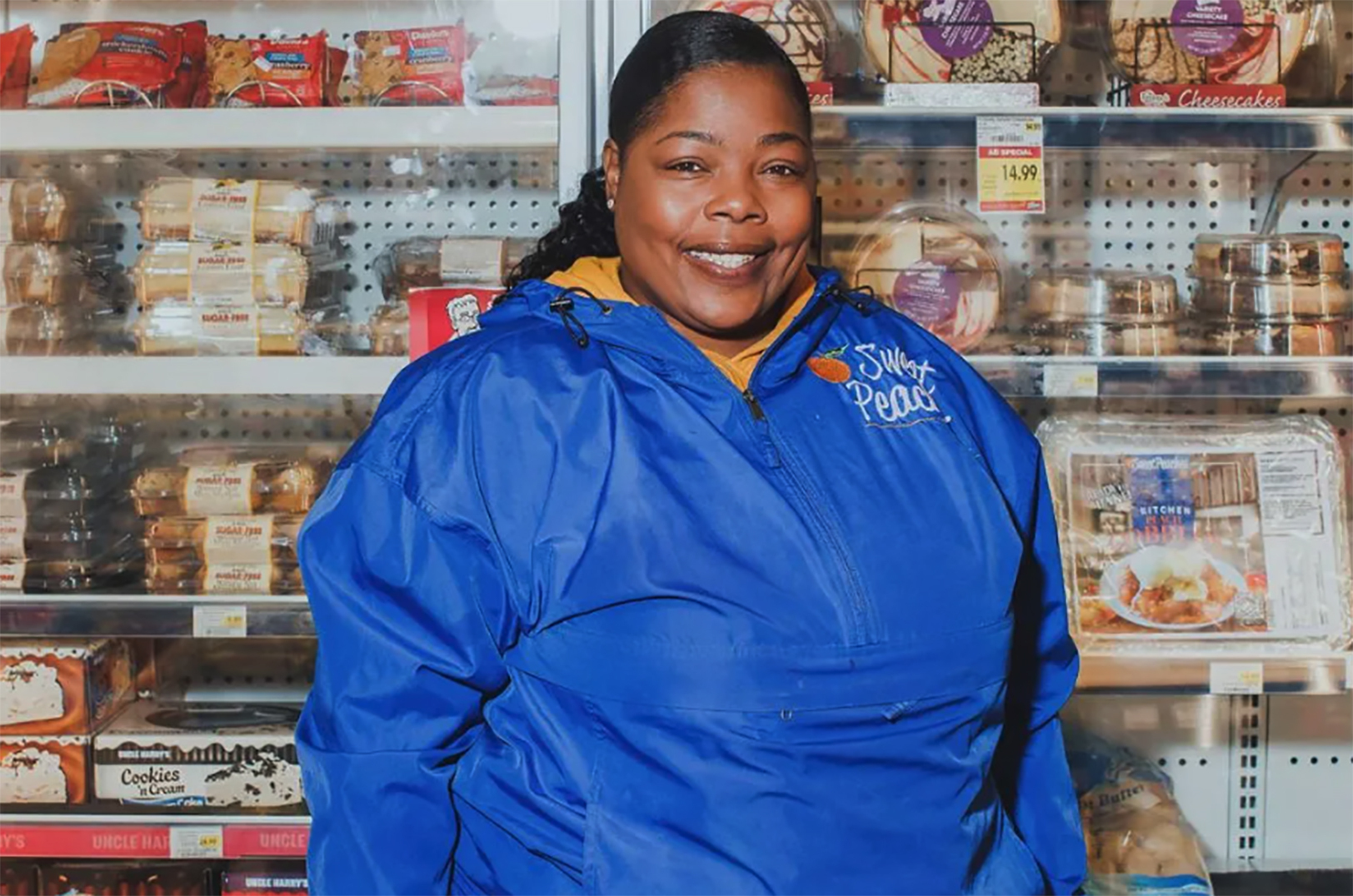
Denisha Jones, owner of Sweet Peaches, makes a delivery to the Price Chopper in Waldo; Photo by Chase Castor, The Kansas City Beacon
Sweet Peaches Cobblers was able to purchase commercial freezers, hire new employees and improve its marketing strategies, Jones said.
“In October of last year, we were only in five stores,” she said. “And now we’re currently in 33 locations.”
While Sweet Peaches Cobblers remains a family-operated business, the GIFT grant has enabled Jones to treat her staff less like volunteers and more like employees.
Grant recipients are required to present an itemized breakdown of how the grant dollars will be used. Eligible expenses include payroll, inventory, fixed costs such as rent and equipment, and other day-to-day expenses.
Leeah Bryant has been on the Sweet Peaches staff since the company launched, providing customer service, working the register and attending events. While her rate of pay is the same, she is no longer donating hours, as she did when she helped her friend get Sweet Peaches off the ground.
“A lot of things that I did to help her were to just help,” Bryant said. “Now I’m paid for each hour that I work, whereas beforehand, a lot of it was just donating my time.”
Next steps for Black-owned businesses
Generating Income For Tomorrow got its start on May 5, 2020. Three weeks later, in Minnesota, a Minneapolis police officer murdered George Floyd, a Black man, by kneeling on his neck and cutting off his oxygen supply.
The videotaped act of brutality ignited a national outcry against institutionalized racism. And it created a wave of support for Black-owned businesses.
Yelp search interest for the term “Black owned” grew by more than 12,000 percent in June 2020 in comparison to the year before. Between June and August of that year, 75 percent of Black business owners saw an increase in business, according to a poll of more than 400 Black business owners by Groupon and the National Black Chamber of Commerce.
That surge in support for Black-owned businesses brought an initial rush of donations to GIFT and its mission. Many of the donations were from people who live outside the neighborhoods that the nonprofit was aiming to serve.
“I think they didn’t want to be seen as the problem, so they got involved and they began to donate,” Gorman said.
Two years later, the support does not look the same. About 45 percent of GIFT’s funding continues to come from individual donors, Gorman said. But while the amount of donations the organization receives is relatively consistent, support from white and more affluent individuals has dropped somewhat, while donations from people more connected with Black communities has ticked up.
The rest of the organization’s funding — about 55 percent — comes from corporations and foundations.
Some of GIFT’s challenges come solely from being a new nonprofit and not well known by funders or even possible recipients, Gorman said.
GIFT tries to be creative to raise its profile. It sponsors a monthly Black business pop-up where entrepreneurs can show off their goods and services. This year it opened a business center at 50th Street and Prospect Avenue, with services available to the community at no cost every weekday.
Most recently, Brandon Calloway, a co-founder of GIFT, received a $100,000 Pinnacle Prize, a no-strings-attached award given annually to two Kansas Citians who are working to strengthen communities facing socioeconomic challenges.
Gorman said his team understands it will have to continue to seek support from individual donors, even as the public’s attention shifts to other causes.
Black-led organizations are also less likely to receive grant funding and often have less revenue than white-led organizations. GIFT currently has a goal of reaching 15,000 donors.
“We still do need the support from the entire Kansas City metro area, while also maintaining and seeing the growth in the inner city, in order to see a better Kansas City for everybody,” Gorman said.
Like its benefactor, Sweet Peaches Cobblers is juggling ambitions and challenges. One of its most pressing goals is to get more staff. Small-business owners nationwide have been struggling to hire as a result of the pandemic.
“It’d be nice if she just had, you know, a good group of people that were on standby, ready. Because right now we’re all just kind of juggling everything,” Bryant said.
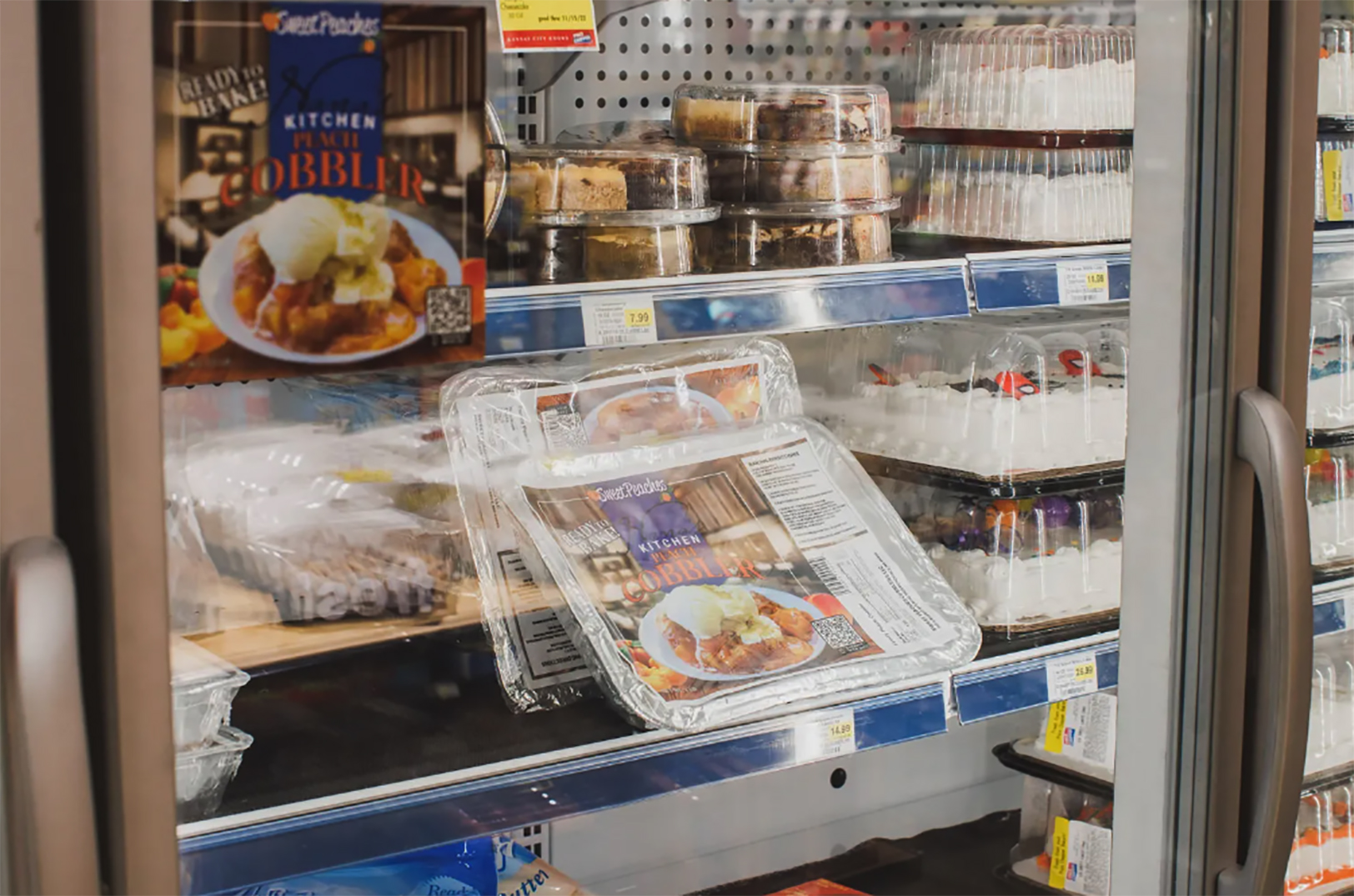
Sweet Peaches Cobblers at the Price Chopper in Waldo; Photo by Chase Castor, The Kansas City Beacon
Sweet Peaches is also looking to produce its products in mass quantity to maximize its profits. The business is currently looking for a co-packager.
A GIFT grant entitles recipients to a year of coaching and other entrepreneurial resources. Jones used her newfound savvy to pitch her business to other funders.. In September, she won the $30,000 grand prize from the Hy-Vee OpportUNITY Inclusive Business Summit and pitch competition.
Jones is confident that with the combination of funding, perseverance and a universally loved product, Sweet Peaches Cobblers will be everywhere in no time.
“Sweet Peaches Cobblers is going to be a global brand,” she said.
Mili Mansaray is the housing and labor reporter at The Kansas City Beacon.

This story is possible thanks to support from the Ewing Marion Kauffman Foundation, a private, nonpartisan foundation that works together with communities in education and entrepreneurship to create uncommon solutions and empower people to shape their futures and be successful.
For more information, visit www.kauffman.org and connect at www.twitter.com/kauffmanfdn and www.facebook.com/kauffmanfdn

Featured Business

2022 Startups to Watch
stats here
Related Posts on Startland News

Tech startup Bungii is your new friend with a truck
“Hey, can I borrow you and your truck this weekend?” It’s a question dreaded by truck owners everywhere, and in April of 2015, it made Ben Jackson regret ever buying his 1999 Ford Ranger. Jackson — and his truck — had just finished an exhausting day helping friends make four hauls across Manhattan, Kan. The…

Google Fiber hops to new, pricier plans for businesses
All good things — or in this case inexpensive things — must come to an end. Google Fiber will soon nix early-access pricing for its gigabit business service and will more than double its costs for new customers in August. Google Fiber — which first arrived in Kansas City in 2012 with residential service —…

Amazon to bring 1,000 jobs, huge facility to KCK
Online retail giant Amazon will open a massive new facility in Kansas City, Kan. The Seattle-based company announced Monday that it will create more than 1,000 full-time jobs and construct an 855,000-square-foot fulfillment facility near the Turner Diagonal on I-70 in Kansas City, Kan. “These aren’t just any jobs. They are the best entry-level jobs our…
Survey: KC is sticky for startups with equity funding
A majority of Kansas City startups choose to maintain their hometown roots after they raise capital — even when the funds come from outside investors, a recent survey found. Of the companies that raised money in 2013 and 2014, 74 percent of them are still active and headquartered in the City of Fountains, according to…