

Allyship means mistakes plus action: New project draws parallels between innovation, DEIB
August 18, 2022 | Nikki Overfelt Chifalu
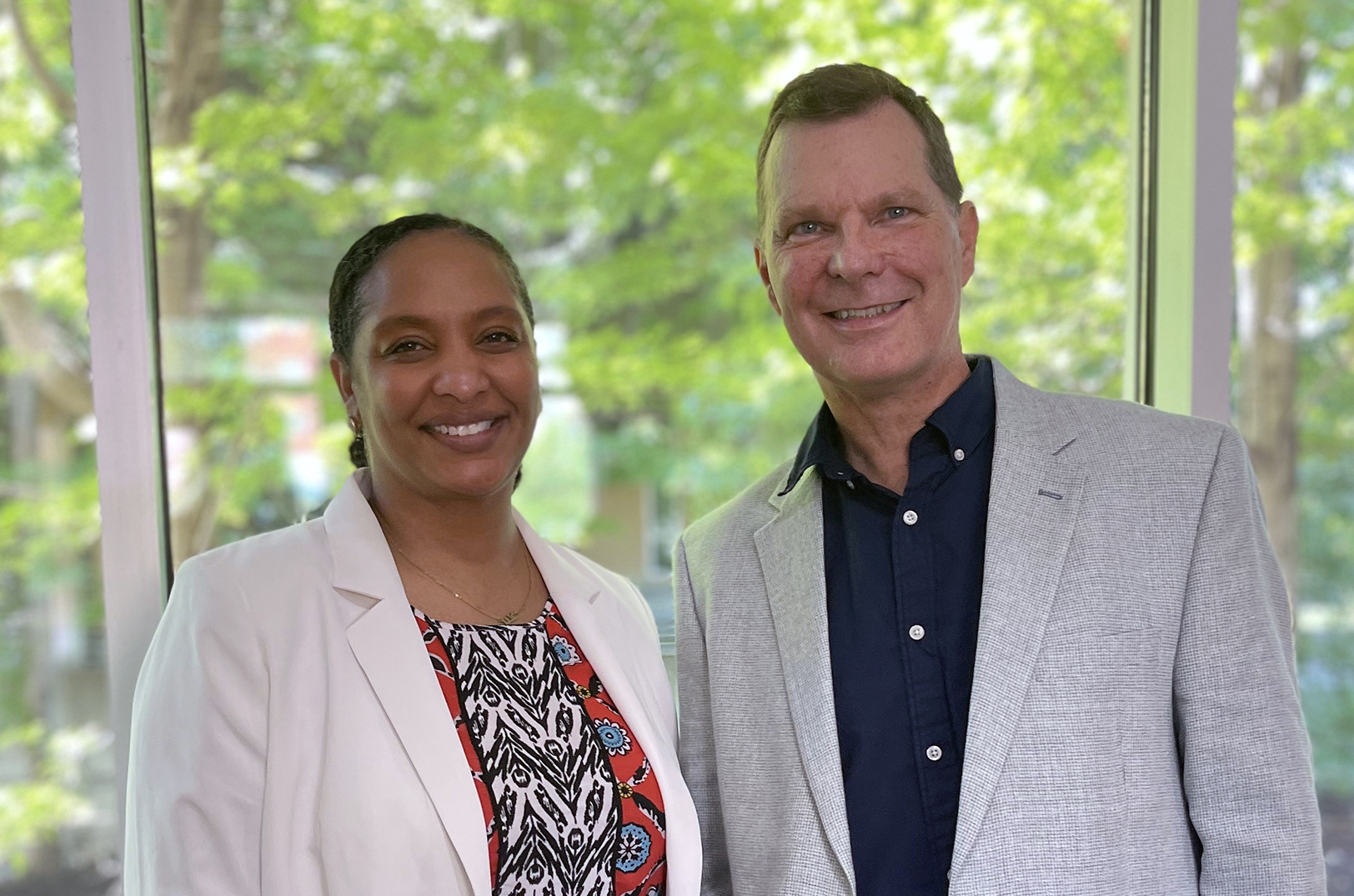
It’s time for coworkers to move beyond best intentions, said Ghadeer Garcia and Mark Logan, announcing the launch of a new project aimed at pushing allies in the workplace to action.
The co-founders created the Ally Lab project through Idealect, an equity-centered social innovation company in Kansas City. The Ally Lab will offer knowledge and skill-building experience to allies through workshops and online courses.
“Both Ghadeer and I are really action-oriented,” Logan said. “We want to move beyond just having conversations and to help people take strategic, systemic, effective action.”
He describes Ally Lab as DEIB (diversity, equity, inclusion, belonging) training fused with design-thinking methods. The name — Ally Lab — is a nod to both the processes of allyship and innovation.
“There are some interesting parallels between innovation and DEIB,” he explained. “They are both ongoing disciplines that involve making mistakes, that involve iteration, that involve learning.”
Click here to learn more about Ally Lab’s effective allyship programming.
For Garcia, she said it’s important for her to be in a place professionally and personally where she can build community, contribute, and learn.
“That’s how we’ve tried to shape the Ally Lab,” she continued. “To Mark’s point about the equity-centered design: What does everybody need? What’s important to everybody? And how do we fit that into this bigger conversation of belonging and inclusion?”
Garcia and Logan met around 2017 when Logan was running the innovation lab at Barkley. Then in 2018, Logan launched Idealect to merge his innovation skill set with social impact work and Garcia was the executive director of the BrandLab — which aims to promote diversity and equity in the advertising industry.
“We’re both obviously invested in the DEIB space,” he added.
They had been looking for a way to collaborate when they landed on their mutual interest of allyship training, so over the past year, they have brought Ally Lab to life.
“Both as a participant and as a facilitator, I frequently felt that a lot of DEI training is lacking,” Logan said. “It feels very sort of basic — particularly in the post-George Floyd era — where we really need to move beyond just having conversations toward action.”
Garcia said Ally Lab is an amalgamation of their own personal experiences and themes from conversations about DEIB work that she had with Logan, with coworkers at BrandLab, and the high school and college students she worked with.
“There were many, many, many, many gaps that needed to be filled,” she explained. “So this Ally Lab work that Mark and I have been developing is really an opportunity to take in hand those themes and put some action behind them with the idea that we need to de-center this shiny object of DEI and really bring it into a place of: We are humans, trying to build community, trying to build bridges over things that have been difficult and problematic and tough to overcome for decades. And apply it to our workplaces, apply it to our relationships, professional and personal.”
For Logan, his own personal experience has been finding his place in the DEI world, he said, and allyship training feels like the right fit.
“Because as someone who embodies a lot of privilege, I didn’t necessarily feel like it was my place to take center stage,” he continued. “And then gradually, I became aware of this swim lane, if you will, of allyship and allyship training. … It’s a swim lane that feels right for me, because I have been through an allyship journey/I’m on an allyship journey. I can help other allies sort of move along in their journey.”
His journey has been shaped as a white stepdad to three Black children.
“That has informed a lot of my interest in and motivation to learn about diversity and equity,” he explained. “Those kids have taught me a lot of things that I was never brought up to learn, even though my parents were very liberal and progressive and open-minded. There’s just a lot of history and reality that white folks in America aren’t typically brought up with.”
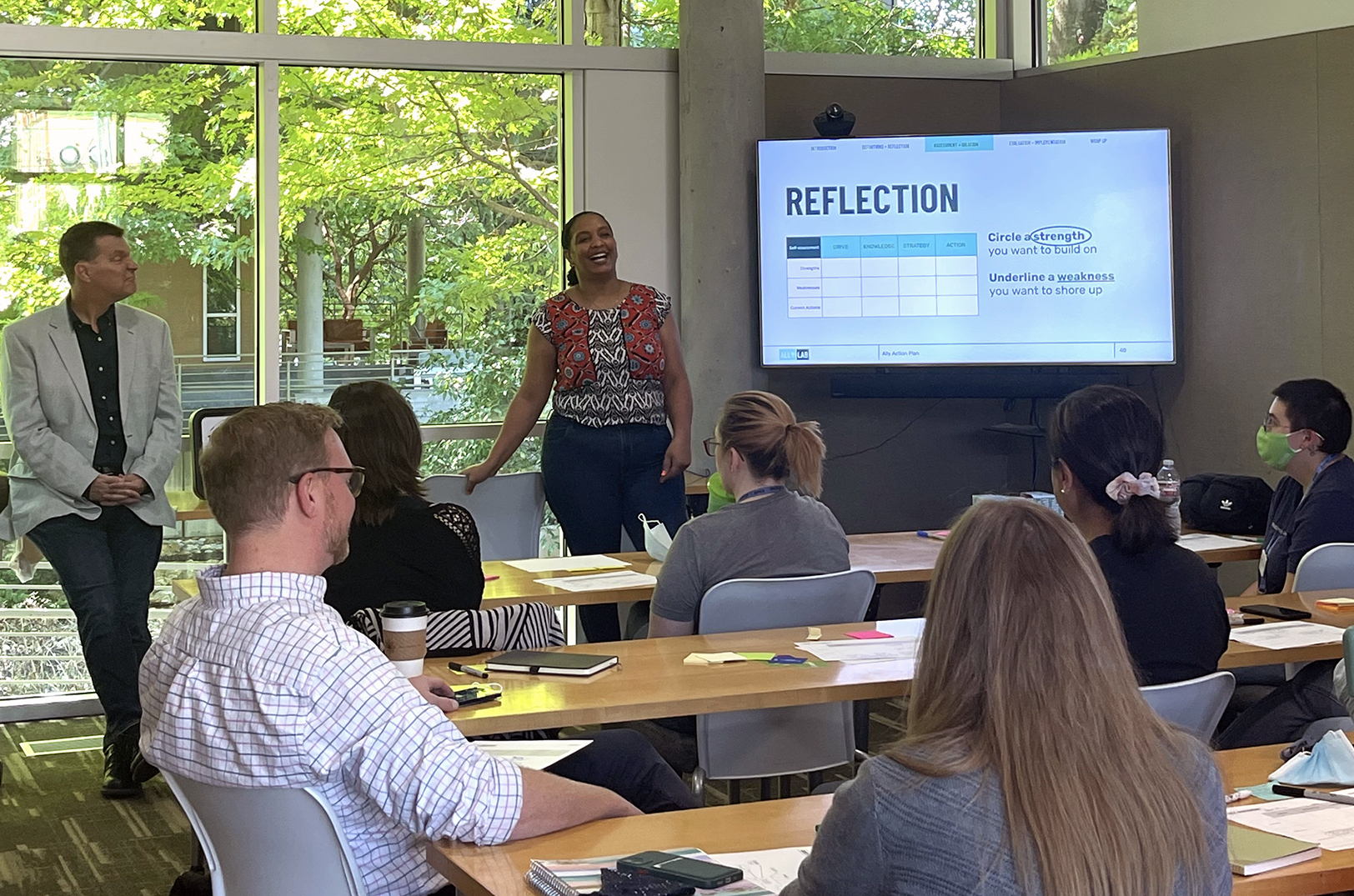
Mark Logan and Ghadeer Garcia, Ally Lab, leading a DEIB workshop
Allyship research
Studies show that allyship training yields specific benefits in the workplace, according to Logan.
He shared a recent survey by Change Catalyst that found that workers in companies that actively promoted allyship were 40 percent more likely to feel safe at work, 80 percent more likely to feel satisfied with workplace culture, and 100 percent more likely to feel that they belong.
“When allyship is actively discussed, and actively taught in workplaces, you see really significant gains in quality of life for members of minoritized groups,” he added. “It has a range of tangible benefits for people and also for businesses. Because if there’s better retention, better productivity, then the business benefits, as well. So we felt really good about the rationale behind allyship training.”
But, he added, allyship is too often a passive concept.
According to a survey by PFLAG, an organization of parents and family members of the LGBTQ+ community that promote allyship specifically for that community, 83 percent of women and 70 percent of men identify as allies in the workplace. But that number drops to 19 percent and 8 percent, respectively, when asked if they were an active ally, such as talking to an LBGTQ+ coworker about their experiences.
“So you’ll hear in some quarters, the word ally gets a bad rap,” he said. “People will say things like, ‘I don’t want an ally. I want a co-conspirator.’ And that’s really what they’re talking about. It’s that well-intentioned ally versus an active ally. So we’re trying to help people become active allies.”
Allyship courses
Garcia and Logan will be co-leading the courses that are offered through the Ally Lab, but they won’t be doing it alone.
“There’s other collaborators and potential partners in our community that are eager to do this work with us,” Garcia noted. “So we’re building a bit of a collective to carry out some of this work.”
They have already started an Ally Action Plan Workshop and Garcia said they have gotten good feedback about it, including about the interactiveness, as well as data and historical information that’s shared.
“It’s nice to hear that folks are feeling like, ‘Oh, this is refreshing; this is something that I can actually tap back into and keep using,’’ she explained. “So that’s one piece and then it’s fun. It’s not a boring, HR-is-making-us-do-this workshop. It’s engaging, fun. I get to meet new people, but I also get to see myself. I also get to connect with myself a little bit more and really do this work that matters, not only to me and the people that I relate to, but to the broader community.”
Ally Lab is also offering online courses. The first is the free Allyship Essentials course.
Click here to learn more about available online allyship courses.
“As we talked to folks in the corporate space, one of the things that we kept getting asked about was, ‘What about online training?’” Logan said. “Particularly in the era of remote work, corporations are leaning more into, not only virtual workshops, but specifically self-paced online courses.”
They plan on offering the Ally Action Plan Workshop as an online course soon, plus courses on Responding to Microaggressions, Listening for Allies, and Leaders as Allies. Those courses are all available for pre-order on the Ally Lab website. They are also planning a possible Keystone Session about Allyship for Entrepreneurs.
Logan said they plan on following three tracks for their courses: allyship for specific industries, like healthcare and finance, allyship for specific communities, like LBGTQ+, and allyship skills, like listening and resilience.
“We really want to target those industries where inequities make a major difference,” he added. “And we think there’s work to be done with different communities that are often the targets of discrimination (and) disinvestment.”

This story is possible thanks to support from the Ewing Marion Kauffman Foundation, a private, nonpartisan foundation that works together with communities in education and entrepreneurship to create uncommon solutions and empower people to shape their futures and be successful.
For more information, visit www.kauffman.org and connect at www.twitter.com/kauffmanfdn and www.facebook.com/kauffmanfdn


2022 Startups to Watch
stats here
Related Posts on Startland News
Jeff Shackelford: Here’s how to land Digital Sandbox funding
When it comes to pitching their startups, most Kansas Citians err on the side of selling themselves short. At least that’s what the Digital Sandbox KC’s Jeff Shackelford told a crowd Tuesday at an event helping community members who are interested in pitching to the incubator-style program. Launched in 2013, Digital Sandbox has supported a…
The education system is broken — these Kansas Citians want to fix it
As you may remember or have experienced with your own child, there seems to come a point in one’s educational journey where kids ask themselves — what’s the point? The answer has always been, so that you can get good grades, to get into a good college to then get a good job. The problem with…

What’s Kansas City doing at SXSW 2017 this year?
March is about to get weird. Startland News is once again returning to the weirdness of Austin, Texas, for the annual insanity that is the SXSW Conference. Like last year, we’ll be venturing to the Lone Star State to report on the Kansas City contingent at arguably the nation’s top conference for innovative ideas: South-by-Southwest…

Olathe-based Flow Forward raises $1M for vascular device
After completing a preclinical study, Olathe-based Flow Forward Medical nabbed another round of capital for its vascular device. The firm raised another $1 million from a group of unnamed, individual investors, bringing the firm’s total raised to $7 million. Flow Forward created the AFE blood pump system, which is designed for temporary use to quickly…