

Kansas City corporate leader works to take ClimateTech from research to the real world
July 13, 2022 | Claire Burke
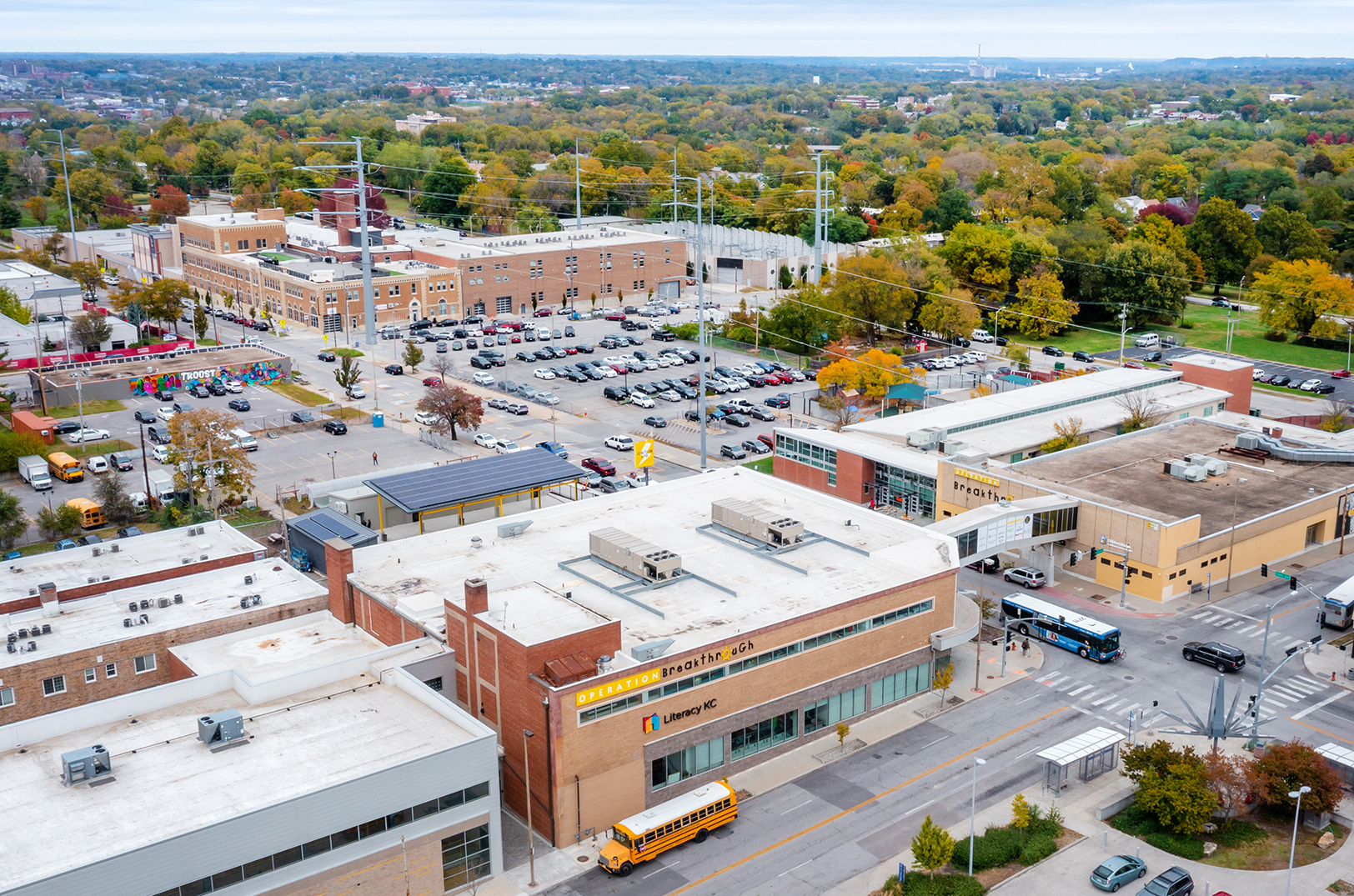
The solar canopy at Operation Breakthrough’s high-profile STEM lab and youth coworking space was an opportunity for Black & Veatch to put one of the firm’s core capabilities to use for the community and the climate, said Ilya Tabakh.
“[Our goal was] to support an initiative that supports STEM education, combines sustainability and technology, and put in infrastructure for Operation Breakthrough that frees a lot of resources for them to retarget towards the important work they do,” said Tabakh, entrepreneur in residence at Black & Veatch, a Kansas City-based global infrastructure firm.
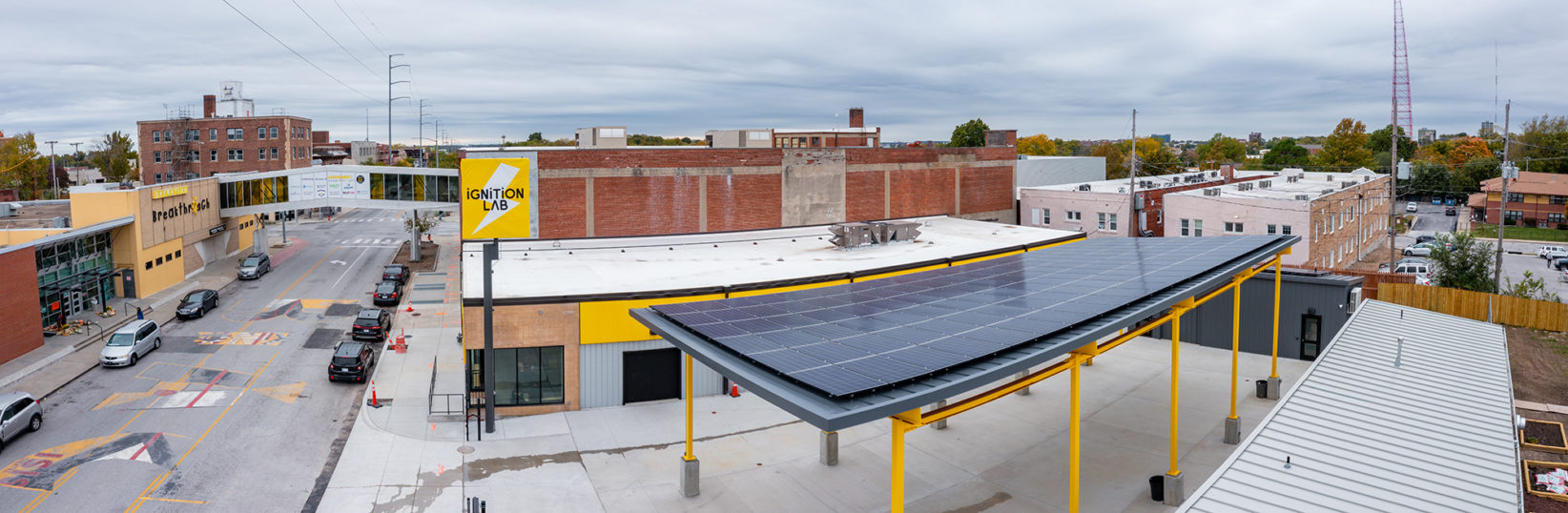
Solar canopy outside the Ignition Lab at Operation Breakthrough
Backed by fellow KC climate-focused corporations — Sun Partners International, JE Dunn, MRIGlobal, and RisingSun Solar — the solar installation allows Operation Breakthrough’s Ignition Lab to generate zero-carbon energy while providing a space for students to learn and gain work experience within STEM fields.
Black & Veatch was integral in the funding and design of the solar project.
Click here to read more about how Kansas City companies gave the Travis Kelce-backed Ignition Lab project a boost.
The solar work at the Troost STEM lab represents just one of Black & Veatch’s recent ventures into sustainable infrastructure. The firm has found that critical infrastructure needs to become “more robust, resilient, and sustainable to continue to operate,” Tabakh said.
Its IgniteX growth accelerator program was introduced to move industries closer to that vision, he added.
First launched as a CleanTech accelerator in 2019, it continued in 2020 as a COVID-19 Response accelerator, and in 2022 the growth program became focused on startups “accelerating a net-zero carbon future” as a ClimateTech accelerator.
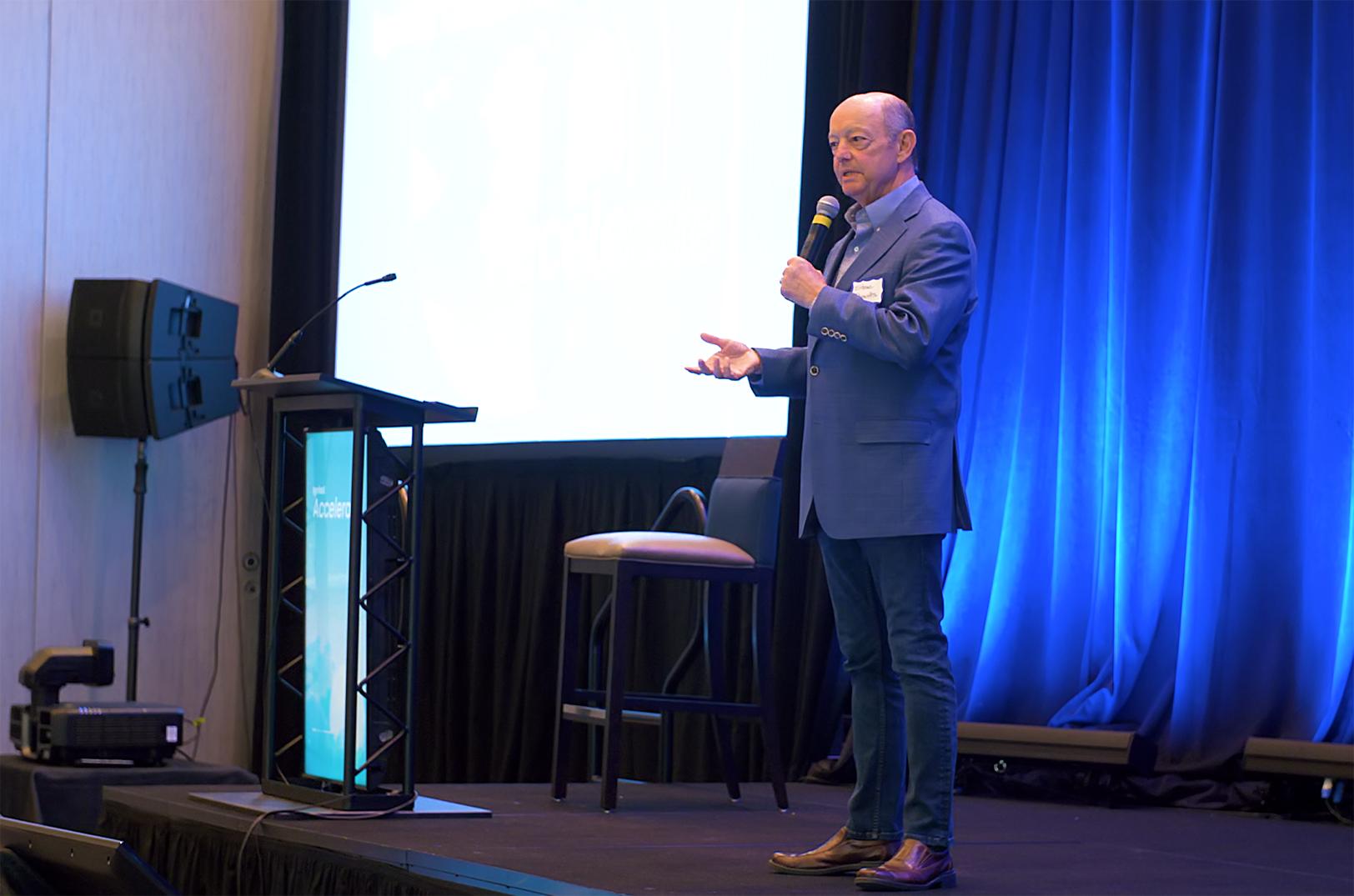
Steve Edwards, outgoing chairman and CEO of Black & Veatch, speaking at the 2022 IgniteX Climate Tech Showcase
Of 90 applicants to the 2022 program, eight were chosen for the 2022 IgniteX Climate Tech Showcase — based on criteria of innovation, sustainable solutions, decarbonization, resiliency, and reinventing industry. From a startup recycling clothing into raw materials known as Circ to a company called Twelve eliminating emissions by transforming CO2 into critical chemicals, materials, and fuels, the cohort showcased ideas for reducing carbon emissions through tech.
“There was a pretty strong focus on ‘How do we partner with other folks in the innovation ecosystem and work with other emerging companies and technology players to continue to drive innovation?’ As some of these cool things are being invented out of research, out of the science lab, our thinking is on ‘What do we actually have to do to bring them into the grid, bring them into the world?’” said Tabakh.
“We find the best and smartest folks working on these issues and we combine them with the deep expertise we have internally until both sides end up running faster and you come up with more dynamic and creative solutions,” he continued.
While the 2022 IgniteX program recently wrapped, Black & Veatch continues to work in line with the goals of the program, Tabakh said.
The firm began releasing sustainability reports in 2020, formalizing Black & Veatch’s approach to leadership and responsibility related to deploying infrastructure that mitigates and adapts to climate change.
In its 2022 report, Black & Veatch commits to “reduce Scope 1 and 2 emissions by 40 percent and overall GHG emissions (Scope 1, Scope 2, and Scope 3 business travel and teleworking) by 20 percent from a 2019 baseline by 2023 and be net zero for overall emissions by 2025.”
As Kansas City officials work on an updated Climate Protection & Resiliency Plan for the city, Black & Veatch provides an example for how corporations and startups can begin to navigate sustainable development and ClimateTeach in a world increasingly focused on sustainability.
“What’s exciting is that regions and cities are really thinking about ‘What does the next generation of their infrastructure look like?’ and thinking about many of the stakeholders involved in those conversations,” said Tabakh. “On the regional plan [for Kansas City], there are quite a lot of conversations taking place.”

Featured Business

2022 Startups to Watch
stats here
Related Posts on Startland News
Novel Capital teams with Crux KC to offer growth-focused marketing to early-stage tech companies
An exclusive partnership between two Kansas City-based innovators is expected to help remove a traditional financial hurdle to business growth, said Ethan Whitehill, president and chief strategy officer for the KC Chamber-lauded marketing firm Crux KC. The collaboration between Crux and Overland Park-headquartered capital provider Novel Capital is expected to offer B2B SaaS and tech…
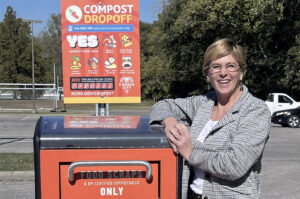
Neighborhood smart cans help Kansas Citians save the planet from their kitchens
Newly introduced composting technology is already turning new ground in Kansas City, Kristan Chamberlain said, with more solar-powered compost cans arriving later this spring across the metro’s urban landscape. Her social venture, KC Can Compost, installed three of the devices in October — free to use for KCMO residents wanting to deposit their soil-making food…

Voodoo Volleyball bounces back in OP: Father-daughter duo doubles as new venture’s setters
Quinn Austin put several sports to the test as a preteen — racing from basketball practice to softball to volleyball. But she latched on to just one. “Volleyball. It was my sport. Everyone was having a good time,” she said. “We just loved the cheers — a cheer when we got a hit, a cheer…

Black farmers are losing ground in the fight to feed their communities, advocates say
More than a century of systemic land dispossession and discriminatory practices has left Black farmers with less than 0.6 percent of U.S. farmland — less than a third of the 16 million acres they operated in 1910, according to local urban farming advocates. They gathered Tuesday at Independence Boulevard Christian Church to confront this history…