

Survival rates for new biz in MO, KS lag national average; What’s getting in their way?
May 26, 2022 | Saurav Rahman
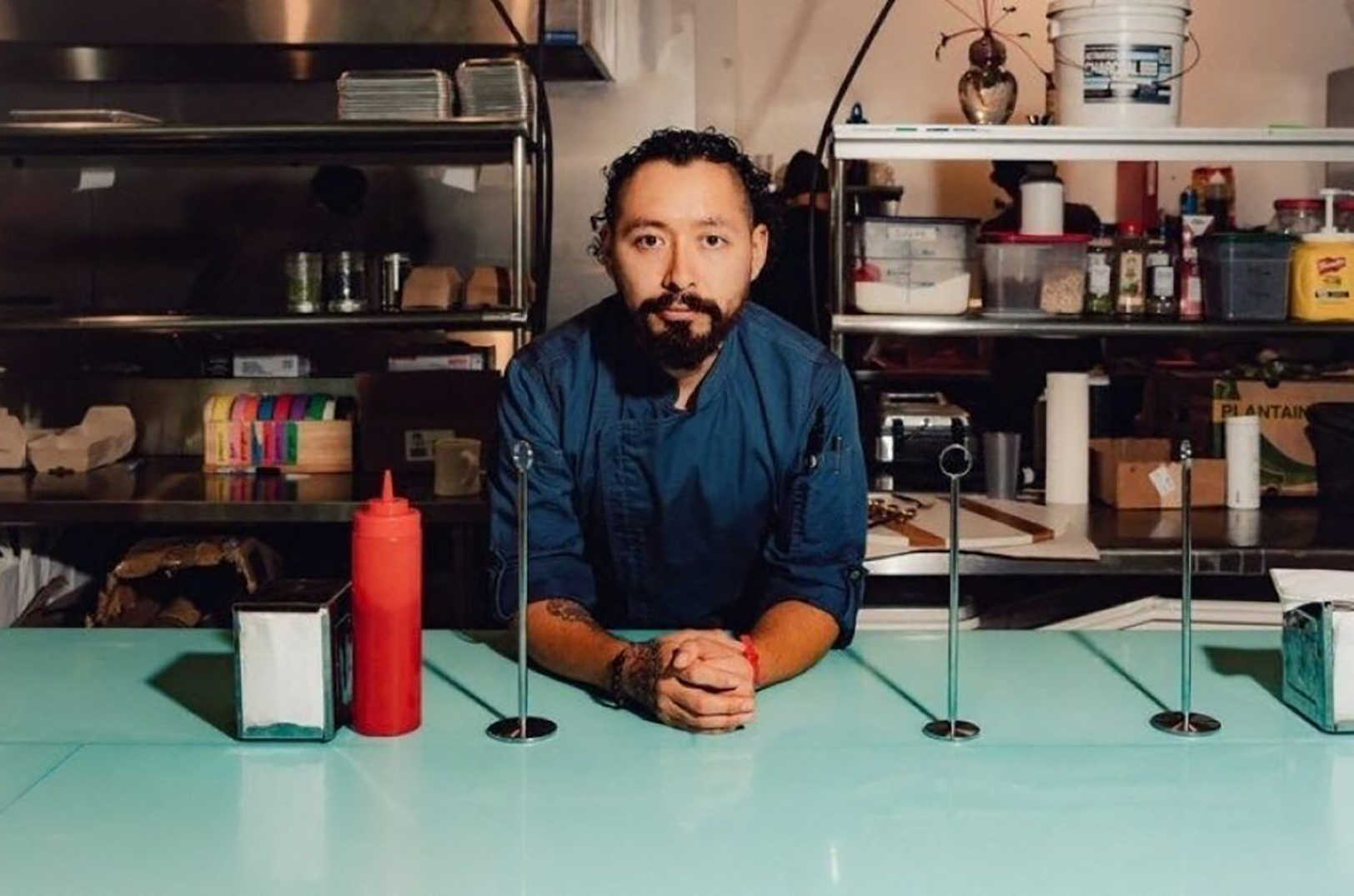
Editor’s note: The following story was originally published by Flatland, the digital magazine of Kansas City PBS and a fellow member of the KC Media Collective. Click here to read the original story or here to sign up for the weekly Flatland email newsletter.
Colorful balloons, ribbons, unlimited drinks, food and of course music. There was everything at the ribbon cutting of Pirate’s Bone Burgers second outlet in town on May 12.
On top of all these joyful arrangements, though, was something that could not be seen in a tangible sense – a dream. A dream to grow as much as possible, so that a small initiative on Main Street can happen again in another state, and someday spread the brand beyond the country.
Coming from a tiny coffee shop in Brookside, after five years Zaid Renato Consuegra Sauza, a young Mexican-born entrepreneur, is now setting his goal for the next 10 years.
“I hope we can grow to another state, that’s the first step,” he said. “And if we can make it to another state, I hope we can make it across the pond. I would love to see a local business that can jump into the European market.
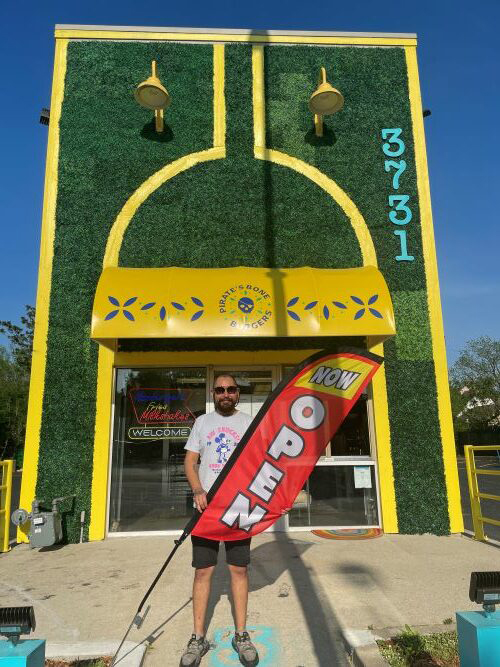
Zaid Renato Consuegra Sauza in front of his newly opened restaurant; photo by Saurav Rahman, Flatland
“I don’t know how doable that is, but it would be a goal, to see if we can cross the border, to Canada at least. I don’t know if we can compete with the bigger companies, because our sales and numbers are still very short, against the franchises. But I would be excited as a goal of mine.”
But the journey from Brookside to the Crossroads and now Main Street wasn’t easy for Sauza and his two partners. They had to wait almost 16 months to set up this new walk-up window restaurant after leasing the property in January 2021.
“The idea was to make this a drive-in restaurant, which means you came, you parked, and we took your order, we brought your order out to the car,” Sauza explained. “But a drive-in here in Kansas City is considered the same as a drive-through, and they do not allow drive-throughs on main streets unless you are in a corner park.
“And as you see we are not in a corner so they wouldn’t allow us to open as a drive-in. So that took probably three to four months to get fully approved and open as a walk-up window restaurant. … Three (to) four months for a restaurant that’s not running does hurt a lot in the pocket. … On top of that, construction took so much longer. So, we needed to wait for just a little over a year without any earning.”
Sauza is blessed that Pirate’s Bone could survive the long waiting period. But other young entrepreneurs aren’t so fortunate.
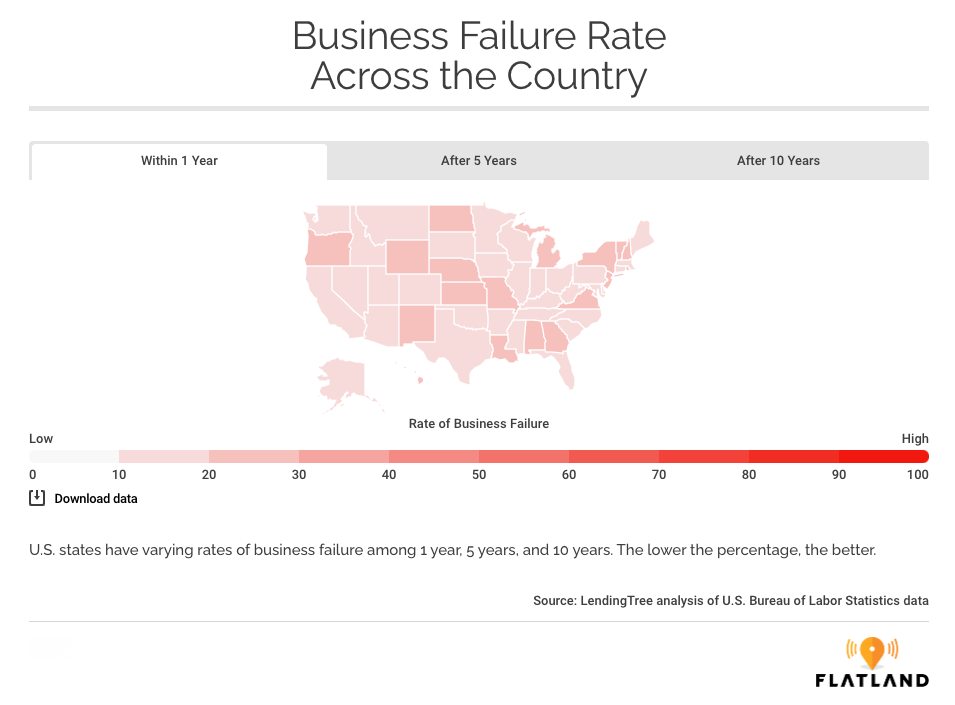
A recent analysis concluded that at least one of five start-up businesses in Kansas and Missouri fails in the first year, a higher failure rate than the national average.
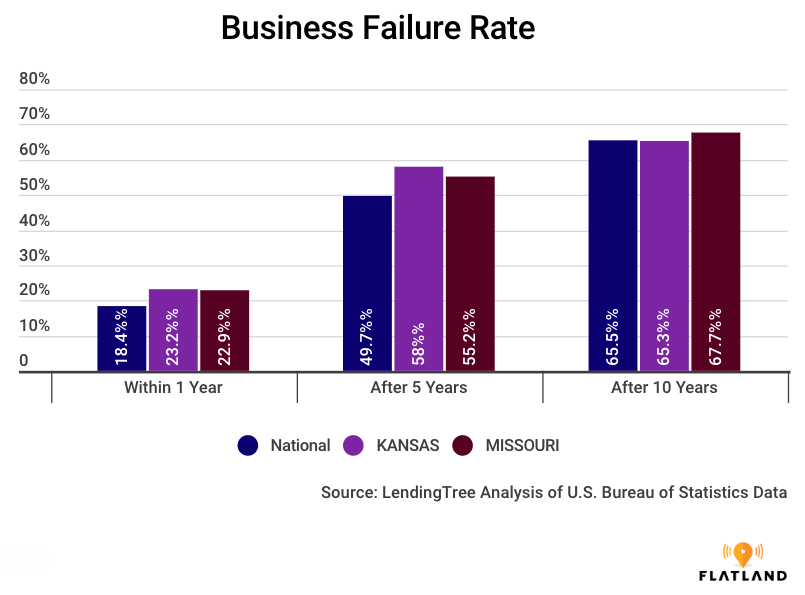
LendingTree, an online lending marketplace, analyzed U.S. Bureau of Labor Statistics (BLS) data and found that the average rate of business closure in the first year across the country is 18.4%. Hawaii topped the list with a 25.4% failure rate, followed by the District of Columbia and Kansas. Missouri experienced a 22.9% business fallout in the same period.
Despite the elevated early stage failure rate in Missouri and Kansas, economist Frank Lenk, director of research services at the Mid-America Regional Council (MARC), said the Kansas City area does a good job supporting start-up businesses and growing them to a certain point.
Later stage growth, according to Lenk, can be more challenging.
“When they need to expand, they often find the capital needed is on the coasts and they need to move,” Lenk said.
But this does not explain a higher than average first-year failure rate, since it only becomes an issue once they have successfully grown and now need additional capital.
According to the LendingTree analysis, 58 percent of startup businesses in Kansas are shut down within the first five years, which is the second highest in the country, after Washington.
Surviving for the first year is the most crucial for the business because the failure rate declines sequentially the longer the business stays open.
BLS data shows 65.5 percent of U.S. enterprises do not continue after 10 years, which is lower than Missouri’s 67.7 percent. For Kansas, the number is 65.3 percent.
Maria Meyers, the founder of SourceLink and Executive Director of UMKC Innovation Center, thinks a closure does not necessarily indicate a business failure of a company. She noted that people close businesses for many different reasons.
“Although the biggest reason is lack of sales, other non-’failure’ closures occur in the data as well, such as retirement (which is significantly increasing), selling the firm, or opening another firm. Health and returning to a more corporate environment also occur in that number,” Meyers said. “So, the term should be ‘closures’ rather than ‘failures’.”
However, it was a failure for Chrissy Nucum. Nucum is one of those entrepreneurs from Missouri who faced closure five years after the business started.
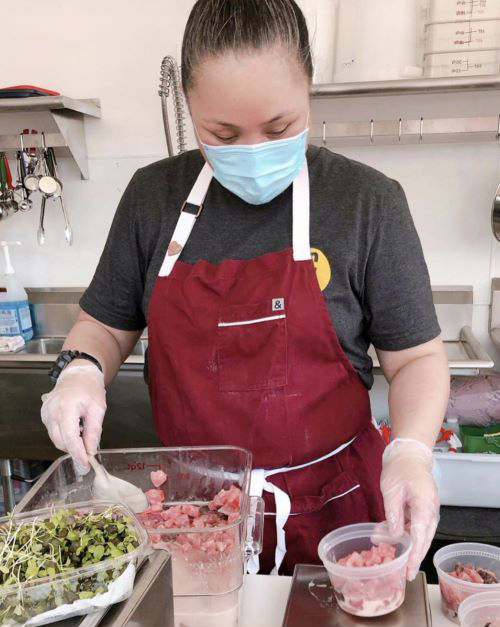
Chrissy Nucum became the chef of another restaurant, after the closure of hers; Photo courtesy of Chrissy Nucum
The Filipino chef started a food truck service, named KC Pinoy back in 2015. After some initial success, KC Pinoy opened a restaurant in 2018. However, the dream came to an end within the next two years, in October of 2020, about six months into the COVID-19 pandemic.
“We lost everything,” said Nucum, who now works as a chef in another restaurant.
Nucum said it wasn’t just the pandemic that made it impossible to keep her restaurant open. “Funding, bureaucracy, discrimination and resources” also played roles, Nucum said.
KC Pinoy’s experience echoes others.
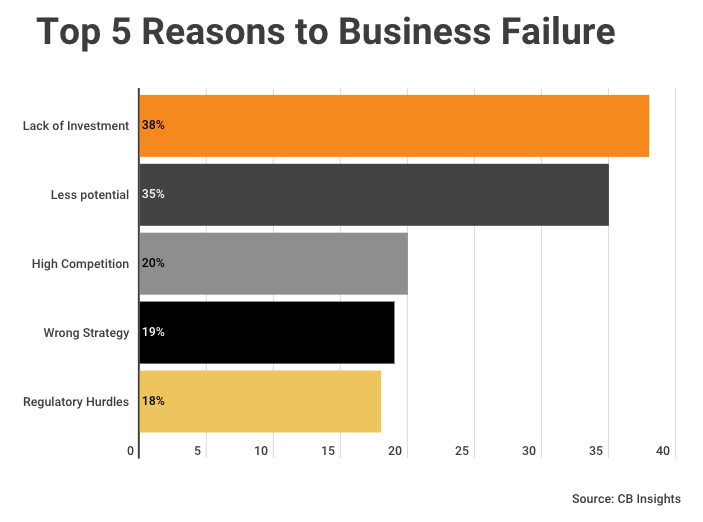
CB Insight, a business analyst platform, found in their research that 38 percent of failed businesses ran out of money a few years after they started the venture and could not manage to raise more capital. Moreover, one-third of ventures started without an analysis of whether there was any demand for their product in the market or not.
One in every five businesses fails due to competition in the industry, according to CB Insight. The same number of businesses cited mistakes in business strategy. And 18% of entrepreneurs said regulatory hurdles were a key reason for their failure.
All told, about 32.5 million small businesses are currently operating in the U.S. LendingTree’s study found that mining and petroleum companies are in the most vulnerable position, noting that just 25 percent survive in this sector over the long haul. In contrast, agriculture-related firms have the best long-term survival rates, with more than half remaining in business.
In terms of states offering the best chance for long-term business survival, Wisconsin ranked first, with a 56.2 percent failure rate. On the other end of the rankings, 81.7 percent of businesses in Washington were closed after 10 years.
In terms of job creation, new businesses are the driving force in the economy.
“We want new business to start and grow,” Meyers said. “Because they are a very important piece of the economy.”
Meyers cited access to capital, a sufficient supply of skilled workers, technical resources and a community that supports small businesses and entrepreneurs as keys to success.
“First and foremost, municipalities need to make it easy to do business within that region,” Meyers said. “That means how easy is it to get a license and permit, inspection and all of those kinds of things the city controls and how quickly they can go through the process to get a business open.”
So that no entrepreneur has to face the same long waiting period to start a venture, as did Zaid Renato Consuegra Sauza.
Saurav Rahman a 2022 visiting fellow through the Alfred Friendly Press Partners program, which provides hands-on training in U.S. and international newsrooms and within the Missouri School of Journalism. He is a senior reporter for Maasranga Television in Bangladesh.

This story is possible thanks to support from the Ewing Marion Kauffman Foundation, a private, nonpartisan foundation that works together with communities in education and entrepreneurship to create uncommon solutions and empower people to shape their futures and be successful.
For more information, visit www.kauffman.org and connect at www.twitter.com/kauffmanfdn and www.facebook.com/kauffmanfdn

Featured Business

2022 Startups to Watch
stats here
Related Posts on Startland News

MECA students to Goodwill: Everyone has a mission now — what else are you selling?
Editor’s note: MECA Challenge and Startland News are both programs of the Kansas City Startup Foundation, though the content below was produced independently by Startland. For more information on the relationship, click here. Goodwill must innovate and change with the times if it’s going to survive after 125 years in business, said Ed Lada. “The…

Prestio drives users to auto dealerships without traditional car buying pain points
Gone are the days of traditional car buying for Ben Anderson, the first customer of Kansas City-based startup Prestio. Anderson, an accounting professional at CBIZ, had grown deeply frustrated by auto dealerships, he said. In fall 2017, he turned to Prestio –– a first-of-its-kind software-as-a-service platform that allows customers to buy, trade, and finance vehicle purchases…

Crema co-founder details expansion experiment at Thinking Bigger breakfast
Crema’s work is all about proximity, said George Brooks, seeking to clarify potential misperceptions about the digital product agency’s foray into markets outside Kansas City. “We’ve been running an experiment,” the Crema co-founder told a crowd at Thinking Bigger Business Media’s recent Big Breakfast. “We’re from Kansas City, but probably 80 percent of our clients…

Techweek 100 list released: Dozens of KC’s top cultivators, ambassadors and innovators
Techweek Kansas City on Friday released its Techweek 100 list of the premier leaders pushing innovation in Kansas City. The collection of cultivators, ambassadors and innovators is a who’s who of familiar names across the startup, entrepreneurship and tech communities. Released in the runup to Techweek KC’s Oct. 8-12 festivities, the list isn’t a ranking,…