

Missouri ranks 7th in electric vehicle use, but access to charging remains a key barrier
May 27, 2022 | Meg Cunningham
Editor’s note: This story is part of a series on climate change in the Kansas City region produced by the KC Media Collective to support and enhance local journalism so every person in Kansas City can lead a richer life. Members of the KC Media Collective are KCUR 89.3, American Public Square, Kansas City PBS/Flatland, Missouri Business Alert, Startland News and The Kansas City Beacon.
Click here to read the original story.
Beto Lugo-Martinez is a grassroots activist who advocates for clean air. A big part of his work is fighting the expansion of “gas guzzling” vehicles and making sure that historically underserved communities receive infrastructure updates, partly to encourage driving an electric vehicle in Kansas City.
Kansas City is no exception to the growing nationwide popularity of electric vehicles, which are known as EVs. As more affordable models hit the market, Lugo-Martinez, the executive director of the nonprofit CleanAirNow, is focused on ensuring equitable access to infrastructure, including charging stations.
“We can just invest and put charging stations everywhere, but if we’re not really worried about investing in communities that are most impacted, we’ll be missing that mark again,” he said.
Missouri was recently ranked seventh in the nation when it came to the number of registered electric vehicle drivers and charging locations, with 6,740 registered electric vehicles across the state and 985 electric vehicle charging stations available.
Evergy, the utility provider for much of the Kansas City metro, has played a role in the installation of many of the area’s electric vehicle charging stations. But the region still has gaps when it comes to electrification.
Census tracts with lower median income often lack public charging options, and the disparity is especially clear on Missouri’s side of the metro. Charging location data from the Department of Energy shows a concentration of stations in the Kansas City’s downtown, financial and Power and Light districts, which are among the city’s most affluent areas, based on Census data.
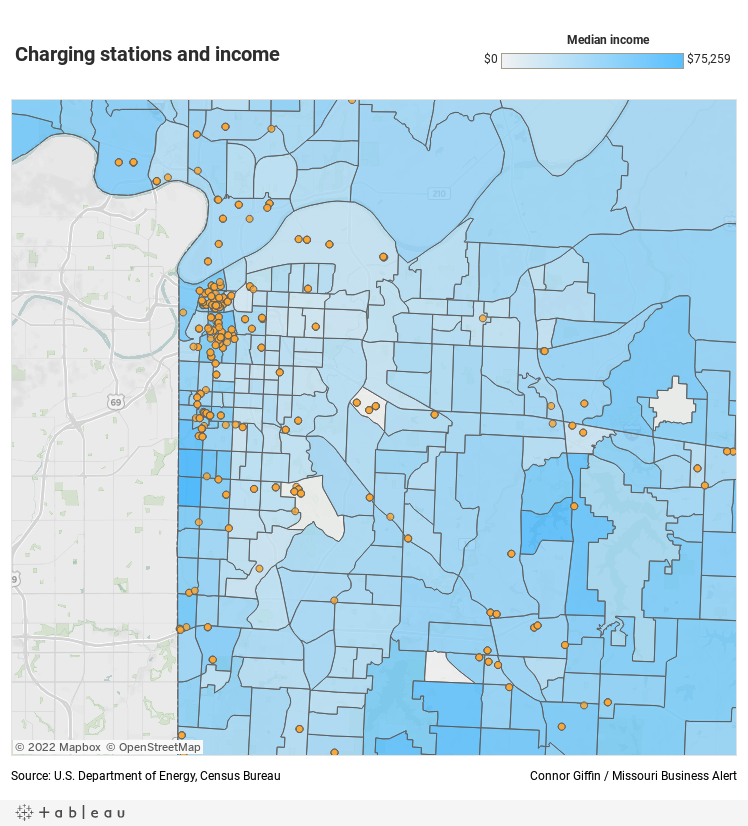
In the area surrounding the Country Club Plaza, another generally high-income neighborhood, public EV charging stations can often be found only a block away from one another.
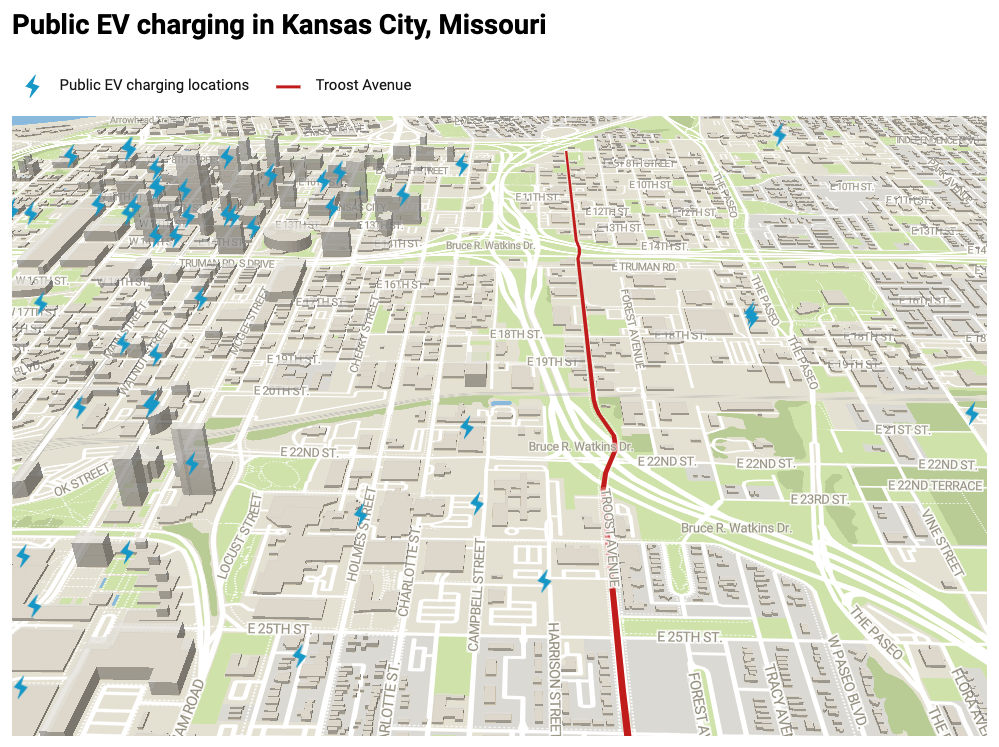
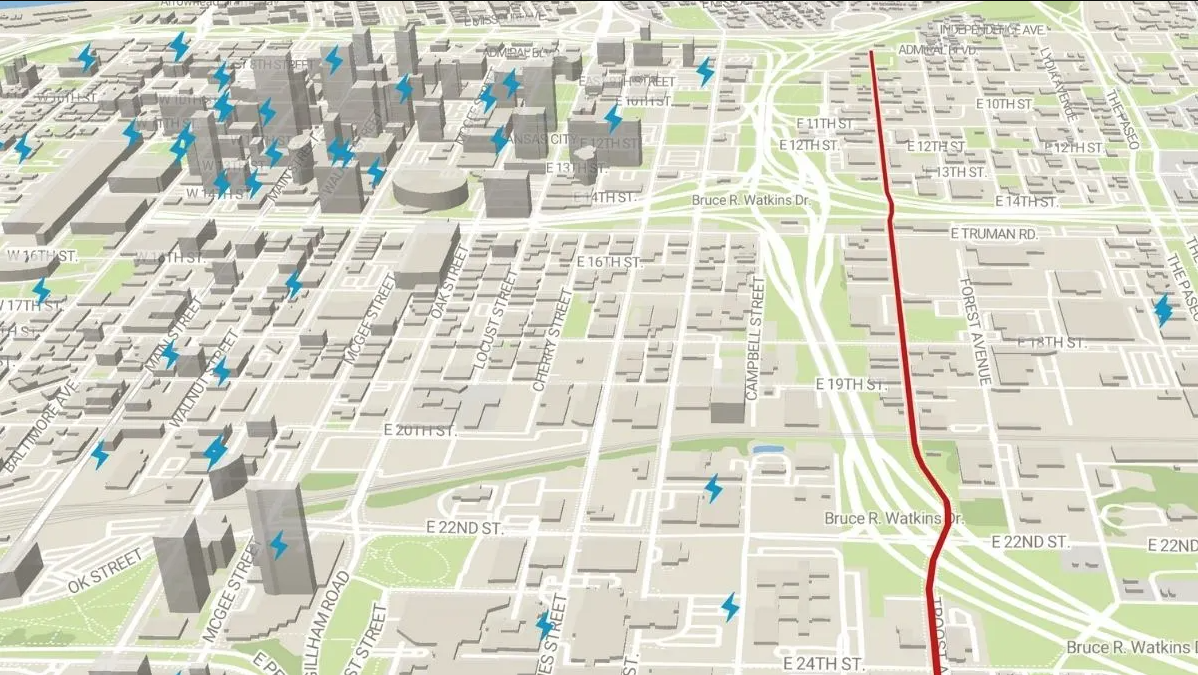
Also, public electric vehicle chargers are most often found west of Troost Avenue, which has represented Kansas City’s racial dividing line for decades. East of Troost, home to many of the city’s low-income residents, electric vehicle charging appears more sparse, with only a fraction of the charging station availability that residents to the west enjoy.
Without big dollars to back investments, waiting game ensues
Under the federal infrastructure law, Missouri can expect to receive $99 million over five years to support the expansion of EV charging in the state. Another $2.5 billion is set aside for states across the country to apply for grants for EV charging.
Electrification infrastructure created some controversy in the Missouri legislature this year. The House passed a bill that would have prevented local governments from requiring owners of buildings to install EV charging stations, unless the cities or counties were willing to foot the bill. Ultimately the bill didn’t progress to a Senate vote.
The Metropolitan Energy Center (MEC) in Kansas City, whose goals are to create “resource efficiency, environmental health and economic vitality,” is fielding some of the money (which will often require a 50% local match) to communities to expand their electrification infrastructure. Much of that work centers around helping cities electrify their vehicles or public buses, which emit pollutants when roving around cities all day. The MEC is also using a small grants program to help municipalities that may not have the funds to match federal dollars.
Miriam Bouallegue, the sustainable transportation manager at MEC, said the nonprofit is trying to assess the needs of the metro as the money flows in.
“How do we define who’s underserved? How do we measure that? How do we target those folks without relying on past definitions that were developed for other types of infrastructure that don’t really relate?” she said.
“Most people that drive an EV are charging their car overnight in their house,” Bouallegue added. “However, if you don’t have a garage, or maybe you do, but maybe your garage was built in the 1940s and has no electricity in it— it’s really more of a shed. Then you might not be able to charge your vehicle as easily or simply as someone who can just pull into their normal spot and plug in.”
Independence, whose utilities are not provided by Evergy like the rest of Kansas City’s, has fewer charging stations than other areas in the metro, but the demand appears to be lower. Joe Hegendeffer, deputy director of Independence Power and Light, said that many of Independence’s charging stations go unused on a day-to-day basis.
Centerpoint Medical Center’s stations, for example, have high use because the hospital’s staff often plugs in during the day.
“But charging stations at Cable Dahmer [Arena] are real hit and miss,” Hegendeffer said. “Ninety percent of the day when you drive by it, there’s nothing going on there. So they’re not being utilized.”
Lugo-Martinez is working on getting community members specialized training on electrification, so the push can come from the ground up.
“One of the other things that we’ve been looking at is creating some pathways for local community members to get involved in green economy, green energy, and get specialized training around EVs, building infrastructure for it in homes because then that can create that pathway for it,” he said.
Lugo-Martinez said the group is also lobbying lawmakers to provide further rebates or incentives for drivers to switch to electric, so lower-income communities aren’t left behind in the push toward electrification.
Missouri was recently ranked seventh in the nation when it came to the number of registered electric vehicle drivers and charging locations, with 6,740 registered electric vehicles across the state and 985 charging stations available. But data shows a disparity among census tracts when it comes to access to chargers. (Connor Giffin/ Missouri Business Alert)
A changing electric vehicle landscape
Electric vehicles can save consumers money in the long run. Charging is generally much cheaper than gasoline, and maintenance costs are usually lower compared to gas-powered vehicles.
The initial purchase price of an electric vehicle, however, remains above that of its gas-powered equivalent.
But industry forecasts suggest electric vehicles will become more affordable and commonplace in the years to come, as production volume grows and technology improves.
Bloomberg’s annual Electric Vehicle Outlook report from last year predicts a steep increase in passenger EV sales in the next few years, though China and Europe are likely to continue dominating in that department.
But American automakers have put down large investments in the transition to electric. Ford is aiming for up to half of its vehicle volume to be battery-powered by the end of the decade with a $30 billion investment. General Motors has promised 30 new EVs between 2020 and 2025 in a $35 billion investment.
“That’s a ton of money, a ton of support,” said Nick Voris, senior manager of electrification products and services at Evergy. “That support is going to manifest itself in terms of a greater variety of EVs, which of course are going to appeal to a larger base of customers.”
Federal, state and local governments have also offered tax credits and other incentives to encourage the transition to electric.
In Kansas City, Evergy offers rebates for developers looking to install electric vehicle charging infrastructure on the Kansas side. The utility is awaiting regulator approval for similar incentives on the Missouri side.
Evergy’s Clean Charge Network has also played a key role in Kansas City’s initial build-out of charging infrastructure. By the time the bulk of that project was complete, about six years ago, the utility had placed about 1,000 chargers around the city.
Since then, Evergy has installed a few dozen more, but has largely taken on a supporting role as private developers take responsibility.
“The industry is turning toward private developers, and, more specifically, private developers that are recipients of grant funding,” Voris said. “Those folks are going to be doing the vast majority of public charging station build-outs for the foreseeable future.”
As the public utility for the Kansas City region, Evergy still helps developers in the planning process. Slight tweaks to infrastructure planning can make chargers more energy- and cost-efficient, and Evergy offers guidance in those decisions.
But as private developers focus on bulking up the Kansas City metro’s charging availability, return on investment remains paramount. That gives Evergy the opportunity to fill the void in places where return on investment might not be as great, Voris said.
“Going forward, that is an area that we, the utility, are going to be much more focused on,” he said. “We, as a utility, have an obligation to ensure equitable access.”
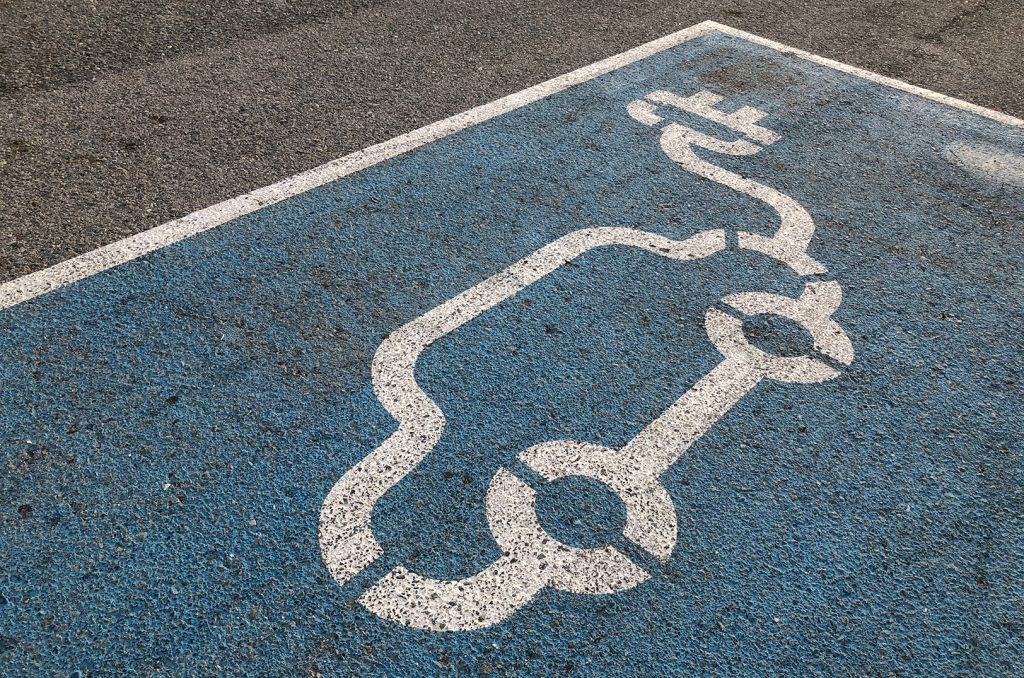
Low-income neighborhoods may be less likely to embrace the transition to electric — largely due to a price barrier. A lack of public charging infrastructure in those communities, where multifamily homes are common and garages are less so, adds further impediment.
A Blast Point study last year found that consumers “ready to buy” an electric vehicle landed in the middle- to higher-income brackets, with an average income of $150,000. That group also tends to be college-educated and living in single-family homes, which are more accommodating to private charging than multifamily dwellings like apartments.
Blast Point found that low-income consumers don’t regard electric vehicles as favorably as more affluent drivers do. This group is more likely to not own a vehicle at all, often relying on public transit or other more affordable means of transportation.
Kansas City Councilwoman Melissa Robinson, whose District 3 includes some of the city’s most impoverished neighborhoods, said she is continuing to prioritize education and electrification of the city’s fleets, as well as energy-efficient public transportation.
“We’re talking about electrification or electric vehicles where people are making $12,000 to $18,000 a year. How does that make sense? It doesn’t,” Robinson said “So we cannot get around this conversation without talking about having a robust public transit option to help people get from point A to point B.”
Lugo-Martinez said that an equitable infrastructure for electric vehicles has to be part of the overall picture.
“We’re seeing that where there’s wealth, of course it’s easier for them to put these stations in,” he said. “This disinvestment is really still creating that inequitable distribution of infrastructure. Because again, we’re investing in the communities that are OK already and literally catering to them.”
He added: “I would just love to see the utilities step it up, and say, ‘Hey, let’s invest and see what happens.’ I think they just need to take that chance on a community, right? And see what we can do and start from there.”

This story is possible thanks to support from the Ewing Marion Kauffman Foundation, a private, nonpartisan foundation that works together with communities in education and entrepreneurship to create uncommon solutions and empower people to shape their futures and be successful.
For more information, visit www.kauffman.org and connect at www.twitter.com/kauffmanfdn and www.facebook.com/kauffmanfdn


2022 Startups to Watch
stats here
Related Posts on Startland News

WATCH: No reason for ‘lone wolfing’ the startup grind, LaunchKC past winners say as application window narrows
Editor’s note: This article is sponsored by LaunchKC but was independently produced by Startland News. With a July 11 application deadline nearing, LaunchKC past winners emphasized the popular, high-profile grants contest is about much more than chasing a payday. “There’s the community piece. There’s the exposure piece. But once you win — or even once…

Accelerate Tech Learning targets the (urban) core of KC’s programmer shortage
Training would-be programmers from Kansas City’s urban core isn’t about getting rich, said Joshua Clark, co-founder of Accelerate Tech Learning. But unfortunately that means it can be tricky to get underestimated students the costly education to become a certified developer in the world of information technology, added Mauri Trent, Accelerate Tech’s executive vice president of…

With Hy-vee Arena, KC Star project, southward expansion, KC Crew plans to double its players
Where KC Crew plays, growth and development follow, said founder Luke Wade. The adult sports and event company filled Kansas City’s Parade Park every night before the Urban Youth Academy broke ground on East 17th Terrace, for example, Wade said. “So it’s kind of that economic development. The same thing happened with the riverfront when…

Mycroft hopes to build community of investment backers with new online public offering
Adding to its array of successful crowdfunding efforts, Mycroft AI recently launched an online public offering that’s generating significant financial support for the startup. Thanks to 2016 changes to the Securities and Exchange Commission’s equity crowdfunding regulations, the Kansas City-based tech startup’s OPO has already amassed more than $173,000 of its $1.07 million funding goal.…