

Calling citizen scientists: KC Digital Drive asking residents along Troost to help measure air pollution
April 12, 2022 | Madison Hopkins
Editor’s note: The following story was originally published by The Kansas City Beacon, a non-profit online news outlet focused on in-depth journalism in the public interest, and a fellow member of the KC Media Collective. Click here to read the original story or here to sign up for the twice-weekly Kansas City Beacon email newsletter.
To learn about Kansas City air quality, a collaboration is seeking local volunteers to place air sensors on their properties.
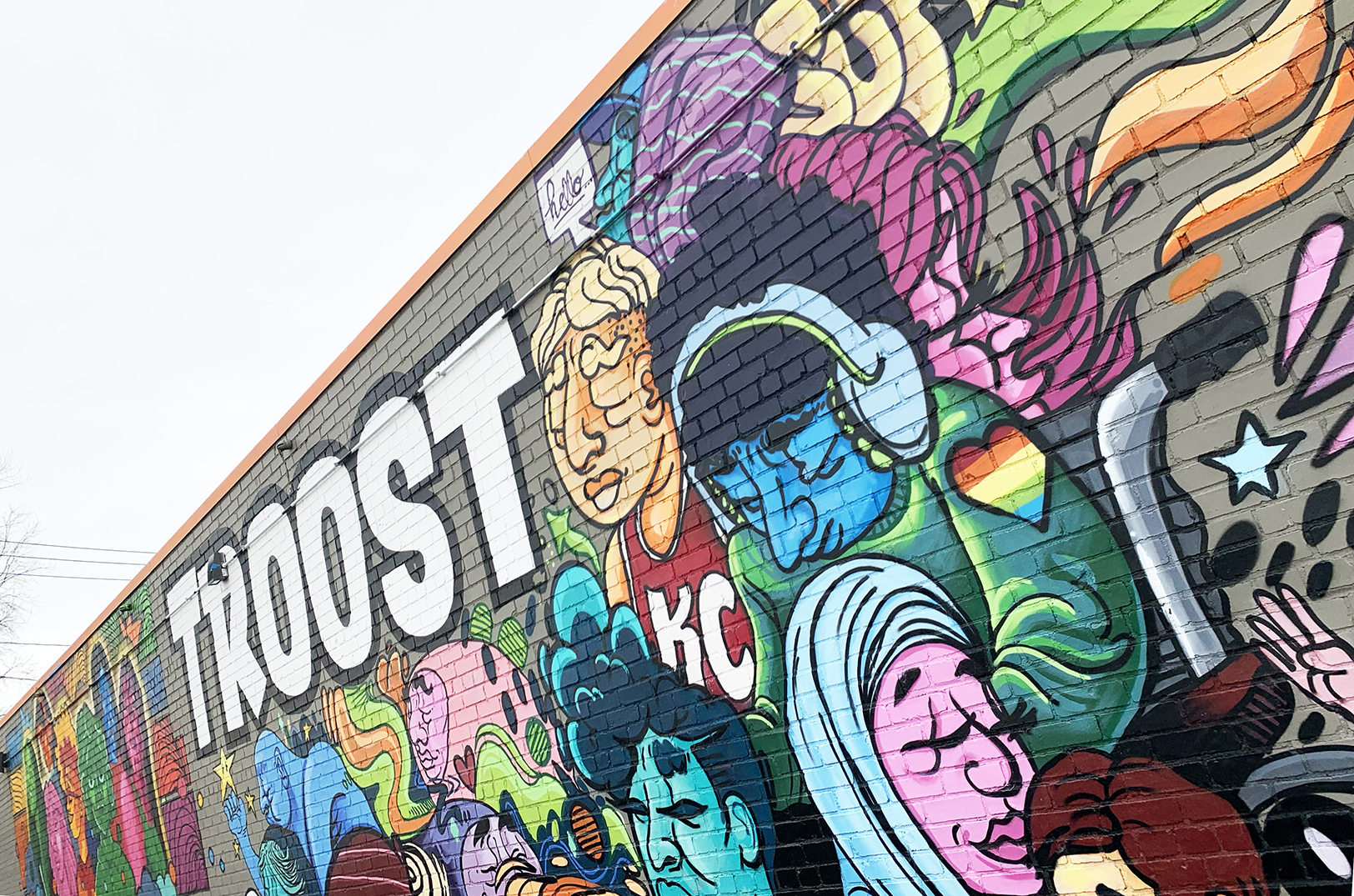
Led by KC Digital Drive and other community partners, the program aims to gather data on climate and pollution along the Troost Avenue corridor.
“The main thing with a project like this is you have to have good community engagement,” said Jim Starcev, solutions lab program manager for KC Digital Drive. “We’re really wanting to take and put these out in houses and involve people as citizen scientists.”
The Kansas City Beacon is co-hosting a community forum on April 30 with KC Digital Drive to discuss the project and explain how the sensors work and how to participate.
The program – funded through a grant from the National Science Foundation – officially kicked off about a year ago with a plan to deploy 50 low-cost air sensors in Kansas City to measure climate, temperature and particulate matter in the air. So far, about 20 air sensors have been placed in an area about 2 miles on either side of Troost Avenue. The group hopes to find homes for 30 more through the upcoming event.
Troost Avenue is frequently viewed as an economic and racial dividing line in the city – the result of past segregationist housing policies. Several sources of potential pollution also exist in the area, including U.S. Route 71 and industrial businesses.
Upcoming event: Community forum for air quality in KC’s historic east side
To learn more about Kansas City air quality issues and how you can get involved, please attend the community forum co-hosted by the Kansas City Beacon and KC Digital Drive.
When: 10 a.m. – noon on Saturday, April 30, 2022
Where: Kansas City Public Library: Lucile H. Bluford Branch, 3050 Prospect Ave.
Sign up: Click here to register for the free event
How do the air sensors work?
The sensors look similar to smoke detectors and are mounted on the outside of a home, between 6 and 20 feet off the ground.
Starcev said the devices use a light beam to measure the amount of particulate matter in the air. Air pollution can cause respiratory diseases such as asthma, as well as cardiovascular problems, cancer and other health concerns, according to several peer-reviewed scientific studies.
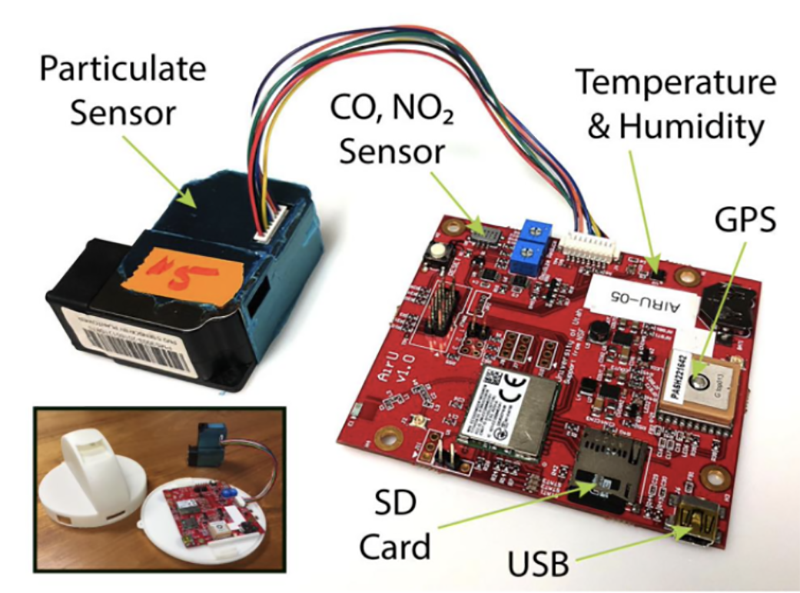
The different components inside the air sensors; photo courtesy of KC Digital Drive
Starcev said the team chose the Troost corridor because a wide range of factors can be studied in the neighborhood.
“If you look at some of the neighborhoods right around Troost, there’s some very wealthy neighborhoods, less wealthy neighborhoods, higher density areas vs. lower density areas,” Starcev said. “For us, it was just kind of fascinating.”
Starcev said some of the early air sensor volunteers live in communities that wanted to verify long-held suspicions that local pollutants were affecting their air quality.
“It’s definitely a kind of environmental justice,” Starcev said.
A map of the air sensors already deployed as well as some sensor data are available at www.kcdigitaldrive.org.
The project aims to empower residents to be more informed about how local air quality may affect their health, as well as aid officials in future policymaking decisions. Additionally, recent studies have shown that higher air pollution is strongly correlated to more COVID-19 deaths.
“If we have an area where we know the conditions exist for the potential to have high levels of pollution, maybe that’s where we need to invest in green infrastructure,” said Doug Norsby, an air quality planner with the Mid-America Regional Council. MARC is also a partner in the air sensor program, conducting data analysis from the results.
“It’s not just enough to put up the sensors and it’s not even enough to create a path to making change. It’s also about the education side of it,” Norsby said. “What is contributing to it? How can people – in the face of a situation that may not have an immediate solution for improvement –how does somebody take care of themselves?”
Why do we need sensors to measure Kansas City air quality?
Before this project, the only tools available to measure air particles in the area were highly sensitive air monitoring devices operated by the U.S. Environmental Protection Agency.
While those sensors produce higher-quality data than those being deployed through the community program, Norsby said the EPA machines have their downsides. He said one of the biggest differences is that the EPA sensors are significantly more expensive. What’s more, because only six are in operation in the area, their use has geographic limitations.
“There is a legitimate concern that there are micro locations where you have higher concentrations,” Norsby said. “What happens in that area as you move away from it is the concentration of particulates will get smaller and we can’t really capture that with a network of six extremely high-quality monitors.”
However, the two types of air sensors aren’t mutually exclusive. In fact, the low-cost sensors from the KC Digital Divide program are being used to enhance the EPA data.
At a high level, the plan places some of the low-cost devices near the EPA machines. Experts can then use data from the higher-quality sensors to account for some of the results in the low-cost ones, correcting for some variations. In practice, this dramatically expands the reach of the EPA devices to areas of the city that have never been able to be monitored on that level, Norsby said.
For example, if the EPA devices pick up high amounts of humidity on any given day, but that information wasn’t reported by the low-cost sensors, scientists can conclude that some of the results from the community machines may still have been affected. This allows them to adjust their findings accordingly.
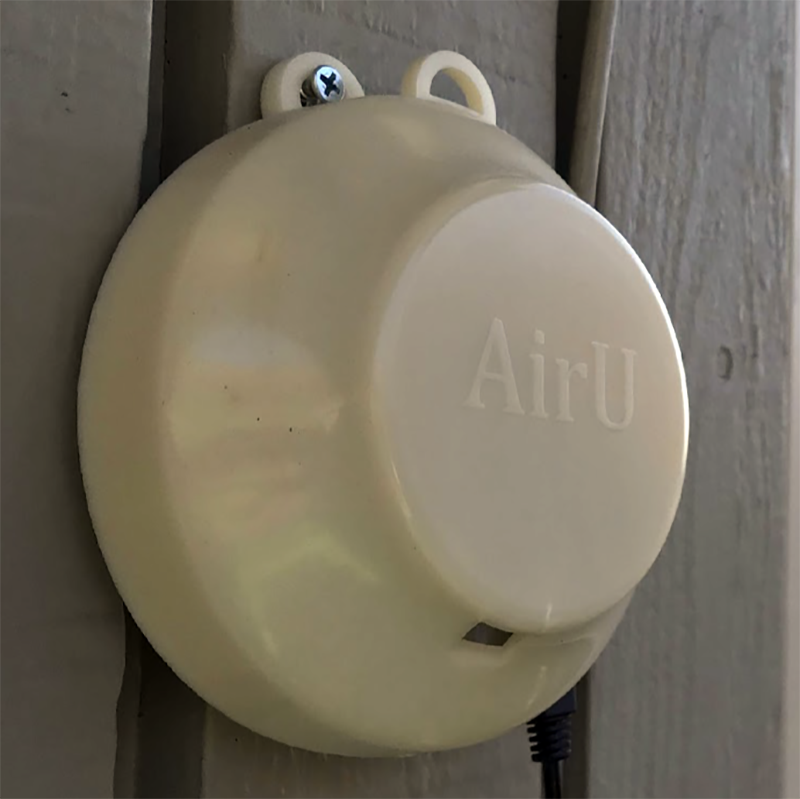
The sensors look similar to smoke detectors and are mounted on the outside of a home, between 6 and 20 feet off the ground; photo courtesy of KC Digital Drive
The more sensors that are deployed in the area, the stronger the network becomes, Norsby said.
“It’s filling in those gaps,” Norsby said. “You can have more confidence in what you’re seeing because you can compare what they’re registering with what is going on at the high-end monitors that are being maintained.”
How can I volunteer to host an air sensor?
So who is eligible to host one of the sensors on their properties? Starcev said the program is open to participants who live within a roughly 18-square-mile area around Troost Avenue. The official program boundaries are Front Street on the north, 85th Street to the south, Main Street to the west and U.S. Route 71 to the east. However, program managers are open to participants slightly outside that zone.
At each property, the sensor will need access to an electrical outlet and a Wi-Fi connection. Starcev estimated the cost of electricity would be less than 11 cents per month. Volunteers will set up the devices on their own Wi-Fi networks using an app downloaded to their smartphones. While data from the sensors will be uploaded to the internet, program staff will have no access to the participants’ Wi-Fi networks.
Starcev said the sensors function best in a location with moderate cover from the elements, such as under a porch overhang. This protects the sensors from heavy rain and other inclement weather.
The sensors can be located on residential or business properties. While the program is open to renters, they’ll need approval from the property owner. The lifespan of the sensors is about three to four years, and if possible, participants are asked to keep the devices for that duration.
If you are interested in learning more about participating in the program or about local air quality in general, you can sign up to attend the April 30 event here or go to this link to volunteer.


2022 Startups to Watch
stats here
Related Posts on Startland News
Effort hopes to rebuild eastern KC neighborhood by reviving jazz roots
Since the 1920s, jazz has built a reputation for Kansas City. About 90 years later, a local organization is hoping the power of jazz can rebuild Kansas City. Led by co-founders and spouses Daniel and Ebony Edwards, KC Jazz LP is working to establish Kansas City as the jazz recording capital of the world while…

After St. Joseph tech firm acquisition, Online Tech expands to KC
Ann Arbor-based Online Tech has acquired a St. Joseph, Mo. cloud firm, paving the way for its expansion into Kansas City. The cloud security company announced Thursday that it purchased St. Joseph-based Echo Cloud, which provides colocation and cloud hosting services. Echo Cloud CEO Bill Severn said he’s pleased to be joining the Online Tech…
Before and after: Tour progress at KC’s massive coworking campus, Westport Commons
Launched in 2015, Plexpod Westport Commons recently opened its doors after completing phase one of the project to revamp a middle school to become a coworking campus. Opened in April, the 160,000 square-foot, formerly vacant Westport Middle School has new life as a huge coworking space that will house more than 500 people and dozens…
Voting open: Hyperloop One gauges interest in semifinalist routes
If MLB All-Star voting is any indication, Kansas Citians are quite adept at voicing their opinions online. Well, that skill should come into play as part of an online poll that could help Kansas City land a Hyperloop One route. The futuristic transportation system would haul people at speeds of about 760 miles per hour,…