

Students hope to make KU the ‘premier blockchain university’; Here’s how startups can help
March 15, 2022 | Channa Steinmetz
Startland News’ Startup Road Trip series explores innovative and uncommon ideas finding success in rural America and Midwestern startup hubs outside the Kansas City metro. This series is possible thanks to the Ewing Marion Kauffman Foundation, which leads a collaborative, nationwide effort to identify and remove large and small barriers to new business creation.
LAWRENCE — Students needn’t attend an Ivy League university or work along the coasts to be successful in the blockchain startup ecosystem, said Rhett Phillips.
But they do need hands-on experience in the budding tech space, he continued, encouraging founders and innovators to consider KU students for initiatives tied to cryptocurrency and other blockchain offshoots.
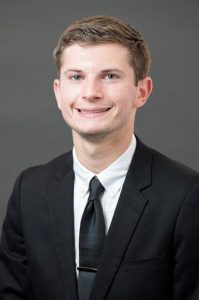
Rhett Phillips, KU Blockchain Institute
“Our primary goal [at the Kansas University Blockchain Institute] is to get students working on projects that could eventually turn into startups or translate into students getting full-time jobs in the startup space,” said Phillips, former president of the KU Blockchain Institute, now a senior studying mechanical engineering.
Since the student-run organization’s founding in 2018, the KU Blockchain Institute has progressed tremendously in both membership and influence, said Phillips, who joined the group as a freshman.
“Over the past year and a half, we’ve focused on growing membership and creating an environment where students can come to learn about blockchain. I was really wanting to create a close-knit group that could really collaborate and work together,” he said, noting that their membership fluctuates between 30 to 50 members.
Click here to read about how the KU Blockchain Institute formed.
Earlier this semester, the group launched the KU Blockchain Research Initiative — a program that provides students with blockchain learning opportunities, student and faculty mentorship, technical help, a platform to showcase their work and even funding if needed. It is through the research initiative that students can experience hands-on work, Phillips added.
“With the research initiative, we try to allow students to select something they’re interested in,” Phillips continued. “For example, if they’re really interested in finance, giving them a finance project would enable them to possibly work in [decentralized finance] projects or cryptocurrencies. … We’ve got a mix of projects that are currently in motion and then some in ideation stages.”
Click here for a background in blockchain and the definitions of basic cryptocurrency terminology.
As a fundraiser for the initiative, the students created a series of collectable KU Blockchain Institute NFTs to sell on OpenSea.
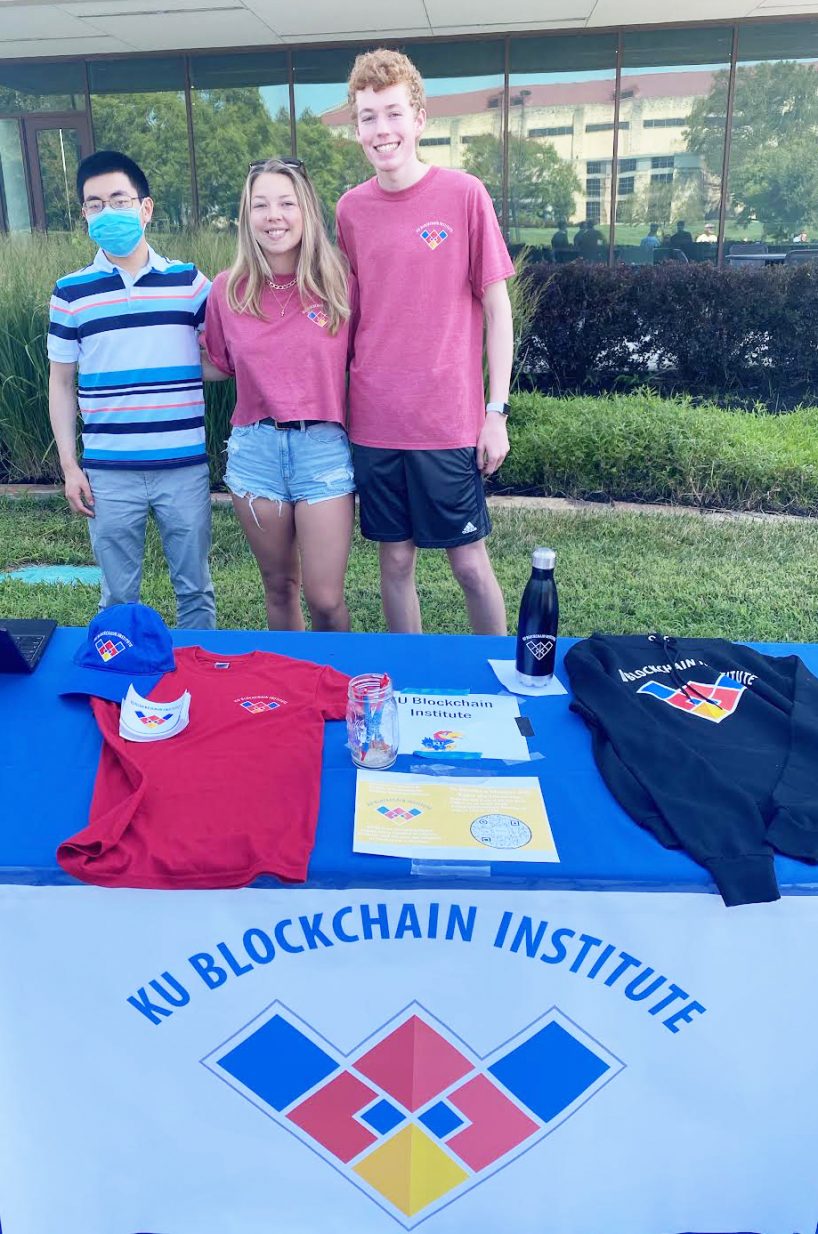
KU Blockchain Institute students
“That was something all student-led,” Phillips said. “We created all the ITs, did all the design work. We led a workshop with the students on how to create an NFT, how to put it on the blockchain and how to open up a hot wallet. It was a really good experience for students to see that whole process, and we ended up raising about $1,000 in 72 hours.”
Tapping into the KU alumni network, the group has played host to KU alumni who have since launched their own blockchain-related businesses, Phillips said. Alumni speakers have included: David Khalif, co-founder and head of operations at Viridi Funds, and Justin Schreiner, the co-founder of Clear Contracts.
“Speaking with our alumni has been really great because, A) they are important connections for our students; and B) it shows them there is a way, if you have ambition and drive, to get into this space, even from the heart of America in Kansas,” he shared.
To stay current on updates from the KU Blockchain Institute, individuals can sign up for the weekly “On the Chain” email newsletter, Phillips said.
“We would love to have companies, founders and community members interacting with us and involved with us,” Phillips said. “If anyone wants to reach out with possible projects for students to work on, or if there are high school students who want to be involved in this space, we’re more than happy to connect.”
Click here to sign up for the KU Blockchain Institute’s weekly newsletter.
The KU Blockchain Institute’s ongoing mission is to make the University of Kansas the premier blockchain university in the Midwest, Phillips shared.
“The general public doesn’t know all the great things going on at KU,” Phillips said. “And our team would like to change that.”

This story is possible thanks to support from the Ewing Marion Kauffman Foundation, a private, nonpartisan foundation that works together with communities in education and entrepreneurship to create uncommon solutions and empower people to shape their futures and be successful.
For more information, visit www.kauffman.org and connect at www.twitter.com/kauffmanfdn and www.facebook.com/kauffmanfdn


2022 Startups to Watch
stats here
Related Posts on Startland News
MTC’s spring $1.4M investment cycle loops Facility Ally, DevStride into equity deals
Two Kansas City startups are among a handful of Missouri companies receiving a collective $1.4 million in investment allocations through a state-sponsored venture capital program. Facility Ally, led by serial entrepreneur Luke Wade; and DevStride, co-founded by Phil Reynolds, Chastin Reynolds, Aaron Saloff and Kujtim Hoxha; must now complete the Missouri Technology Corporation’s due diligence process…
Kauffman CEO: Foundation’s reset aligns Mr. K’s intent with KC’s needs of the moment
A recently announced strategy refresh for the Ewing Marion Kauffman Foundation will drive the organization’s collective impact in the community — honoring the vision of its namesake while recognizing the challenges Kansas City faces today, said Dr. DeAngela Burns-Wallace. “Mr. K had very distinct philosophies and ideas around how he wanted this work done,” explained…
Block by block: Prototype builds startup’s housing vision where everyone can afford their own castle
A mock home facade project on the grounds of Kansas City’s historic Workhouse Castle serves as a proof point for Godfrey Riddle’s rebooted Civic Saint — a social venture built on compressed earth blocks as its key to affordable, sustainable housing. “CEBs (compressed earth blocks) are great for Kansas City, because non-expansive sandy clay soil…

Resource revival: Digital Inclusion Fund relaunches with initial grants focused on devices
Kansas Citians can’t upgrade skills or devices they don’t already have, said organizers of a newly relaunched Digital Inclusion Fund — emphasizing a need to attack the metro’s digital divide at the infrastructure level. The fund is set to award up to $250,000 to 501(c)(3) public charities (including schools and churches) or governmental entities across…