

Deploying tech to today’s American warfighter: FirePoint taps startup space to help modernize military
February 26, 2022 | Austin Barnes

Startland News’ Startup Road Trip series explores innovative and uncommon ideas finding success in rural America and Midwestern startup hubs outside the Kansas City metro. This series is possible thanks to the Ewing Marion Kauffman Foundation, which leads a collaborative, nationwide effort to identify and remove large and small barriers to new business creation.
[divide]
Modern challenges of the U.S. Army are being solved on the campus of Wichita State University where the principles of innovation and collaboration have been enlisted to accelerate the military branch’s efforts.
“I think of us as a force multiplier for the Army and their technology development and its integration,” explained Steve Cyrus, executive director of FirePoint Innovations Center at WSU — an effort launched in 2017 between the university and the U.S. Army’s Combat Capabilities Development Command, Aviation and Missile Center (DEVCOM AvMC).
The program is intended to accelerate joint technology development, transfer, and commercialization between DEVCOM, universities, industries, and government organizations. It was inspired by The Bayh-Dole Act of 1980 — introduced by U.S. Sens. Bob Dole, R-Kansas, and Birch Bayh, D-Indiana.
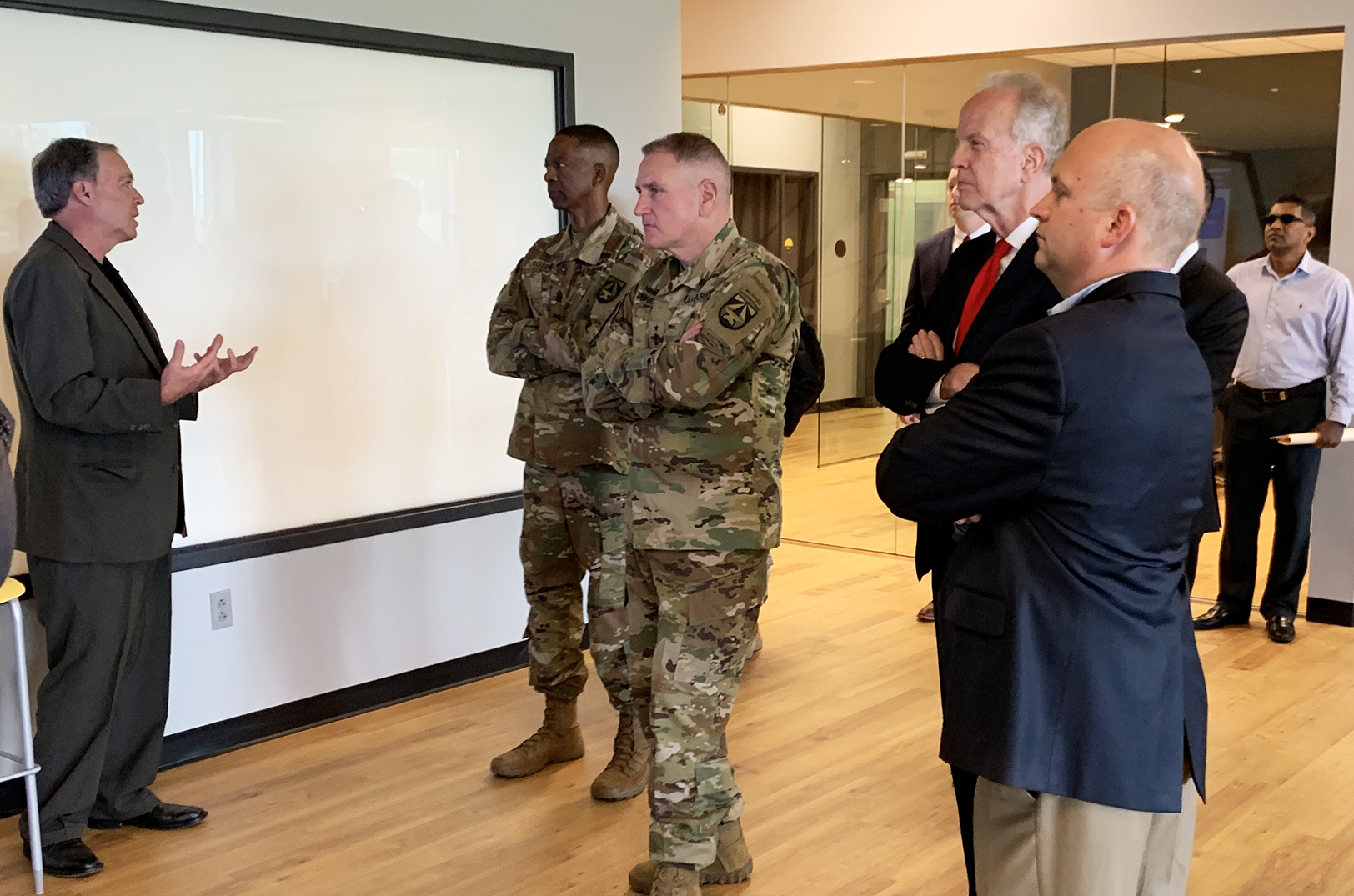
Pete Perna, director of business development at FirePoint, Command Sergeant Major Crosby, General Murray, U.S. Sen. Jerry Moran, and John Tomblin, senior vice president for Industry and Defense Programs at Wichita State University
“[The Bayh-Dole act] is [focused on] technology transfer. They realized that there was a lot of development that was taking place within the Department of Defense (DOD) — specifically within their labs, that could be of benefit to businesses and to the commercial sector,” Cyrus said, detailing the makings of a partnership intermediary agreement and how it functions.
When the AvMC issued a broad agency announcement (BAA) proposal in 2017, WSU saw an opportunity to invest in FirePoint, standing it up and beating stiff competition across the country to secure its support, he recalled.
“We’re looking at Army technology and pushing it out — but then, also, we’re looking at what’s happening in the startup space and in the commercial sector and seeing what we can press into the aviation and missile center and on their mission to give technology and get technology to the warfighter,” Cyrus said.
From students to startups, the program’s impact on workforce development has been widespread, he added, pointing out that WSU spends tens of millions of dollars each year paying wages to students working within its industry and defense programs — which includes FirePoint — helping to realize ideas that directly impact the Army’s ability to fulfill its six modernization priorities.
Army focus-areas include the modernization of combat vehicles, air-and-missile defense, soldier lethality, long-range precision fire, vertical lift, and networks.
Click here to learn more about FirePoint and the key cross-functional team priorities it supports.

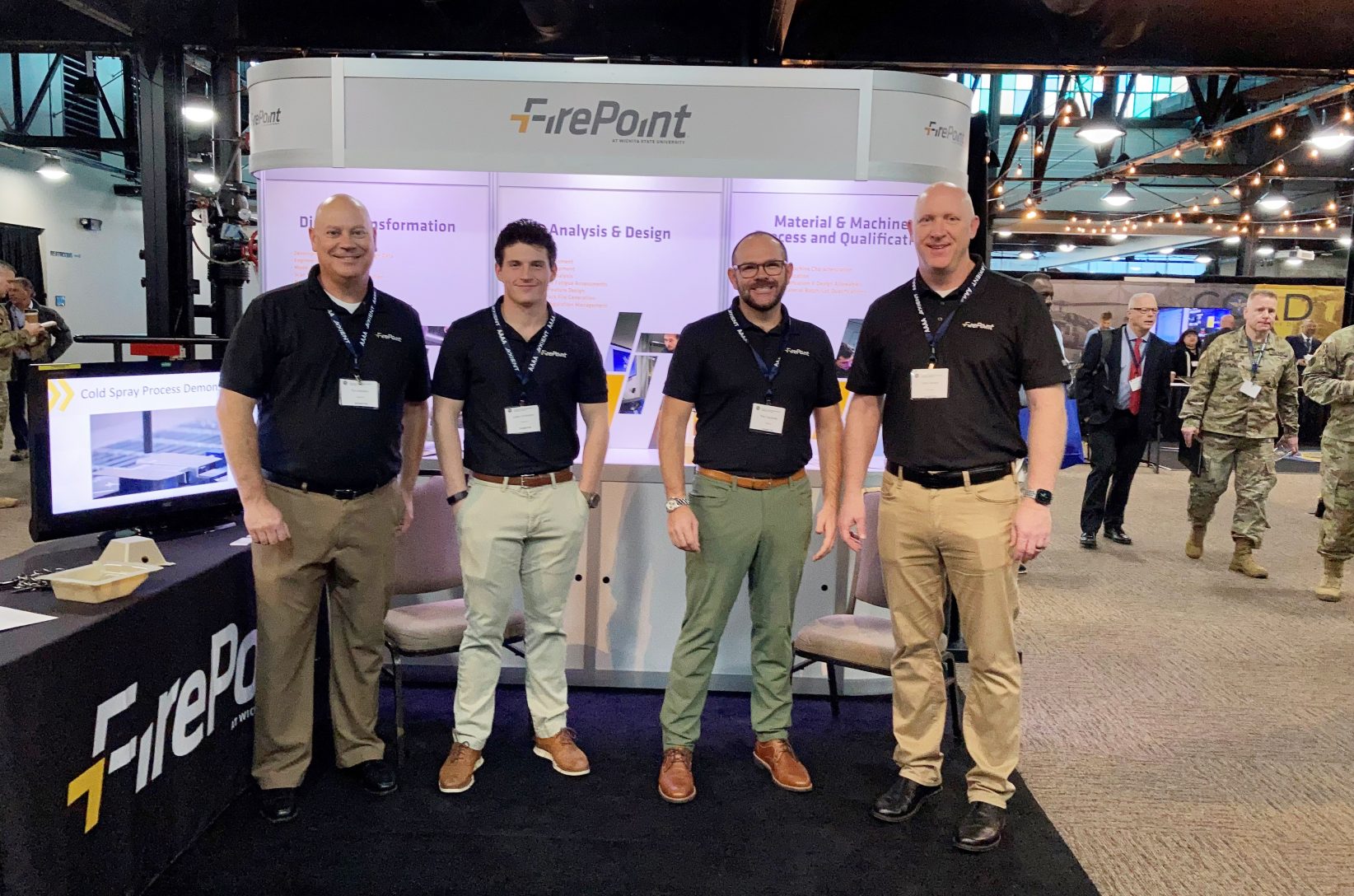
Understanding FirePoint
“Working closely with non-traditional and traditional partners alike, FirePoint brings the best expertise, technology and capabilities from industry, academia and government to help the Army accelerate the development and delivery of new capabilities to the warfighter.”
“Our core efforts focus on identifying, aligning and exploiting applied research and development to enable the Army of the Future to be ready to deploy, fight and win decisively against any adversary on the multi-domain battlespace.”

Wichita State University student analysts
Working specifically to tackle half of the Army’s outlined goals in partnership with the AvMC and its expertise, FirePoint plays a small role in shaping its future, admitted Cyrus. But that doesn’t reduce the size of the program’s impact — and its ability to engage with startups and startup talent could prove invaluable for the military branch.
“The Army sees us as a partner — not as a contractor [or] vendor,” he explained.
[pullquote]
FirePoint’s mission: “With a focus on innovation, we apply our engineering and business skills to understand urgent Army customer needs and requirements, and integrate crucial expertise and technology to create successful outcomes for the warfighter.”
[/pullquote]
“A group like FirePoint that’s made up of folks who came [from] an original equipment manufacturer (OEM) world allows us to take that skill set and give a different kind of answer to some of the technology problems that the Army might have.”
“What we’re usually trying to do is get people in front of people with great technology [and] in front of folks that could actually go and purchase that [technology.]”
While the program doesn’t offer funding or other staple resources of entrepreneurship support efforts, its ability to “play matchmaker” and connect founders with the Army has proven to create a steady pipeline that can prepare startups for landing course-changing contracts with the DoD.
FirePoint hopes to further build out its startup engagement efforts in the year ahead, Cyrus said.
“As the Army continues on this modernization path there will be a lot of growth in the technology space. From a FirePoint perspective, I’m excited to see where all of this goes and how it grows and the ecosystem that we’re able to develop here in Kansas,” he said.
“I think as we grow in that direction there will be a lot of interesting things that happen. There’s a lot of growth in the future that we’re looking forward to.”
[divide]

This story is possible thanks to support from the Ewing Marion Kauffman Foundation, a private, nonpartisan foundation that works together with communities in education and entrepreneurship to create uncommon solutions and empower people to shape their futures and be successful.
For more information, visit www.kauffman.org and connect at www.twitter.com/kauffmanfdn and www.facebook.com/kauffmanfdn

Featured Business

2022 Startups to Watch
stats here
Related Posts on Startland News

Entrepreneur of the Year honorees stepped through a wormhole of fate: Here’s what they found in KC
The ultra successful all share one common influence, said Peter Mallouk: luck. And for the president and CEO of Creative Planning, good fortune has revolved around Kansas City. It all started when his parents left Egypt and ended up in Brookside, he told a crowd Wednesday evening during the 39th University of Missouri-Kansas City Entrepreneur…

How UMKC’s top student entrepreneur found shelter (and a path forward) as a founder
Shapree Marshall’s path began with shared struggle, re-routed to survival — and ultimately made a stop Wednesday evening at H&R Block’s World Headquarters where the startup founder was honored as UMKC’s 2025 Student Entrepreneur of the Year. “My journey into entrepreneurship did not begin with a business plan or a class project,” said Marshall, founder…

First look: Made in KC’s new Union Station shop boasts all the trimmings (and World Cup timing)
An influx of holiday shoppers is just the start for Made in KC’s newly-opened store inside Union Station — positioned to take advantage of coming FIFA World Cup traveler traffic — years after the local-first retailer’s owners first envisioned making the quintessential Kansas City destination a home for one of their shops. “We’ve been wanting…

KC Tech Council reboots its visual identity, teases plans to open new downtown HQ
It’ll be new year, new look for KC Tech Council as the regional tech advocate relocates to a collaborative headquarters space in downtown Kansas City, as well as embracing a bold brand update — all coded to better reflect a modern, tech-driven ecosystem. “As KCTC powers initiatives that further establish Kansas City as a premier,…