

Hey, where’s that snowplow? Kansas City adopts a new tech for guiding more than 100 trucks
January 6, 2022 | Emily Wolf
Editor’s note: The following story was originally published by The Kansas City Beacon, a non-profit online news outlet focused on in-depth journalism in the public interest, and a fellow member of the KC Media Collective. Click here to read the original story or here to sign up for the twice-weekly Kansas City Beacon email newsletter.
With winter in Kansas City, Missouri, comes snow. And with snow comes the full force of the KC snowplow crew. Responsible for clearing hundreds of routes each day, drivers have for years been forced to rely on old-fashioned maps to guide them.
“I rode with a driver last season and he literally had a paper map spread across the dashboard,” said Maggie Green, public information officer for the city. “And he was like ‘All right, Maggie, take the pen and mark off where we’ve been down.’”
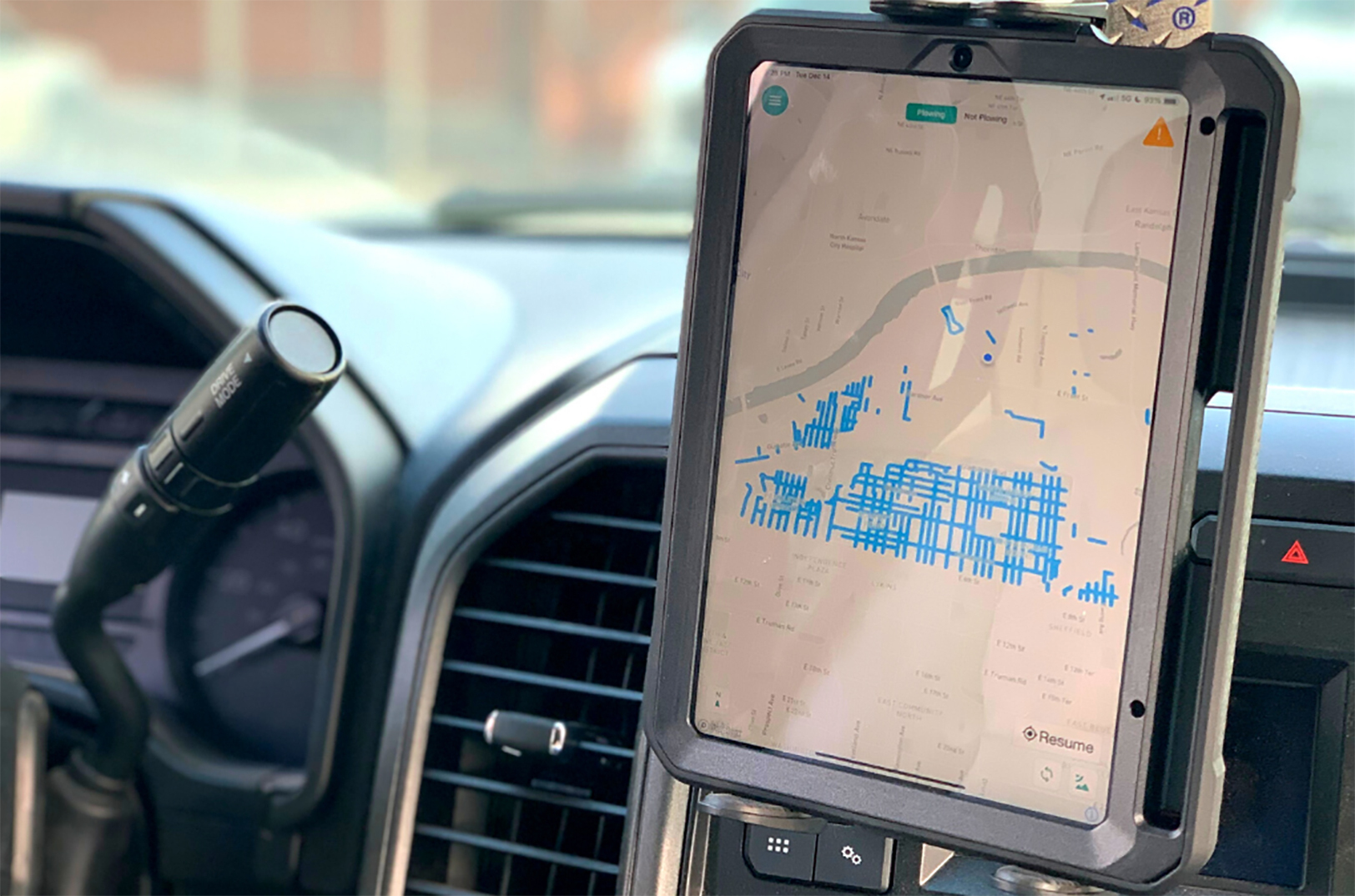
This year, drivers will have a new tool to help them clear the streets: digital maps that update as they drive. More than 100 trucks will be outfitted with an electronic tablet, which will display whichever route the driver inputs and track their progress using location data.
The technology is primarily designed to help drivers identify which routes they’ve already plowed, and where on their route they need to go next.
“When you get in that vehicle and you run over those routes, the GPS tells you where you’re at and when you’re on the street, it will change to a different color,” said Eric Falk, a senior registered engineer with the Public Works Department. Streets that haven’t been driven on yet will be marked blue; streets that a plow has already gone through will be marked purple.
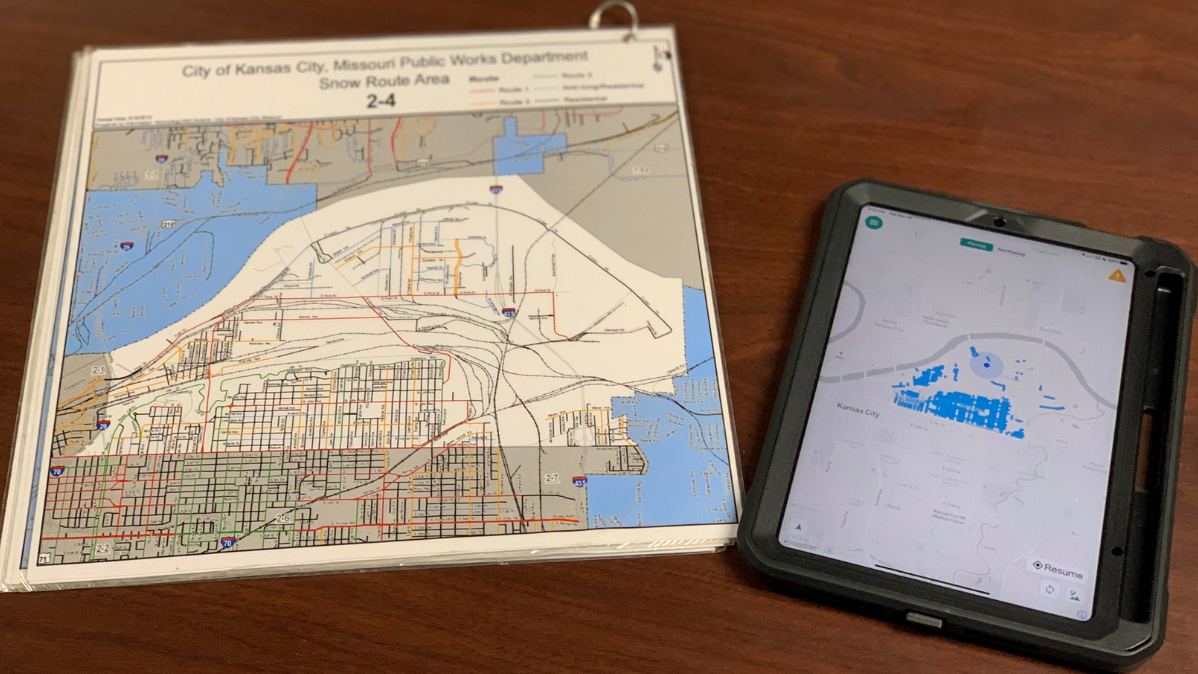
A traditional map lies beside the new technology snowplow drivers will be using to guide their routes. (Emily Wolf/The Beacon)
This is the city’s first year using the technology, but officials said residents shouldn’t notice much of a difference in service.
“This is functioning pretty darn well,” Falk said. “I’m sure with any technology we’ll have some issues. But for the most part, hopefully, drivers will see the difference in the colors and they’ll be like, ‘Oh, look, I didn’t get there.’ And that will hopefully reduce the number of missed spots.”
For the initial rollout, the Public Works Department is prioritizing drivers who clear residential snow routes. Green said Kansas City has about 3,300 miles of those. Arterial routes are handled by larger plows and span 2,700 miles.
“When you’re up in different parts of the city it gets rather confusing when you get turned around,” Falk said. “I’ve been out there plenty of times, like, ‘What the heck?’”
Working on future improvements to KC snowplow tech
Earlier this year, the Public Works Department committed to staying in a neighborhood and making multiple passes through its streets to get them fully cleared. While useful for residents, this more comprehensive approach creates a new wrinkle for the digital technology.
Falk said department staff are working with the technology company to develop a solution. It may involve developing multiple color codes in addition to the current blue and purple framework. The city already uses a color-coded system to inform residents how recently a road was plowed.
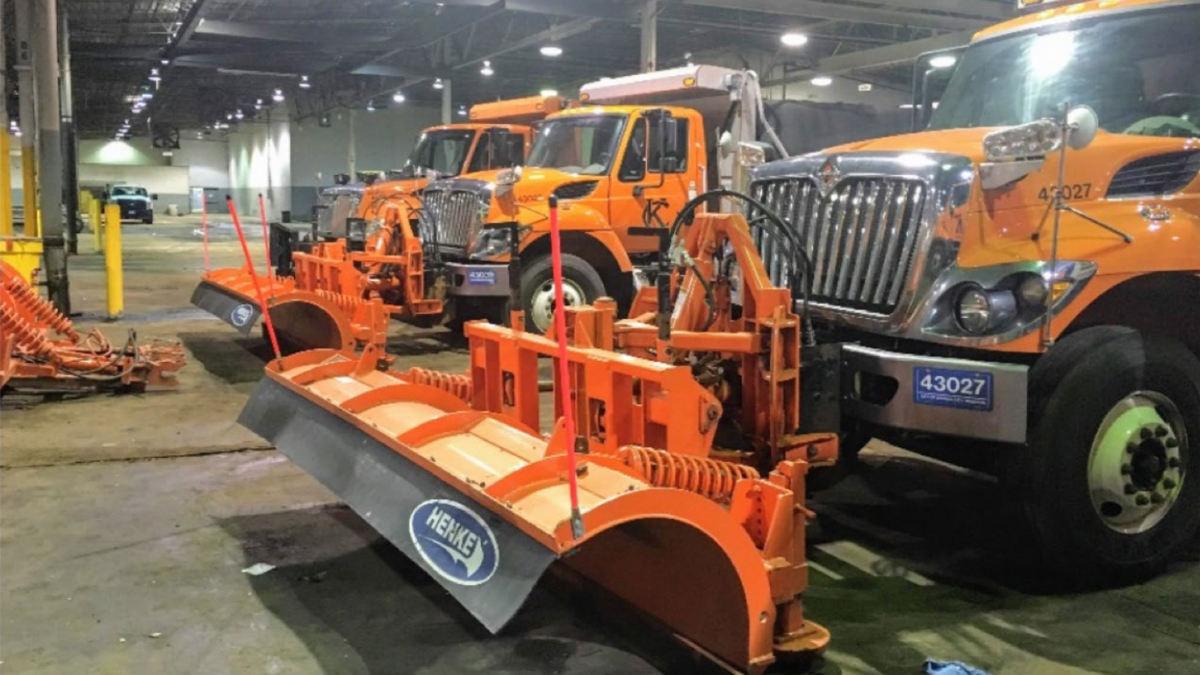
A few Kansas City snowplows sit ready for action in case of inclement weather. (City of Kansas City, Missouri, Public Works Department)
Falk said the city would eventually like to use the technology to generate turn-by-turn directions for drivers on their routes. Right now it is able to guide drivers from point A to B, but sometimes erroneously directs drivers to streets they’ve already been over.
“I don’t think anybody really has done navigation, turn by turn navigation like this,” Falk said.
The department is hopeful the navigational capabilities will be ready to use sometime this season.
“This will be a multiyear process, to hopefully get the technology better and better,” Falk said.
Emily Wolf is a local government accountability reporter with a focus on telling meaningful stories through data at The Kansas City Beacon. She is a Report for America corps member.

This story is possible thanks to support from the Ewing Marion Kauffman Foundation, a private, nonpartisan foundation that works together with communities in education and entrepreneurship to create uncommon solutions and empower people to shape their futures and be successful.
For more information, visit www.kauffman.org and connect at www.twitter.com/kauffmanfdn and www.facebook.com/kauffmanfdn


2022 Startups to Watch
stats here
Related Posts on Startland News

Closing KCK’s Black-owned coffee shop opens opportunity for Kinship to brew bigger, owner says
When TJ Roberts posted on social media about closing Kinship Cafe, a Black-owned coffee shop in Kansas City’s Strawberry Hill neighborhood, he was surprised by the outpouring of support — a morale boost that not only gives him the spirit to keep fighting for the business, but expand it, he said. “When we posted about…

Kansas brothers launch speedy trial for app that eases reentry for the wrongfully incarcerated
Podcast host-turned-innovator Dylan Carnahan is a man built for talking, he said, but there’s a time when words aren’t enough — when action is needed in the face of injustice. For Carnahan and his brother, that moment is now. “While media spreads awareness, software facilitates action,” said Carnahan, teasing the tech he’s developing alongside Alex…
Restaurant’s nostalgia is only part of it’s recipe: How Paul’s Drive In sizzled a community staple by ‘doing good first’
Editor’s note: The following story was written and first published by the Economic Development Corporation of Kansas City, Missouri (EDCKC). Click here to read the original story. In the heart of South Kansas City, Paul’s Drive In on Blue Ridge Blvd has been a cherished staple since the 1960s. Through ups and downs — including…

Meet six coalitions earning grants through Kauffman Foundation’s new ‘Collective Impact’ funding pathway
Systemic change happens when communities come together to drive transformation through collaboration, said Dr. DeAngela Burns-Wallace, announcing a half-dozen grants to high-capacity organizations with strategies to close economic mobility gaps in the Kansas City region. The “Collective Impact” planning grants of up to $500,000 are awarded to the winning coalitions are the first piece of…