

Why underserved founders shouldn’t patiently ‘wait their turn’; Pipeline Pathfinder applications close Nov. 9
November 4, 2021 | Tommy Felts

Editor’s note: Pipeline is a financial supporter of Startland News. Pipeline’s new Pathfinder program is accepting applications through Nov. 9. Click here to apply.
[divide]
Proof points long used to indicate a startup’s readiness to scale or raise capital favor white, male-led companies, said Melissa Vincent, stressing traditional markers like even a founder’s ability to dedicate full-time attention to their startup.

“There’s not an even playing field — not even to get into Pipeline,” said Vincent, executive director of Pipeline, an elite network of entrepreneurs founded in 2006. “And that’s where we have the opportunity to build a pathway to greater access — removing barriers for female, minority or rural entrepreneurs who are looking at our programming.”
Pipeline announced in September its new “Pathfinder” program for entrepreneurs who might not yet meet eligibility criteria for its traditional fellowship. The industry agnostic initiative specifically targets underserved entrepreneurs leading scalable companies, but who have not yet made the leap to full-time founder.
Click here to learn more about the Pipeline Pathfinder program or to apply. Applications have been extended to Nov. 9.
“I’m not comfortable sitting back and just saying, ‘You know what? You’re not ready. Come back later when you’re appropriate for Pipeline,’” Vincent said.
“The theory behind Pipeline was to have a massive impact on the region’s economy by bringing in really amazing resources for Midwest startups from the coasts and by focusing on the serial, high-growth entrepreneurs,” she continued. “Based on all of the data we’ve collected over the past 14 years, that’s absolutely true. 100 percent. But that’s just the first chapter of Pipeline and what it can be.”
Pipeline’s traditional program serves entrepreneurs who are working on their companies full-time and are typically making $500,000 to a million dollars in revenue by the time they make it to the fellowship, Vincent detailed.
“We’re helping them scale to try to get to an exit,” she said, noting the application windows for Pipeline’s traditional fellowship and new Pathfinder program have been running concurrently this fall.
“But when we were going through the recruiting process in 2020, we realized there’s another entrepreneur out there — one who isn’t a high-growth, serial entrepreneur yet; one who isn’t even able to work on their company full time,” Vincent continued. “And when we looked closer, they had some really amazing ideas and companies. They were just really early. And the other pattern we recognized: they were most frequently underserved entrepreneurs. We said, ‘This is exactly who we want to invest in.’”
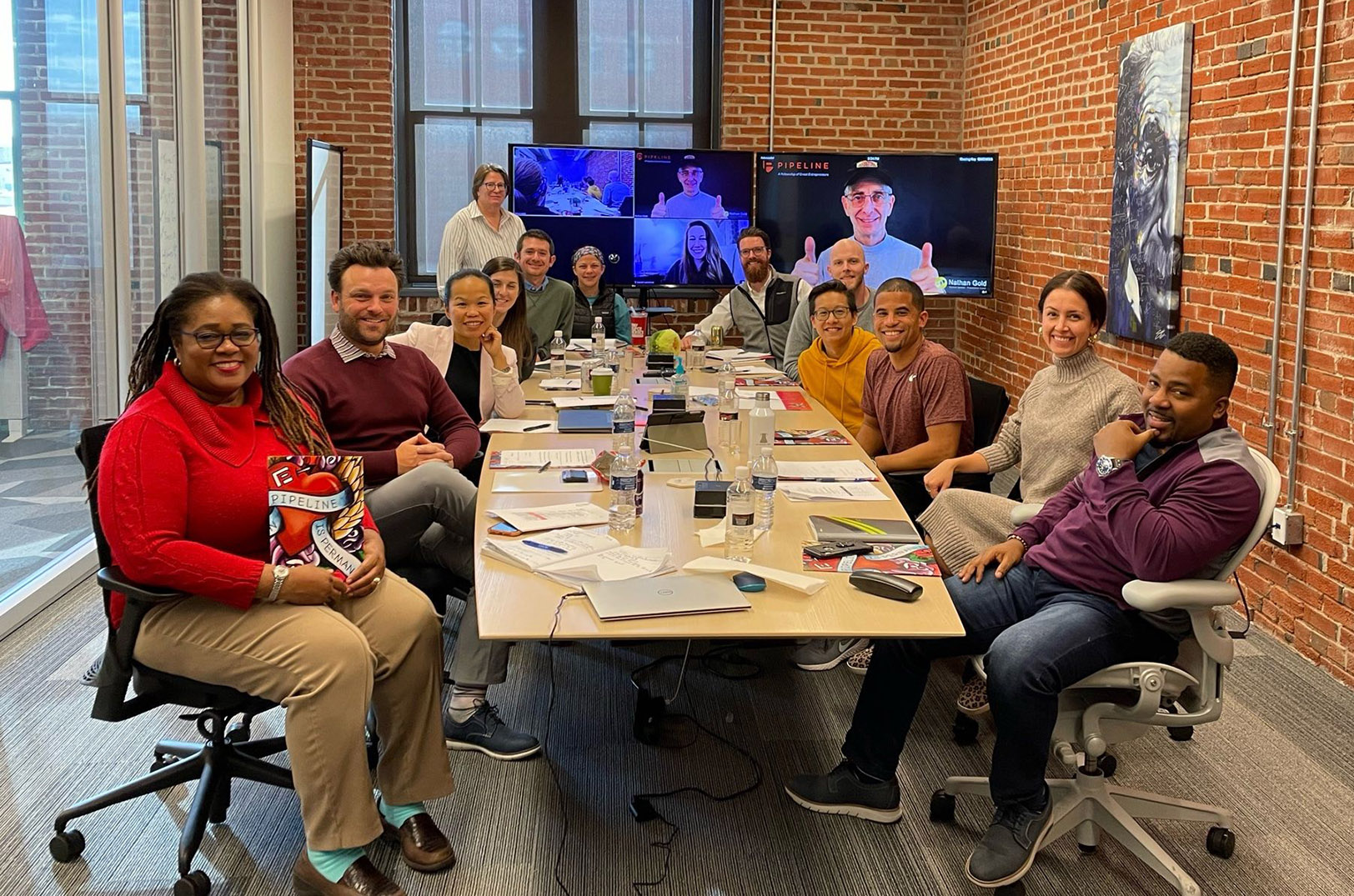
2021 Pipeline fellows during the program’s recent St. Louis module
Pipeline Pathfinder (expected to debut its first crop of founders in 2022) is set to cover similar topics as the Pipeline fellowship — which already has made strides toward greater diversity under Vincent’s leadership — like market validation, business models, financials, and communication.
“We want to take the same quality of resources and apply them at an earlier stage, so we can see an earlier impact,” Vincent said. “We’re kind of extending the continuum of care for entrepreneurs. It’s really just an evolution of what we’ve proven to be successful in our programming for more than 14 years.”
Pipeline’s hope for those completing Pathfinder: the ability to run their companies full-time and an entry point into the traditional Pipeline fellowship and its network of members and mentors.
“When you’re a member of Pipeline, it creates a portal for people to give back,” Vincent said, emphasizing the importance and impact of adding more diversity to such a portal.
With Pathfinder, Pipeline enters a space in the Kansas City startup ecosystem somewhere between resource providers like The Porter House KC and Entrepreneur Business Basics — who already are providing amazing impact for many women- and minority-led small businesses, Vincent said — and startup-focused organizations like Digital Sandbox KC and Techstars Kansas City.
“You have all these organizations that are like pieces of a puzzle. When an ecosystem really gets built is when those individual puzzle pieces come together, inclusively, and — instead of claiming ‘We serve all entrepreneurs’ — say ‘How can we help each other? What can we do together to help create more opportunities for everyone across the entire spectrum?’” she said. “And that’s an area of collaboration where I think Kansas City is already so far ahead.”
Vincent is eager to challenge assumptions and break norms with Pathfinder, she said.
“It’s easy to have a skewed view on what ‘works.’ If a certain demographic is more easily able to raise capital, obviously you’re going to see more of them having big outcomes, the hockey stick growth we’re always talking about,” Vincent said. “But if you apply those same resources to underserved communities, we’re going to see a shift in who can accomplish that growth, and ultimately the kind of capital and exits that follow.”
Showing such a transition over time would prove “anybody can do it,” she emphasized.
“Pipeline has historically been very white male dominated,” Vincent said. “But if we can show there’s another pathway — and we can stay committed to it — we’re going to be having a very different conversation in two years when our data beautifully backs up this theory, this impact.”
“We’re all going to be saying what Pipeline is saying now: ‘Look what these entrepreneurs are capable of. Give them resources and access to capital. That’s all they’re lacking,’” she said. “It’s not quality of ideas. It’s not quality of founders. It’s literally access to resources.”
Click here to apply for Pipeline’s Pathfinder program or the traditional fellowship.

Featured Business

2021 Startups to Watch
stats here
Related Posts on Startland News

Security firm Nodal nabs $100K, ramps up hiring
Good news is stacking up for Kansas City-based Nodal Industries. The security hardware tech company recently snagged $100,000 in seed funding as part of an opportunity to participate in the 500 Startup accelerator program, based in Mountain View, Calif. The funding will allow Nodal to hire up to eight people, as well as ramp up production…
Play-It Health lands in top-ranked digital health accelerator
As with many successful startups, the idea for Play-It Health was born out of personal experience with an unsolved industry need. Kim Gandy, a former clinician and now the founder and CEO of Play-It Health, recognized that patients were having trouble engaging and adhering to their medical regimen. In the worst cases, this led to…
LaunchKC, Techweek to welcome 10 tech firms to KC in style
In roughly four months, Kansas City will welcome a crop of tech startups bolstered by thousands of dollars in funding and a rockstar arrival. Kansas City’s LaunchKC competition — which aims to attract 10 tech firms to relocate to KC with $50,000 grants — has partnered with national tech conference Techweek to offer the winners…

New platform GUILDit offers art entrepreneurs visibility
A new program called GUILDit to promote and support art entrepreneurship is coming to Kansas City. The program is a bi-monthly gathering where art entrepreneurs take the stage to give six-minute presentations followed by questions and answers in the hopes of crafting a stronger Kansas City art economy, and to further connections between local artists.…