

Retaking the ‘entrepreneur’ label: ‘You need to have a good product, but ultimately it needs to be about more’
November 15, 2021 | Elizabeth MacBride and Seth Levine

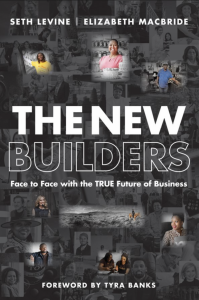
In “The New Builders,” written by Times of Entrepreneurship founder Elizabeth MacBride and venture capitalist Seth Levine, the authors look at the landscape of entrepreneurship across America. In this excerpt — from Chapter 3: The Definition Of Success — the authors focus on Isaac Collins, a Kansas City entrepreneur who also faces and fights added obstacles for People of Color.
When Isaac Collins looked at the kids gathered in the elementary school library, he saw himself.
“I grew up a couple of miles away from here,” he said. “These kids are me.”
The elementary school, the Academy For Integrated Arts is the school, “wasn’t in the best part of town.” he said. But the hallways were decorated with art, and he was heartened by the stories he was hearing. Of progress, of hope. A number of the students had made breakthroughs, especially through an innovative yoga program — one that Isaac helped found and fund — that was brought to the school. Instead of acting out in class, they were learning to calm themselves by taking a break for a few yoga poses. While it may be counterintuitive to think of groups of elementary kids breaking out into yoga for a quick break, the program was working. On field trips, the boys in particular liked to show off their poses. The tougher ones, of course, like the chair pose.
Most of the kids were minorities: African-American and Hispanic. All the kids had name tags, and the mats fanned out in a circle rather than in rows. Isaac and the teachers who work for the nonprofit planned it that way — they didn’t want anything about the classes taught to pre-K through sixth graders to be sexualized. The central idea was to teach the kids a way to regulate their emotions and a positive way to play.

Isaac Collins, Superhero Yoga
A successful restaurateur, Isaac had started the Superhero Yoga nonprofit on the side with two friends, Janis King and Laurie Bomba. The nonprofit brought half-hour yoga classes to schools in poor neighborhoods. And he loved it — he meditated and practiced yoga himself. But he still struggled with what to tell the kids sometimes when he had opportunities to speak with them.
He didn’t like all the talk about saving people — especially saving Black people. In his mind it wasn’t about that. It was about liberating people from a fundamentally wrong system. He needed the kids to focus on accessing the resources they needed to succeed. He tried to inspire them to do that by telling his own story, as the son of two felons and who was now a successful businessman and community leader — the owner of three Yogurtini stores in the city (and with a fourth in the works, despite the pandemic).
“Black people need to know that there’s more than what they see around them,” he said. “The narrative around the United States is that people of color can’t get money, can’t find success. It makes it hard for people to want to try.”
Isaac has also represented his community by joining the Black Lives Matter protests, speaking out about his decision to the local media.
“We’re angry but deeper than that — we’re scared,” he told a reporter who visited his Yogurtini shop on Main Street south of the Plaza. “This is not a game to us. It’s not a joke. It’s spirit-crushing.”
Isaac embraced his role as a community leader. When he looked out at that room full of kids at Superhero Yoga, he knew what a lot of them were living with at home because he had lived with it, too. His parents were hustlers. “Scrappy as hell,” as he described it. But for them, part of being scrappy was to sell drugs to make ends meet. Both eventually turned their lives around after Isaac was born. Isaac’s’s father became the second Black prison warden in Missouri, and the first without a college degree. His mother became a nurse.
Often, the message Isaac preached to kids was about taking themselves seriously. He’d done just that — writing a business plan at Missouri Western University, where he attended college, and in so doing, winning a chance in 2012 to buy a Rocky Mountain Chocolate Factory store in partnership with Steve Craig. Craig had a real estate business, owning at one point 13 outlet centers in seven states, and had become a huge donor to Missouri Western. One of the projects he settled on was helping business students at the school that bears his name become their own bosses.
With the help of Craig, Isaac bought the store for $104,000, paid off the debt, and sold it for $300,000. He used the money to get Yogurtini franchises started in Kansas City. He now employs 36 people across his businesses.


Isaac is a role model, a leader, and a successful businessman. Moreover, he loves what he does, creating a place where people gather, where they’re served well, and where children delight in putting one of 65 toppings on their Yogurt. For kids, these are gummi worm, maraschino cherry, marshmallow bowls of heaven. He runs a “Books for Yo” program, so kids get free yogurt for reading.
His work brings him a significant amount of joy. But there are headaches, too: bookkeeping and management, cash flow, and the seasonal ups and downs of running a business whose product is more popular during the summer months. But the good days far outnumber the bad ones, he tells us.
“The key to my business is the key to every business. You need to have a good product, but ultimately it needs to be about more. So we are hyper-local in the area of each store. We invest in the community. We have a big emphasis on customer service, on keeping the stores clean, on providing friendly service like opening the door for our customers. We welcome them and treat them like we appreciate them.”
Entrepreneurs like Isaac dream big. Big dreams don’t necessarily mean size and scale, although Isaac certainly has growth in his sights. But impact is as important to entrepreneurs like Isaac: their role in their communities and their ability to impact the lives of others around them. New Builders dream of an idea, passion, or cause and then set out to create a business that reflects this ambition. Often, the role they will play in their community is an integral part of their dream.

Isaac Collins, Yogurtini; Photo by Scott Suchman
 Businesses like Isaac’s aren’t sexy but they are found in the sectors of the economy that employ people at far greater rates than the high-flying companies of Silicon Valley fame. In many technology businesses, profitability is the result of how few people they employ relative to their size. For example, Facebook employed just 17,000 people to serve 2 billion users in 2017, compared to the New York Times, which despite job cuts, employed 3,500 to serve 2.3 million digital subscribers that year. One of the reasons high-tech businesses can “scale” is because they don’t have many employees in their business models.
Not so with the service sector of our economy. Companies like Isaac’s are the absolute bulwark of our economy, creating two-thirds of new jobs and responsible for about 45 percent of the U,S. GDP. And yet, they are the last place that policymakers look to for economic growth — and increasingly, dreams like Isaac’s are getting crowded out by the high-tech story.
To understand how we got to this place, where we’ve nearly abandoned the people who are our best hope for building a better future, we need to start with a short trip into the past, on the shoulders of that too long, too complicated and now seemingly co-opted word: entrepreneur.
Chick here to order The New Builders on Amazon. For links to independent bookstores, go to www.newbuilders.com.

This story is possible thanks to support from the Ewing Marion Kauffman Foundation, a private, nonpartisan foundation that works together with communities in education and entrepreneurship to create uncommon solutions and empower people to shape their futures and be successful.
For more information, visit www.kauffman.org and connect at www.twitter.com/kauffmanfdn and www.facebook.com/kauffmanfdn


2021 Startups to Watch
stats here
Related Posts on Startland News

Kauffman address leaves DC; Execs say the people (not politicians) will revive entrepreneurship
Everyone should have the opportunity to take a risk, achieve success, and give back to their communities through entrepreneurship, Wendy Guillies said. But it’s a collaborative process that begins at home, she noted. “The reality is we all have a part to play in creating a more prosperous national economy and that starts with growing…

No Coast finalists: Trio of startup heavyweights among KC Tech Council award contenders
Updated: Click here for No Coast winners. KC Tech Council released finalists Wednesday for its No Coast awards — a March 8 celebration of trailblazing innovators across the tech industry in Kansas City — which features a handful of startup founders and companies. “These are the folks who went above and beyond in tech,” KC Tech…

Bo tell it on the mountain: Thou Mayest founder reveals spirit driving his brand of business
Your spirit makes you alive — don’t ignore its voice when it speaks to you, Bo Nelson advised a captive audience gathered to hear how his entrepreneurial experience at Thou Mayest Coffee Roasters has enabled Kansas Citians to reach their highest good. Nelson read Tuesday from a personal journal he kept during a significant time…

Former ECJC exec Melissa Roberts joins Kauffman Foundation grant making team
Everyone has potential if given the right resources, said Melissa Roberts. “Everybody has great ideas if given the right education. Everybody has the potential to be an economic contributor in our society if given the right motivation and support,” she continued. These aren’t her words and values alone, Roberts said. They’re the legacy of Ewing…