

Divide and conquer: Splitsy pulls $70K from crowdfunding, ‘extra bump’ toward launch
August 19, 2021 | Austin Barnes

Splitsy is ready to cash in on its widespread consumer appeal, revealed Brad Starnes, announcing the close of the startup’s first crowdfunding campaign and what it might mean for its rapidly scaling future.

“We’re sitting at about $130,000 in funding right now,” said Starnes, co-founder of Splitsy, noting a nearly $71,000 chunk of the startup’s launch-phase funding came from the recent close of a WeFunder campaign.
“We learned the hard way that [crowd]funding takes twice as long to do and you get about half the amount [you think] you’re going to,” he laughed, adding he and his team are overall impressed with the success of the recent campaign, which is expected to help fuel the startup — maker of a mobile app that allows users to automatically split large shared bills without the need for P2P transferring services — as it begins to probe the possibility of venture capital backing.
“All the investors that we raised from are on a single cap table and that’s important to us as we [begin thinking about] venture capital.”
Additional funding for Splitsy comes from a successful run at the University of Missouri-Kansas City-backed Regnier Venture Creation Challenge earlier this year and a Digital Sandbox KC grant.
Click here to read more about Splitsy’s success with local programs and funding opportunities.
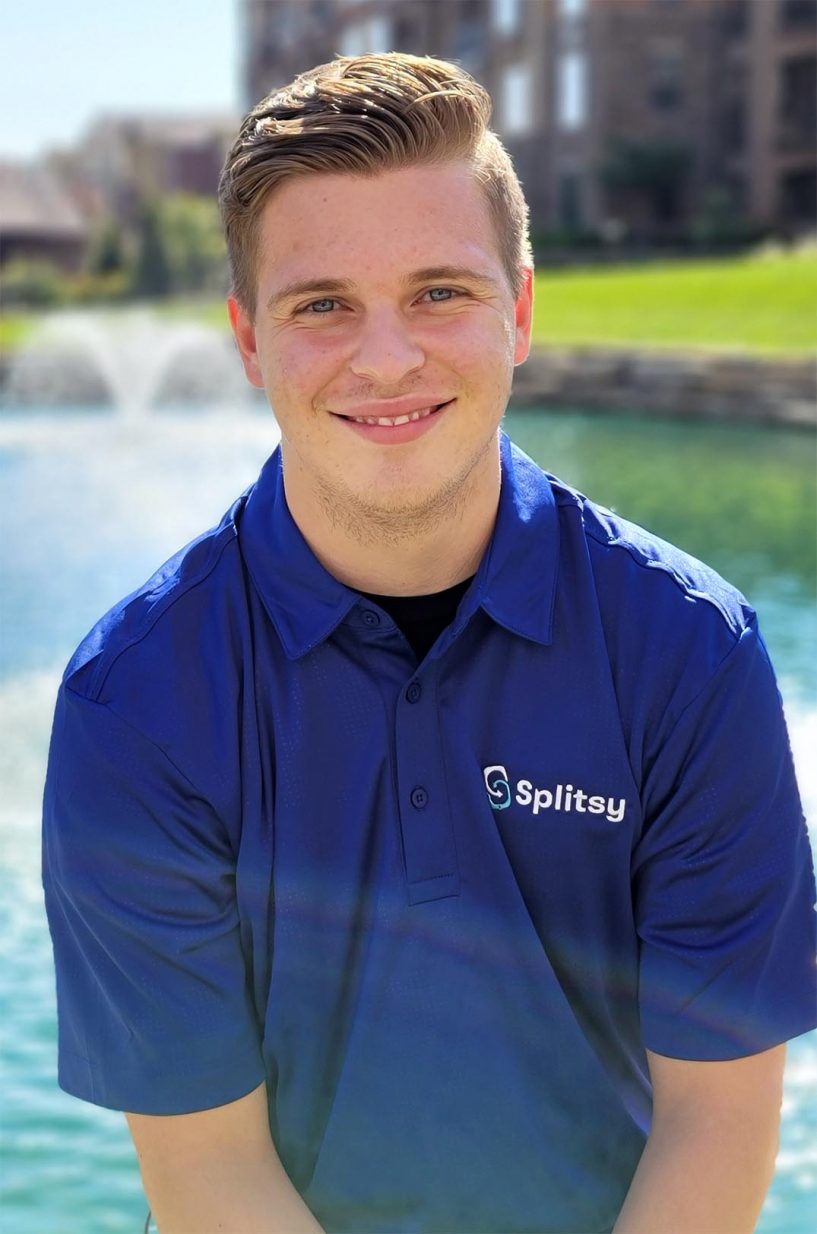
Joe Allen, co-founder, Splitsy

Nolan McMichael, co-founder, Splitsy
“[Previous funding] helped us develop what we have so far, but this WeFunder campaign is kind of that extra bump that not only allows us to launch, but to be able to start trying to acquire users until we can get to that next inflection point of raising,” Starnes said, adding Splitsy is seeing angel investors actively interested in taking a chance on the early-stage company.
Growth opportunities for Splitsy don’t stop with funding, he continued. The startup was recently accepted into the 1871 Equifax Design Sprint program, which is expected to help expand the Splitsy product to include credit building for shared payments.
“We’re working on how we can allow Splitsy to report to Equifax for payments shared with roommates,” he said. “The head of household won’t just earn credit for [split] bills, there is potential for subtenants to do so also.”
Starnes said he’s hopeful such momentum has the startup launched, rolling out even more add-on features, and primed to begin its bid for venture capital backing by next year.
“I feel that [the mindsets of] a lot of funds and grant programs are beginning to shift and they’re starting to realize that there are a lot of young entrepreneurs who have some very creative, outside-of-the-box thinking,” he said.
“I think that is what’s helped contribute to our success — in conjunction with knowing our pitch and knowing our product. … Delivery of your product and knowing what your business is about is the most important thing.”

Featured Business

2021 Startups to Watch
stats here
Related Posts on Startland News

Raaxo takes shape after pivot from Aphrodite Bra Co’s body scan concept
Despite its use of body-mapping technology, Aphrodite Bra Company wasn’t the right fit for customers’ needs, said Carlanda McKinney, founder of the newly rebooted custom intimates company Raaxo. “Aphrodite had been stuck in the starting-up space,” she said. “We’d never really gotten enough sales or enough traction to say, ‘We’re launched,’ or, ‘We’re in business.’…
Serial entrepreneur leverages past success for Bridge Space coworking project
Bridge Space will be more than a coworking office, Ben Rao said. He hopes it will be the heart of Lee’s Summit’s blossoming entrepreneurial ecosystem. “My No. 1 goal is to accelerate entrepreneurs’ success,” said Rao, Bridge Space founder and a serial entrepreneur himself. “It’s an opportunity for me to build something that would make…

KC mom’s humble entrepreneurial journey draws on healing power of creativity
Huddled in her parents’ basement, between the cribs of her crying twin babies, Keliah Smith began to draw. She was unemployed and feeling emotionally drained. The relationship with her children’s father had soured. Her escape: the stylus and smartphone in her hands. The Kansas City mother drew what she didn’t see in the mirror, she…

Harvard University recognizes KCMO digital inclusion map
Kansas City’s geographic work to illustrate the area’s digital divide earned high praise from a prestigious university. Harvard University recently highlighted the City of Kansas City, Missouri’s Digital Inclusion map, a tool that — at a block-by-block scale — detail residents’ access to internet connectivity overlaid with poverty levels. “This visualization was chosen as Harvard’s…