

60 percent of Black residents on KC’s east side are renters: How one small biz hopes to reverse redlining’s hit to homeownership
June 19, 2021 | Austin Barnes
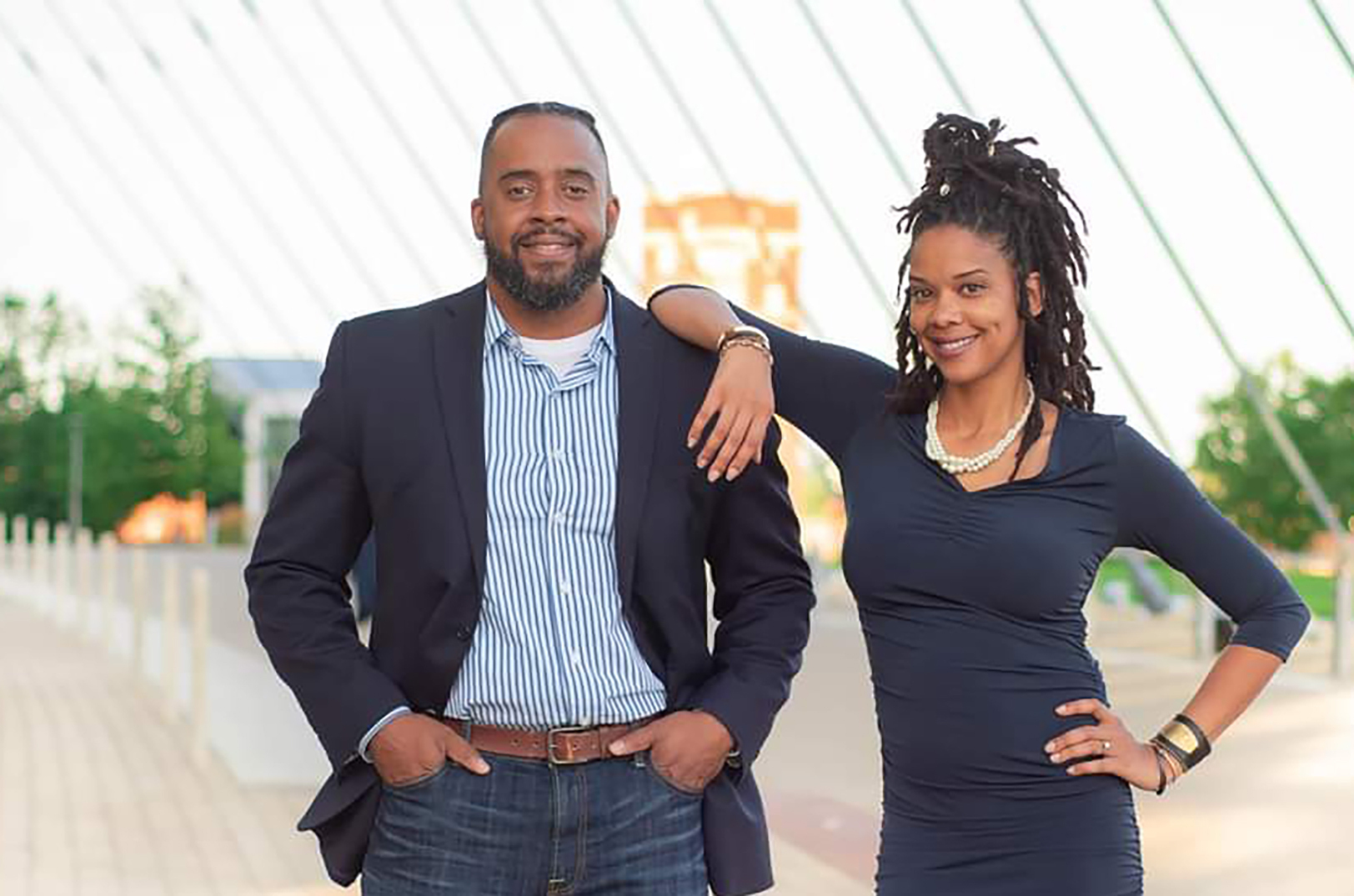
An investment in The Greenline Initiative is, on its face, an investment in the future of Kansas City’s historic and re-emerging east side, said Ajia Morris.
But there’s more to the effort than meets the eye, the effort’s co-founder explained, detailing ways she and her husband, Christopher, hope to uplift the metro’s Black community; a group of people long denied equal access to homeownership through legal and regulatory practices called “redlining.”
“We are at a racial reckoning. Things have been bad for so long,” Morris said, recalling reasons the couple in 2019 combined their skills and successes in law and finance to found The Greenline Initiative — an effort that renovates blighted homes in Kansas City’s urban core and owner finances their sales through crowdfunding, launched out of their own experience as east side homebuyers.
Click here to learn more about The Greenline Initiative or to connect with Morris.
“My husband and I [are] very intentional about living and raising our family on the east side of Kansas City,” she said, recalling their effort to find the perfect home for their family — which has grown to include four children.
“We experienced significant struggles identifying quality housing in the community of our choice. We bought a home through The Land Bank [of Kansas City], but there were a lot of challenges and bureaucracy,” Morris continued, noting the home took significantly longer to redevelop than the couple had planned, prompting them to purchase another property several blocks away.
The tedious process brought with it dozens of lessons, Morris said, noting some of the most critical of them as a challenging construction loan process and lack of awareness surrounding community initiatives and programs designed to provide homebuyers with grants and educational opportunities.
“We decided to create a vehicle that uses our resources on the front end (our capital) to renovate the homes and keep them at a price point that our neighbors can afford,” she said, adding each home sold carries a mortgage that’s of equal or lesser value than its buyer was paying in rent on a similarly sized property.
“There is 37.9 percent homeownership for Blacks on the east side of Kansas City. The other 60 [some] percent are renting — and that isn’t necessarily by choice or by design,” Morris said. “Unfair practices like your credit score, oftentimes, don’t adequately reflect who you are and your capacity to own a home.”
Such negative indicators shouldn’t be the gold standard for home buying, she said, advocating for things like job and rental history to carry more weight in the buying process.“If we invest in ourselves and invest in our neighbors, we still get that equity return and benefit,” Morris said. “We also get the satisfaction of recapturing a home that had been previously vacant or abandoned.”
2021 market challenges
“It’s been rough,” Morris said of work to scale The Greenline Initiative in a record-breaking housing market. “The cost of lumber has tripled and then the labor … It’s a crazy time.”
In response, Morris and her husband have turned their attention to smaller properties and first-time home buyers.
“What we’re doing, honestly, is taking it slow. Some of our builds are taking more time and we’re spacing it out to be cost effective. If we just powered through it and built additional houses at the additional cost [driven up by the pandemic], it might put them out of the price point for most of our neighbors. That’s not what we want.”
“We bought a home, but it would take over $200,000 at this point to renovate it just based on lumber and the estimates that we’re receiving. So we’re going to hold off on it because there aren’t too many people currently in our community who can afford that. If we were to renovate that home right now, it’d be an invitation to gentrification and that’s not our intent.”
Raising green
In an effort to boost its reach, The Greenline Initiative has for the second year partnered with the Give Black KC campaign — timed to coincide with Juneteenth — aiming to raise at least $10,000 to support its work in redlined neighborhoods.
“I’m really excited about it and proud of the momentum — and Kansas City for supporting Black-owned and Black-operated businesses,” Morris said of the partnership, which pairs seven additional Black-owned businesses and organizations with Generating Income for Tomorrow (Kansas City G.I.F.T.) — each one working to fill gaps around a pressing social issue.
“We’re housing; there’s food insecurity, there’s digital connectivity, there’s mental health,” she continued. “It’s a call for the community to rally and support eight organizations that are dedicated to uplifting and empowering Black people and eight organizations that have real impact and are mission aligned to do what’s in the best interest of the community.”
Click here to learn more about the Give Black KC campaign or here to make a donation.
Family business
Such work has also proven in the best interest of the Morris family as a whole, Morris added.
“My two eldest children are in middle school and high school and they help us with the work. We find their talents and try to leverage them so they can be comfortable and feel empowered because this is a family business,” she said, noting her 4-year-old has also found ways to help.

Ajia Morris, The Greenline Initiative
“When we drive past properties, she identifies those that are the most blighted and asks, ‘Can we fix them?’ … Having those types of conversations, where our children understand that we’re working to build a community, I think builds in them a sense of ownership and responsibility to give back because they recognize their experience isn’t necessarily the same as our neighbors — but they are still our neighbors and they’re still our community and they’re still our family.”
But a family is only as strong as its weakest link, Morris added.
“Currently, 25 percent of Black children are being raised in poverty. That is compared to 7 percent of white youth in Kansas City. Collectively, America will be stronger when those of us who are marginalized and most vulnerable have a safe space,” she said.
“As the rich get richer and the poor get poorer, it creates a wider divide — and that’s not what we need. So by focusing on and supporting our neighbors dreams of home ownership, you’re actually uplifting all of Kansas City.”
And doing so creates community impact that extends far beyond a roof and four walls, Morris continued.
“When you have people who own their homes, their children are more likely to graduate from high school. When you own your home, you can finance higher education. You can finance starting a small, Black-owned business when you own your home,” she said. “There’s so many more opportunities that you have just by the nature of that stability.”
“We think it’s the anchor; the cornerstone of creating generational wealth, because it will bring back pride and community,” Morris continued. “It will also build the wealth and opportunities for you to better leverage real estate — and that’s something that we have been denied, historically, for a very long time.”

This story is possible thanks to support from the Ewing Marion Kauffman Foundation, a private, nonpartisan foundation that seeks to build inclusive prosperity through a prepared workforce and entrepreneur-focused economic development. The Foundation works to change conditions, address root causes, and break down systemic barriers so that all people – regardless of race, gender, or geography – have the opportunity to achieve economic stability, mobility, and prosperity.
For more information, visit www.kauffman.org and connect with us at www.twitter.com/kauffmanfdn and www.facebook.com/kauffmanfdn.

Featured Business

2021 Startups to Watch
stats here
Related Posts on Startland News

Global Prairie sues ag tech firm FarmLink for loan default
Kansas City-based marketing firm Global Prairie has filed suit against a local ag tech firm for defaulting on a loan, according to a document that was filed Nov. 14 in Jackson County Court. In the document, Global Prairie alleged that Kansas City-based FarmLink failed to fulfill payments on a promissory note in the amount of…

Judge: KC, St. Louis Tesla shops can remain open (for now)
As we said goodbye to 2016, Tesla — along with many other Americans — faced an uncertain future in the Show Me State. When the clock struck midnight, the auto maker’s license to sell cars in Missouri expired. This prompted the firm to close its three locations in Kansas City and St. Louis on Saturday — but not…

Eyeing a funding round? InvestMidwest deadline looms
The top investment forum in the Midwest is hoping to garner more applications from fast-growing firms in the Kansas City area. Now in its 18th year, the InvestMidwest Venture Capital Forum hosts investors from around the world that hope to hear from the region’s most-promising firms that need a boost of capital. Companies that presented…
How Meshuggah Bagels and Ruby Jean’s Juicery dealt with rapid growth
Imagine this. It’s opening day at your quaint cafe and you hope Kansas Citians like your bagels. It turns out they do — a whole lot. So much in fact that the line spills out the door for the next few weeks, spurring demand that’s more than 300 percent higher than anticipated. Pair that challenge…