

How a Columbia startup spun smart window tech into a holoflective gun scope that could help prevent accidental shootings
April 16, 2021 | Austin Barnes
Innovation has no limits for Fielding Staton — and his company’s 250-plus inventions offer just a glimpse into how he and his team hope to shape the future.

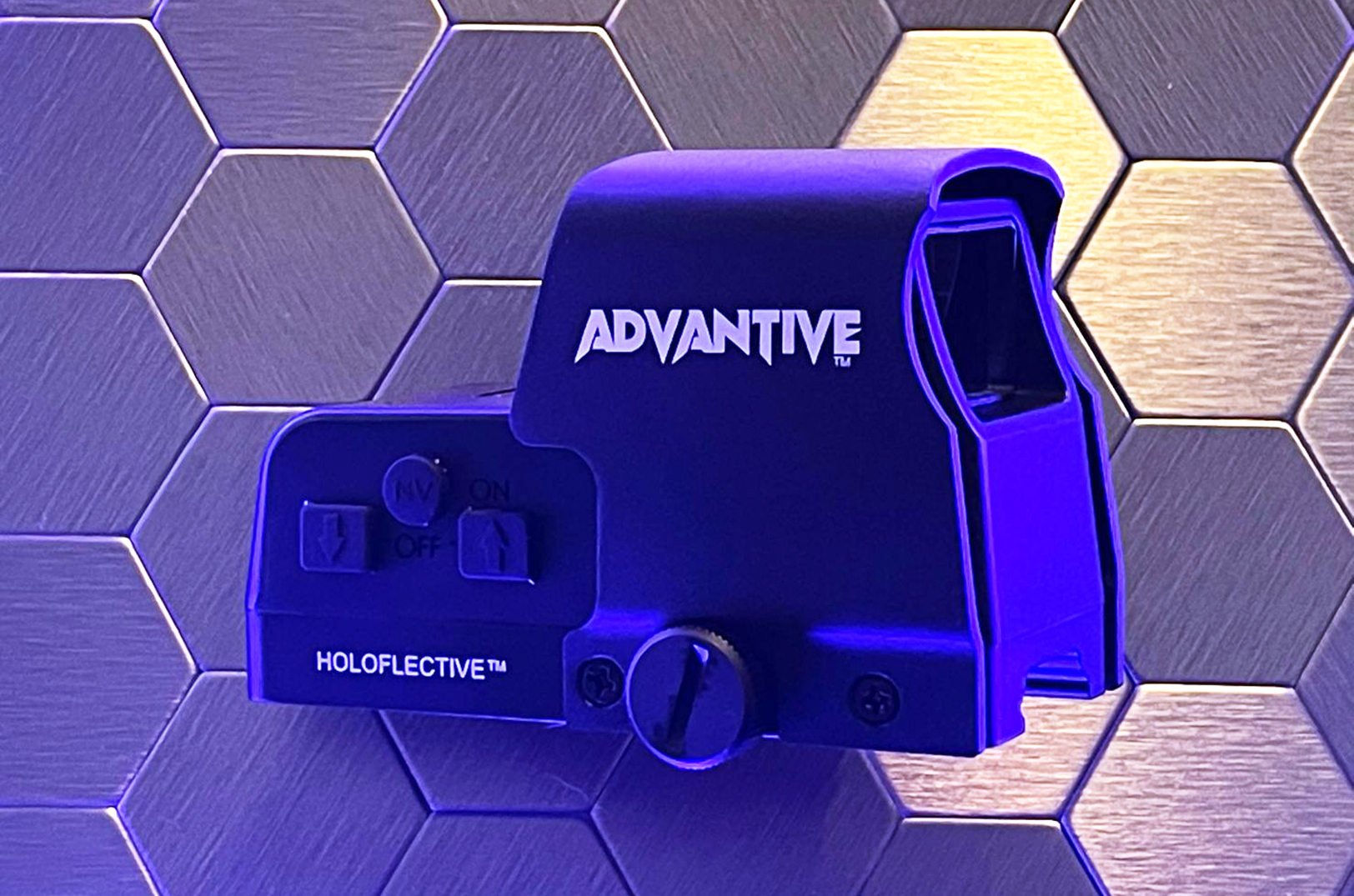
Windgo Advantive holoflective gun scope on a Smith & Wesson M&P 15 Sport Rifle
Among the most recent products to take shape inside the walls of Columbia-manufactured Windgo: a holoflective gun scope with the potential to save lives.
“A lot of gun scopes are using a concave lens or a lot of mirrors to culminate an image — we’re using just a reflected, flat plane,” explained Staton, founder, CEO, and serial innovator.
“The next version of our scope will combine a reflected thermal image with a holographic reticle — it’s going to be something that’s never been seen before,” he continued, adding the combined holographic and reflective technology creates holoflective images.
“Normal thermal images would be just color. You really can’t use it to shoot anything because you’re shooting at [what feels like] a cartoon,” Staton explained.
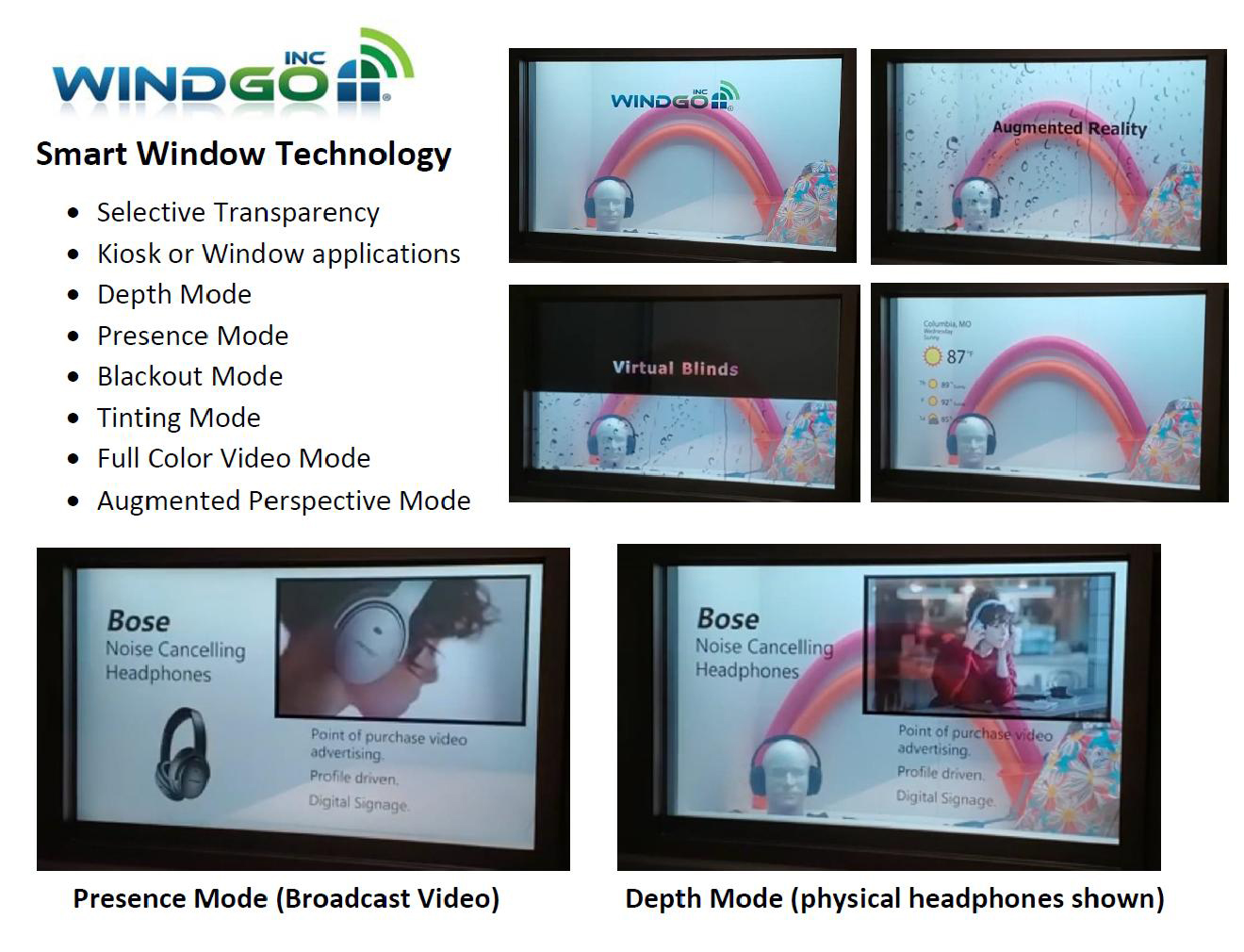
Windgo smart window
“When you reflect that image on a clear plane, then you’ve created a heads-up display and a transparent thermal image — which is really cool when you’re shooting things in low light. … It could [prevent] people from accidentally getting shot.”
The gun scope came to the team at Windgo as an offshoot of a smart window patent they’d secured a few years ago, Staton said, noting that’s often how he and his team develop new products — part of a continuous cycle of evolution with a passion for efficiency at its center.
“Fielding got this started and did an exceptional job of putting together a baseline of technology that did have patents granted before we even incorporated,” noted David Strumpf, vice president of research and development.
Tapping into versatile tech
From a drone delivery chute to lighted weatherstripping to color changing fishing lure and the smart windows that gave the emerging technology startup its name, Staton has been intentional in his efforts to establish Windgo with as much versatility as possible.
“The goal is to formulate a diversified portfolio of solutions that compliment each other and can be bundled to enhance other people’s market needs or technology,” Strumpf explained.
“We don’t [always] make the products, but we make the products you use better and we tend to follow that philosophical model. What we’re doing is trying to take the materials that are all around us and make those materials smarter — and a smart material can be a cost saver and it can be a paradigm shift in enabling technologies.”

Fielding Staton, Windgo
Such a strategy has to date seen Windgo launch four spinoff startups.
Click here to learn more about the full lineup of Windgo-held companies, products, and how they work.
“We know the general landscape of what the future is going to need — sense and response and things like low latency delivery; things you hear about today with 5G and internet migration to rural communities,” Strumpf explained.
“These are all the things that are setting the stage for the future — and we’re in this space. But what we don’t know is where that is going to monetize in the most direct way.”
Patented COVID response
Boasting an arsenal of tech that’s ready to deploy at a moment’s notice is expected to help the company meet future demands before competitors, he continued, noting the COVID-19 pandemic is its best example to date of the value in product preparation.
The startup participated in the 2020 Black & Veatch IgniteX COVID Response Accelerator last summer, putting its UV-enabled smart lighting on display as a virus-killing mechanism.
“The entire past year has been a reaction and a chance to see what we — as individuals and as companies — can do to help with the COVID need,” he said, adding Windgo’s capabilities in the smart glass, projection, and fighting arenas proved up to the challenge of the program.
“A lot of our fixture applications are used for digital signage. … We happened to also be working in ultraviolet output for things like water treatment for the pipes in your drain — making sure they don’t build up any bacterial or mold growth,” Strumpf explained, noting the company already held patents for various products in each area.
The overall experience reinforced Windgo’s primary focus; smart building materials are the window to the future, Staton added.
“[The company] started in the smart window arena. We can add sense and response to [many things] whether its coatings or paints or sheet rock or windows or doors,” Staton continued.
“We feel like all this stuff is going to be communicating at some point — we’re trying to be in that arena.”

Featured Business

2021 Startups to Watch
stats here
Related Posts on Startland News

designWerx makes room for growing makers in North Kansas City
A home garage workspace can be a lonely, stifling place for a maker trying to grow his or her business, said Pam Newton, who is leading the artistic vision for designWerx, a new coworking space and incubator specifically for makers in North Kansas City. “You’re alone constantly. Sometimes it’s hard to get motivated,” she said.…

KCultivator Q&A: Tyler Enders talks his biggest failure, the ‘Made In’ concept and Obama
Seated amid vintage mosaic tile and striking black-and-white portraits by Kansas City photographer Cameron Gee, founder Tyler Enders seems at home within the walls of the Made in KC Cafe. He’s an art lover with a finance degree — not to mention one of the minds behind Made in KC, a retail showcase for local…

Kimberly Gandy: Proof a startup can emerge stronger from its founder’s cancer diagnosis
Cancer needn’t mean can’t, Kimberly Gandy said. When the Play-It Health founder and CEO was diagnosed with an aggressive, mid-stage cancer in May 2016, her startup found itself at a crossroads. Gandy had just joined the Kansas City-based Pipeline fellowship and her company was poised for growth through its web- and mobile-based health regimen tracking…

Code Ninjas uses karate format to punch into KC youth STEM scene
Students often want more than their schools can offer, said Jason Hansen, of Code Ninjas. For some, that’s competitive sports teams or specialty athletics, he said. Others yearn for greater STEM-based learning opportunities — like those offered at Hansen’s Leawood center. “It’s just like you might have a dance studio, or a baseball academy,” Hansen…