

TrackMy Vaccines allows patients to record COVID-19 vaccine reactions; use real-time data to ID trends
January 7, 2021 | Channa Steinmetz

With millions of Americans set to be inoculated with the Pfizer COVID-19 vaccine this year, Kansas City startup TrackMy Solutions transformed its technology into a web app with which patients can track their vaccine reactions, Jeremy Elias said.
“There’s a system known as VAERS, or Vaccine Adverse Event Reporting System, that exists today for any patient and provider,” said Elias, detailing the need for the TrackMy Vaccines app. “But if you look at that system, it’s a series of about five different web pages. A patient is never going to fill it out. What we are doing is making it easier for patients to submit that information directly from their TrackMy platform.”
The platform’s purpose is not to discourage or encourage inoculation of the COVID-19 vaccine, said Elias — who has 12 years of experience in the healthcare industry working for Cerner. Rather, TrackMy Vaccines uses the real-time data to help with analyzing trends and insights, he continued.
“We are not biased one way or another. If you want to get the vaccine, we want to give you the best information we can,” Elias said. “Our mission is to engage, educate, inform and involve.”
Other patients will be able to see the data collected, but the platform is HIPAA compliant to protect patient privacy, Elias added.
Click here to learn more about TrackMy Solutions.
Along with tracking any side effects to the COVID-19 vaccination, patients will receive a reminder to schedule their second vaccination appointment (as the Pfizer vaccine is a two-dose vaccination) and any needed follow-ups with a doctor — as well as access to their inoculation documents.
“We created a digital vaccination card,” Elias said, noting that the current paper card system is flawed: patients can easily damage or misplace their proof of vaccination.
The technology has gained government interest when it comes to state-level contracts for assisting in the setups of emerging mobile vaccination clinics, Elias stated.
“[TrackMy Vaccines] does everything from inventory management to patient tracking to telehealth,” he said, adding that there are competitors who might already provide a specific service, but they do not encompass everything that is needed by mobile vaccination clinics.
Patients can create a TrackMy account for free, while healthcare providers must pay for the platform’s services, Elias said. TrackMy Vaccine is set to launch at the end of January, but registration to make a TrackMy account can be found here.
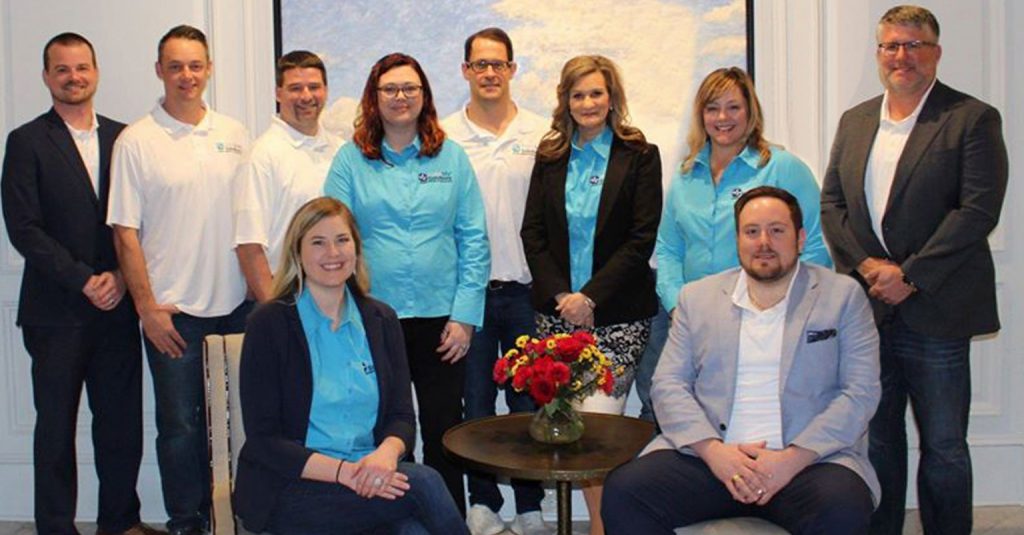
TrackMy Solutions team
TrackMy Implant
Before tracking vaccinations, TrackMy Solutions was solely focused on tracking medical implants with its technology known as TrackMy Implants.
While working at Cerner, Elias discovered that all implantable devices contain a barcode known as a unique device identifier (UDI). Data from UDIs were collected by hospitals, but no actions were being taken with the information, Elias explained.
He saw an opening in the market; yet, it was personal experience that was the catalyst to creating TrackMy Solutions, Elias shared.
“My best friend’s grandfather passed away from a defective, recalled pacemaker,” Elias said. “He found out only four days before he died that the pacemaker in his body had been recalled six months earlier.”
“There was no plan of care that could have saved him at that point,” he continued. “However, if we had had TrackMy Implants, we could have saved his life because he would have been notified about the recall immediately.”
Since launching in 2017, TrackMy Implants has 1,000 users on the platform and has identified 16 patients who had recalled devices, Elias said.
“The majority of those cases were women who had the textured breast implant, Allergen, which was found to cause cancer,” he stated. “They were able to know immediately and contact their surgeon to get their breast implant removed.”
The goal of TrackMy Solutions is to educate patients and prevent tragedy, Elias shared.
“Our vision is to save lives through technology,” Elias said. “One of the most challenging things we have to do is educate the patient population and educate the healthcare ecosystem. But, of course, we are here to solve those challenges.”

Featured Business

2021 Startups to Watch
stats here
Related Posts on Startland News

What the Flokk? Startup to connect residents with area events
For Trey Rhedrick, the alarm sounds at 5 a.m. He rises before the sun to work at Black & Veatch as a chemical engineer project manager. When finished at 5 p.m., Rhedrick conducts a couple meetings for his other gig before heading home to snarf down dinner. For the next six to eight hours —…

Sprint Accelerator graduate acquired by medical giant
A large California-based health care provider recently announced that it acquired Medicast, a graduate of the Kansas City-based Sprint Mobile Health Accelerator program. Providence St. Joseph Health purchased the firm for an undisclosed amount for its logistics and management platform that automates remote care delivery. In 2014, Medicast participated in the inaugural, three-month program at…

Uber finds KCMO’s proposed ride-sharing regulations ‘troubling’
In a move that will likely reignite lively discussions among government, businesses and residents, the City of Kansas City, Mo. is now considering changes to its ride-sharing regulations for companies like Uber. By directive of the Kansas City Council, city officials are reviewing rules drafted in April of 2015 that aim to ensure public safety…

What do 1 Million Cups presenters reveal about KC’s entrepreneurial community?
Editor’s note: Opinions expressed in this commentary are the author’s alone. Every Wednesday morning in Kansas City and 91 other cities nationwide, one or two early-stage startups present a six-minute profile of their companies to a diverse audience, followed by 20 minutes of open Q&A. I recently reviewed 51 presentations delivered at 1 Million Cups…