

Entrepreneurs’ intellectual property rights: This is where things get tricky
November 16, 2020 | Chris Brown

Editor’s note: The opinions expressed in this commentary — the first in a four-part series — are the author’s alone. Chris Brown is the founder of Venture Legal where he represents startups, freelancers, and small businesses. This column is intended to be general in detail and does not constitute legal advice.
For many new businesses, the value of their intellectual property will exceed the value of their physical assets. Unfortunately, the laws which protect intellectual property are not always intuitive and are often blurry. In a four-part series for Startland News, we’ll explore what entrepreneurs should know about copyrights, trademarks, trade secrets, and patents. And we’ll start with copyrights.
What is a copyright?
Copyrights protect creative works, from art and music to business documents, computer software and more. It’s important to note that you can’t copyright an idea, but only your original expression of the idea. You may think of a food delivery app, but that’s just an idea. The expression of the idea would be the specific screen layouts, content, and user flow of the app itself. That expression is the component you can protect using copyright.
How do you obtain a copyright?
Copyrights spring to life as soon as an original work is reduced to a tangible medium (for example, in writing, an audio recording, or something similar). Although registration with the Copyright Office is encouraged, it isn’t strictly required. Of course, it is often best to register your works, and many entrepreneurs can do this on their own using the Copyright Office’s website.
Once you obtain rights, you can prevent others from reproducing, distributing, displaying, performing, or creating derivative works using your original work (we commonly call these the “bundle of rights”).
Who owns the copyright?
This is where things get tricky and entrepreneurs often get it wrong.
The default rule is that the person that creates an original work is the owner of the copyright to that work. However, there are three primary ways someone else might become the owner of the copyright. The first is easy–the owner assigns the copyright (in writing) to someone else. The second is also kind of easy–when an employee creates an original work within the scope of their employment, the employer will own the copyright.
The third is a bit more complicated, and it involves situations when an independent contractor creates an original work. In that case, the work may be (but usually is not) a “work made for hire.” And in either event, it is critical that the contractor and her client come to an agreement on copyright ownership in a written document (usually in a client or contractor agreement).
How long does a copyright last?
Generally speaking, rights under the Copyright Act will last for the life of the creator plus 70 years. There are situations where the length will be different, but it’s often easy to just assume “life plus 70” unless you really need to dig into the fact pattern.
What constitutes copyright infringement?
There are many misconceptions about copyright infringement out there (like the idea that if you change a work by 10 percent you are in the clear … which is not true). The true test is whether someone exercises one of the “bundle of rights” referenced above without authorization from the copyright owner. The “copy” doesn’t even have to be a literal copy. All that is required is that the copy be substantially similar to the original.
At this point, many entrepreneurs claim their use is “fair use” but it is important to note that the fair use defenses under copyright law are pretty narrow and you should never assume a use is fair use without speaking to a lawyer.
What’s next
Next up: We’ll talk about trademarks, and in future installments of this series we’ll cover trade secrets and patents.
Chris Brown is the founder of Venture Legal where he represents startups, freelancers, and small businesses. He also co-founded Contract Canvas, a digital contract platform for freelancers. www.venturelegalkc.com // @CSBCounsel

Featured Business

2020 Startups to Watch
stats here
Related Posts on Startland News

Once a near-throwaway startup idea, TicketRX sells to Overland Park fintech firm MSTS
From bootstrapped to exit, Kansas City citation solutions platform TicketRX on Monday announced its sale to an Overland Park fintech company with global reach. “I’m excited to bring our mobile, AI-driven technology under the MSTS umbrella,” said Bryan Shannon, TicketRX founder and CEO. “MSTS’s long history and leadership experience in the transportation industry will ensure…
EDCKC selects 2019 Cornerstone Awards finalists; May celebration to honor Emanuel Cleaver
Innovators and leaders in new construction, redevelopment, capital investments, job creation and expansion projects in Kansas City, Missouri, are set to be honored in late May at the 2019 Cornerstone Awards. The Economic Development Corporation of Kansas City, Missouri, (EDCKC) announced 22 finalists for the honors today. “The Cornerstone Awards are a chance to take…
KC Rising update: Kansas City falling short in economic race with peer markets
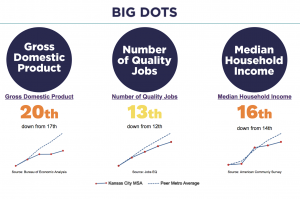
Bill Gautreaux sounded the alarm with a mixed refrain meant as a KC Rising call to action: “We’re good, but we’re not good enough.” Throughout a recent KC Rising update on the region’s economic growth, Gautreaux and other KC Rising leaders championed Kansas City’s efforts to move the needle, while also lamenting the slow speed…

Startup advocates rally, demand KCMO invest more of its $1.73B budget in entrepreneurs
If Kansas City leaders want to build a stronger community, they should start by supporting early stage entrepreneurs, said Lesa Mitchell. “I’m simply here to say — we’re not spending enough money … and we need to look at it,” Mitchell, managing director of Techstars Kansas City, told KCMO city council members Saturday during a public…