

Ready to hire? First ask: Does your startup really need another full-time employee?
July 6, 2020 | Stephanie Smithmier

Editor’s note: The opinions expressed in this commentary are the author’s alone. Stephanie Smithmier is an expert in talent recruitment, serving as the director of the administrative division at Morgan Hunter in Kansas City.
I’m a toe-dipper.
A pool, the lake, the ocean — I’m going to test the waters first, only willing to sacrifice a single digit to the potentially freezing water.
As an entrepreneur, you’re more likely to be a cannonballer, a diver, a jump-right-in-with-both-feet-er. That spirit is what fuels the startup community and has helped bring a lot of deserved attention and interest to Kansas City’s entrepreneurial ecosystem.
But as you know, making the leap and then doing the hard work to grow that business are two different things. Even after you hone your craft or polish that MVP, you’re still left to deal with the HR manager hat hovering above your head. And finding those initial employees can be tough, as Serenity Gibbons writes in Forbes:
“You need help to get everything done in a reasonable amount of time, but full-time employees are so costly and difficult to recruit that it might compromise your prospects for growth. With no one to share the stress, it expands.”
The best approach may be one that combines both of the above philosophies, a way to explore the vast talent pool in Kansas City without committing to a full-time hire before you know exactly what you need. That’s precisely what one recent startup did.
Founded in 2019, FineLine HR Consulting, LLC — a Kansas City startup offering training, investigations and HR consulting to businesses — wanted to hire an executive assistant. But after learning more about where they were in their growth and their needs, the better fit turned out to be a temporary employee.
Recently, I sat down with founding member Alison Sheehan to talk about the results of that decision.
Q: Tell me about your decision-making process as you compared a permanent hire with a temporary employee.

Alison Sheehan, FineLine HR Consulting, LLC
A: After eight months in business, we knew we needed administrative assistance. However, we didn’t know how many hours per week we really needed, or whether we had a short- or long-term need, whether we needed someone in the office or working virtually, etc.
After talking through the position, we knew it would be premature to hire someone as a regular employee (whether full- or part-time) with the possibility that we really wouldn’t need someone long-term. We decided we needed a three-month trial run to evaluate our true business needs.
Q: Looking back, why was hiring a temp the right choice for you?
A: We listened to our own advice that we give our clients, some of whom are startups — that sometimes it’s best to start with the mutual understanding that the role may not be needed down the road. We could always hire the person if the trial run proved the need, but we didn’t want to have to separate someone’s employment if the need wasn’t there after all.
Q: From working with startups – and still in that stage yourself – when are contract employees often a better choice for early-stage companies?
A: Contract workers allow you to take some time with “few strings attached” to test and evaluate the need. Startups can also lean on staffing experts to do the recruiting and vetting of talent, and guide the company on realistic pay and expectations of duties.
Perhaps even more important, don’t jump into being an employer, being responsible for payroll and payroll taxes, worrying about benefits, etc., until the company’s principals have the infrastructure in place and confidence they can support them.
Q: Did having a temp help you better define the role?
A: The role has actually gone away, in part because the need diminished as we learned about ourselves and how we would use the resource (or not). After three months, we mutually acknowledged we should redefine what we needed going forward.
It was very helpful to have that temp with years of executive assistant experience, who could partner with us and tell us where we were underutilizing her and overestimating our needs.
Contract employees can be an ideal alternative to allow you to evaluate the right responsibilities for the role, see how many hours you need, even see how that person will mesh with your culture (which is even more important when your team is small).
Of course, the right fit can often be a needle in the haystack — especially someone with the right skills and availability — and hiring is usually only one of a thousand tasks on your list as an entrepreneur. Partner with a staffing firm who knows how to find the right fit for you in this market so you can dive headfirst into your next big idea.
Stephanie Smithmier is director of the administrative division at Morgan Hunter, serving Kansas City-area employers to address a range of hiring needs — from temporary staffing to direct-hire placements. Click here to learn more about Morgan Hunter.

Featured Business

2020 Startups to Watch
stats here
Related Posts on Startland News

KC-based PatientsVoices pulls $150K in first round of seed capital, additional $75K from MTC
Competing for a spot in a Nashville-based health tech accelerator, PatientsVoices landed its first round of seed capital — with a booster shot from the State of Missouri. A $150,000 innovation grant from Jumpstart Foundry investment group represents a leap forward for PatientsVoices, headquartered in iWerx’s North Kansas City entrepreneurial development center, said founder and…

Beyond buzzwords: Foxtrot Supply mounts protest of an increasingly online-only world
A large butcher block table stands between the owners of Foxtrot Supply Co. and its customers. But the found-object centerpiece of their Crossroads store is meant as a meeting place, not a barrier, said Ryan Hetu. “It’s alluring, inviting and kind of vulnerable,” the Foxtrot co-founder explained. Stitched into the high-traffic fabric of First Fridays…

Peek inside: Made in KC Marketplace offers a glimpse of its new Plaza store (Photos)
Amid the bustle of traffic and construction in one of Kansas City’s most dominant shopping destinations, the Made in KC Marketplace has quietly been taking shape on the Country Club Plaza. The retailer — which specializes in showcasing wares crafted by local makers — opened the doors of its new location with little fanfare this…
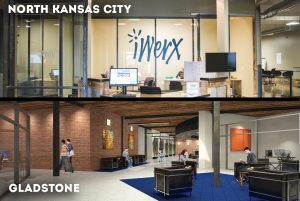
iWerx Gladstone to expand Northland coworking, incubator options in former racquetball club
Two years after launching its sprawling flagship site in North Kansas City, a premiere coworking community is expected to debut iWerx Gladstone in late fall. The two-story, 32,000-square-foot space — originally built as a racquetball club and renovated into a traditional office building in the mid 1980s — will be home to about 80 offices,…