

Smart doorway could detect high temp, neutralize COVID on clothing, KC tech pioneer says
July 23, 2020 | Whitney Burke

Blockchain might be the future, but eliminating exposure to COVID-19 is the now, said serial entrepreneur Shekhar Gupta as he takes an intelligent disinfecting doorway to market.
“When you go to the airport you have to go through the X-Ray machines, right? So we developed a similar structure, but to detect COVID-19 and neutralize it off your clothes,” said Gupta, COO of Blockchain Initiatives and director of software product and technology at Kansas City-based Interacshn, a startup focusing on machine learning and AI-based smart city and COVID 19 solutions.
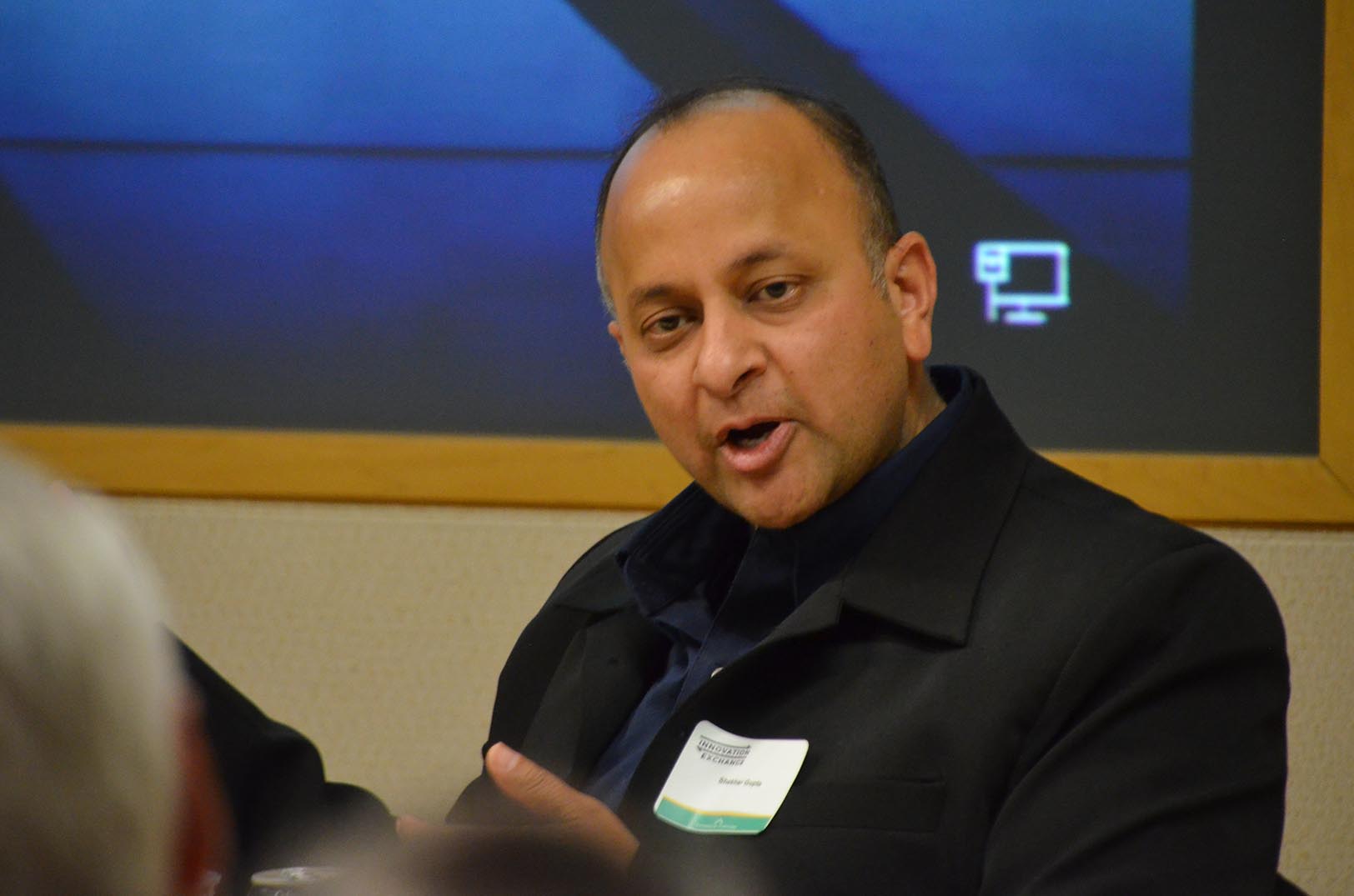
Shekhar Gupta, Blockchain Initiatives, KCCOVID 19; STARTLAND’s Innovation Exchange, November 2019
After developing the health tech device this spring, 15 models were produced — all of them already sold and serving as market proof for the concept, he said, noting research conducted at Boston University on the effectiveness of UV rays on COVID-19 was key.
Click here to read more about the intelligent disinfection door.
“These are going to the investors who bought from me first,” Gupta said, specifically mentioning buyers in New York, Texas and Florida where outbreaks have been most extreme. “I am very excited about this door tech because I think we can use it in Kansas City, and I want to generate some enthusiasm in Kansas City about it too.”
After further testing of the sold devices, Gupta plans to offer the product to local businesses, restaurants and churches in Kansas City, he said.
“I may reach out to Mayor Lucas as well, as it could be a good installation in City Hall,” Gupta added.
“Kansas City is about two years behind in the technology world. Things get to New York City and California a lot faster and my entire goal is to put KC at the forefront of it,” he added. “We need to be a leader.”
Variations of the technology are also being manufactured by others in the space.

So how does the doorway from Gupta’s company work? It’s a multi-step solution, but only takes a few seconds, he said.
“First when you walk up to the gate, about one and a half to two feet away it will monitor your temperature,” he described. “Then when you step inside, the UV machine goes all around your body and neutralizes the COVID-19 from your clothes so you can walk up into your workplace safely without having to worry.”
Working with researchers who sprayed the virus on clothing, Gupta’s prototypes eliminated the COVID-causing elements with the UV light, he said.
“There is also a module that does a light mist of sanitizer over you,” he added.
Gupta’s intelligent disinfection door isn’t his only foray into the fight against COVID, he said. In addition to a sister product — a portable room fog disinfectant — Gupta also helped create an online platform to help connect those with needs during the pandemic to people with the ability to provide relief.
Click here to learn more about Gupta’s KCCOVID 19 site.
“We developed a website a few months back that matches a seeker with a donor that is free to use, because when this started, you walked into any store and the shelves were totally empty. You wouldn’t find anything,” he explained. “So to me that was like, ‘OK if people who are living in these suburbs are not finding it, then people who are living in urban areas do not have the means to go buy something that used to be really cheap that is now really expensive.’”
“Since people hoarded things like toilet paper and the hand sanitizers so much, my hope with the website was that I would be able to match a seeker with a donor so if you need something you would post it on there and someone who would have plenty of it would reach out and let you know they have it,” he added.
Response ranged from senior care centers in Kansas City to people from as far away as South Africa, Gupta said.
Up next: the never-resting entrepreneur is pursuing a National Science Foundation grant for another COVID-related effort, he said.
“This research project is not to track the disease; I am more onto tracking the clusters and finding out the relationship between one cluster to another cluster,” Gupta detailed. “My hope is that by doing that research that we would be one step ahead of the disease. We can even find out where an outbreak happens before it even does.”

This story is possible thanks to support from the Ewing Marion Kauffman Foundation, a private, nonpartisan foundation that works together with communities in education and entrepreneurship to create uncommon solutions and empower people to shape their futures and be successful.
For more information, visit www.kauffman.org and connect at www.twitter.com/kauffmanfdn and www.facebook.com/kauffmanfdn

Featured Business

2020 Startups to Watch
stats here
Related Posts on Startland News

Novel Capital teams with Crux KC to offer growth-focused marketing to early-stage tech companies
An exclusive partnership between two Kansas City-based innovators is expected to help remove a traditional financial hurdle to business growth, said Ethan Whitehill, president and chief strategy officer for the KC Chamber-lauded marketing firm Crux KC. The collaboration between Crux and Overland Park-headquartered capital provider Novel Capital is expected to offer B2B SaaS and tech…
Neighborhood smart cans help Kansas Citians save the planet from their kitchens
Newly introduced composting technology is already turning new ground in Kansas City, Kristan Chamberlain said, with more solar-powered compost cans arriving later this spring across the metro’s urban landscape. Her social venture, KC Can Compost, installed three of the devices in October — free to use for KCMO residents wanting to deposit their soil-making food…

Voodoo Volleyball bounces back in OP: Father-daughter duo doubles as new venture’s setters
Quinn Austin put several sports to the test as a preteen — racing from basketball practice to softball to volleyball. But she latched on to just one. “Volleyball. It was my sport. Everyone was having a good time,” she said. “We just loved the cheers — a cheer when we got a hit, a cheer…

Black farmers are losing ground in the fight to feed their communities, advocates say
More than a century of systemic land dispossession and discriminatory practices has left Black farmers with less than 0.6 percent of U.S. farmland — less than a third of the 16 million acres they operated in 1910, according to local urban farming advocates. They gathered Tuesday at Independence Boulevard Christian Church to confront this history…