

Ronawk cultivates first funding round, fight against COVID-19 from new Olathe lab
June 25, 2020 | Austin Barnes
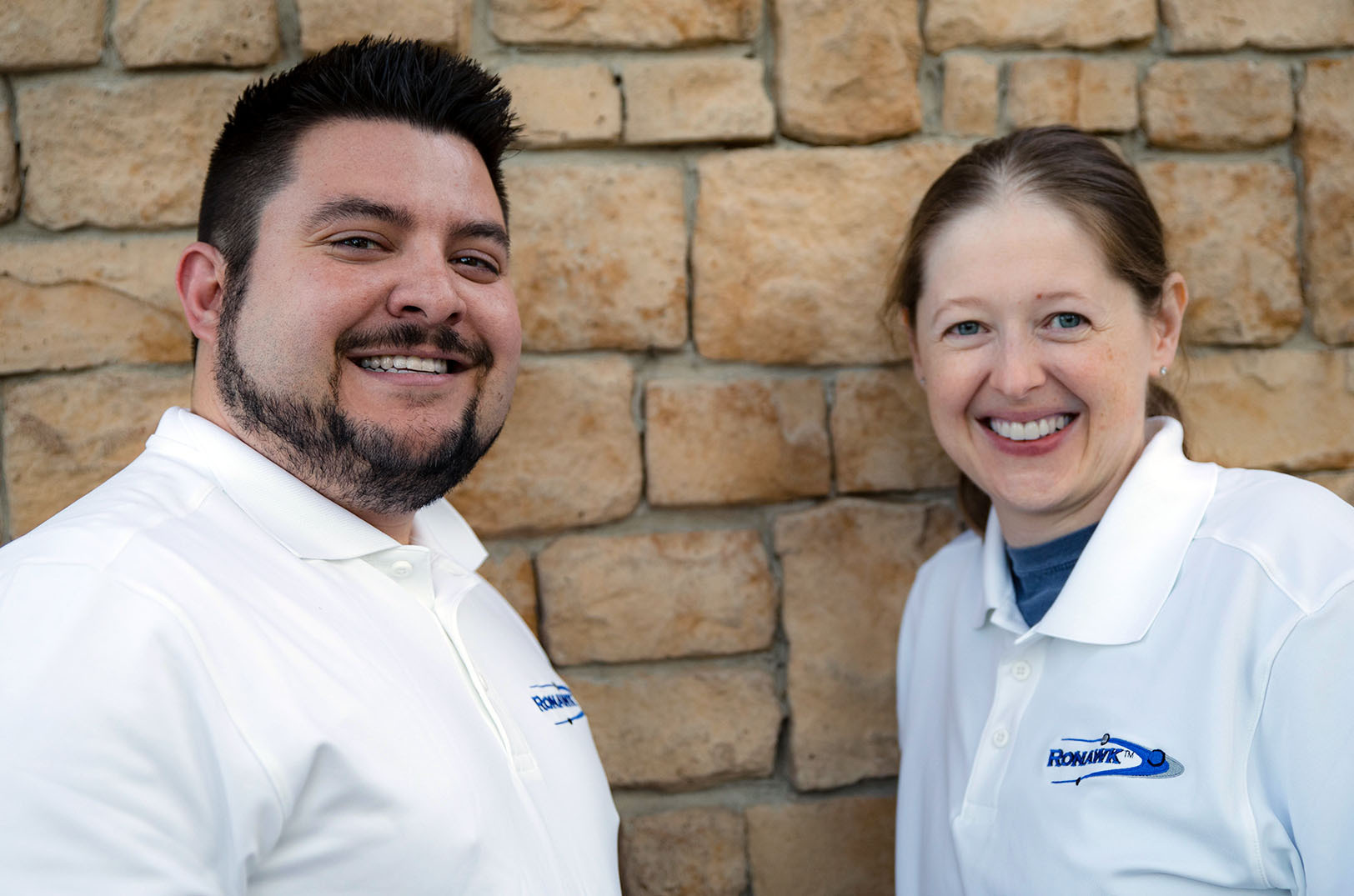
As COVID-19 continues to wage war on the world, researchers in an Olathe-based lab are generating trillions of human cells that could be used to cure the ever-lingering virus.
“It eliminates a lot of the work that’s needed,” A.J. Mellott, president and co-founder of Ronawk, said of the health tech startup’s premiere product — Tissue Blocks (T-Blocks).
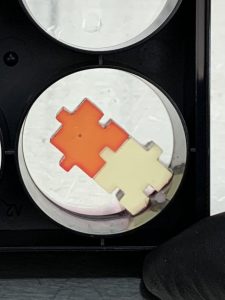
T-Blocks by Ronawk
Built on modular and expandable 3D substrates, T-Blocks enable researchers across the globe to rapidly expand growth of cells — up to one trillion at a time — used in critical research that could save lives and shatter the COVID curve once and for all, Mellott added, calling the method a “critical bottleneck.”
“It uses fewer resources and we’ve eliminated the need to subculture,” he explained, noting the innovation’s 3D model also eliminates the need for the traditional, plastic, 2D culture trays, which greatly reduced available surface area for cell growth.
“We eliminate the need to subculture, which is when cells have divided so much that they’re covering almost the entire surface and then you have to detach them and dilute them and put them on a new surface so they don’t start developing weird characteristics,” Mellott elaborated.
“With our technology, you no longer have to do that. You just continue to add on one of our T-Blocks like a Lego as you need more surface area for your cells to grow.”
The startup began offering T-Blocks to researchers in April.
Click here to read more about Ronawk’s T-Blocks technology.
Mellott and his small but mighty team — which also includes Heather Decker, vice president and co-founder — weren’t expecting to use T-Blocks in the fight against a global pandemic a year into the endeavor, which formally launched in February 2019, Mellott said.
“[Five years ago] I developed a technology to help with the production of STEM cells because they are so challenging to grow,” he recalled. “I had a university position at KU Med and [Decker] and I had been colleagues for about a decade and decided to found Ronawk to help accelerate discovery research for scientists.”
And the trial by fire opportunity that’s come with the pandemic has helped Ronawk prove its mission, Mellott added.
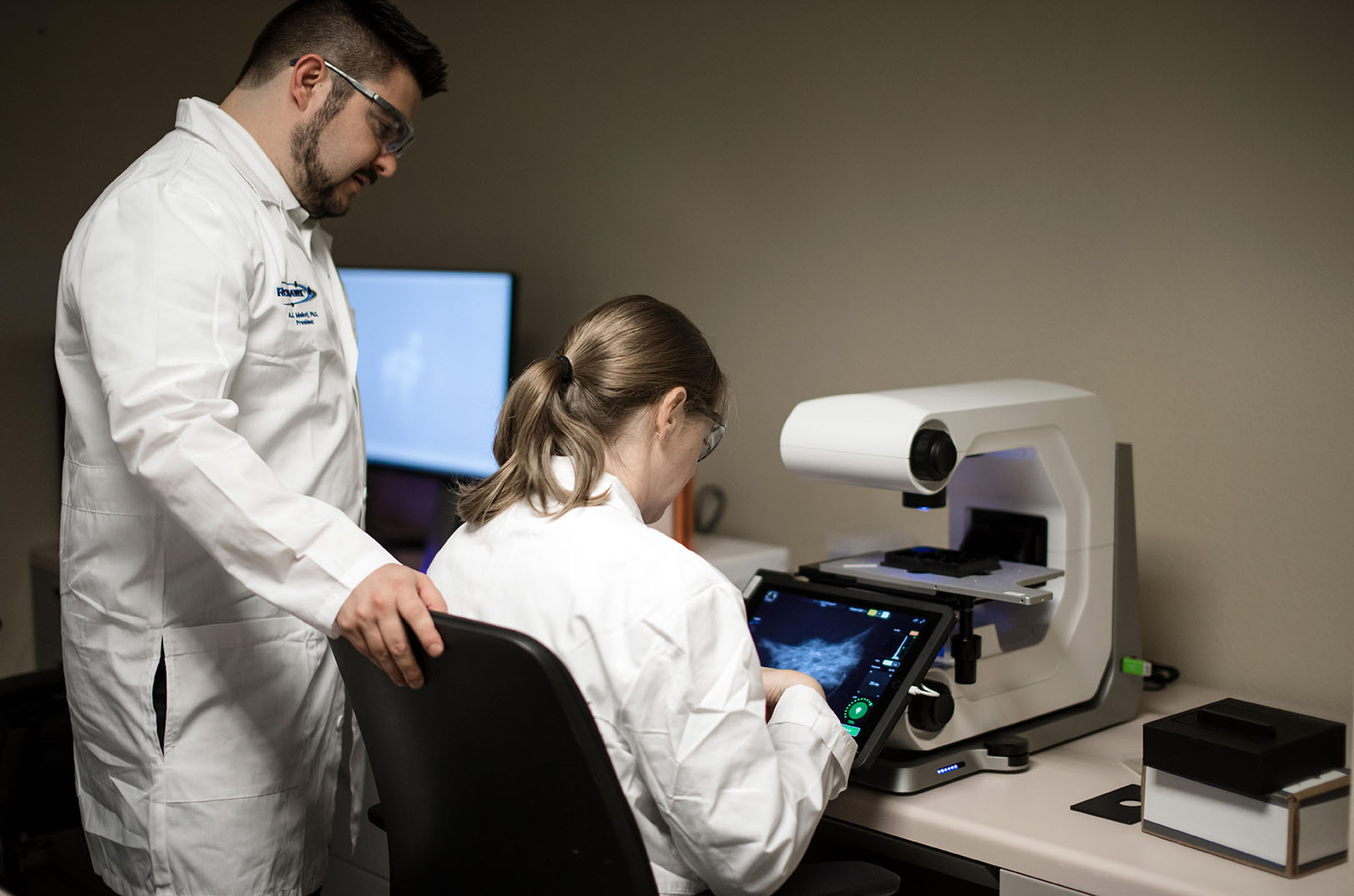
A.J. Mellott and Heather Decker, Ronawk
“We are a Kansas City company that is here to help scientists and engineers in the Midwest to accelerate discovery research so that Kansas can help the rest of the nation,” he said of the startup’s opportunity.
“[What we’re creating is] going to help overcome some of the diseases that currently the whole world is facing and fighting against.”
Such goals are being achieved with the help of key partners at the University of Kansas and within its medical system where Mellott has retained a faculty position, he noted.
“What’s been nice about the university is it’s allowed me to validate the technology with some funding and resources that I wouldn’t otherwise have and that has been very beneficial,” he said.
A two-way street, the relationship will soon allow Ronawk to return such support with the opening of its new Olathe lab space, Mellott said.
“We can take on some work that might be difficult in certain university settings or other companies [because of social distancing],” he explained, noting the Ronawk space could allow researchers to spread out and take on work in an additional setting as opposed to slowing progression with a limited number of people working in a university lab.
“We get to help out there, but also with our product. In producing cells, a lot of the biologics or things that are going to go toward making brand new diagnostic tests or creating therapies are going to be derived from the cells which are challenging to produce. We have the ability to help with that production and in a way, be a supplier of cells in a limited capacity.”
Initially fueled by proof of concept funds from Digital Sandbox, Ronawk recently closed its first funding round, which is expected to help the startup grow more than cells and expand by way of team capacity, Mellot said.
“Now that we have that, it’s allowed us to become a bit more independent and has provided several more opportunities for what we’re able to do,” he said of the milestone.
“We’ve gone from two people working in a tiny office to now being able to operate it in a separate facility.”
Ronawk declined to disclose the full amount of the funding round, but Mellot said it has already allowed the startup to make several key hires and purchase necessary equipment that will drive company growth in the coming year.
“We have an incredible team that I’m really proud of. [Decker] has been phenomenal in going on this journey with me — and I feel very lucky that the colleagues I have in the university gave me the push I needed to do this,” he said.
“We’re hoping we can do a lot of good for Kansas City.”

This story is possible thanks to support from the Ewing Marion Kauffman Foundation, a private, nonpartisan foundation that works together with communities in education and entrepreneurship to create uncommon solutions and empower people to shape their futures and be successful.
For more information, visit www.kauffman.org and connect at www.twitter.com/kauffmanfdn and www.facebook.com/kauffmanfdn


2020 Startups to Watch
stats here
Related Posts on Startland News

Reconciliation Services hopes to heal trauma in the heart of stigmatized Troost corridor
Commanded by Scripture, David Altschul journeyed into parts unknown, said his successor, Father Justin Mathews. In the mid-1980s, a philanthropic pull tugged at the heart of Altschul — a white, insurance salesman from Johnson County — and eventually led him into the distressed, history-rich neighborhoods that lined Troost Avenue on the east side of…
Thelma’s Kitchen cooks up pay-what-you-can cafe concept to preserve community
Twenty people once filled the kitchen of Thelma Gardner’s apartment in search of their next meal. Their hunger for food fueled her hunger for humanity, recounted Father Justin Mathews as he sat sipping coffee in the newly opened Thelma’s Kitchen. The pay-what-you-can restaurant — located inside of the Reconciliation Services building at 3101 Troost Ave.…
Operation Breakthrough bridge over Troost symbolizes ‘real community’ at an intersection
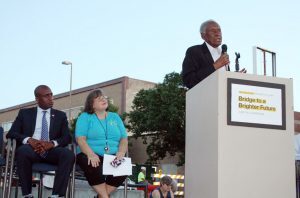
With reflection in his voice, Alvin Brooks paused. “The city has to be a partner,” the Civil Rights activist and veteran Kansas City Police Commissioner said as he spoke of the redevelopment of Troost Avenue — the well known racial dividing line, that has long isolated the east side of the Kansas City metro from the…

Troostapalooza aims to shed the old skin of city’s racial dividing line, says Kemet Coleman
Troostapalooza will build community while constructively addressing the elephant in the room, said Kemet Coleman, organizer of the newly developed street festival. “We wanted to create a home away from home on Troost that is inclusive and sensitive to the historic and existing nuances,” he said. “Not the violent, divisive one that is portrayed by…