

Julep owner: KCMO liquor rules could drown bar-restaurants already struggling to reopen
June 2, 2020 | Austin Barnes

As locally owned bars and restaurants start to reopen, a new threat to their success is emerging — city regulations designed in a pre-pandemic world.
“There’s a lot of unintended consequences from these mandated shutdowns that need to be addressed from a legal standpoint,” explained Beau Williams, owner of Julep Cocktail Club in Westport.

Julep KC
While planning the reopening of Julep, Williams contacted the city’s division of regulated industries to see if there would be allowances to regulations surrounding the food sales minimums needed to maintain a liquor license for the neighborhood whiskey house.
“In their typical, terse fashion they said, ‘Well, it’s a city ordinance … we don’t offer an extension on city ordinances,’” Williams told Startland News, frustrated by what he perceives to be a lack of understanding and empathy amid unprecedented times.
Click here to learn more about Julep and its hand-crafted cocktails.
Current city regulations require restaurant-bars to show that 50 percent — or at least $200,000 — of their gross revenue comes from the sale of food if they want to hold a liquor license.
A restaurant-bar typically has a two-year window to meet the number, said Williams — well-known for his time as a bartender at Manifesto — but because of the Coronavirus (COVID-19) pandemic, meeting the requirement would be nearly impossible for the already struggling small business and would ultimately pose a threat into 2021.
Julep, for example, needs to maintain the minimum food sales, while also complying with social distancing measures that would reduce their capacity for customers by half, Williams said. And while outdoor service could be an option outside the bar’s front door, that solution would come with additional expenses and reduced space for foot traffic, he said.
“Restaurant and bars right now are facing an unprecedented crisis — especially small ones, and we’re definitely one of those,” Williams said. “There’s really no sense in adding another layer or another hurdle … It’s really driving people to the brink.”
‘Fighting an uphill battle’
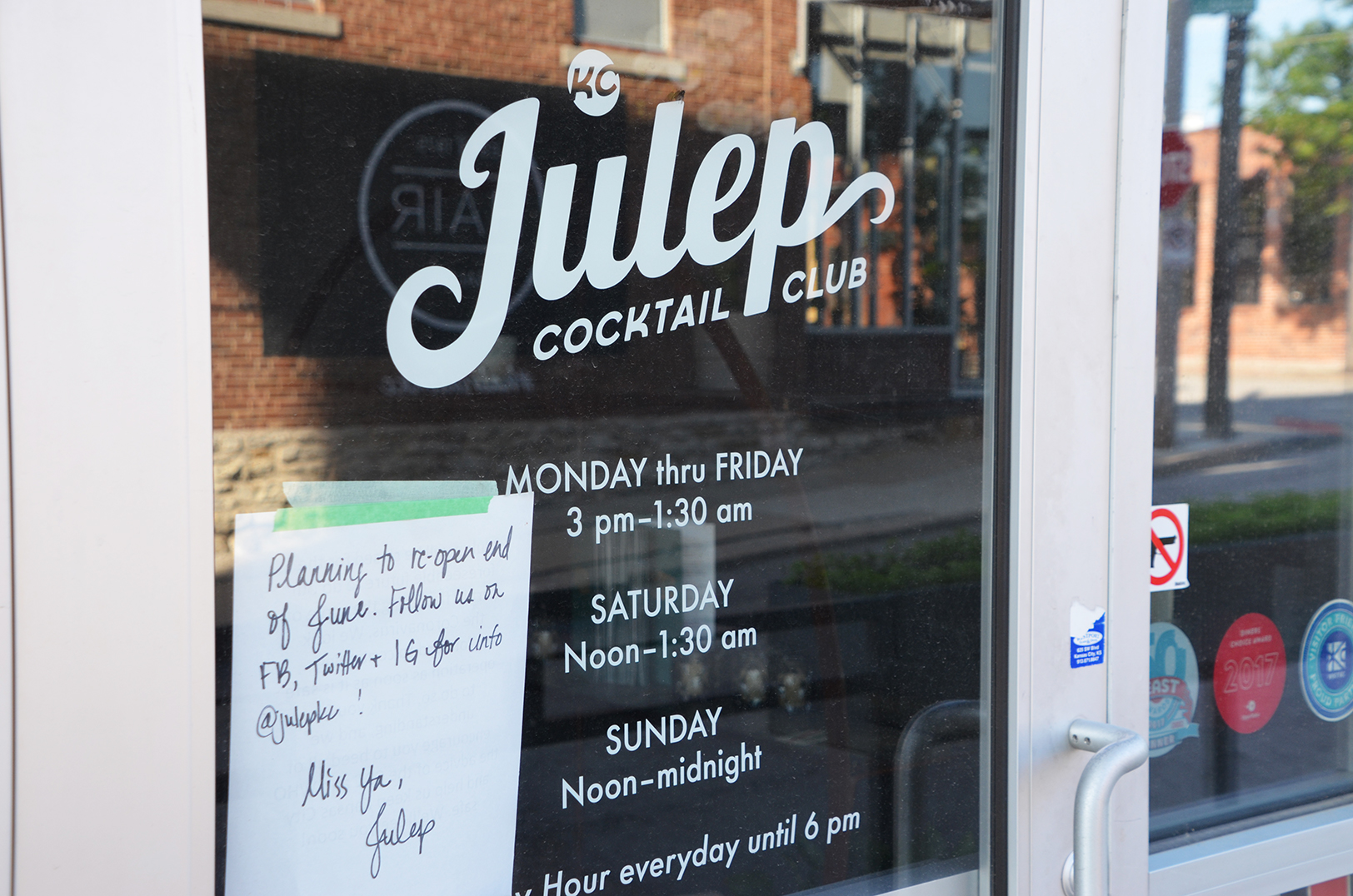
Julep marked its sixth anniversary in late April, amid the peak of the COVID-19 shutdown. It has remained shuttered through the pandemic, with plans to reopen in late June. The space currently is being refreshed with new furniture and finishes.

Beau Williams and Keely Edgington, Julep KC; Photo courtesy of threethree photography
“We have to overhaul and recalculate our whole guest experience,” Williams said, noting the inevitable change in vibe and shift in service that will come with fewer bar-goers and staff in the space.
“It’s frustrating because we want to be here and we love doing business here,” he added. “I wish it felt like our business was as important to the city as we find the city to be important to us in our business.”
With countless issues impacting Kansas City in a time of national unrest coupled with the remains of a raging, global health crisis, Williams noted he doesn’t expect swift action from the city.
Instead, he’s hopeful Julep can be used as an example, bringing awareness to the kinds of businesses Kansas City could lose if regulations aren’t adapted to meet the needs of a new world.
“We’re staring down the barrel of an unprecedented loss in tax revenue, unprecedented amount of closures of restaurants and bars — and then we’re going to force other people out on top of this? Over an ordinance, that under normal [circumstances] is still maybe a little misguided?” he asked, urging the city to take a closer look at current regulations.
“This is a city I love and I’ve grown up in and we want to keep doing business here. We want to keep doing this,” Williams added. “I don’t know what’s down the road if this is going to continue to be the case, if it’s going to feel like you’re continually fighting an uphill battle.”
To-go cocktails not a universal fix
Although to-go liquor sales are allowed in Kansas City until Dec. 31, curbside service for Julep’s limited, small-bite menu didn’t make much sense, Williams added.

Julep’s Sippin Santa pop-up bar
“We did Grubhub for a long time [before the pandemic], and to be honest, the appeal [from customers] really wasn’t there. Dine-in guests were the vast majority of our food sales and suddenly we didn’t have that environment,” he explained.
On top of a lack of interest, risking the health of Julep’s staff wasn’t worth the risk, Williams said.
“To-go options and everything were on the table from the get-go. But in the first few weeks of this, I was pretty certain that wasn’t a wise decision, public health wise,” he said “And luckily we haven’t seen a huge explosion from that — but I was nervous.”
Hard times and the threat of shuttering are especially unexpected for Julep — which recently played host to the Sippin’ Santa pop-up bar and it’s own Valentine’s Day-inspired pop-up creation, Williams noted, adding the experiences drove incredible sales.
“We were in a good place financially before this started, but at this point it’s all gone after paying employees, landlords, all that stuff. We were in a better position than most, but that cushion went out the window,” he said. “All that hard work is just kind of up in smoke.”
‘This isn’t what open looks like’
As of Monday, several city council members had reached out to Williams after Julep announced the likely loss of its liquor license on Facebook and Twitter.
Julep KC
“We’ll just see how this plays out. We’re hopeful that drawing some attention to this helps people realize how dire the situation already is for so many struggling businesses,” he said.
“I know so many people who started back up again and are struggling to even remotely do a fraction of the numbers that they were before,” Williams added. “And the last thing we need to do as a city is to kick restaurants while they’re down.”
Startland News reached out to Mayor Quinton Lucas for comment but did not hear back from his office, amid a fourth day of protests in Kansas City over police brutality and systemic racism.
“This city is on fire,” Williams said Tuesday morning, noting boarded up storefronts across Westport following weekend protests and related violence, on top of COVID-19 challenges. “They say everyone is reopened now. But this isn’t what open looks like.”
Williams proposed prorating sales minimums as a possible temporary solution to the regulation challenge.
Without a fix, he said, he’s afraid businesses like Julep will continue to face stress well into 2021.
“This should be the last thing we’re really concerned about at this point.”

Featured Business

2020 Startups to Watch
stats here
Related Posts on Startland News

NXTUS expands enterprise-focused program beyond Kansas; four KC-area startups selected
WICHITA, Kan. — An ongoing initiative to demystify the relationship-building process between emerging entrepreneurs and potential enterprise partners just expanded deeper into the Midwest, welcoming 20 growth-minded innovators from Wichita to St. Louis. “For entrepreneurs whose success depends on forging relationships with ‘the big guys,’ this unique program is so valuable,” said Mary Beth Jarvis, president…

Here’s how Bungii delivered spot No. 981 in its Inc. 5000 fastest-growing companies debut
Nailing Bungii’s geographic expansion model has unlocked significant growth, said Ben Jackson, detailing a years-long evolution that earned his Kansas City-built final-mile delivery carrier a coveted spot on the latest Inc. 5000 fastest-growing companies list. “Bungii’s network is becoming one of the largest sharing economy footprints across the U.S.,” explained Jackson, who co-founded the company…

Caterpillar subsidiary expands into KC, turning dirt to create 85 jobs in revitalized industrial corridor near riverfront
A multi-million dollar expansion project is expected to put an aging manufacturing site back on track in Kansas City, officials at Progress Rail announced Monday, noting the converted operation will focus on re-manufacturing railcar wheelsets and bearings. Progress Rail — a wholly owned subsidiary of Caterpillar Inc. — expects to bring 85 new full-time jobs…

Emerging KC space tech startup relocating to Colorado to build autonomous factory
A space tech startup that shot into orbit from its West Bottoms headquarters in Kansas City has announced plans to build its first smart factory in Colorado — relocating operations to Broomfield to join the Centennial State’s “robust aerospace and defense ecosystem.” “Colorado is home to some of the best aerospace, defense, and manufacturing talent…