

Kauffman leader at pitch contest: Listen to young people’s ideas, vision for the future
June 4, 2020 | Lucia Umbreit

Editor’s note: The following is a student-written article written by one of 357 interns in CommunityAmerica Credit Union’s recent virtual innovation internship program. Lucia Umbreit is an incoming junior at Liberty High School. CommunityAmerica is a financial partner of STARTLAND, the parent organization of Startland News.
Student teams made three-minute pitches to five Kansas City celebrity judges during a live COVID-19 pitch competition May 27. The top eight teams (four high school and four college teams) from 357 of CommunityAmerica Credit Union’s virtual innovation interns competed for $26,000 in cash prizes.
“I was blown away by the passion, composure and creativity of the student teams,” said judge Wendy Guillies, president and CEO of the Ewing Marion Kauffman Foundation. “It gives me hope for the future.”
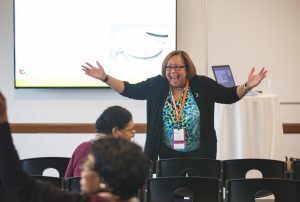
The competition both began and ended with speaker Anita Newton, chief innovation officer at CommunityAmerica who created and ran the internship. Newton believes that working in groups allowed the students to build real world skills, she said.
“We put the students in 40 diverse teams, randomly selected,” said Newton. “We wanted students to leverage their teammates, who they just met, test their idea with users, compare it with competitors, scrub their numbers, validate their ideas with members and mentors — and do it in between college exams and AP tests and double shifts and babysitting duties, all 100 percent virtually and in less than three weeks.”
Wednesday’s teams all logged off with at least $1,500 thanks to a surprise donation from the Kauffman Foundation on top of the CommunityAmerica prize money. However, there were two big winners.
HexaChat, the top high school team and the audience winner, pitched a free mental health app for teens during COVID-19 isolation. Connection Bear, the top college team, pitched a stuffed bear with technology enabling users to speak with family members separated by COVID-19 circumstances.
Click here to learn more about the winners.
“It was definitely not what I was expecting it to be,” said Vince Lewis, a senior at Park Hill High School and member of Connection Bear. “Before we were even selected, I thought it was going to be pretty lame, but it was amazing. I think that is primarily a result of the level of talent we were up against. The other three college teams in the final were phenomenal. I thought we got last because their pitches just went so well.”
Lewis’ winning team left the competition with $6,500. However, the cash wasn’t the only motivator — a major goal was real-world learning.
“I absolutely loved being part of the pitch competition because I learned how a simple idea could turn into an actual solution when you put time and dedication in making it a reality,” said Chinecherem Ihenacho, a junior at Raytown South High School who participated in the first rounds of the pitch competition. “It is important for young adults to have experiences like this because it allows them to be open in learning from other students from a diverse background, and how they can use their own experiences in life to come together and create something meaningful.”
The COVID-19 crisis has made it difficult for students to find real-world experience and internships, but many educators and community leaders are advocating that there be more of it in schools.
“I don’t think we listen enough to the ideas of our young people,” said Guillies. “Our education system needs to encourage more real-world entrepreneurial thinking and innovation because that mindset and those skill sets will serve our youth well throughout their lives. Great ideas can and do come from anywhere and anyone — regardless of age, race, income or geography.”
Real-world learning also teaches teamwork, which interns had a lot of practice with during the competition.
“These experiences are important to bond with people you have no idea who they are,” added Vince Lewis, emphasizing the diversity within his group. “All of us are from different corners of the city, so it’s very likely none of us would have ever met each other. To be grouped up with complete strangers and have to get along with and work with quickly is worth it in itself.”
While viewers only saw the top eight teams compete, all of the interns gained real-world problem solving skills. Their ideas and solutions inspired both the judges and the community.
“There’s so much uncertainty and anxiety right now — and few answers. It’s a tough time,” said Guillies, who encouraged the students to get curious. “That curiosity applies to the pandemic but extends to other facets of our society, including the racism and inequities illuminated by too many tragic events in recent weeks. More than ever, our community and our country need young people to engage with their voices and their ideas.”
Lucia Umbreit is an incoming junior at Liberty High School. She plans to pursue a career in either journalism, engineering or law.
Sydney Newton, an incoming junior at Shawnee Mission East High School, contributed to this story.

This story is possible thanks to support from the Ewing Marion Kauffman Foundation, a private, nonpartisan foundation that works together with communities in education and entrepreneurship to create uncommon solutions and empower people to shape their futures and be successful.
For more information, visit www.kauffman.org and connect at www.twitter.com/kauffmanfdn and www.facebook.com/kauffmanfdn
Watch the full pitch competition below.

Featured Business

2020 Startups to Watch
stats here
Related Posts on Startland News

Scared away from networking events? Anti-social introverts can turn to tech
Networking strength comes in numbers — even for anti-social introverts, Jeremy A. Smith told a crowd Tuesday at Global Entrepreneurship Week. “Anti-social people, myself included, hate events,” he said. But like all other entrepreneurs, such introverts still must build and maintain actionable professional networks from which they can request and receive value, Smith said. In-person networking…

Longfellow Farm coworking the soil amid KC’s urban food desert
In a city ripe with coworking office spaces, there’s a hunger for similar environments outdoors, Ami Freeberg said. As with maintaining individual workplaces, traditional urban farming also can be isolating and expensive, the Longfellow Farm manager said. By working together, however, the collaborative process allows for shared resources, greater human expertise and, of course, more…
Procrastinating? Eat the frog, don’t chase the squirrels
On the metal wall in front of my desk, I’ve magnetically fastened a famous recommendation from Mark Twain. “Eat a live frog first thing in the morning and nothing worse will happen to you the rest of the day,” the humorist from Missouri wrote. Though it can become an aspiration rather than a rule,…

KCultivator Q&A: ‘Fashionpreneur’ Jordan Williams on starting with nothing but his smile
Editor’s note: KCultivators is a lighthearted profile series to highlight people who are meaningfully enriching Kansas City’s entrepreneurial ecosystem. Check out our features on Plexpod founder Gerald Smith, innovation coach Diana Kander, Victor & Penny’s Erin McGrane, SEED Law’s Adrienne Haynes, Code Koalas’ Robert Manigold, Prep-KC CEO Susan Wally and community builder Donald Carter. Jordan…