

Tesseract’s robot reveal: Wearable proximity trackers to keep workers at a safe distance
May 27, 2020 | Austin Barnes

Kansas City-wired clip-on robots could make social distancing a second thought, as Tesseract Ventures shares its first mainstream product with the world.
“This product exemplifies our mantra that there is nothing more human than technology and is a great example of what you can expect to see from Tesseract Ventures in the future,” said John Boucard, Tesseract Ventures founder and CEO.
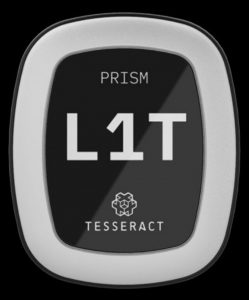
Tesseract PRISM
The high-tech robotics startup — one of Startland News’ Kansas City Startups to Watch in 2020 — announced the Tesseract PRISM (TM) Wednesday, marking the first major unveiling of a product for the company, which has raised significant venture capital from local funders — despite heavily guarding its plans and technology.
“We recognize how hard essential employees are working right now, and we are proud to be able to provide a technology that can help create safer work environments during this difficult time,” Boucard added.
Click here to read more about Boucard and his vision for the future of robotics.
Unveiled as Stay at Home orders continue their roll back, PRISM acts as part of a larger cyber-physical worksite-management system, in tandem with Tesseract PRISM Anchors — wearable badges which track and document the proximity of workers and students in real time and alerts staff and management if social distance is broken, ultimately creating safer work and school environments, the company explained in a release.
“The capabilities of this product are endless, now and in the future,” said Dave Starr, vice president of research and development for Tesseract. “Not only is PRISM a vital piece of technology for ensuring workers keep their distance from one another during this pandemic, it was originally designed to benefit industry operators by providing data to help them identify problem zones within a site.”



Full product capabilities include credentialed worker identification; emergency SOS beaconing; control site access, defined entry and exclusion zones within the job site; the ability to assign workgroups, privileges and certifications for individuals; the ability to assign personal space requirements and receive alerts when cross-contamination occurs; rugged, site-ready construction; and RFID compatibility with existing access points.

John Boucard, Tesseract Ventures
PRISM was developed in Tesseract Ventures’, Crossroads-based Future Lab — an advanced, multi-disciplinary R&D studio — and was built in the company’s Martin City-based Cyber-Physical studio, which develops products that will define the future of work.
The company has two additional development studios — Experiential Entertainment and Human Things — which round out its mission to empower businesses and people to be able to defy the boundaries of space and time, Boucard told a crowd gathered for the Startland News’ Kansas City Startups to Watch in 2020 Celebration in January.
The startup’s mission was most recently backed by a $2 million investment from UMB Capital Corporation in March.

Featured Business

2020 Startups to Watch
stats here
Related Posts on Startland News

Pipeline rotates The Innovators gala to Omaha for celebration of fellows, incoming cohort
Pipeline hopes moving its The Innovators gala to Omaha for 2019 will help keep the premier startup event fresh after more than a decade in Kansas City, said Joni Cobb. “Change and experimentation are what Pipeline is all about,” said Cobb, president and CEO of Pipeline. “We are an entrepreneurial organization, and as such we…

KCultivator Q&A: Lesa Mitchell talks eating eyeballs, remembering names, growing startups
Editor’s note: KCultivators is a lighthearted profile series to highlight people who are meaningfully enriching Kansas City’s entrepreneurial ecosystem. The KCultivator Series is sponsored by WeWork Corrigan Station, a modern twist on Kansas City office space. Growth is a daily driver, Lesa Mitchell said, but it can be limited by the environment around entrepreneurs. “If…
STEM education bill backed by KC Tech Council passes MO Senate, heads back to governor
Despite initial pushback, a bill that would broaden access to computer education in Missouri high schools, could be gaining momentum, said Ryan Weber. If passed, the legislation would increase STEM awareness in public schools and require districts to count computer science courses as math and science credits, the KC Tech Council president and an advocate…
Beyond language barriers: DivvyHQ partners with translation tech firm for greater global reach
A newly announced partnership provides DivvyHQ an expanded toolset to open the doors to a global market — translating and delivering any type of marketing-related content across any device, channel or language, said Brock Stechman. “We’ve been working so hard over the past few years to really build this company from the ground up,” said…